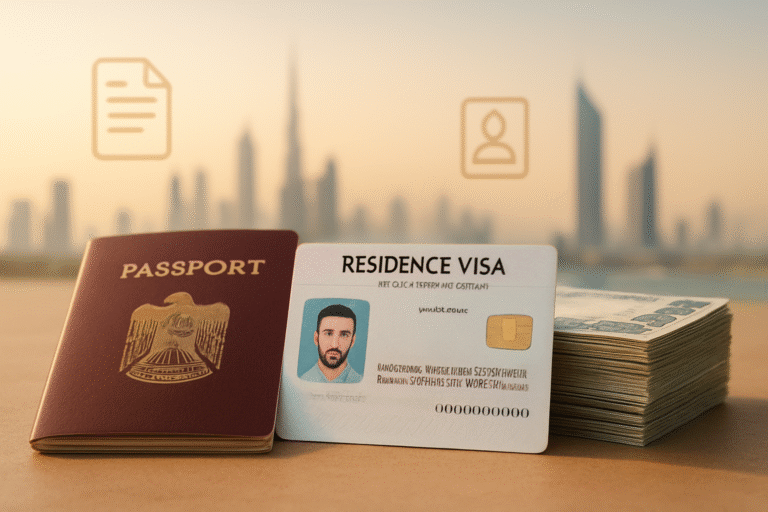

If your passport alone would require a visa for a destination, a valid UAE residence visa can sometimes get you in without one. That is the practical meaning of a free visa for UAE residents: extra travel access on top of your passport, not a replacement for it.
Key Takeaways

- The phrase covers two different searches: travel privileges unlocked by UAE residency, and “free visa” slots bundled into company formation packages.
- UAE residency can open destinations your passport alone would not reach. Third-party visa lists commonly cite around 15–20 additional countries, including Georgia, Oman and Bahrain — treat those lists as leads, not proof. Source
- Eligibility is decided by the destination, not by the fact that you live in the UAE. A residence visa does not guarantee entry under every residency-friendly policy. Source
- Visa-free entry, visa on arrival and e-visa are three different processes with different lead times, costs and boarding rules.
- The extra privileges are tied to a valid residence visa. Expiry, cancellation or a renewal gap resets you to your passport’s standard requirements. Source
- In business setup, a “free visa” means a residence visa slot bundled into a package — not a zero-cost visa. Judge the package on total cost across the licence term.
What Does “Free Visa for UAE Residents” Actually Mean?
The phrase carries two very different meanings. Confusing them leads to expensive mistakes.
Meaning one — travel access. Most people searching this want to know which countries they can enter without applying for a visa in advance, based on their UAE residence visa. This is the travel-privilege angle, and it is what most of this guide covers.
Meaning two — business setup bundles. In the UAE business world, “free visa” usually describes a residence visa slot bundled into a company formation or free zone package. Nothing about that visa is literally free; the cost sits inside the package price. We unpack that properly further down.
For the travel angle, the logic is simple. Your passport nationality sets your baseline travel rights. A UAE residence visa can then open additional destinations on top of that baseline. Third-party visa compilations frequently cite somewhere around 15–20 extra countries, listing Georgia, Oman and Bahrain among the examples. Source
One caution matters more than anything else here: holding a UAE residence visa does not automatically make you eligible for entry to every country that runs a residency-friendly policy. Source
That single sentence is the difference between a smooth trip and a refused boarding. Entry is granted by the destination country, at its discretion, under the rules in force on the day you arrive.
So this is not a frozen country list — those go stale within weeks. What follows is the eligibility logic, the verification sequence, the documents worth carrying, how costs and timelines actually work, and how to judge a “free visa” offer in a company formation package.
A note we take seriously: country rules, permitted stay lengths and validity conditions change, sometimes with little warning. Confirm everything with the destination’s official immigration authority or your airline before you travel. Treat any list, including the examples below, as discovery rather than verification.
Which Countries Offer Visa-Free Entry to UAE Residence Visa Holders?
Organising destinations by region helps you scan for where you are actually going. Keep one thing in mind throughout: a regional list is a map, not a guarantee. Two neighbouring countries can treat UAE residents in completely different ways.
Caucasus: Georgia
Georgia is the headline example most travellers already know. Third-party visa lists describe it as offering visa-free entry of up to one year to UAE residence visa holders. Source
That is a headline duration, and it comes from a secondary list rather than an official Georgian source. Treat it as a lead worth checking, not a settled fact. Before booking, confirm the current duration and entry conditions on Georgian government immigration pages. Duration and conditions are exactly the details that shift.
The GCC: Oman and Bahrain
Closer to home, Oman and Bahrain are frequently cited as destinations where UAE residency itself forms the basis for entry. Source
Before you drive to the border or book a flight, confirm three things. First, the permitted stay. Second, whether pre-registration is required. Third, which entry points accept the residency-based route. Land crossings and airports do not always operate the same way.
Asia
Parts of Asia appear regularly in UAE-resident visa lists, though the mechanism varies. Some destinations run e-visa systems aimed at UAE residents. Others issue visas on arrival. A smaller number offer genuine visa-free entry. Because the category differs from country to country, check each destination individually rather than assuming a regional pattern.
Africa
A similar mix applies across Africa, with visa-on-arrival and e-visa routes more common than outright visa-free entry. If a destination appears on a residency-based list, confirm whether you still need to complete an online application and pay a fee before departure.
The Americas
Residency-based privileges are thinner in the Americas. Entry rules there generally follow passport nationality and bilateral arrangements rather than residence in a third country. If you see a claim that UAE residency grants visa-free entry somewhere in this region, verify it directly with that country’s immigration authority before you build a trip around it.
Europe
Europe is where residency-based claims deserve the most scrutiny. European entry rules largely turn on passport nationality and the Schengen visa framework rather than UAE residency. Any “UAE residents can enter visa-free” claim for a European destination should be confirmed with that country’s embassy or immigration portal.
Visa on arrival and e-visa destinations are not the same thing
Several destinations casually labelled “visa-free” actually issue a visa on arrival or expect an e-visa completed in advance. Arriving at a counter that expects a pre-approval you never obtained is a poor start to any trip.
Be careful here: visas are issued by the destination and can be refused at the border, even where a policy exists. Verify before you fly. Use the destination’s official immigration portal, the relevant embassy page and your airline’s travel-document tool at the time of booking. Save a dated screenshot or printout. Third-party lists are useful for finding leads, not for proving eligibility.
Visa-Free vs Visa on Arrival vs e-Visa: What’s the Difference and Which Applies to You?
These three terms get used interchangeably in conversation. In practice they describe three different processes with different preparation windows.
| Category | What it means | When the visa is issued | What it changes for you |
|---|---|---|---|
| Visa-free entry | No visa needed in advance | No visa issued; entry granted on arrival | Fastest route — but you must still satisfy entry conditions and purpose-of-visit rules |
| Visa on arrival | A visa is issued at the border or airport | On arrival, at the port of entry | Expect queues, possible fees, and proof-of-funds or accommodation checks at the counter |
| e-Visa | You apply online before travelling | Before departure, usually after approval | Requires lead time, an approval document and a fee; boarding may be refused without it |
Why the distinction changes your planning:
- Lead time. Visa-free entry needs none. An e-visa may need days. Build that into your booking dates.
- Cost. Visa-free entry means no visa fee — though some destinations still charge service, departure or administrative fees. Visa-on-arrival and e-visa routes carry their own charges.
- Documents. Visa-on-arrival and e-visa counters tend to ask for proof of funds, confirmed accommodation and onward tickets more routinely.
- Airline checks. Airlines verify your documents against the destination’s current rules before boarding. If your paperwork does not match, you may be stopped at check-in rather than at immigration.
There is another layer worth understanding. The same destination can treat two UAE residents differently, because the rule may be written around passport nationality as well as residency. One colleague may enter without a visa while another is e-visa-only — even though both hold identical UAE residence visas. Never assume someone else’s experience applies to you.
To find out which category applies to you, check in this order: the destination’s immigration website, the destination’s embassy page for your nationality, then your airline’s travel-document tool when you book. Airlines are frequently the first checkpoint, not immigration officers, and they can refuse boarding.
Why Your Passport Still Matters More Than Your UAE Residence Visa
Your passport nationality determines your baseline travel rights. Your UAE residence visa adds a layer of privileges on top. It does not replace, override or upgrade your passport.
The additional destinations that a free visa for UAE residents arrangement can open sit alongside your passport entitlements, never instead of them. Both sets of rules apply at the same time, and you must satisfy the destination’s conditions for whichever route you use.
A residence visa is also not a travel document. It does not function like a second passport, it is not accepted as a substitute for one, and it does not change how an immigration officer reads your passport.
Two groups need to be especially careful:
- Dual nationals. You travel on one passport and must meet the rules for that passport. If your two passports carry different access levels, decide which one you are using before you book.
- Dependents on sponsored visas. A spouse or child on your sponsorship has their own residence visa and their own passport. Their eligibility is assessed separately, so a family trip can be visa-free for one member and visa-required for another.
And the rule that catches people out most often: if your residence visa expires or is cancelled, the additional entry privileges no longer apply, and you revert to the standard entry requirements for your passport nationality. Source
How Do I Check If My UAE Residence Visa Qualifies Me for Visa-Free Entry?
Checking whether residency-based entry applies to your specific trip takes a few minutes. Work through these six steps in order.
- Confirm your passport’s baseline rules. Check the destination’s entry requirements for your nationality first, setting your UAE residency aside entirely. That is your floor.
- Confirm the destination’s policy for UAE residence visa holders. Look for any minimum remaining validity requirement on the residence visa, and any conditions attached to the policy.
- Check your residence visa status and expiry against your travel dates. The visa needs to be valid for the whole trip, including your return — not just your departure date.
- Verify on an official source. Use the destination’s immigration portal, its embassy, or an airline travel-document tool. Save a screenshot or printout dated at the time of booking.
- Confirm the permitted purpose of visit. Residency-based visa-free entry is often tourism-only. Business meetings, paid work and long stays may fall outside it.
- Confirm entry point and onward-travel requirements. Some rules apply only at specific airports or land crossings, and onward tickets are commonly requested.
If any step produces an unclear answer, treat that as a no and apply for a proper visa. A refused boarding costs far more than an application fee.
Documents UAE Residents Should Carry When Travelling on a Visa-Free Basis
Even when no visa is required, you still need to prove you qualify. The checklist below is what a border officer or airline agent is most likely to ask for.
| Document | Why it matters |
|---|---|
| Passport | Many destinations require at least six months’ validity beyond your intended departure date — check yours |
| UAE residence visa and Emirates ID | Bring the physical cards and keep copies separately in case of loss |
| Return or onward ticket | Commonly requested even where no visa is required |
| Confirmed accommodation | Evidence of where you will stay during the trip |
| Proof of funds and travel insurance | Routinely requested on visa-on-arrival and e-visa routes |
| Employer or sponsor NOC | Required for some roles, visa types or destinations |
| Printed copy of the official rule you are relying on | If questioned at check-in or immigration, showing the source ends the conversation quickly |
| Digital backups and your PRO’s contact details | Your PRO handles government paperwork for your company — useful if something goes wrong abroad |
What Happens If Your UAE Residence Visa Expires, Is Cancelled, or Is Under Renewal?
Here is the rule in one line: the privilege is only as strong as the residence visa behind it.
The additional entry privileges are specifically linked to holding a valid UAE residence visa. Once it expires or is cancelled, those privileges no longer apply, and you revert to the standard entry requirements for your passport nationality. Source In practice, that can mean suddenly needing a visa for a country you visited without one last month.
The renewal window is a planning risk, not a technicality. While your residence visa is expired, cancelled or mid-renewal, avoid building international travel plans that depend on residency-based entry. Renew first, or apply for a regular visa for that specific trip.
To confirm current renewal steps, fees and processing times, speak to your sponsor, your free zone authority, or your PRO through the relevant GDRFA or ICP channel. Cancellation also triggers its own timeline and exit obligations inside the UAE, and those run on the authority’s schedule rather than yours. Sequence your travel plans around that process, not the other way round.
The simplest habit to adopt: check your residence visa expiry first, then book the trip.
Common Mistakes UAE Residents Make When Relying on Visa-Free Lists
- Assuming residency alone guarantees eligibility. Entry is granted at the destination’s discretion and can be refused. Source
- Trusting undated blog lists. Rules, stay lengths and fees change without notice, and many lists are recycled year after year.
- Booking travel while the residence visa is expired, cancelled or awaiting renewal, then being denied boarding.
- Forgetting that dependents have their own status. Each family member’s eligibility is assessed individually.
- Assuming business travel is covered by a tourism-focused rule, or that transit through a third country needs no documentation at all.
- Ignoring airline check-in requirements, which can be stricter than the border itself.
- Miscounting permitted days and triggering overstay penalties — or assuming “free” entry means no cost at all, when some destinations still charge service or departure fees.
Costs and Timelines: What ‘Free’ Really Means
“Free” in this context means one thing precisely: no visa fee is charged for genuine visa-free entry. Everything else is a separate line item.
Costs you may still face:
- Visa fees — zero for true visa-free entry.
- e-Visa and visa-on-arrival charges — set by the destination, and they vary widely.
- Service and departure fees — some destinations charge administrative fees even when no visa is needed.
- Travel insurance — commonly required, and worth having regardless.
- Residence visa maintenance — renewal, cancellation and amendment carry their own government fees and processing times.
We deliberately avoid quoting figures here. Fees and processing times change, and a stale number is worse than no number. Confirm current amounts and turnaround times with the relevant UAE authority, your free zone, or your PRO before you budget — they are the only sources that can give you a figure that is valid today.
Timelines interact in ways worth planning for. An e-visa approval window, an airline’s document verification step, and a residence visa renewal can all overlap, and each has its own queue. Leave buffer before a fixed-date trip rather than assuming a same-week turnaround.
A practical budgeting tip: for business trips with fixed dates, compare the total cost and time of relying on a free visa for UAE residents arrangement against simply applying for the appropriate visa in advance. The predictable option often wins.
The Business Angle: Are ‘Free Visa’ Offers in UAE Company Setup Genuine?
In the UAE business-setup context, a “free visa” usually means a residence visa slot bundled into a company formation or free zone package — not a visa with zero underlying cost. The cost is built into the package price. That can be genuinely good value, and it can also be clever marketing. The difference shows up in the fine print.
Before you sign anything, check these three things:
- How many visa quota slots are included. A licence carries a visa quota — the number of residence visas it can sponsor. Confirm the number, and the cost of each additional slot beyond it.
- Whether the free visa is tied to a minimum contract or renewal commitment. A “free” visa attached to a multi-year obligation is a pricing structure, not a gift.
- What happens to the visa if the licence lapses. If the company licence is not renewed, the sponsored residence visa is at risk. Understand that sequence before you commit.
It also helps to know which route you are actually on. Company-sponsored residence visas, Golden Visa routes, and personal or family sponsorship each carry different eligibility and validity characteristics. If long-term residency is your goal, our guide to Golden Visa UAE benefits explains who qualifies and why it is worth applying.
On timelines, expect a sequence rather than a single step: licence issuance, establishment card (the company’s immigration file that allows it to sponsor visas), e-channel registration, visa quota application, then medical testing and Emirates ID. Confirm current durations with the authority handling your application — we will not quote processing times that may already have changed.
A practical framework: choose your package on total cost of ownership across the licence term, not on the headline “free visa” value. Work out what you will actually spend, including ongoing compliance. Our breakdown of the UAE corporate tax rate sets out who pays and how much, and our explainer on what a Tax Identification Number in the UAE is covers the registration step new companies often overlook.
Jurisdiction choice matters just as much. Our guide to which Abu Dhabi free zone fits your business walks through matching an activity to a free zone, and the Arabic-language guide to what an LLC means in the UAE covers the structure question in detail. If funding the setup is the constraint, a business loan in the UAE is one route, and once the licence is live, our comparison of American banks in the UAE helps you pick the right banking partner.
When you start hiring, your sponsored staff inherit their own visa status and their own employment protections. It is worth knowing where you stand as an employer — our summary of sick leave in UAE labour law covers rights and pay rules.
And it connects straight back to travel: a valid, well-maintained residence visa is what keeps your residency-based travel privileges alive. Let it lapse and you lose both the sponsorship and the perks.
Quick Recommendation Framework: Should You Rely on Visa-Free Entry or Apply for a Visa?
Most decisions fall into one of five situations. Find yours and follow the corresponding approach.
| Your situation | Recommended approach |
|---|---|
| Short leisure trip, valid residence visa, confirmed residency-based entry rule, tourism purpose | Rely on visa-free entry, and carry the supporting documents listed above |
| Business trip, long stay, work purpose, or a rule that is unclear or recently changed | Apply for the appropriate visa in advance rather than risk refusal |
| Residence visa expiring, expired, cancelled or under renewal | Do not build travel plans around residency privileges — renew first, or apply for a regular visa |
| Strong passport baseline | Residency adds options but is not essential; compare convenience against the effort of checking |
| Restricted passport baseline | Residency privileges are high value — verify them carefully and keep your residence visa current |
Whatever your situation, apply the same three-check rule before booking:
- Passport nationality — what does the destination require from you regardless of UAE residency?
- The destination’s UAE-resident policy — does it exist, and what conditions come with it?
- Residence visa validity — is it valid for every day of the trip, including the return?
Three clear answers mean you can book with confidence.
Free visa access for UAE residents is real, conditional, and only as strong as the residence visa behind it. If you want your residence visa handled properly — from company formation through to renewal, so your travel privileges never lapse — our team can walk you through the options. Book a free consultation and we will map the right route for your business.
Frequently Asked Questions About Free Visa For Uae Residents
Which countries are visa-free for UAE residence visa holders?
Third-party visa lists commonly cite around 15–20 additional countries that UAE residents can enter without a visa in advance, including Georgia, Oman and Bahrain. These lists are leads rather than proof, because the destination country decides eligibility and rules change. Always confirm with the destination’s official immigration authority before booking.
Do UAE residents need a visa to travel to Georgia?
Third-party visa lists describe Georgia as offering visa-free entry of up to one year to UAE residence visa holders. That duration comes from a secondary list rather than an official Georgian source, so treat it as a lead. Confirm the current duration and entry conditions on Georgian government immigration pages before you book.
Can I travel visa-free if my UAE residence visa has expired or been cancelled?
No. The additional entry privileges are tied to a valid residence visa. If your visa expires, is cancelled, or falls into a renewal gap, you revert to the standard entry requirements for your passport nationality.
Does having a UAE residence visa mean I can enter any country that offers a visa-free policy?
No. Holding a UAE residence visa does not automatically make you eligible for every country that runs a residency-friendly policy. Entry is granted by the destination country at its discretion, under the rules in force on the day you arrive. Some destinations also write their rules around passport nationality as well as residency.
Can I get a free visa in the UAE through a company setup or free zone package?
In business setup, a “free visa” usually means a residence visa slot bundled into a company formation or free zone package. Nothing about that visa is literally free — the cost sits inside the package price. Judge any such package on its total cost across the licence term.
How do I check whether my passport and UAE residency qualify me for visa-free entry before booking a flight?
Check the destination’s immigration website, then the destination’s embassy page for your nationality, then your airline’s travel-document tool when you book. Airlines often act as the first checkpoint and can refuse boarding. Save a dated screenshot or printout of what you find.