
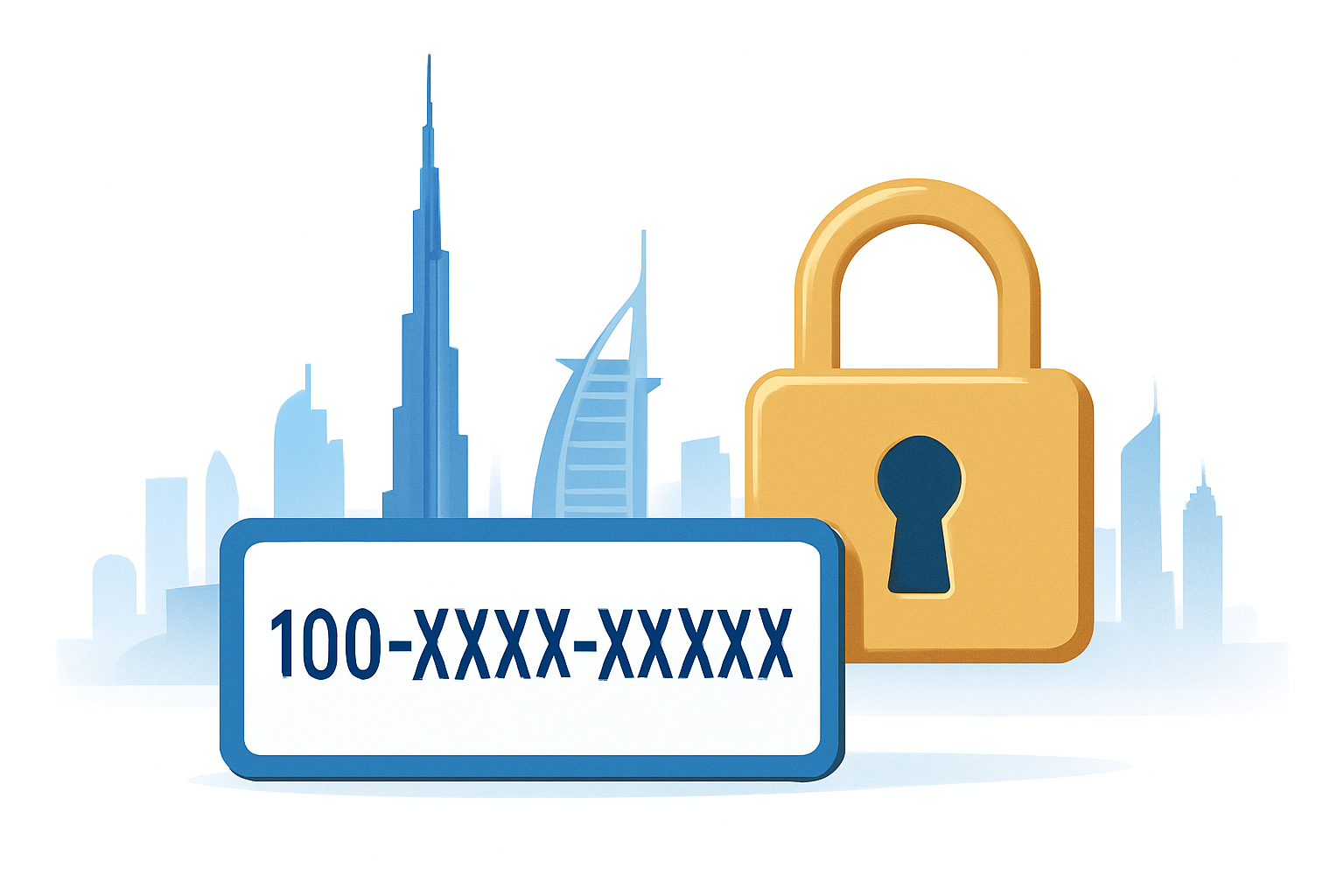
If you are trying to work out what is a tax identification number in UAE terms, the straight answer is this: it is the unique 15-digit code the Federal Tax Authority (FTA) issues to identify your business for tax purposes — and in the UAE it carries the same number as your Tax Registration Number, or TRN.
There is no second, hidden registration hiding behind the letters. One authority, one taxpayer record, one number. The confusion you have run into online is almost entirely about naming, not about substance.
Key Takeaways
- In the UAE, a TIN and a TRN are the same 15-digit identifier issued by the FTA. You do not apply for them separately.
- The UAE does not issue personal TINs, because there is no personal income tax. Here, a TIN refers to the VAT or Corporate Tax registration number held by a business or a self-employed professional.
- The number normally follows the format 100-xxxx-xxxxxxx, which is how you can recognise it quickly on FTA letters and certificates.
- You receive your number automatically once you register for VAT or Corporate Tax. There is no standalone application.
- VAT registration is mandatory above AED 375,000 in annual revenue, with voluntary registration available between AED 187,500 and AED 375,000.
- Corporate Tax registration applies to most businesses, including many that are not registered for VAT.
What Is a Tax Identification Number (TIN) in the UAE?
The FTA issues a unique 15-digit code to identify each taxpayer. That code is what a tax identification number in UAE practice actually refers to. It is not a separate number sitting alongside your TRN — it is the same identifier, spoken about under a different name depending on which document or authority you are facing.
The confusion starts with the term itself. “Tax Identification Number” is a global label used by tax authorities across the world. The UAE’s FTA uses its own wording inside its systems — Tax Registration Number. Both point to one record tied to one taxpayer.
One clarification matters more than the rest. The UAE does not issue personal TINs, because there is no individual income tax here. When you see “TIN” attached to the UAE, it means the VAT or Corporate Tax registration number held by a company or a self-employed professional.
Once you know the shape of the number — 100-xxxx-xxxxxxx — you can spot it instantly on a registration certificate, a tax invoice, or your FTA portal account.
TIN vs TRN: What’s the Difference in the UAE?
Functionally, none. In the UAE, TIN and TRN refer to the same number. They are not two registrations, and there is no separate queue to join for either one.
The distinction is linguistic, not legal:
- TIN (Tax Identification Number) is the broad, internationally recognised term. You will meet it in OECD documents, cross-border reporting frameworks, and foreign bank forms.
- TRN (Tax Registration Number) is the UAE-specific term used inside the FTA system. It is what appears on your certificate and what you quote to suppliers, customers, and banks.
You may also read that “TIN” applies to Corporate Tax while “TRN” applies to VAT. That reading is misleading. Both are the same unique identifier issued by the same authority. If you are registered for VAT and Corporate Tax, you are still dealing with a single taxpayer record, not two.
This matters in practice. Conflicting definitions online push business owners into trying to register twice — which generates duplicate records, delays, and avoidable correspondence with the FTA. When in doubt, check the FTA website directly or ask a qualified tax advisor before you submit anything.
Comparison: TIN vs TRN in the UAE
| Point of comparison | TIN | TRN |
|---|---|---|
| Full name | Tax Identification Number | Tax Registration Number |
| Where the term comes from | Global and international tax usage | UAE Federal Tax Authority |
| Does it exist separately in the UAE? | No — it is the same number as the TRN | Yes — this is the FTA’s own term |
| Applied for separately? | No | No |
| Issued by | FTA (as the same identifier) | FTA |
| Typical format | 100-xxxx-xxxxxxx | 100-xxxx-xxxxxxx |
| Where you use it | Cross-border forms and foreign counterparts | Tax invoices, VAT returns, FTA portal |
For every practical purpose, treat these as one number with two names.
Do You Actually Need a TIN for Your UAE Business?
If your business is registered for VAT or Corporate Tax, the number arrives automatically as part of that registration. There is no separate TIN application to file. So the real question is not “do I need a TIN?” but “do I need to register for a tax?”
Here is how the obligations usually break down across the three main groups.
VAT registration. Under UAE VAT law, businesses with annual revenues exceeding AED 375,000 must register for VAT and obtain a TRN. Between AED 187,500 and AED 375,000, voluntary registration is available. Below that range, VAT registration is generally not required.
Corporate Tax registration. This applies to most businesses operating in the UAE, including plenty that are not VAT-registered. Assuming VAT registration covers everything is one of the most expensive assumptions a founder can make.
Freelancers and self-employed professionals. Whether you need to register depends on your income level and the nature of your activity. Many freelancers sit outside mandatory VAT registration but still fall within Corporate Tax obligations. A short conversation with a tax advisor usually settles this faster than any article can.
One rule is absolute: if you are not registered for any tax, you do not have a TIN. And you cannot obtain a tax identification number in UAE simply by asking for one — it only follows a valid tax registration.
How to Get a Tax Identification Number in the UAE: Step-by-Step
The process runs through the FTA’s EmaraTax portal. Here is the sequence in plain terms.
Step 1 — Decide what you are registering for. VAT, Corporate Tax, or both. This determines which application you file and which documents you need.
Step 2 — Gather your documents. Typically this means your trade licence, passport copies, Emirates ID, proof of business address, and financial statements or revenue estimates. Missing paperwork is the single biggest cause of delay, so assemble everything before you begin.
Step 3 — Create your EmaraTax account. You will need an authorised signatory on the business and a verified email address for FTA correspondence.
Step 4 — Submit the application. Upload your supporting documents and review every field before you submit. Wrong business activity codes or a mismatched legal structure trigger manual FTA queries that can add days or weeks.
Step 5 — Receive your TRN/TIN. Once approved, the FTA issues your number. Turnaround is usually a few business days, though it depends on how complete your file is and current FTA processing volumes.
Step 6 — Start using it. Your number must appear on tax invoices, tax credit notes, and VAT returns. It becomes the reference point for every filing you make.
You can complete these steps yourself. Many businesses choose a tax agent instead, particularly on a first registration or when several obligations land at once. If you are still choosing a structure before you register, our guide to how long it takes to set up a company in Dubai covers the timeline, and if you are weighing free zone against mainland, see which Abu Dhabi free zone is right for your business.
How Long Does It Take to Get a TIN in the UAE?
Once your application is complete and your documents are in order, processing usually takes a few business days. VAT and Corporate Tax applications tend to move on similar timelines.
Delays seldom come from the FTA’s side. They come from:
- Incomplete or mismatched documents — a trade licence name that does not match your application, or an expired Emirates ID.
- Incorrect business activity codes — classifying your activity as something you do not actually do.
- FTA queries — any clarification request resets the clock while you respond.
Two practical rules follow. First, apply well before any tax deadline, not the week before. Late registration can expose you to penalties, and penalties do not care how busy you were. Second, treat the application as a compliance document rather than a form to rush through.
Because the FTA sets and updates processing times, verify the current position on the official portal or with a qualified advisor rather than relying on older guidance. What holds true regardless of timing is that a complete, error-free application is the fastest application.
What You Can Do With Your TIN (And What You Can’t)
Your number is a working tool. Here is what it unlocks, and where its limits sit.
What your TIN lets you do:
- File tax returns through the FTA portal
- Collect VAT from customers on taxable supplies
- Claim input tax credits on eligible business expenses
- Issue valid tax invoices your customers can rely on
- Meet your Corporate Tax filing obligations
- Correspond formally with the FTA
What your TIN does not do:
- It does not reduce what you owe. It is an identifier, not a strategy.
- It does not authorise you to trade — that comes from your trade licence, which is a separate matter entirely.
- It cannot be obtained without first registering for a specific tax.
One obligation is easy to overlook: you must display your TRN on all tax-related documents. Leaving it off an invoice can attract fines even when the underlying transaction is perfectly compliant.
Common Mistakes to Avoid When Registering for a TIN
Most registration problems are predictable. Sidestep these and you save weeks of back-and-forth.
Treating TIN and TRN as two different numbers. They are one. Attempting to register twice creates duplicate records and confusion.
Missing the VAT threshold. Once revenue crosses AED 375,000, registration becomes mandatory. Crossing it unnoticed and registering late invites penalties.
Getting your business activity wrong. Incorrect activity details or the wrong legal structure description trigger FTA queries. If you operate through an LLC and are unsure how it should be described, our Arabic guide to the meaning of an LLC in the UAE explains the fundamentals.
Forgetting to update the FTA. If your address, ownership, or business details change, tell the FTA. An outdated record causes trouble at filing time.
Weak record-keeping. Without clean records of sales and expenses, filing becomes guesswork. Set up a simple bookkeeping routine from day one.
Ignoring Corporate Tax because you registered for VAT. These are separate obligations, and one does not satisfy the other.
How a TIN Fits Into Your Overall UAE Tax Compliance
Your number sits at the centre of your tax life. Every filing, every return, and every FTA interaction links back to that identifier and the taxpayer record behind it.
Practically, you need it for:
- Periodic VAT returns — filed monthly or quarterly, depending on your assigned tax period.
- Annual Corporate Tax returns — where taxable income is declared and assessed.
- Transfer pricing documentation — relevant when you transact with related parties across borders.
- Economic substance regulations — for certain categories of licensed activity.
- Tax residency certificates — frequently requested by foreign banks and counterparties.
Without a valid number, you cannot claim input tax credits or offset losses. You also open the door to fines and, in more serious cases, audits. Registration is not a box you tick once and forget — it is the foundation your compliance calendar is built on.
If your business is expanding and you are arranging banking or finance alongside tax registration, two further reads help: American banks in the UAE: which one fits your business and our overview of requirements to start a business in the UAE as a non-resident. Lenders routinely ask for your TRN, so having it ready speeds up every application.
Should You Handle TIN Registration Yourself or Use an Expert?
Both routes work. They differ in how much time and risk you absorb.
Doing it yourself. There is no cost beyond your own time. The risk is the learning curve: activity codes, document formats, and portal fields are unforgiving of small mistakes. A rejected or queried application costs days you may not have before a deadline.
Using a tax agent or consultant. You pay for expertise, and in return you get a correct first-time application, faster processing, and someone who knows what the FTA is likely to ask before they ask it. Ongoing compliance support often comes bundled in.
The right choice turns on three things: how complex your business is, how much tax knowledge you hold in-house, and whether you operate across multiple tax regimes. For most SMEs and startups here, outsourcing to a local expert proves more cost-effective once you price in the time and the cost of getting it wrong.
Sort out your licensing basics first, especially if you are new to the market. If you are weighing licence types and their annual costs, our breakdown of the general trading licence cost in Dubai per year is a useful reference.
Get Your TIN Without the Headache: How Al Ain Business Center Can Help
We handle the entire TIN/TRN registration process for you — from preparing your documents to submitting through the FTA portal. No guesswork, no rejected submissions, no chasing clarifications.
Our experts make sure you register for the right taxes at the right time. That means no late registration penalties, no missed Corporate Tax obligations, and no surprise queries months down the line. We also support ongoing VAT and Corporate Tax filing, so compliance settles into a routine part of your year rather than a recurring scramble.
You started your business to build something, not to decode tax terminology. That part is ours to carry. Book a free consultation and we will review your business, tell you plainly which registrations apply, and hand you a clear action plan with next steps. If you would like to see the wider setup picture first, our guide to getting a trade licence with a virtual office in Dubai answers a question we hear often from new founders.
Contact Al Ain Business Center today to simplify your UAE tax registration — and start your journey with your number in hand, not on your to-do list.
Frequently Asked Questions About What Is Tax Identification Number In Uae
Is TIN the same as TRN in the UAE?
Yes. In the UAE, a TIN and a TRN are the same 15-digit identifier issued by the Federal Tax Authority. TIN is the broad international term, while TRN is the FTA’s own wording. You do not apply for them separately.
Do I need a TIN if I’m a freelancer in the UAE?
It depends on your income level and the nature of your activity. Many freelancers sit outside mandatory VAT registration but may still fall within Corporate Tax obligations. A short conversation with a tax advisor usually settles this faster than any article can.
How can I get a Tax Identification Number in the UAE?
Register for VAT or Corporate Tax through the FTA’s EmaraTax portal. Once your application is approved, the FTA issues your TIN/TRN automatically. There is no standalone TIN application.
What is the difference between TIN and TRN?
Functionally, none. TIN is the broad, internationally recognised term used in OECD documents and cross-border reporting, while TRN is the UAE-specific term used inside the FTA system. Both refer to the same unique identifier.
How long does it take to get a TIN in the UAE?
Once your application is complete and documents are in order, processing usually takes a few business days. Delays typically come from incomplete documents, incorrect business activity codes, or FTA queries.
Is a TIN required for Corporate Tax in the UAE?
Yes, you need a TIN to meet your Corporate Tax filing obligations. Corporate Tax registration applies to most businesses, including many that are not registered for VAT. You receive your TIN automatically once you register.
Related articles
 Tax & Accounting
 Tax & Accounting
 Tax & Accounting