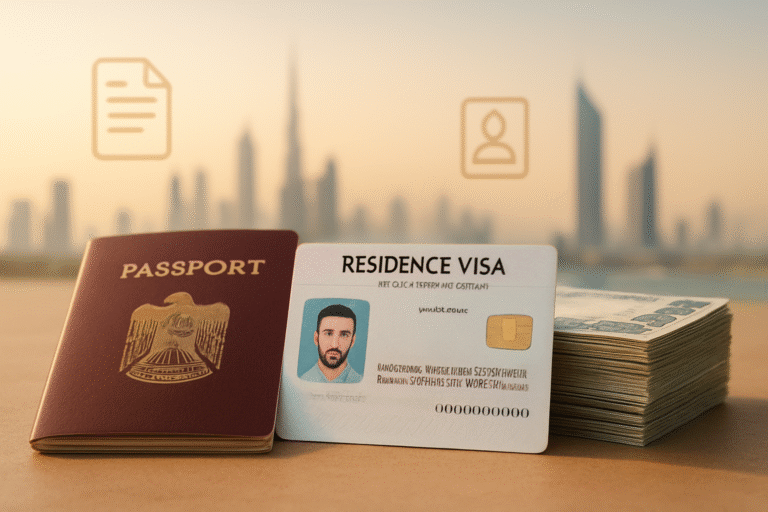

If you live in the UAE and want to travel without applying for a visa in advance, the decisive factor is the passport you hold — not the residence permit in your wallet. Most guides to uae resident visa free countries blend Emirati citizens, UAE residence visa holders and GCC residents into one list, and that list may have nothing to do with your own eligibility.
Key Takeaways

- A UAE residence visa is permission to live in the UAE. It is not a travel document, and on its own it does not grant you entry to another country.
- Three factors decide your entry: your passport nationality, your UAE residence visa status, and the destination country’s immigration policy.
- “Visa-free”, “visa on arrival”, “e-visa” and “embassy visa” are four different outcomes, each with its own lead time and its own risk at the airport.
- Any headline count of countries describes a category of travellers, never a personal entitlement.
- Verify twice: once when you plan and book, and again within days of departure.
This article is built around one idea. Instead of memorising someone else’s country list, you check your own combination of passport, permit and destination — then book knowing the answer rather than hoping at the check-in desk.
What Does “Visa-Free for UAE Residents” Actually Mean?
Your UAE residence visa is your permission to live in the UAE for a defined period. It sits in your passport and is linked to your Emirates ID, the identity card issued alongside your residency. Neither document is a travel document. They tell other countries who you are and where you live. They do not tell another country that you are welcome to enter.
According to one travel agency’s guide, visa-free rules depend on three factors: your passport nationality, your UAE residence visa status, and the destination country’s immigration policy. Read that order slowly, because it matters. Your passport comes first. Your residency is a supporting factor, and only for destinations that explicitly recognise it.
The four outcomes you can face
When you check a specific destination, you will land on one of four results:
- Visa-free entry — no visa is needed, before travel or at the border. You present your passport and your supporting travel documents.
- Visa on arrival — a visa is issued to you at the border, often for a fee, once you meet the stated conditions.
- e-Visa or pre-approved visa — you apply online before departure and travel with an approval already in hand.
- Embassy visa required — you apply at the destination’s embassy or consulate before you fly.
The gap between the first two is where most confusion starts. Visa-free means no visa at all. Visa on arrival means a visa is issued at the border, usually for a fee and only if you satisfy specific conditions. Airlines maintain their own destination guides and typically list visa on arrival as a category separate from visa-free travel — a useful signal that the two are processed differently.
UAE Nationals vs UAE Residents vs GCC Residents: Why the Lists Keep Confusing You
The most common flaw in published lists is simple: content written for UAE passport holders gets republished as though it applies to residence visa holders. When a page says “UAE citizens” can enter a country visa-free, that is a statement about the Emirati passport. It tells you nothing about an Indian, Pakistani, Egyptian, Filipino, British or Nigerian passport.
UAE nationals travel on a UAE passport. The entry rights they enjoy belong to that document.
UAE residents travel on the passport of their country of origin, plus a UAE residence permit and Emirates ID. Your permit matters for how you re-enter the UAE, and for some destinations it affects whether you qualify for a specific concession. It does not change the entry rights attached to your nationality.
GCC residents are a third, separate category. Some destinations set conditions based on GCC residency rather than UAE residency specifically, and those conditions — including which residence permits qualify and what supporting documents are requested — vary and change over time. Confirm the current rule with the destination’s official immigration source rather than a summary list.
One point deserves a clear flag: a UAE Golden Visa is a UAE residency status with a long validity period. It does not change the passport you hold and does not unlock passport-based visa-free access. Our guide to Golden Visa UAE Benefits: Why It’s Worth Applying explains exactly what that status does and does not do. In short, any list of uae resident visa free countries is really three different lists stacked together, and you need the one that matches your passport.
Quick self-identification checklist
- You hold a UAE passport. You are a UAE national. UAE passport entry rules apply to you.
- You hold a foreign passport plus a UAE residence visa. You are a UAE resident. Your passport rules apply, with UAE residency as a possible supporting factor for certain destinations.
- You hold a residence permit from another GCC state. You fall under GCC resident rules, which are separate from UAE residency and should be checked directly with the destination.
- You hold a Golden Visa but a foreign passport. You remain a UAE resident for travel purposes. Your passport still governs your entry rights.
Work out which line describes you before you read a single country list. It takes thirty seconds and prevents the most expensive mistakes.
Visa-Free vs Visa on Arrival vs e-Visa: Know Which One You Are Booking
Plain definitions first, then what each one means in practice.
| Category | What it means | When the visa is issued | What to prepare | Main risk |
|---|---|---|---|---|
| Visa-free | No visa required at all | Not applicable | Passport, onward or return ticket, accommodation details, proof of funds if asked | Refused boarding or entry for missing supporting documents |
| Visa on arrival | A visa is issued at the border, often for a fee | On arrival, by the immigration officer | Passport, fee where applicable, forms, photos or supporting documents if specified | Refusal at the border if conditions are not met |
| e-Visa / pre-approved visa | You apply online before departure and travel with approval in hand | Before departure | Approval copy, passport, supporting documents | Delay if you apply too close to the travel date |
| Embassy visa | You apply at the destination’s embassy or consulate | Before departure, at the mission | Appointment, forms, fee, documents | Processing time may force you to move the trip |
At check-in, airline staff are often your first checkpoint — not immigration officers. They apply their own reading of the destination’s rules, because they carry the cost of flying you back if you are refused. That is why cross-checking your airline’s destination guidance matters as much as checking the government rule.
Even visa-free entry comes with conditions. A valid passport with sufficient remaining validity, evidence of onward or return travel, and proof of accommodation or funds are routinely requested. Permitted stay lengths vary by destination, nationality and immigration policy — one destination page for BNW advises travellers to verify the latest entry requirements and permitted stay periods before travelling.
The practical distinction is predictability. A visa on arrival can be refused at the border if you do not meet the conditions, and by then your flight is already booked. A pre-approved e-visa is confirmed before you leave, which is why it is often worth applying even when visa-free entry is technically available.
Which Countries Are Commonly Listed as “uae resident visa free countries”?
Treat everything below as commonly cited for UAE residents, not guaranteed. Your eligibility still depends on your passport nationality and the destination’s current policy.
A widely referenced list from BNW names Armenia, Georgia, Malaysia, Maldives, Mauritius, Oman, Qatar and Seychelles as visa-free destinations for UAE residents. Separately, one travel agency page states that UAE residents can visit more than 140 countries without an advance visa application procedure.
That larger figure deserves context. It describes the total reach of a mixed group of passports and residencies. It does not mean your passport can enter 140 countries, and it does not mean your UAE residence visa adds 140 destinations to your existing access. Read it as a measure of how much visa-free travel UAE residents collectively enjoy — then verify your own route.
Grouping the examples by region makes them easier to scan against a real trip:
| Region | Frequently cited examples | What to verify before booking |
|---|---|---|
| GCC and Middle East | Oman, Qatar | Whether residency or nationality is the qualifying factor, and how long you may stay |
| Caucasus | Armenia, Georgia | Passport-specific rules and permitted stay length |
| Southeast Asia | Malaysia | Whether your passport needs an e-visa or entry is visa-free |
| Indian Ocean and Africa | Maldives, Mauritius, Seychelles | Onward travel evidence, accommodation proof and any entry fee |
Two cautions. First, list articles age quickly, and a page dated to a previous year may describe rules that have since changed. Second, before you book anything, re-verify your specific country against the destination’s official immigration source — not a blog, not a forum thread.
Practical Requirements Beyond the Visa: Passport Validity, Emirates ID and Proof of Travel
The visa category is only half the story. Immigration officers and airline staff typically expect to see:
- Your passport, with enough remaining validity for the destination’s requirement.
- Your UAE residence permit or Emirates ID.
- A return or onward ticket.
- Hotel or accommodation booking.
- Proof of funds, or a bank statement, if requested.
Many destinations set a minimum remaining passport validity, and a passport with too few blank pages can cause problems even when your visa status is fine. Check both, and check them early — renewing a passport takes longer than most people plan for.
Your residence visa validity on the travel date also matters for your return. If your permit expires while you are abroad, or falls during a renewal gap, you need to resolve that before you leave. Residents on shorter-term or employment-linked permits should confirm their re-entry position in advance rather than assume it.
For Sick Leave in UAE Labour Law: Your Rights and Pay Rules, the same discipline applies as for travel: know what your documents entitle you to before a problem arises, not after.
A simple pre-travel document folder — physical and digital — removes most check-in stress. Include a passport copy, your Emirates ID copy, your residence visa copy, the flight itinerary, the hotel booking, your insurance certificate, and a screenshot of the official entry rule you relied on. Keep the digital set in cloud storage you can reach from any phone.
Travel insurance is both a practical safeguard and, for some destinations, a documented entry condition. Check whether your destination requires it and whether your policy covers the activities you plan.
How Do You Check Whether Your Passport Qualifies? A 5-Step Verification Routine
This is the routine we recommend to clients before any booking. It takes about fifteen minutes.
Step 1: Identify your passport nationality exactly as it appears on your passport. Not your country of residence, not your country of birth, not where you
Frequently Asked Questions About Uae Resident Visa Free Countries
How many countries can UAE residents visit visa free?
It depends entirely on the passport you hold, not your UAE residence visa. Some sources cite more than 140 countries, but that figure covers a mixed group of passports and residencies rather than any individual traveller. Verify your own passport, residency and destination combination instead of relying on a headline count.
Can UAE residents travel to Europe without a visa?
The article does not state any visa-free European destinations for UAE residents. Europe is not included in the commonly cited examples, which cover the GCC, the Caucasus, Southeast Asia, and the Indian Ocean and Africa. Check the destination country’s official immigration source before booking.
Does a UAE residence visa let me enter Georgia, Armenia or Malaysia visa free?
Georgia, Armenia and Malaysia appear on a widely referenced list of visa-free destinations for UAE residents. However, eligibility still depends on your passport nationality and the destination’s current policy. Confirm the rule with the destination’s official immigration source before you book.
Is a visa on arrival the same as visa free for UAE residents?
No. Visa-free entry means no visa is needed at all, before travel or at the border. Visa on arrival means a visa is issued at the border, often for a fee and only if you meet stated conditions, so it can be refused on arrival. Airlines typically list the two as separate categories.
Does holding a UAE Golden Visa give me visa-free travel to more countries?
No. A Golden Visa is a UAE residency status with a long validity period, but it does not change the passport you hold. Passport-based visa-free access is unaffected, so your country of origin still governs your entry rights.
Do UAE residents need a visa for Oman and Qatar?
Oman and Qatar appear on a commonly cited list of visa-free destinations for UAE residents. You should still verify whether residency or nationality is the qualifying factor, how long you may stay, and the current rule with the destination’s official source before travelling.
How long before travel should I verify my visa-free eligibility?
The article recommends verifying twice: once when you plan and book, and again within days of departure. Rules and list articles change quickly, so re-check your specific country against the destination’s official immigration source rather than a blog or forum.