
Getting a trade license in Abu Dhabi all starts with one big question: mainland or free zone? This isn't just about picking a location; it's a strategic decision that will shape your company's future, dictating everything from your market access to your ownership structure.
Think of it this way: mainland licenses are for businesses that want to dive right into the local UAE market, while free zones are perfect for those who want benefits like 100% foreign ownership and tax exemptions.
Choosing Your Path: Mainland vs Free Zone Licenses

The first thing any entrepreneur needs to figure out is, "Where am I actually going to do business?" Answering this sets you on the path to either a mainland or a free zone license. This choice goes way beyond just a spot on the map—it defines the entire legal and operational framework of your new company.
Let's say you want to open a boutique shop selling handcrafted goods in a popular Abu Dhabi neighbourhood. Your goal is to sell directly to residents and tourists. In this case, a mainland license is the only way to go. It gives you the freedom to set up shop anywhere in the emirate and trade directly with the local market.
Now, imagine you're setting up an international tech consultancy with clients scattered across the globe. A free zone license makes far more sense. Zones like the Abu Dhabi Global Market (ADGM) or Masdar City are designed specifically to attract foreign investment with incentives that are ideal for businesses that don't need a physical storefront on the local high street.
To make this choice clearer, let's break down the key differences.
Mainland vs Free Zone License at a Glance
| Feature | Mainland License | Free Zone License |
|---|---|---|
| Market Access | Can trade directly across the entire UAE | Restricted to operating within the free zone and internationally |
| Business Scope | Wide range of activities; can bid on government contracts | Often tailored to specific industries (e.g., media, tech, finance) |
| Ownership | 100% foreign ownership for over 2,000+ activities | 100% foreign ownership is standard |
| Office Location | Can rent commercial space anywhere in Abu Dhabi | Must operate from premises within the designated free zone |
| Visa Quota | Generally more flexible, based on office size | Quota is often linked to the size of the office/facility leased |
| Customs Duty | Standard customs duties apply to imported goods | 0% customs duty on goods traded within or between free zones |
| Governing Body | Abu Dhabi Department of Economic Development (ADDED) | Specific free zone authority (e.g., ADGM, Masdar City) |
Ultimately, the right choice hinges entirely on your business model. Do you need to be on the ground, interacting with the local market? Go for the mainland. Is your focus international? A free zone is likely your best bet.
The Mainland Advantage: Direct Market Access
A mainland license, issued by the Abu Dhabi Department of Economic Development (ADDED), is your all-access pass to the UAE economy. It lets you set up your office anywhere in Abu Dhabi, participate in government tenders, and trade without restriction with any other company in the country.
Recent reforms have made the mainland proposition even more attractive. Now, foreigners can have 100% ownership for over 2,000 commercial and industrial activities, a game-changer that has ignited the local economy. In fact, Abu Dhabi saw a 16% rise in new economic licenses on the mainland, with renewals jumping by 27%, proving it's a powerful magnet for global investment.
Key Takeaway: A mainland license offers unmatched freedom and direct access to the local UAE economy. It's the go-to choice for any business focused on domestic trade, retail, or local services.
The Free Zone Advantage: Ownership and Tax Benefits
Abu Dhabi is home to several world-class free zones, each tailored to specific industries. These zones operate with their own independent regulations, offering a package of compelling benefits that are hard to ignore.
Here’s what makes them so appealing:
- 100% Foreign Ownership: You maintain total control over your business, no local partner needed.
- Tax Exemptions: Most free zones offer 0% corporate and personal income taxes.
- Customs Duty Exemption: Goods imported into and traded within the free zone are typically exempt from customs duties.
The trade-off? A free zone company is usually limited to operating within its zone boundaries or internationally. If you want to sell products or services on the mainland, you’ll need to work with a local distributor. For a deeper dive into the setup process, our guide on how to start a business in the UAE covers all the essential details.
This structure is ideal for import/export companies, global consultancies, and international service providers.
Your Pre-Application Blueprint: Documents and Decisions
Getting a trade license in Abu Dhabi goes much smoother when you've done your homework. Before you even touch an application form, you need a solid blueprint. This early prep work is what helps you avoid the frustrating delays that catch so many new entrepreneurs off guard.
Think of it like gathering all your ingredients before you start cooking; missing just one thing can bring the whole process to a grinding halt. The first, and most critical, decision is nailing down exactly what your business will do.
Pinpointing Your Business Activities
Your choice of business activities is the absolute cornerstone of your license application. This isn't a step to be rushed. The Abu Dhabi Department of Economic Development (ADDED) has a massive list of approved activities, and the specific ones you pick will directly influence your license type, your company's legal structure, and any outside approvals you'll need to chase down.
For example, choosing "General Trading" gives you a huge scope to operate, but it also comes with much higher government fees. On the other hand, something more specific like "IT Consultancy" might fall under a professional license, which opens up different ownership rules. A misstep here can mean having to start your application all over again.
Expert Tip: Don't just pick activities that sound about right for today. Think about where you want the business to be in a few years. While you can add activities later, it means going through an amendment process and paying more fees. It's often smarter and more cost-effective to group several related activities together from the very beginning.
Once you've locked in your activities, it's time for the creative part: naming your venture.
Choosing and Reserving a Compliant Trade Name
Your trade name is your brand's identity, but in Abu Dhabi, it has to play by the strict rules set by ADDED. Getting this wrong is one of the fastest ways to get your application rejected right out of the gate.
To make sure your name gets the green light, stick to these essential rules:
- Be Original: Your name can't be identical or even sound too similar to another business already registered anywhere in the UAE.
- Keep it Professional: Avoid any names that could be considered offensive, blasphemous, or that go against public morals.
- Make it Relevant: The name must logically connect to your business activities. You can't, for instance, call your IT company "Global Foodstuff Trading."
- Add the Right Suffix: Your name has to end with the correct legal form, like LLC (Limited Liability Company) or FZE (Free Zone Establishment).
Once you've brainstormed a few compliant options, you'll need to submit them for reservation. This holds the name for you, so no one else can take it while you sort out the rest of your paperwork.
Assembling Your Document Checklist
With your activities defined and your name reserved, the final pre-application job is to gather all the necessary documents. Missing paperwork or incorrectly attested documents are, without a doubt, the biggest cause of delays we see. The exact list changes depending on who the shareholders are—individuals or another company.
For Individual Shareholders:
- Passport Copies: Clear, valid copies for every partner and the appointed manager.
- Visa and Emirates ID Copies: If you're already a UAE resident, you'll need copies of your current residence visa and Emirates ID.
- Proof of Address: A recent utility bill or a similar official document for each shareholder usually does the trick.
- NOC (No Objection Certificate): If you're currently employed in the UAE on another company's visa, you might need an NOC from your sponsor. This depends on the jurisdiction and the specific license you're after.
For Corporate Shareholders:
- Certificate of Incorporation: A copy of the parent company's original registration certificate.
- Memorandum of Association (MOA): The constitutional documents that govern the parent company.
- Board Resolution: An official, signed resolution from the board of directors confirming their decision to open a branch or subsidiary in Abu Dhabi and appointing a manager to run it.
- Certificate of Good Standing: A document from the parent company's registrar that proves it's compliant and in good health.
Here's a crucial point: any documents coming from a parent company outside the UAE must go through a full legalisation process. This means getting them translated into Arabic, attested by the UAE Embassy in the country of origin, and finally, stamped by the Ministry of Foreign Affairs (MOFA) here in the UAE. This attestation chain can take weeks, so it's vital to get the ball rolling on this as early as possible.
The Application and Approval Journey
You’ve done the prep work. Your business idea is solid, you've chosen a name, and your initial documents are in order. Now it's time to dive into the official application process. This is where your careful planning starts to pay off, turning what can feel like a complex journey into a series of clear, manageable steps. The trick is knowing who to talk to and what to expect.
If you’re setting up a mainland trade license in Abu Dhabi, your main point of contact will be the Abu Dhabi Department of Economic Development (ADDED). For a free zone company, you'll work directly with that zone's specific authority, whether it's ADGM, Masdar City, or another. Each has its own dedicated portal and procedures, which are usually quite streamlined.
Getting the Initial Approval
The first official hurdle to clear is securing your Initial Approval. Think of this as a preliminary green light from the authorities. It confirms they have no immediate objections to your proposed business and gives you the go-ahead to proceed with the more formal aspects of company formation. It's a critical milestone that tells you you're on the right track.
This approval is granted once you’ve submitted your core documents, like passport copies for all shareholders, your trade name reservation certificate, and the application form detailing your chosen business activities. Getting this approval is vital because it's the key that unlocks the next stage: drafting your company’s legal documents.
The diagram below breaks down the essential prep work that leads up to this point.
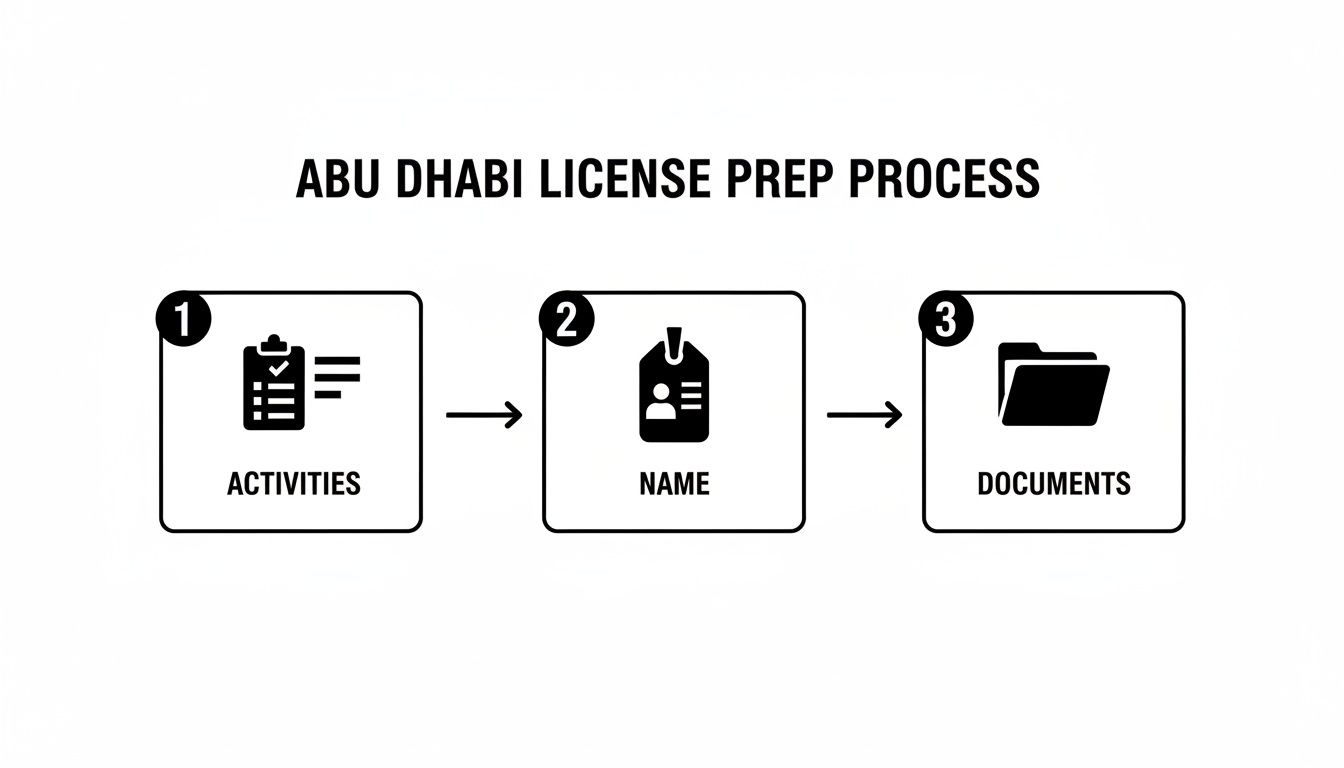
As you can see, defining your activities, securing a name, and getting your documents sorted are the non-negotiable foundations you must build before you can even think about applying.
Drafting and Notarising Your Company’s Foundation
With your Initial Approval in hand, the next major task is creating the Memorandum of Association (MOA). If you're forming a Limited Liability Company (LLC), this document is the legal backbone of your business.
The MOA is where you formalise all the critical details, including:
- Who the shareholders are and their ownership percentages.
- The company's objectives and planned business activities.
- Who the appointed manager is and what powers they hold.
- The total share capital of the company.
This document isn't just a formality. It must be drafted in both English and Arabic, and then all partners must sign it in front of a public notary in Abu Dhabi. It’s a serious, non-negotiable step that legally establishes your partnership and the operational rules of your new company.
The Importance of a Physical Office Address
Here’s a hurdle that often trips up new entrepreneurs on the mainland: securing a registered physical office. For most license types, this is a mandatory requirement, not just a suggestion. You simply cannot finalise your trade license application without a valid tenancy contract for a commercial space.
This isn't just any rental agreement. The contract has to be registered through Abu Dhabi's Tawtheeq system, the emirate's official tenancy contract register. The authorities use this system to verify that your business has a legitimate physical presence.
This requirement really highlights the government’s focus on creating a robust and transparent business environment. It ensures every registered company is a tangible entity with a verifiable address, which adds a crucial layer of credibility and accountability to the ecosystem.
The business landscape in the UAE is booming, with over 1.5 million active commercial licenses now operating nationwide. Abu Dhabi is a massive contributor to this growth, recently seeing a 16% jump in new mainland licenses and a 22% increase in active free zone licenses. This growth is feeding a national surge in key sectors like e-commerce and general trade. You can explore the full research on these economic trends to get a better sense of the market's dynamic energy.
Getting External Approvals for Specialised Activities
For many straightforward business activities, the nod from ADDED or your free zone authority is all you’ll need. However, if your business operates in a specialised or regulated industry, you're going to need additional approvals from other government ministries or departments.
Let’s look at some real-world examples:
- Setting up a medical clinic? You’ll need the blessing of the Department of Health – Abu Dhabi (DoH).
- Opening an educational institution? The Abu Dhabi Department of Education and Knowledge (ADEK) will have to sign off.
- Launching an engineering consultancy? You’ll require approval from the Abu Dhabi Municipality.
- Starting a food trading business? Permission from the Abu Dhabi Agriculture and Food Safety Authority (ADAFSA) is a must.
These external approvals often run on a parallel track to your main license application and can sometimes add extra time to your overall timeline. It’s crucial to identify these requirements early on and start the conversation with the relevant departments as soon as you have your Initial Approval. Proactively managing this step is the best way to prevent your entire application from stalling while you wait for one critical sign-off.
Decoding the True Cost of Your Trade License
Launching a business in Abu Dhabi is exciting, but a realistic budget is everything. When people think about getting a trade license in Abu Dhabi, they often just focus on the main issuance fee. That’s a common mistake, because it's only one small piece of the puzzle.
The reality is, the total cost is a blend of one-time setup charges and ongoing annual expenses. Understanding this full financial picture from day one helps you avoid nasty surprises down the road and builds your venture on a solid foundation. Let's break down what you actually need to budget for.
Your Initial Setup Investment
Before you even hold that shiny new license, you’ll need to cover several mandatory, one-time fees. Think of these as the costs for laying the legal groundwork for your company.
- Trade Name Reservation: This is a small but crucial first step. It secures your chosen business name with the authorities, making sure no one else can legally use it.
- Initial Approval Fee: Once you’ve submitted your primary documents, you'll need to pay for the Initial Approval. This is basically the government’s preliminary nod, giving you the green light to proceed with the rest of your company formation.
- Document Attestation: This is a non-negotiable step if you have corporate shareholders or personal documents from outside the UAE. It involves getting your papers stamped by the UAE Embassy in your home country and then again by the Ministry of Foreign Affairs here. The costs can add up quickly, as you pay per document.
- Memorandum of Association (MOA) Notarisation: For those setting up an LLC, your MOA isn't just a document—it needs to be legally drafted and signed in front of a public notary, which carries its own standard fee.
Depending on your specific company structure, these initial setup costs can range anywhere from a few thousand to several thousand dirhams.
Recurring Costs: The Annual Financial Commitment
Getting your trade license isn’t a one-and-done payment. To keep your business running legally, you have to plan for a few key annual expenses. These will become a core part of your yearly operational budget.
The biggest one is the annual license renewal fee. You'll pay this to the relevant authority every single year to keep your license active. If you miss the deadline, you’re looking at hefty fines and potentially having your company's bank account and employee visas frozen.
One of the most common budgeting mistakes we see is underestimating the cost of physical office space. Most mainland licenses require a registered tenancy contract (known as Tawtheeq), which makes annual rent a major, unavoidable operational expense.
Here are a few other recurring costs to factor in:
- Office Rent: Whether it's a full-fledged office, a flexi-desk in a free zone, or even a virtual office package, this is a significant annual cost.
- Establishment Card Renewal: This card is what links your company to the immigration and labour departments, and it needs to be renewed every year.
- PRO Service Fees: Many businesses find it easier to retain a Public Relations Officer (PRO) on an annual contract. They handle all the government paperwork, renewals, and official processes, which can save you a ton of time and stress.
- Corporate Bank Account Fees: While some business bank accounts have no minimum balance, many do. If you drop below that threshold, you could be hit with monthly charges.
For a deeper dive into how different license options can affect your setup costs, take a look at our detailed guide on business licenses in the UAE https://alainbcenter.com/business-licenses-in-uae/.
The Often-Overlooked Visa Costs
Finally, whatever you do, don't forget to budget for visas. Every single visa—whether for an investor, partner, or employee—involves multiple steps, and each one has its own fee.
You’ll be paying for things like the entry permit, the mandatory medical fitness test, the Emirates ID application, and the final visa stamping in the passport. These costs can add up surprisingly fast, especially if you plan on building a team from the get-go.
Life After the License: Visas and Operational Setup

Securing your trade license in Abu Dhabi feels like crossing the finish line, but it’s actually the starting gun for the next critical phase: making your business fully operational. Your license is the legal foundation, but without the right cards and visas, your company exists only on paper.
The very next step is to bridge that gap by getting your company registered with the immigration authorities. This all begins with applying for an Establishment Card. It's a small card, but it holds immense power.
This card officially registers your business with the General Directorate of Residency and Foreigners Affairs (GDRFA) and is the non-negotiable prerequisite for sponsoring anyone, from yourself as an investor to your first employee. Without it, you simply cannot issue any visas under your company's name.
Unlocking Visa Sponsorship with the Establishment Card
Think of the Establishment Card as your company's passport. It uniquely identifies your business within the immigration system and links directly to your trade license. Applying for it is a straightforward process once your license is issued, and it’s a critical first move to activate your operational capabilities.
Once this card is in hand, your company is officially recognised as a sponsoring entity. This unlocks the ability to apply for residence visas for owners, partners, and staff, allowing you to build the team you need to run your business in the UAE.
The Visa Application Pathway Explained
Whether you’re applying for your own investor visa or bringing on a new team member, the process involves several key milestones. It’s a multi-stage journey that moves from initial entry permission to full residency status.
Here’s what that journey typically looks like:
- Entry Permit Application: First up is applying for an entry permit (also called an employment visa for staff). This document allows the individual to legally enter or stay in the UAE while the rest of the residency formalities are sorted.
- Status Change: If the person is already inside the UAE, maybe on a tourist visa, a "status change" is needed once the entry permit is issued. This officially transitions them from a visitor to a resident-in-process.
- Medical Fitness Test: Every single applicant for a residence visa has to go through a mandatory medical screening at a government-approved health centre. The test screens for specific communicable diseases to ensure public health and safety.
- Emirates ID Biometrics: The applicant then visits a Federal Authority for Identity and Citizenship (ICA) centre to provide their fingerprints and a photograph for their Emirates ID card. This card is a legal requirement for all residents and serves as their primary ID in the UAE.
- Visa Stamping: Once the medical results are clear and biometrics are done, the final step is submitting the passport to have the residence visa stamped inside. This stamp is the official confirmation of their residency status, typically for two years.
For a deeper dive into the specifics, our guide on https://alainbcenter.com/uae-work-visa-requirements/ provides a thorough overview of the entire process.
The Essential Role of PRO Services
Navigating government portals, submitting Arabic-language forms, and keeping track of renewal deadlines can quickly become a full-time job. This is where professional Public Relations Officer (PRO) services become invaluable. A skilled PRO acts as your company’s representative, handling all interactions with government departments.
Engaging a reliable PRO service isn't an expense; it's an investment in efficiency and compliance. They prevent costly fines from missed deadlines and free you up to focus on what you do best—growing your business.
Their role extends far beyond just visa processing. A good PRO service manages trade license renewals, Establishment Card renewals, and any amendments to your license, ensuring your company remains fully compliant with all UAE regulations.
As you set up your physical operations, other practical needs will pop up. For instance, you might need work done on your new business premises. This guide on finding a reliable handyman in Abu Dhabi is a useful resource for getting your new office ready.
This operational phase is also where you can see diverse economic sectors come to life. The Abu Dhabi Registration Authority (ADRA) recently noted a striking 29% increase in new licenses for agriculture, fisheries, and livestock. A significant 61.8% of this growth was concentrated in the Al Ain Region, demonstrating the specialised business opportunities emerging across the emirate.
Your Abu Dhabi Business Setup Questions Answered
Starting a new business in Abu Dhabi is exciting, but it’s natural to have a lot of questions spinning in your head. Getting clear, straightforward answers is the key to moving forward with confidence. Here are some of the most common queries we hear from entrepreneurs just like you.
Can I Get a Trade License Without Renting an Office?
Yes, in many cases, you can! The idea of running a lean operation without the overhead of a physical office is very appealing, and Abu Dhabi has created some great options to make it a reality.
The mainland's 'Tajer Abu Dhabi' license, for example, is a game-changer for home-based and online businesses. It allows you to operate legally for your first few years without needing a commercial lease, which is perfect for solo entrepreneurs and startups testing the waters.
Free zones are also famous for their flexibility here. Most offer smart, cost-effective solutions that tick the legal box for a registered address, such as:
- Flexi-desks: These give you access to a shared workspace for a set number of hours each month.
- Virtual office packages: You get a premium business address and mail handling services without the physical desk space.
But—and this is a big one—for most mainland companies, especially if you plan on hiring staff and sponsoring employee visas, a physical office with a registered tenancy contract (Tawtheeq) is non-negotiable.
How Long Does It Take to Get a Trade License in Abu Dhabi?
This really boils down to two things: the complexity of your business and how organised you are with your paperwork. A well-prepared application for a standard commercial activity can move incredibly fast.
In an ideal world, where every document is correct and complete from the get-go, you could have your license in hand in as little as one to two weeks. It’s a real testament to the efficient systems put in place by authorities like the Abu Dhabi Department of Economic Development (ADDED).
Expert Insight: Preparation is the single biggest accelerator in the licensing process. Having every document correctly attested, every form filled out perfectly, and every decision made before you submit anything can shave weeks off your timeline.
On the flip side, if your business is in a regulated field, you'll need to be more patient. Activities needing special approvals from external bodies—like healthcare (Department of Health), education (ADEK), or finance—can easily stretch the process to between four and eight weeks, sometimes even longer.
What Is the Difference Between a Commercial and a Professional License?
This is one of the most fundamental questions, as the answer directly shapes your company's legal structure and ownership. The choice hinges entirely on what your business actually does.
A Commercial License is for any business that involves trading, buying, and selling goods. Think general trading, import-export, retail shops, or e-commerce platforms.
A Professional License is designed for service-based businesses that rely on an individual's intellectual or artistic skills. We're talking about consultants, designers, accountants, lawyers, and IT service providers. Here, the "product" is expertise.
A huge advantage of a professional license on the mainland is the ability to have 100% foreign ownership. There's a catch, though: you must appoint a UAE national as a 'Local Service Agent' (LSA). The LSA has no shares or say in the business operations; they are simply paid a fixed annual fee for their role.
What Are the Most Common Mistakes to Avoid?
While the setup process is generally smooth, a few common slip-ups can cause major delays and surprise costs. Knowing what they are from the start can save you a world of headaches.
The most frequent missteps we see are:
- Choosing the wrong business activities: Picking activities from the official list that don't perfectly match your business model can lead to rejection or serious limitations down the line.
- Submitting incomplete or improperly attested documents: Any document from outside the UAE has to go through a very specific legalisation process. If you miss a single step in that chain, your application will grind to a halt.
- Underestimating the total cost: It's easy to focus on the license fee and forget to budget for other essentials like office rent, visa processing, document attestation, and annual renewal fees. A complete budget is your best friend for a sustainable launch.
Meticulous, detailed preparation isn't just a nice-to-have; it's the most effective strategy for making sure your journey to getting a trade license in Abu Dhabi is a success.
Navigating the complexities of business setup in Abu Dhabi is simpler with an expert partner. Al Ain Business Center offers end-to-end solutions, from choosing the right license to managing your visas and ensuring full compliance, so you can launch and grow with confidence. https://alainbcenter.com