
Getting a business license in the UAE is the first, most crucial step you'll take. It’s the move that makes your business idea a legal, operational reality in one of the world's most exciting economies. This document isn't just a piece of paper; it's your official green light to join a thriving marketplace, giving your company legitimacy and opening doors to countless commercial opportunities.
Why a Business License Is Your Key to the UAE Market

Think of the UAE's business scene as an exclusive, members-only club. To get in and start doing anything—whether it's selling products or offering professional services—you need a membership card. In this world, your business license is that exclusive card. It's the government's nod of approval, confirming your company is legitimate, follows local laws, and has the authority to operate.
Without it, you're on the outside looking in. A valid license is the foundation every successful UAE company is built on. It defines what your business can do, where it can operate, and how it can legally engage with customers, suppliers, and government entities.
This legal recognition unlocks everything else. Without a license, you simply can't perform basic business functions. These include:
- Opening a corporate bank account.
- Leasing an office or commercial space.
- Sponsoring visas for yourself and your employees.
- Legally importing and exporting goods.
- Bidding on government contracts and tenders.
Understanding Your Operational Arenas
Before you even think about the specific types of business licenses in UAE, you need to get the lay of the land. The country is carved into three distinct commercial jurisdictions, and each one comes with its own set of rules, benefits, and limitations for entrepreneurs.
Choosing the right jurisdiction is your first big strategic move. It's a decision that will fundamentally shape your company's path, dictating your market access, ownership structure, and the overall scope of your operations.
The core idea is simple: your license and jurisdiction work together. One defines what you can do, while the other defines where and how you can do it. Getting this combination right from the start is crucial for long-term success.
Mainland, Free Zone, and Offshore Setups
The three main playgrounds for setting up your business are Mainland, Free Zone, and Offshore. A Mainland license gives you unrestricted access to the entire UAE market. You can trade directly with any customer or company located anywhere within the Emirates, with no restrictions.
Free Zones are specialised economic hubs, often built around specific industries like media, tech, or finance. They offer fantastic perks like 100% foreign ownership and tax exemptions but usually come with a catch: they restrict direct trade with the UAE mainland market. Offshore setups are a different beast altogether, used mainly for international trade and holding assets, with no direct operations permitted inside the UAE.
The UAE's pro-business stance has sparked an incredible entrepreneurial boom. The total number of active commercial licenses has shot past 1.5 million—a historic high driven by reforms designed to empower the private sector. In just one recent year, the UAE issued around 200,000 new economic licenses, with e-commerce and general trading leading the pack. You can discover more insights about the increase in business registrations across the UAE. This growth just goes to show the incredible opportunity waiting for properly licensed businesses.
The 3 Main Types of UAE Business Licenses You Need to Know
Choosing the right business license in the UAE is a bit like picking the right gear for an expedition. You wouldn't take a race car into the desert, and you wouldn't use a professional license to run a trading company. Each license is a specialised tool, designed for a specific set of business activities. Getting this right from day one is the single most important step to making sure your business runs legally and smoothly.
The whole system is built around three fundamental categories that cover just about any business you can imagine: Commercial, Professional, and Industrial. Getting your head around what each one does is the first real step in matching your business idea to the UAE's regulatory framework.
Think of it as choosing your lane. The lane you pick dictates what you can sell, the services you can offer, and the journey your business will take. Let's dive into these core categories and see which one is the perfect fit for you.
The Commercial License: Your Gateway to Trade
The Commercial License is easily the most common and versatile license you’ll find in the UAE. Simply put, this is your permission slip to trade. It gives you the authority to buy, sell, import, and export goods. If your business model revolves around physical products in any way, shape, or form, this is the one you'll be looking at.
It's your official pass to join the UAE's buzzing marketplace. This license covers a massive spectrum of activities, from a "general trading" license that lets you deal in all sorts of different products to more specialised licenses for things like electronics, clothing, or building materials.
Here’s where you’d see a Commercial License in action:
- An e-commerce brand selling fashion accessories online.
- A retail shop in a mall selling the latest smartphones.
- A logistics company importing and distributing industrial equipment.
- A real estate brokerage firm managing property sales and rentals.
All these businesses are fundamentally about the movement and sale of goods or assets, making the Commercial License their non-negotiable legal foundation.
The Professional License: For the Experts and Creators
While a Commercial License is for traders, the Professional License is built for individuals and companies whose main asset is their skill. This license is your official stamp of approval, legitimising your expertise, talent, or specialised knowledge.
It’s tailor-made for service-based businesses where the value comes from intellectual or creative work, not a physical product. Think consultants, lawyers, artists, designers, and tech specialists—they all fall under the professional umbrella.
One of the biggest draws of the Professional License, especially on the Mainland, is that it allows for 100% foreign ownership for most activities. This is a game-changer for international experts and consultants who want to set up shop in the UAE without needing a local Emirati partner.
This license type is the backbone of the UAE's booming service economy. It empowers skilled professionals to turn their knowledge into a business, driving innovation across countless industries.
Classic examples of businesses that need a Professional License include:
- Management and business consultancy firms.
- Marketing agencies and creative studios.
- IT service providers and custom software developers.
- Educational institutes and corporate training centres.
- Artisans, designers, and entertainers.
- Medical clinics and legal advisory firms.
If your business makes money by providing a service, solving a problem, or creating something with your intellect, the Professional License is your path forward.
The Industrial License: The Blueprint for Manufacturers
The third major category is the Industrial License. This is your blueprint for manufacturing. It's an absolute must for any business involved in making, producing, processing, or assembling goods. This license isn't for businesses that sell products—it's for the ones that create them.
Getting an Industrial License is a more complex process because it involves approvals from multiple bodies, like the Ministry of Industry and Advanced Technology. This is to ensure that factories and production plants meet the UAE's high environmental and safety standards.
This license is for any business that takes raw materials and turns them into something new. The activities can range from huge factories in food processing or metal fabrication to smaller, more nimble assembly operations.
For instance, a business would need an Industrial License to:
- Manufacture furniture from timber and fabric.
- Assemble electronic parts into finished gadgets.
- Process and package food and beverage products.
- Fabricate steel structures for the construction industry.
To help you see the differences side-by-side, here’s a quick look at how the three main business licenses in the UAE stack up.
UAE Business License Categories at a Glance
This table breaks down the core license types to give you a clear, at-a-glance comparison. Think of it as a quick reference guide to help you pinpoint which category your business idea falls into.
| License Type | Primary Function | Example Activities | Ideal For |
|---|---|---|---|
| Commercial | Trading and Sales | Import/Export, E-commerce, Real Estate, Retail | Businesses selling physical goods or products. |
| Professional | Service Provision | Consultancy, IT Services, Education, Marketing | Experts, consultants, and skilled service providers. |
| Industrial | Manufacturing & Production | Assembly, Processing, Fabrication, Packaging | Companies that create or manufacture products. |
Choosing the right license is a foundational decision that will shape everything from your legal structure and permitted activities to your company's long-term growth. By getting clear on whether your core business is trading, providing services, or manufacturing, you can confidently select the license that will act as the bedrock for your success in the UAE.
Choosing Your Business Playground: Mainland vs. Free Zone
Once you’ve pinned down your business activities and the right license type, you’re facing your next big decision: where to set up shop. This is a huge one. It determines who you can sell to, how your company is owned, and the rules you'll operate by. In the UAE, this boils down to two main choices: Mainland or Free Zone.
Let's use a simple analogy. Setting up on the Mainland is like opening a flagship store on a bustling high street. You have direct, unrestricted access to the entire local market, letting you trade with any person, company, or government body across all seven Emirates.
A Free Zone license, however, is more like opening a boutique inside an exclusive, specialised shopping centre. You become part of a curated ecosystem with fantastic perks, but your business activities are generally confined to that zone or international markets.
The All-Access Pass: Mainland Setup
A Mainland license, issued by the Department of Economic Development (DED) in whichever Emirate you choose, is your golden ticket to the entire UAE marketplace. This is the go-to route for any business aiming to serve the local community directly. If your plan involves opening a physical shop, offering services to residents, or bidding on lucrative government contracts, then a Mainland setup is non-negotiable.
It used to be that this path required a local Emirati sponsor holding a 51% share. But recent, game-changing legal reforms now allow for 100% foreign ownership for a huge number of business activities. This has made the Mainland an incredibly compelling option for international entrepreneurs.
What are the biggest draws of a Mainland license?
- Unrestricted Market Access: You can trade freely and directly with anyone, anywhere in the UAE.
- Government Contract Eligibility: This is the only way to get in on profitable government tenders.
- Total Geographical Freedom: You can set up your office, warehouse, or storefront anywhere you like within the Emirate.
This freedom is the core appeal, making it the perfect choice for businesses laser-focused on the domestic UAE economy.
The Specialist Hub: Free Zone Setup
Free Zones are a different beast entirely. They are designated economic areas with their own set of rules and governing authorities, operating independently from the Mainland. With over 40 Free Zones scattered across the UAE, many are hyper-focused on specific industries—think technology, media, finance, or commodities. For instance, Dubai Media City is a magnet for media firms, while the Dubai International Financial Centre (DIFC) is the epicentre for financial services.
The main attraction? A powerful package of incentives designed to pull in foreign investment. Free Zones have offered 100% foreign ownership from the get-go, long before the Mainland reforms, making them a trusted favourite for international businesses.
To get you started, here’s a quick visual guide on how your primary business activity points towards a certain license type.
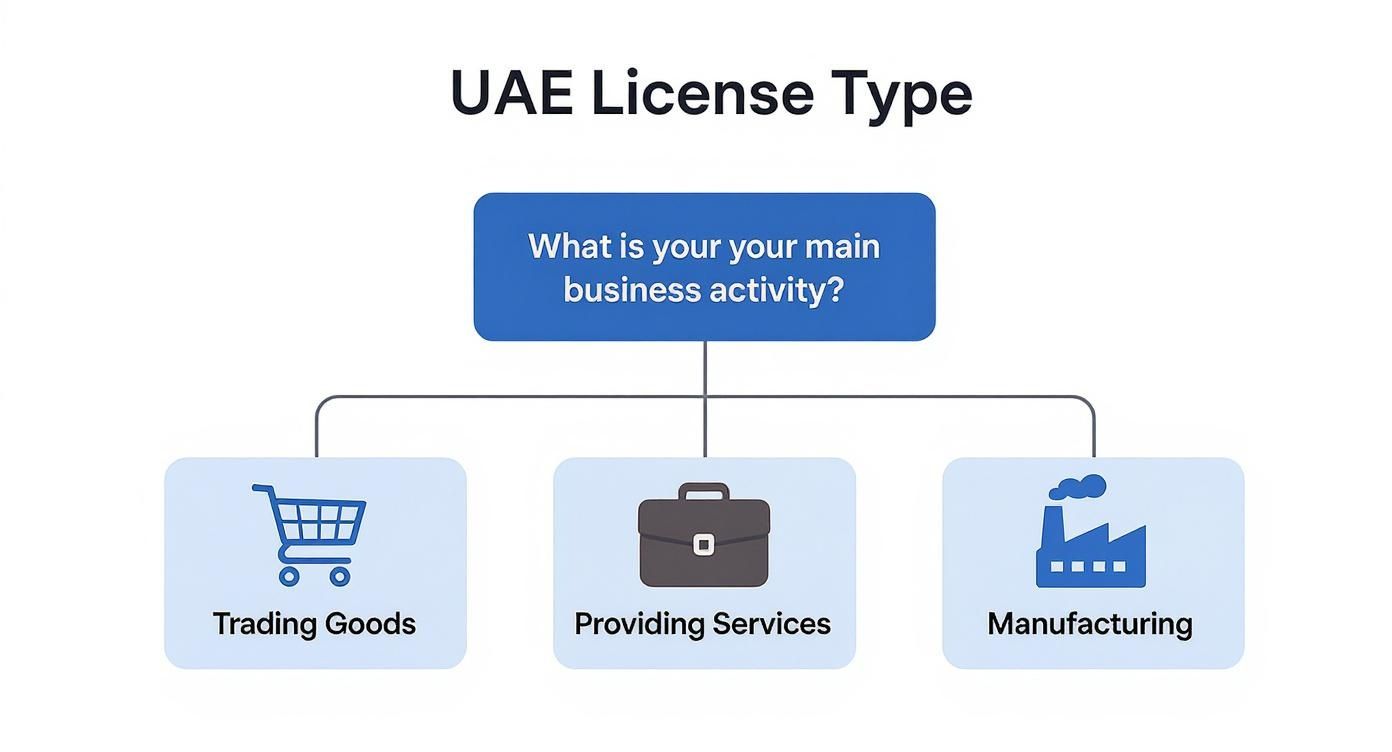
This simple flowchart shows how your core function—whether it's trading goods, providing services, or manufacturing—is the first clue to finding the right license category for you.
Key benefits of setting up in a Free Zone typically include:
- Complete Foreign Ownership: You retain full control and ownership of your company.
- Tax Exemptions: Most Free Zones boast 0% corporate and personal income taxes.
- Customs Duty Exemption: No customs duties on goods traded within the zone or for export.
- Industry-Specific Infrastructure: You're surrounded by peers and have access to facilities built for your sector.
The trade-off, however, is that Free Zone companies can't trade directly with the Mainland market. To do that, they need to go through a locally appointed distributor. This setup is ideal for businesses focused on international trade, B2B services, or consulting for other companies within the same zone. You can dive deeper into the nuances in our detailed guide on Free Zone vs. Mainland in Dubai.
The question isn't "which is better?" but "which is the better fit for me?" Let your target market, ownership preferences, and long-term vision guide your decision.
A Note on Offshore Companies
There is a third, highly specialised option: an Offshore company. It's crucial not to mix this up with a Free Zone company. An Offshore setup, registered in jurisdictions like Jebel Ali Free Zone (JAFZA) or Ras Al Khaimah (RAK), is a legal tool designed for international business. It is not permitted to conduct any real business inside the UAE.
Its main job is to act as a holding company—managing international assets, owning property, and conducting trade entirely outside the Emirates. Think of it as a corporate vehicle for global entrepreneurs who need a UAE-based entity for holding purposes but have zero plans to operate locally.
Your Step-by-Step Path to Getting Licensed
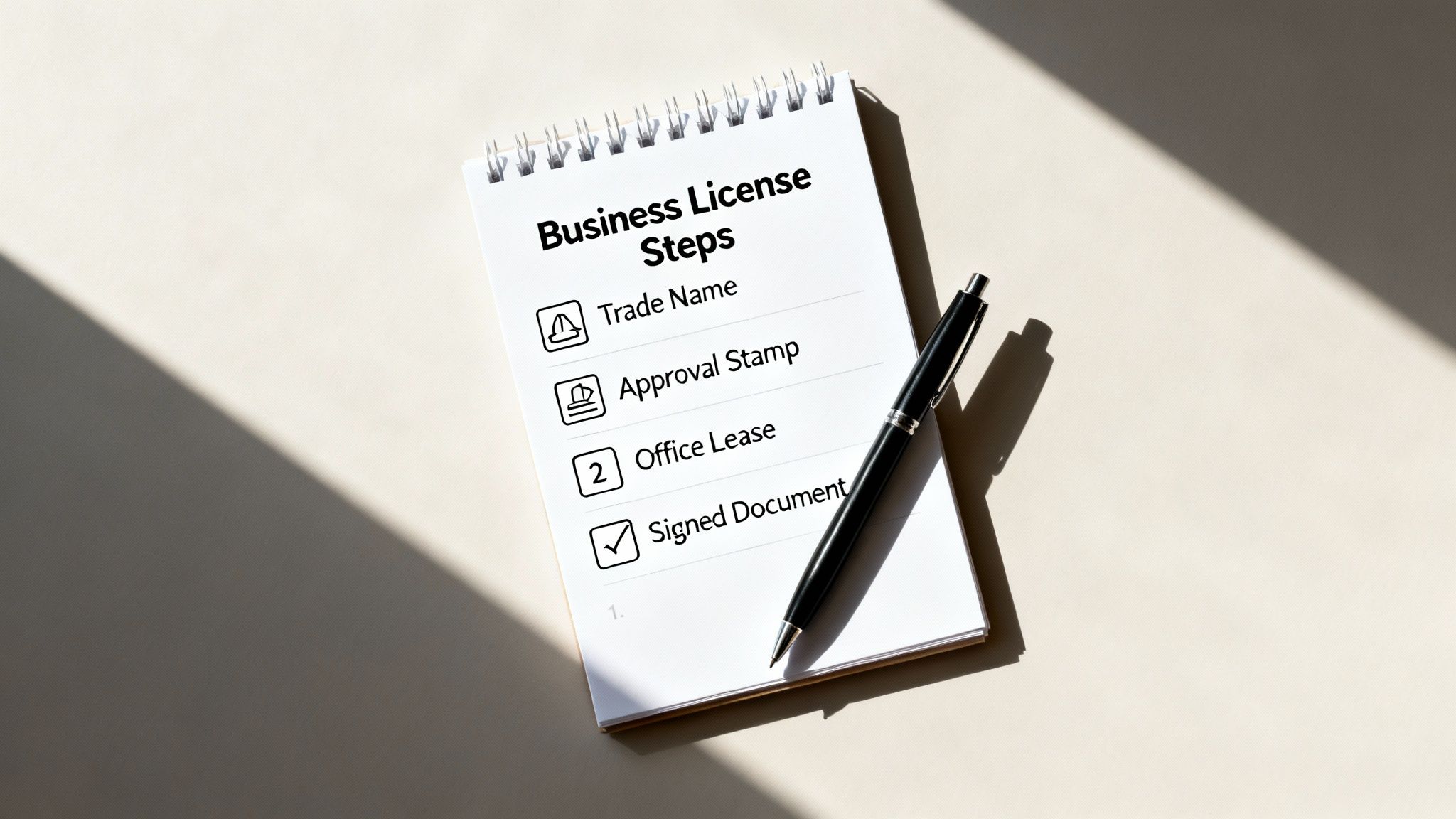
Securing your business license in the UAE isn't a single action, but a sequence of key milestones. From the outside, it can look like a maze of paperwork and approvals. But when you break it down, it’s a clear, manageable journey. Let's walk through the roadmap, piece by piece.
Think of it like building a house. You can't put the roof on before the foundation is poured. Each step builds on the last, leading to the final prize: your legally operating business.
Step 1: Define Your Business Activities
First things first, you need to get crystal clear on exactly what your business will do. This is the absolute bedrock of your application. Why? Because every activity you list directly determines the license you need—Commercial, Professional, or Industrial—and even dictates which jurisdictions you can operate in.
The UAE authorities have a huge, detailed list of approved business activities. You have to pick the ones that perfectly match your model. Being vague or choosing the wrong category is a recipe for rejection or, worse, legal headaches down the road. Precision is everything here.
Step 2: Reserve Your Unique Trade Name
With your activities sorted, it's time to give your business a name. This is more than just branding; your trade name has to be officially approved and registered by the relevant economic department. The UAE has strict naming rules you need to follow.
For instance, your name can't offend public morals, include religious or political slang, or be a carbon copy of an existing company. Our advice? Come prepared with a list of three or four names, ranked by preference, to speed things up. It's also smart to understand the legal side of naming and protecting your business name to keep your brand safe from the start.
Step 3: Secure Initial Approval
Okay, activities are defined and your name is reserved. The next milestone is getting Initial Approval. This is the first official nod from the authorities, confirming they have no objection to your business idea.
This document is your ticket to move forward with the bigger steps, like drafting legal documents or signing an office lease. It's the government's way of saying your concept fits within UAE regulations, clearing the path for the final hurdles.
Think of the Initial Approval as an 'approval-in-principle'. It’s not the final license, but it's the official permission you need to get the rest of your legal and logistical ducks in a row.
Step 4: Prepare Legal Documents and Lease an Office
Now we get into the heavy lifting: the core legal paperwork. For most companies, this means drafting a Memorandum of Association (MoA). If you're a sole establishment, you might need a Local Service Agent (LSA) agreement instead. These documents are the rulebook for your company, outlining ownership, shares, and how you'll operate.
At the same time, your business needs a home. For a Mainland license, you have to lease a commercial space and get the tenancy contract registered with Ejari. Even in Free Zones, you'll need to show proof of at least a flexi-desk or physical office space within that zone.
Step 5: Submit Final Documents and Pay Fees
You've made it to the final stretch. With your full package of documents in hand—Initial Approval, trade name certificate, signed MoA, and tenancy contract—you’re ready for the final submission. You'll present all of this to the relevant authority, whether that's the DED for Mainland or a specific Free Zone administration.
This is also when you'll settle the final license issuance fees. The total amount depends on your jurisdiction, license type, and other variables. After one last review, the authorities will print your official trade license. You're now officially in business. For a deeper look at this process in Dubai specifically, our guide on how to get a trade license in Dubai offers some extra pointers.
A Realistic Look at Business License Costs and Fees
Trying to budget for your business license in the UAE can feel a bit like aiming at a moving target. There isn't a single, neat price tag. Instead, the total cost is a sum of different fees, and the final number really hinges on the specific choices you make for your business. Getting your head around this structure is the secret to creating a solid financial plan and avoiding any nasty surprises down the road.
The easiest way to think about the cost is to split it into two buckets. First, you've got the one-time setup fees—these cover all the initial paperwork and administrative steps to get you registered. Then, you have the recurring annual costs, which is mainly the license renewal fee that keeps your company legal and active each year.
These costs aren't set in stone. They shift based on a few key decisions. The biggest factors that will influence your final bill are your chosen jurisdiction (Mainland vs. a specific Free Zone), the type of license you're after (Commercial, Professional, or Industrial), and how many employee visas you'll need.
Breaking Down the Initial Setup Costs
When you kick off the license application, you'll face a series of one-off payments. While the exact figures can differ, these are the typical charges you need to factor into your initial budget. Planning for these upfront ensures you have the capital to see the process through without hitting any financial bumps.
- Trade Name Registration: A fee paid to reserve your unique company name.
- Initial Approval Fee: A charge for the authorities to give your application the preliminary green light.
- License Issuance Fee: This is the main cost for the trade license itself and can vary quite a bit.
- Office Rent (Ejari): For Mainland companies, this is a major expense. You must have a physical office lease, and the contract needs to be registered.
- Memorandum of Association (MoA) Fees: This covers the costs for drafting and notarising your company's foundational legal documents.
It's a common myth that Free Zones are always the cheaper option. While some offer very attractive packages, the more premium zones with top-tier infrastructure can sometimes have a higher initial setup cost than a standard Mainland license.
Understanding Recurring Annual Expenses
Your financial commitments don't stop once you have the license in hand. To keep your business running and compliant, you absolutely must plan for annual renewals. This is, by far, the most significant recurring cost tied directly to your license.
The renewal fee essentially keeps your license active for another 12 months. It's critical to pay this on time to avoid penalties, which can range from fines to having your business activities and even your corporate bank account frozen. Alongside the renewal fee, you’ll also need to budget for the ongoing cost of your office space or flexi-desk agreement, which is a requirement for keeping your license valid.
For a deeper dive into the numbers, you'll find our complete guide on the Dubai trading license cost really helpful.
By breaking down the expenses into these two categories—one-time and recurring—you can build a much clearer, more realistic budget. This approach helps you manage your cash flow from day one and sets you up for the long-term financial health of your new venture in the UAE.
Your Business Is Licensed. What Happens Next?
Getting your business license is a massive milestone. It feels like the end of a long journey, but it’s really just the starting pistol firing. Think of it like this: you've just been handed the keys to a brand-new car. It’s yours, but you can’t drive it off the lot just yet. You still need to get it registered, insured, and put some fuel in the tank.
This next phase is all about turning that piece of paper—your license—into a fully functioning, legally compliant business. With the license sorted, your next steps are purely operational, and they’re not optional. Let's walk through the post-licensing checklist that gets you from a registered name to a company ready to make its mark.
Activating Your Business Operations
First things first, you need the official credentials that let your company plug into the UAE's government and economic systems. This boils down to three critical steps:
-
Apply for an Establishment Card: This is non-negotiable. Issued by the immigration authorities, this card officially registers your company in their system. Without it, you can't hire anyone or even get your own visa processed under the company name.
-
Process Visas: Once you have the Establishment Card, you can start the visa applications. This includes securing your own investor or partner visa, which is crucial, as well as any employment visas for the team you plan to bring on board.
-
Open a Corporate Bank Account: A corporate bank account is essential for managing your finances professionally, accepting payments from clients, and maintaining clear financial records. To open one, UAE banks will almost always ask to see your new trade license, Memorandum of Association (MoA), and copies of shareholder visas.
Getting the business license is a huge win, but the real work starts now. How you handle these next steps is what truly transforms a legal document into a thriving, operational business.
Staying Compliant and Planning for Growth
Compliance isn’t a one-and-done task. The UAE's business environment is constantly evolving, and staying on top of your legal duties is the key to long-term survival and success. The most important recurring task is the annual renewal of your business license. Mark this in your calendar with reminders, because failing to renew on time can lead to hefty fines and even a freeze on all your business activities.
The UAE recently hit a major economic milestone, with nearly one million active business licenses on record. This incredible growth is being driven by sectors like e-commerce and general trading, which shows just how much opportunity there is for new businesses. You can read more about this surge in business registrations.
With your operations up and running, it's time to shift your focus to scaling up. Exploring effective 10 Small Business Growth Strategies can give you the blueprint you need to not just survive, but truly thrive in the competitive UAE market.
Your Questions Answered: UAE Business Licenses
When you're diving into setting up a business in the UAE, a lot of practical questions pop up. We get it. We hear them every day from entrepreneurs just like you. Here are some straight answers to the most common queries, designed to give you the clarity you need to move forward.
How Long Does It Take to Get a Business License?
This is the big one, isn't it? The timeline can be anywhere from a few business days to a few weeks. It really boils down to a few things: the jurisdiction you pick, your specific business activities, and whether your paperwork is spot on. As a general rule of thumb, Free Zones are known for their speedy, streamlined processing, often getting you your license faster than a Mainland setup.
Can I Get a License Without a Physical Office?
This is a classic "it depends" situation. Many Free Zones are incredibly flexible, offering virtual office packages or flexi-desk solutions that tick the box without the commitment of a full-blown office. For a Mainland license, however, a registered physical office lease—what's known as an Ejari—is almost always a non-negotiable requirement. Your choice of jurisdiction is the key that unlocks the answer here.
The need for a physical office is one of the clearest dividing lines between Mainland and Free Zone setups. Your decision will have a direct impact on your initial setup costs and how flexibly you can operate.
Do I Still Need a Local Emirati Partner?
Fantastic news on this front. For the vast majority of business activities on the Mainland, the old rule about needing a local Emirati sponsor with a majority stake is a thing of the past. A major reform now allows for 100% foreign ownership, which has been a game-changer for international entrepreneurs wanting to launch here. That said, a handful of strategic sectors still have their own specific ownership rules.
What Is the Difference Between a Trade Name and a Legal Name?
It's easy to mix these two up. Think of your trade name as your brand identity—it's the name you trade under, the one your customers see on your website and marketing materials. It has to be unique and get the official stamp of approval.
Your legal name, on the other hand, is the official, registered name of your company in the eyes of the authorities. This is the name that will have a legal suffix attached to it, like "LLC" for a Limited Liability Company or "FZE" for a Free Zone Establishment.
Ready to get your UAE business license without the headache? The expert team at Al Ain Business Center is here to handle the entire journey for you, from getting the initial approvals to the final visa stamping. Get your free consultation today!