
Starting a business in Dubai as a foreigner isn't just a smart move; it's becoming an essential strategy for ambitious entrepreneurs. Thanks to its incredibly pro-business climate, futuristic infrastructure, and frankly unbeatable tax advantages, the path is clear. It all boils down to choosing the right jurisdiction, defining your business activities, and navigating a straightforward registration process designed to pull in global talent.
Why Dubai Is the Ultimate Launchpad for Global Entrepreneurs

Dubai has masterfully shed its image as just a luxury travel spot and cemented its status as a serious global business powerhouse. For entrepreneurs from abroad, the city presents a rare mix of stability, massive growth potential, and a quality of life that’s hard to find anywhere else. This is a place where ambition isn’t just tolerated; it's actively fuelled by government policy.
The biggest draw for many is, without a doubt, the tax environment. With 0% personal income tax and a very competitive 9% corporate tax (which only applies to profits over AED 375,000), the financial upside is enormous compared to most Western economies.
A Strategic Position for Global Trade
You can't argue with geography. Dubai sits squarely at the crossroads of Europe, Asia, and Africa, giving businesses phenomenal access to both mature and emerging markets. If you’re in logistics, import-export, or e-commerce, this means slicker supply chains and a direct line into the Middle East, North Africa, and South Asia. This natural advantage is bolstered by world-class infrastructure like Jebel Ali Port and Dubai International Airport, which keep global trade flowing smoothly.
Thriving Economic Growth and Investment
The economic energy here is electric; you can feel it. New businesses are popping up constantly. Just look at the first half of 2025—Dubai saw a massive surge, with the Dubai Chamber reporting 35,500 new companies registered. This isn't a fluke. It's driven by powerful foreign direct investment, with UAE inflows jumping from around US$11 billion to US$21 billion in the years leading up to 2025. You can dig into the numbers yourself in the latest Dubai Chamber reports.
This isn't just paperwork; it’s real, tangible economic activity. This kind of boom shows a deep-seated confidence from the global business community in Dubai's long-term stability and vision.
The government works hard to keep this momentum going, offering business-friendly policies and a transparent legal framework that aligns with international best practices. For an entrepreneur, the benefits are clear:
- 100% Foreign Ownership: The old requirement for a local partner is gone for most business activities. You have full control of your company.
- Full Capital Repatriation: You are free to transfer 100% of your capital and profits back home, with no catches or restrictions.
- Access to a Diverse Talent Pool: Dubai is a magnet for skilled professionals from every corner of the globe, making it much easier to assemble a world-class team.
All these factors come together to create the perfect ecosystem for entrepreneurs who aren’t just looking to start a business, but to build an empire on the global stage.
Choosing Your Jurisdiction: Mainland vs. Free Zone
When you’re looking to set up a business in Dubai as a foreigner, this is the first big decision you'll make. It's a real fork in the road. Getting this choice right from the start aligns your entire business strategy with how the UAE operates. If you get it wrong, you could be facing unnecessary restrictions and costs later on. This isn't just about picking an option; it's about choosing the fundamental operating system for your new company.
The decision really comes down to one simple question: Where will your primary customers be? How you answer that will point you towards either a Mainland or a Free Zone setup.
The Dubai Mainland Advantage: Direct Market Access
A Dubai Mainland company, licensed by the Department of Economy and Tourism (DED), is your all-access pass to operate anywhere in the UAE and internationally. If your business plan involves dealing directly with the local market, this is almost always the way to go.
Let me put it this way. Are you planning to open a café, a retail shop, a local marketing agency, or a consultancy that wants to bid on government projects? If so, a Mainland licence is non-negotiable. It gives you the freedom to trade without barriers, rent your office anywhere in Dubai, and tap into the entire UAE consumer base directly.
There's a common misconception that used to hold a lot of foreign entrepreneurs back—the old ownership rule. Historically, setting up on the Mainland meant you needed a local Emirati partner who would hold a 51% share in your company. Thankfully, that's changed dramatically.
The old rules are gone. Landmark legal reforms now permit 100% foreign ownership for over a thousand business activities on the Mainland. This has been a complete game-changer, opening up the local market like never before for international investors.
This shift is huge. It means you can have full control of your business while operating right in the heart of one of the region's most dynamic economies.
The Free Zone Advantage: Global Operations and Simplicity
On the other side of the coin, you have Dubai's 40+ specialised Free Zones. Think of each zone as its own self-contained economic area with its own rules and regulations, often tailored to specific industries. If your clients are mainly international and you don't need to trade directly within the UAE, a Free Zone offers some fantastic benefits.
For example, maybe you run a software development company with clients in Europe and the US. Or perhaps you're a global commodities trader. In situations like these, a Free Zone is a perfect fit. You get:
- 100% foreign ownership (this has always been a key feature of Free Zones).
- 100% repatriation of capital and profits, so you can send all your earnings back home without any restrictions.
- Exemption from customs duties for any import and re-export activities.
- A simpler and often much faster setup process.
These zones are true ecosystems. Dubai Media City is the hub for media and advertising firms, while the Dubai International Financial Centre (DIFC) is the go-to for finance and banking. Choosing the right one places you right in the middle of your industry peers and potential partners. To get a really detailed comparison, our guide on Free Zone vs Mainland Dubai breaks it all down.
The Evolving Landscape of Foreign Ownership
The lines between Mainland and Free Zone have definitely become more blurred recently. As the UAE continues to liberalise its foreign investment rules, we're seeing a massive expansion in the number of onshore activities that can be 100% foreign-owned.
These reforms have added more than 1,000 activities to the "positive list," covering everything from trade and tech to e-commerce. This has narrowed the historical advantage that free zones once had as the only path to full ownership.
So, what's the bottom line? The decision is less about ownership now and much more about your operational focus. Do you need direct access to the UAE market and government contracts? Go Mainland. Is your focus global? A Free Zone is likely your best bet.
A Quick Comparison to Guide Your Choice
To help you see the differences more clearly, I've put together a simple table. This lays out the most important factors for any foreigner starting a business here.
Mainland vs Free Zone: Key Differences at a Glance
| Feature | Dubai Mainland (DED) | Dubai Free Zone |
|---|---|---|
| Market Access | Unrestricted access to the entire UAE local market. | Operations are generally restricted to the free zone and international markets. |
| Business Scope | Can trade directly with any business or consumer in the UAE. | Direct trade with the UAE mainland requires a local distributor or agent. |
| Office Location | Can rent an office anywhere in Dubai. A physical address is mandatory. | Must operate from within the specific free zone's geographical boundaries. |
| Government Tenders | Eligible to bid for and work on lucrative UAE government contracts. | Generally not eligible to bid for government projects. |
| Visa Eligibility | Visa eligibility is linked to the size of the office space leased. | Typically offers a set number of visas per package, independent of office size. |
This table should give you a solid starting point for figuring out which structure fits your business model best.
When a Local Service Agent Still Makes Sense
Even with 100% foreign ownership now possible for many professional services on the Mainland (like IT or management consulting), there's one more piece to the puzzle: you'll still need to appoint a Local Service Agent (LSA). An LSA is an Emirati national or a UAE-owned company.
But don't worry, this isn't like the old local partner model. An LSA holds zero shares in your company and has absolutely no say in its management or operations. Their role is purely administrative—they act as your representative for licensing and government paperwork. It’s a formal requirement, and choosing a reliable LSA is key to making sure all your admin runs smoothly.
Making the right choice between Mainland and Free Zone is the bedrock of your business's success in Dubai. Take the time to carefully evaluate your business model, your target audience, and your long-term goals. Getting this strategic decision right will pave the way for a smooth and prosperous journey ahead.
The Company Formation Process Demystified
Now that you've navigated the crucial mainland vs. free zone decision, it’s time to roll up our sleeves and get into the practical side of things: the company formation process itself. This is more than just a paper-pushing exercise. Each step lays another brick in the legal and operational foundation of your business.
Getting these details right from the start is the difference between a smooth launch and months of frustrating, costly delays. We're going to walk through what this process actually feels like for a foreign entrepreneur in Dubai, moving beyond the sterile official checklists.
This visual flow helps clarify how your primary business goals directly influence whether a Mainland or Free Zone setup is the right path for your venture.
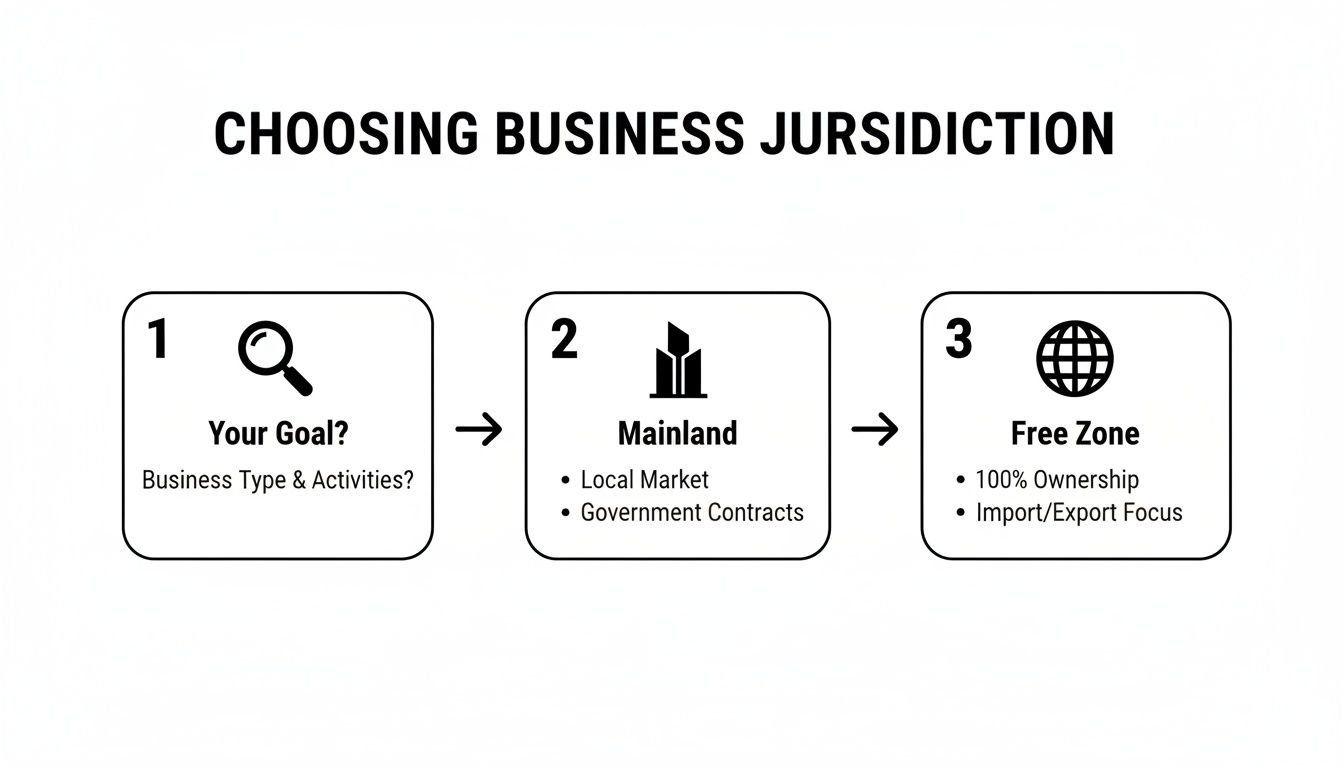
As you can see, the journey doesn’t start with paperwork, but with a crystal-clear vision of your goals. That clarity is what points you towards the ideal jurisdiction.
Defining Your Business Activities
Everything starts here. You need to precisely define every single commercial activity your company will perform. This isn't the time for broad strokes; the authorities require you to select from a pre-approved list of over 2,100 business activities.
This choice is critical because it directly determines the type of licence you'll be issued. For instance, if you plan to import and sell electronics, you’ll need a Commercial Licence. If you’re offering marketing consultancy, it’s a Professional Licence. For a closer look at the different categories, you can learn more about the various business licenses in the UAE and see how they match up with specific industries.
A classic mistake I see is entrepreneurs being too narrow with their activity list, which boxes them in later when they want to expand. It’s often a smart move to include potential future services or product lines in your initial application to give yourself room to grow.
Choosing and Registering Your Trade Name
With your activities locked in, the next fun part is naming your company. It seems straightforward, but the UAE has strict naming conventions that often catch foreign entrepreneurs off guard.
Your proposed name must:
- Not be offensive or contradict public morals.
- Avoid religious names or references to governing bodies.
- Be followed by its legal structure suffix (e.g., LLC, FZE).
- Be completely unique and not already registered.
For example, a name like "Dubai Best Trading" would almost certainly be rejected for using "Dubai" and being too generic. A name like "Apex Global Solutions FZCO" is much more likely to pass—it's specific, professional, and compliant. You'll typically need to submit three name options for approval, so have a few backups ready.
Obtaining Initial Approval
Think of the Initial Approval as the government’s nod of acceptance. Issued by the Department of Economy and Tourism (DED) for mainland or the relevant free zone authority, it’s a foundational document. It’s essentially a no-objection certificate confirming that the UAE government is okay with your proposed business and its owners.
This step unlocks your ability to proceed with other legal formalities, like drafting your official company documents or leasing an office. To get it, you’ll submit your application form, shareholder passport copies, and a brief business plan.
This is more than just a formality. The Initial Approval signals that the government has vetted your proposed business concept and given you the green light to proceed with the more substantial steps of formation.
Without this document, you cannot legally sign contracts or secure a commercial lease in your company's name. It’s the key that opens the next set of doors.
Drafting Key Legal Documents
With your Initial Approval secured, you'll move on to building your company's legal framework. The most important piece of paper here is the Memorandum of Association (MoA). For mainland companies, this must be drafted in both Arabic and English and then notarised at a public notary.
The MoA is the rulebook for your company, outlining critical details like:
- Shareholder information and ownership percentages.
- The legal structure of the company.
- The appointed manager and their powers.
- The company's registered address and activities.
A poorly drafted MoA is a recipe for disaster. Any ambiguity or error can lead to weeks of delays as the authorities will simply send it back for corrections. This is one area where professional help is genuinely invaluable to ensure the document is airtight and fully compliant with UAE Commercial Law.
Securing Your Business Premises
Every single company in Dubai, whether it's on the mainland or in a free zone, must have a registered physical address. This is a non-negotiable requirement to get your licence issued.
For mainland companies, this means leasing a physical office and registering the tenancy contract through the Ejari system. This generates a unique code that proves your lease is legitimate and officially recorded.
Free zones, on the other hand, offer a lot more flexibility, which is perfect for new businesses. Their cost-effective solutions often include:
- Flexi-desks: A shared workspace that satisfies the physical address requirement without the cost of a private office.
- Virtual offices: A registered address without a physical desk, which can work for certain service-based businesses.
- Serviced offices: Fully furnished, ready-to-use private offices for a quick start.
The right choice comes down to your operational needs and budget. Once you have your tenancy contract or flexi-desk agreement in hand, you can submit all your documents for the final trade licence issuance—the ultimate prize that officially allows you to start doing business.
Securing Your Residency Visa and Emirates ID
Successfully forming your company is a huge milestone, but it’s also the key that unlocks the next critical step in your journey: establishing your legal residency in Dubai. Your new trade licence is your direct pathway to living and working in the UAE, transforming you from a visitor into a resident. It's a well-trodden path, but one with a few important steps.
For most founders, the company itself acts as the sponsor, allowing you to apply for a residency visa. This is the official permit that lets you live in the UAE long-term. Paired with this is the Emirates ID, the mandatory identification card for all residents. You’ll use this for everything, from opening a bank account to renting an apartment.
Investor Visa vs Employment Visa: What Is the Difference?
As the owner of your new company, you generally have two main visa options. Choosing the right one really just depends on your official role and the legal structure of your business.
- An Investor Visa (often called a Partner Visa) is for shareholders or owners of the company. It signifies your stake in the business and is typically valid for two years. This is the most common route for entrepreneurs starting out in Dubai.
- An Employment Visa is for individuals hired as employees. If you appoint yourself as a General Manager in your own company, you would be issued an employment visa. The key difference lies in the paperwork and your official designation.
Key Takeaway: The primary distinction is your official capacity. An Investor Visa designates you as a business owner, while an Employment Visa classifies you as an employee—even if it's your own company. The benefits and residency rights are largely the same.
The Visa Application Journey Mapped Out
Once your company's Establishment Card is issued—a crucial document registering your business with the immigration authorities—your personal visa process can officially begin.
First, your company applies for an entry permit. Think of this as a temporary visa that allows you to be in the country legally while you complete the rest of the residency formalities. If you're already in the UAE on a tourist visa, you'll need to do a "status change" once this permit is approved.
Next up is the medical fitness test. All new residents must undergo a mandatory medical screening, which involves a blood test and a chest X-ray to check for specific communicable diseases. For a faster turnaround, you can opt for the VIP service, which often gets you results in just a few hours.
With your medical results in hand, you'll attend an appointment for Emirates ID biometrics, where they take your fingerprints and photograph.
Finally, it’s time for visa stamping. Your passport is submitted to the immigration authority, and they will affix a residency visa sticker inside, finalising your new status as a UAE resident.
It's a process with a lot of moving parts. Our detailed guide on how to get a residence visa in Dubai breaks down each stage even further.
Your Company as a Gateway to the Golden Visa
Your new business can also be a powerful launchpad for securing the prestigious UAE Golden Visa, a long-term residency permit valid for up to 10 years. This visa is designed to attract and retain top talent, investors, and entrepreneurs who are making a real impact on the economy.
The UAE government has actively fostered a supportive environment for founders. Initiatives like the Project of the 50 have committed approximately $8.7 billion to bolster the SME sector. It's no surprise the UAE has ranked first in the Global Entrepreneurship Monitor for four consecutive years. You can discover more about these findings on the Ministry of Economy's report.
To qualify for a Golden Visa as an entrepreneur, you typically need to meet one of these criteria:
- Own a startup project of a technical or future-oriented nature based on risk and innovation.
- Receive an approval letter from an accredited business incubator in the UAE.
- Be a founder of a previous entrepreneurial project that was sold for a total of not less than AED 7 million.
This long-term visa offers incredible stability, removing the need for frequent renewals and providing a solid foundation for you and your family as you grow your business in Dubai.
What Happens After You Get Your Licence?
Getting your trade licence is a huge milestone, but it’s really just the starting line. Now the real work begins: running a compliant, successful business in Dubai. This next phase is all about building a solid operational foundation and staying on top of your responsibilities as a foreign business owner.
The first, and often most stressful, task is opening a corporate bank account. This sounds simple, but for new foreign-owned companies in the UAE, it can be a real roadblock. Banks here have become incredibly strict with their due diligence and know-your-customer (KYC) processes.
You can't just walk in with your new trade licence and expect an account. You need to come prepared with a comprehensive file that paints a clear, legitimate picture of your business. If you’re not ready, you could be looking at weeks, or even months, of frustrating delays.
Opening Your Corporate Bank Account
To give yourself the best shot at a quick approval, get your documents in order before you even think about meeting with a banker. It shows you’re organised and serious.
Here’s what you’ll need to have in your application package:
- Company Trade Licence: The main document proving you're a legal entity.
- Memorandum of Association (MoA): This lays out your company's structure and who the shareholders are.
- Share Certificates: The official proof of ownership for each partner.
- Passport and Visa Copies: For every shareholder and anyone who will be a signatory on the account.
- Emirates ID Copies: Also for all shareholders and signatories.
- Company Establishment Card: This proves your company is registered with immigration.
- A Detailed Business Plan: This is crucial. It needs to explain what your business actually does, who your target clients are, and include realistic income projections.
Paperwork aside, the banks want to see real substance. They’re on high alert for shell companies. Showing them proof of a physical office (like your Ejari or flexi-desk contract) and having a professional business website can make a massive difference in how they view your application.
A common mistake I see is people underestimating how much context the bank needs. They want to understand your business model. A one-page business plan just won't do. You need to tell a clear story about where your revenue is coming from and why you’ve chosen to set up in Dubai.
Staying Compliant with Corporate Tax
The introduction of a 9% corporate tax on profits over AED 375,000 is the biggest change to hit the UAE business world in years. Compliance isn't optional, and it all starts with getting registered correctly.
Even if you’re certain your profits will be below the threshold, you still have to register with the Federal Tax Authority (FTA) and get a Tax Registration Number (TRN). The FTA requires every single licensed business to register, no matter what you expect to earn. Skipping this step can lead to hefty penalties.
Keeping Your Books in Order
With corporate tax now in effect, keeping meticulous financial records is non-negotiable. The days of casual bookkeeping are long gone. The FTA can require businesses to show audited financial statements and you must keep records for at least seven years.
This means you need a proper accounting system from day one. Good bookkeeping isn't just about being ready for tax season; it gives you a clear view of your company’s financial health, which helps you make smarter business decisions. Once your company is up and running, getting a handle on global trade rules and tax duties is essential for keeping things running smoothly. It's worth spending time navigating the complexities of international trade and taxation to understand the bigger picture.
Don't Forget the Annual Licence Renewal
Finally, remember your trade licence isn't a one-and-done deal. It has to be renewed every single year. This process involves paying the renewal fees and making sure all your company documents, like your office lease, are still valid.
If you miss the renewal deadline, you're looking at fines and potentially having your company’s bank account and visas frozen. That kind of disruption can cripple a new business. Mark the date in your calendar and start the renewal process at least a month ahead of time to avoid any last-minute panic.
Common Questions from Foreign Entrepreneurs
When you're navigating the Dubai business setup for the first time, a lot of practical questions come up. Getting straight answers to these common queries can save you a world of time and prevent some expensive missteps down the line.
Here are some of the things we're asked most often by foreign entrepreneurs just starting their Dubai journey. Think of this as the quick-fire round, clarifying the key issues that might not be covered in the bigger guides.
Can I Start the Business Setup Process on a Tourist Visa?
Absolutely. You can kick off the initial steps of your company formation—like reserving your trade name and getting initial approvals—while you're in Dubai on a tourist visa. It's a common and perfectly legal way to get the ball rolling.
However, to finalise the company registration and, more importantly, to issue your own residency visa, you'll need to go through what's called a "visa status change." An experienced consultant can help you time this perfectly. This ensures you have a seamless transition from tourist to resident without any legal hiccups.
The key here is all about timing. Starting on a tourist visa is efficient, but the final steps require your status to be adjusted. If you mishandle this transition, you could face unnecessary delays or even fines, so it’s crucial to get the sequence right.
What Is the Real Minimum Cost to Open a Company in Dubai?
Truthfully, there's no single, government-set "minimum investment" for starting a business here. The real cost depends entirely on the choices you make for your company.
Your final figure is a sum of several moving parts:
- Your Business Activity: Highly specialised activities often need more external approvals from different government bodies, which adds to the cost.
- Your Jurisdiction: A mainland setup has a totally different cost structure than a free zone. And even between free zones, the package prices can vary wildly.
- Your Office Needs: A physical office on the mainland will cost more than a flexi-desk package in a free zone.
While some free zone packages can start as low as AED 5,750, a mainland licence for a professional services firm will be in a different ballpark. We can only give you an accurate quote once we have a clear picture of your specific business model.
Is a Physical Office Mandatory in Dubai?
This depends entirely on where you set up—your jurisdiction. For a Dubai mainland licence, the answer is a firm yes. You must have a physical address registered through the Ejari system.
But this doesn't mean you have to lease a massive, expensive office. Business centres offer compliant, ready-to-use office solutions that tick this box without the high overheads of a traditional lease.
In contrast, most free zones are far more flexible. They offer cost-effective options that are perfect for startups and solo entrepreneurs, like virtual office packages and flexi-desks. These give you a legitimate business address without the commitment of a full-time physical space.
How Long Does the Entire Setup and Visa Process Actually Take?
The timeline can really vary, mostly depending on how complex your company is and which jurisdiction you've chosen. A straightforward free zone company can often be registered in just a few days.
A mainland company, on the other hand, usually takes a bit longer—think 2-4 weeks. This is because it might require approvals from multiple external government departments. Once the company's trade licence is issued, the residency visa process for the owner generally takes another 2-3 weeks. This period covers getting the entry permit, doing the medical test and biometrics, and the final visa stamping in your passport.
Working with an experienced professional can seriously speed this up, mainly by making sure all your paperwork is submitted correctly the first time around.
Navigating these questions is the first step towards a successful launch. At Al Ain Business Center, we provide clear answers and expert guidance for every stage of your setup. Let us help you start your business in Dubai with confidence. https://alainbcenter.com