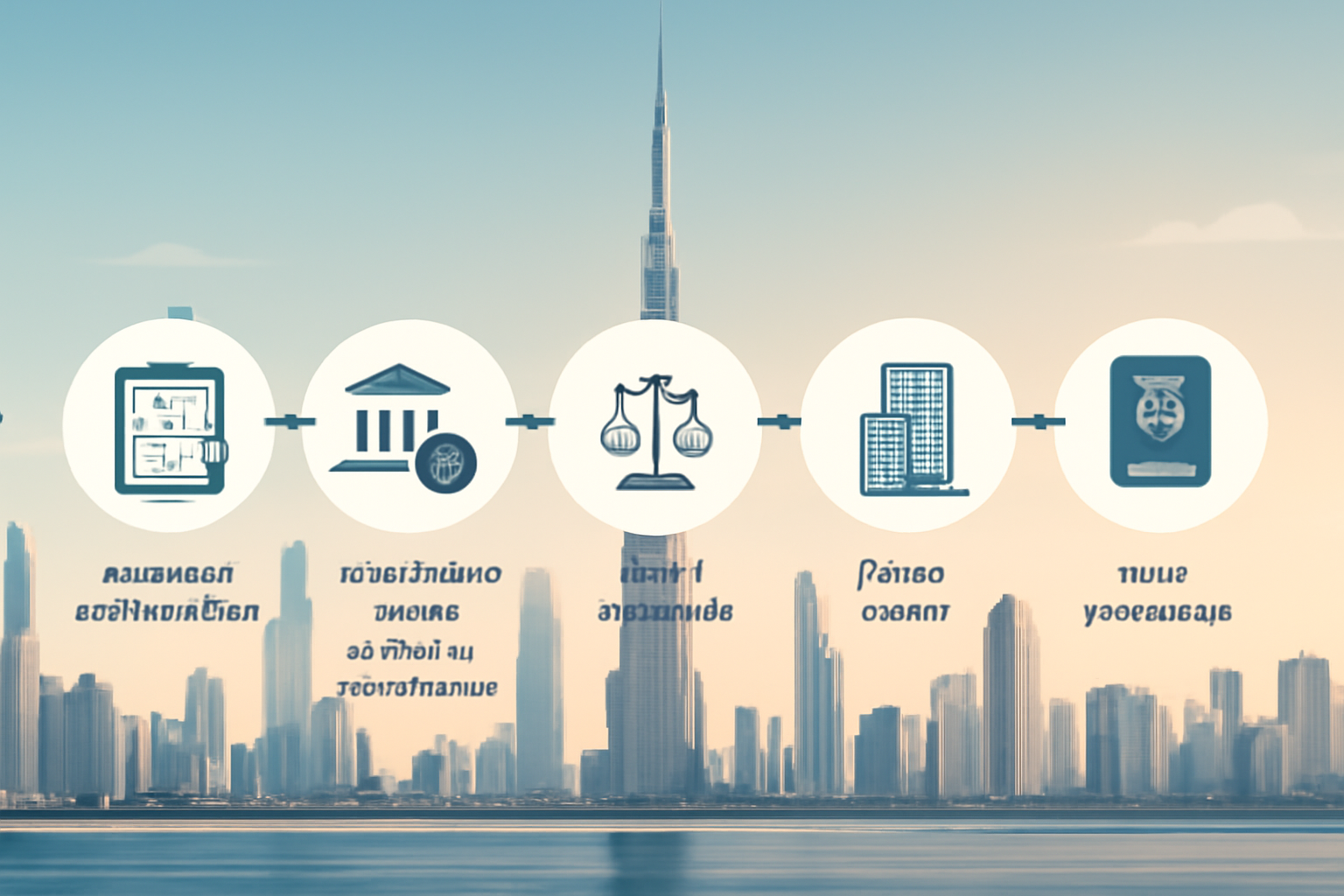
How to start a business in Dubai step by step is simpler when you break the process into seven clear stages: choose your business activity, pick a jurisdiction, reserve a company name, secure an address, submit your licence application, receive your trade licence, and apply for your investor visa. In many free zones, you can hold a trade licence within 72 hours after your documents are complete. A mainland licence usually takes five to ten working days.
This guide walks you through the exact action plan without heavy legal jargon. We focus on the decisions, fees, timelines, and compliance checks that actually affect your launch, whether you are inside the UAE or abroad.
Key Takeaways
- Dubai offers more than 2,000 business activities across commercial, professional, industrial, and tourism categories. Your chosen activity sets your licence type and future compliance.
- Mainland, free zone, and offshore jurisdictions differ in where you can trade, how many visas you get, and what office you need.
- Free zone licences start from around AED 5,750. Mainland licences usually start from AED 15,000, with additional costs for office space, visas, translation, and notarisation.
- Most trade licence applications are processed within one to five working days after your documents are complete and correctly translated.
- You can sponsor your spouse and children after your investor visa is stamped, provided you meet the minimum salary threshold.
- The most damaging DIY mistakes are choosing the wrong activity, signing a long-term lease before approval, submitting incomplete documents, and delaying your bank account application.
How to Start a Business in Dubai Step by Step: The 7-Step Action Plan
Below is the same sequence our team follows for clients launching in Dubai for the first time. Some stages move quickly. Others, especially opening a corporate bank account, need early action.
Step 1: Identify Your Business Activity and License Type
Every Dubai business starts with one activity. The Dubai Department of Economy and Tourism and free zone authorities publish searchable lists with more than 2,000 activities. You can search the official Invest in Dubai business setup portal using simple terms like “digital marketing,” “ecommerce,” or “management consultancy.”
Match the activity to the correct licence type before you move forward. A commercial licence covers trading physical goods. A professional licence covers consultancy, creative, and medical services. An industrial licence covers manufacturing and light assembly. A tourism licence covers travel and hospitality services.
You can list several related activities under one licence. A digital agency might select web design, mobile app development, and digital marketing consultancy together. Each additional activity may add a small fee, but it costs far less than a second licence.
If you are planning an online retail operation, read our How to Start an Ecommerce Business in Dubai: Full Guide. It explains payment gateways, customs codes, and warehouse options in practical detail.
Mistake to avoid: selecting an activity that sounds impressive but does not match what you actually deliver. Authorities audit companies after licensing. A mismatch can mean fines or a forced amendment. We help clients choose the exact DED or free zone activity code before submission because this decision affects everything that follows.
Step 2: Choose Your Jurisdiction – Mainland, Free Zone, or Offshore
Your jurisdiction decides who you can sell to, how many visas you receive, and what office you need. Dubai gives you three pathways.
- Mainland: A mainland licence is issued by the Dubai Department of Economy and Tourism. This jurisdiction lets you trade directly across the UAE, bid on government contracts, and operate anywhere in the country. For many commercial activities, 100% foreign ownership is now permitted without a local service agent. Your visa quota links to your office space. Choose mainland if you need a physical shop, multiple outlets, or heavy UAE B2B sales.
- Free Zone: Each free zone is a self-regulated business hub built around specific sectors. You get 100% foreign ownership, full profit repatriation, and no currency restrictions. Packages often bundle a flexi-desk and visa allocations. However, free zone companies are generally limited to business within the zone, international trade, or trade through a local distributor. Free zones suit consultants, online businesses, and export-focused traders.
- Offshore: An offshore company cannot trade physically within the UAE. People use it for holding international assets, tax structuring, inheritance planning, and trading outside the region. No UAE office is required. Common choices include JAFZA Offshore and RAK ICC.
Here is a comparison table we use with clients to make the choice clearer.
| Criteria | Mainland | Free Zone | Offshore |
|---|---|---|---|
| Foreign ownership | 100% for most activities | 100% | 100% |
| Local UAE trade | Direct, unrestricted | Via distributor or transfer | Not permitted |
| Government contracts | Yes | No | No |
| Office requirement | Ejari-registered lease or flexi-desk | Flexi-desk or office, varies by zone | Registered agent address only |
| Visa eligibility | Unlimited, tied to office size | Typically 1–6 visas, expandable | No UAE residency visa |
| Startup licence cost | From AED 15,000 | From AED 5,750 | AED 12,000–15,000 |
| Setup speed | 5–10 working days | 1–5 working days | 3–7 working days |
The right choice depends on your customer. If your revenue comes from UAE-based clients and you need direct mainland operations, choose mainland. If you operate remotely for international clients or run a lean online brand, a free zone is usually better.
For lower-cost free zone options, see our guide on the Cheapest Free Zone License in UAE With Visa: Top Picks. For a detailed fee breakdown, read UAE Freezone Company Setup Cost: 2026 Price Breakdown.
How Much Capital Do You Really Need to Start a Business in Dubai?
The licence fee is only part of your first-year budget. Many founders forget office rent, visa deposits, translation, and medical fees. Budgeting for the full first year prevents a cash crunch after the licence arrives.
| Cost component | Typical range (AED) | Notes |
|---|---|---|
| Trade licence, free zone | 5,750–15,000 | Varies by activity and visa bundle |
| Trade licence, mainland | 15,000–35,000 | Includes initial approval and sponsor service if needed |
| Trade name reservation | 700–2,000 | Higher for premium or foreign names |
| Office or flexi-desk | 3,000–8,000/year virtual/flexi; 15,000+ physical | Must be registered for mainland |
| Investor visa, per person | 3,500–7,000 | Covers entry permit, medical, Emirates ID, stamping |
| Employee visa deposit | 3,000–5,000 per person | Refundable bank guarantee, varies by jurisdiction |
| Translation and notarisation | 1,000–3,000 | Arabic translations for non-Arabic documents |
| Medical and Emirates ID | 700–1,200 | Required for each visa applicant |
| PRO or consultant fees | 2,000–6,000 | Optional but often saves time |
| Bank account opening | 0–5,000 | Some banks require minimum balance or maintenance fee |
Most free zones and mainland LLCs have no minimum capital requirement, except for certain regulated activities. A lean free zone consultancy with one visa can be fully operational for about AED 15,000–20,000 all-in during the first year. A mainland trading company with a physical shop and multiple visas can easily reach AED 40,000–60,000.
If you want to keep overhead low, a virtual office may meet your licensing requirement. Our Dubai Virtual Office Cost: Pricing and What’s Included guide explains how a registered address works without a physical lease.
You can also check the official UAE government portal for a centralised overview of starting a business in the UAE. It is a useful reference before you speak with a consultant.
A setup consultant can bundle trade name reservation, translation, notarisation, and PRO work into one fee. In our experience, that often saves 20–30% compared with paying each government department separately. It also removes the expensive mistakes that come from guessing.
Step 3: Select Your Legal Structure and Company Name
Your legal structure affects liability, shareholding, and trading rights. The main options include:
- Limited Liability Company (LLC): The most common mainland structure. Foreign ownership up to 100% is now allowed for most commercial activities. An LLC separates your personal assets from company debts.
- Sole Establishment: Used for professional services such as consultancy, medicine, or engineering. A single individual owns the business, but personal liability is unlimited.
- Free Zone Establishment (FZE) / Free Zone Company (FZC): In free zones, an FZE has one shareholder and an FZC has two or more. Both offer limited liability.
- Branch of a Foreign Company: An existing overseas entity can open a fully owned branch in Dubai. On the mainland, this may require a local service agent unless you set up in a free zone.
- Offshore IBC: Used for holding companies, asset protection, and international trade. It cannot trade within the UAE.
Company naming is stricter than many founders realise. The name must reflect your activity. It cannot include religious or political terms. It must include a legal suffix such as “LLC” or “FZE.” If you use a personal name, it must be the full shareholder name. Initials and abbreviations are not accepted. The authority rejects names that infringe existing trademarks or are considered offensive.
You submit three preferred names through the DED e-services or the free zone portal. Approval takes one to two working days. Once approved, you receive a trade name reservation certificate.
Mistake to avoid: trying to reserve a generic name like “Dubai General Trading.” It will be refused. Work with someone who knows the naming rules to get approval on the first attempt.
Step 4: Secure a Business Address and Office Space
Every trade licence requires a registered business address. The form of that address depends on your jurisdiction.
- Mainland: You need an Ejari-registered tenancy contract. Ejari is Dubai’s official tenancy registration system. This can be a physical office, shop, or warehouse. A flexi-desk in a licensed business centre also satisfies the requirement if the centre issues an Ejari-compliant lease. Flexi-desk prices start from around AED 3,000 per year.
- Free Zone: Most free zones offer flexi-desks from about AED 6,000 per year. Some zones allow virtual offices for low-risk activities. You can also lease a private office or rent land for custom-built facilities.
- Offshore: No physical UAE office is required. The registered office is the address of your registered agent, who files your annual returns.
Short-term serviced offices and co-working spaces work well for startups. They give you front-desk support, meeting rooms, and ready IT infrastructure without a long lease.
Mistake to avoid: signing a three-year commercial lease before licence approval. If your activity is refused or you need to change jurisdiction, you are locked in. Get initial approval first, or use a business centre flexi-desk that lets you upgrade later.
Step 5: Gather Documents and Submit Your License Application
Documentation is where many applications stall. You will typically need:
- Clear passport copies of all shareholders and managers, valid for at least six months
- Passport-size photographs on a white background
- UAE residence visa page, if you are already a resident
- Emirates ID, if applicable
- No-objection certificate from your current UAE sponsor if you are employed
- Business plan for certain regulated activities
- For mainland companies, a Memorandum of Association notarised by a public notary
Mainland applications follow two stages. First, you get initial approval from the DED confirming that the government has no objection to your activity. Then you submit the notarised Memorandum of Association, tenancy contract, and other supporting documents. Free zone applications are mostly paperless. You upload scanned documents, pay the fees, and wait for approval.
If you are applying from abroad, you usually do not need to be physically present for the licence stage. A setup consultant can handle document attestation and courier documents for electronic signature. Many free zones accept e-signatures, so you may not visit an immigration office until the residency visa stage.
All non-Arabic documents must be legally translated into Arabic. Translation offices provide this service, and it is often included in PRO packages. A PRO, or public relations officer, handles government department submissions on your behalf.
Processing time once documents are complete is one to five working days. If your company will sponsor employees later, you will also need an establishment card. This is a separate immigration file issued by the General Directorate of Residency and Foreigners Affairs. It connects your company to its visa quota.
For a broader roadmap on small business setup, see our How to Start a Small Business in UAE: Beginner’s Guide. If you are a foreign national, the process is explained in How to Start a Business in UAE as a Foreigner (2026).
Step 6: Receive Your Trade License and Start Trading
Once your application is approved, pay the licence fee. You receive an e-licence immediately. A hard copy follows if you request one.
Mainland companies receive a licence certificate. Free zones issue a combined licence and incorporation certificate. Now you can legally invoice clients, sign contracts, and open a bank account.
Start the bank account process early. It takes two to four weeks. If you need a physical shop or warehouse, plan the fit-out after licence issuance. Some activities allow simultaneous setup, but do not assume the rules are the same for every authority.
Mistake to avoid: waiting to start marketing. Announce your launch immediately to capitalise on momentum.
Step 7: Apply for Your UAE Residence Visa and Sponsor Family
Your investor visa is what lets you live and work in the UAE. It is usually valid for three years and is renewable.
The process follows this sequence: entry permit, status change, medical test, biometrics, Emirates ID registration, and visa stamping. You get visa quotas with your licence. Free zone packages often include one to six visas. Mainland quotas link to office space, usually one visa per 10 square metres of office space.
You can sponsor your spouse and children after your investor visa is stamped. You must meet the minimum salary threshold. The current threshold is AED 4,000 per month or AED 3,000 plus employer-provided accommodation.
The timeline from entry to stamped visa is typically seven to fourteen working days. If you invest AED 2 million or more in a company, or if you qualify as an entrepreneur, you may be eligible for a 10-year Golden Visa.
Post-Setup Must-Dos: Bank Account, Compliance, and Renewals
Trading legally is not the finish line. Your bank account, accounting, and renewals all need attention.
Opening a corporate bank account is difficult for new businesses. Free zone licences and consultant referrals help, but you should still expect a detailed review. Digital-first banks like Wio and Mashreq Neo can move faster than traditional lenders.
For accounting and VAT, register if your annual turnover exceeds AED 375,000. File VAT returns quarterly. Maintain proper books from day one.
Renew your licence before expiry. Fees are usually similar to setup. Some free zones require an auditor’s report for certain activities. Update your licence whenever you change your activity, office, or ownership. Avoid penalties by keeping your records current.
Keep a PRO on retainer or use your setup consultant for
Frequently Asked Questions About How To Start A Business In Dubai Step By Step
Can a foreigner start a business in Dubai without a local partner?
Yes, in most cases. Mainland licences now allow 100% foreign ownership for the majority of commercial activities, and all free zones and offshore jurisdictions permit full foreign ownership without a local partner. Some regulated activities may still require a local service agent.
What is the cheapest free zone in Dubai for trading license?
The article notes free zone licences start from around AED 5,750, but does not name a single cheapest trading zone. For specific lower-cost options, refer to the guide ‘Cheapest Free Zone License in UAE With Visa: Top Picks’ mentioned in the article.
How long does it take to get a trade license in Dubai?
After all documents are complete, most trade licence applications are processed within one to five working days. Free zones can issue licences within 72 hours, while mainland licences typically take five to ten working days.
Do I need to be physically present to set up a company in Dubai?
No, the process can be completed remotely if you work with a registered agent or consultant. The article states the guide is for founders inside the UAE or abroad, and documents can be submitted online. However, some steps like visa stamping and Emirates ID biometrics may require a personal visit.
Can I get a UAE residence visa if I start a business in Dubai?
Yes, after your trade licence is issued, you can apply for an investor visa and then sponsor your spouse and children, provided you meet the minimum salary threshold. Investor visa costs typically range from AED 3,500 to 7,000 per person.
What documents are required to open a corporate bank account in Dubai?
The article does not list specific documents, but it emphasises starting the bank account application early. Generally, banks require your trade licence, shareholder passports, Emirates ID, proof of registered address, and company incorporation documents.