

Choosing a business bank account is rarely about picking the most famous name on the skyline. When business owners ask us about the best banks in UAE for corporate use, the honest answer is that the right bank depends on your entity type, your transaction profile, and how well your file documents both — and the biggest brands are not automatically the easiest to onboard with. This guide compares the banks UAE entrepreneurs actually approach on the things that decide the outcome: account opening difficulty, minimum balance, fees, FX cost, digital tools, and readiness.
Key takeaways
- The “best” bank is profile-specific. A mainland trading LLC, a free zone consultancy, a freelancer and a holding structure should not be applying to the same institutions.
- FAB, Emirates NBD and ADCB are the three largest UAE banks by total assets, which supports perceived stability and correspondent banking reach — but size does not equal ease of onboarding.
- CBUAE compliance standards, not unhelpful staff, are the root cause of most slow applications and rejections.
- Digital-first banks open accounts quickly and cheaply but may lack trade finance, chequebooks or the physical presence some landlords and government entities expect.
- Most rejections trace back to a file problem: an unclear activity description, weak source of funds evidence, inconsistent documents or unrealistic turnover projections.
- Preparation changes the outcome. A consistent, credible file presented to two or three well-matched banks outperforms a scattergun approach every time.
Best Banks in UAE for Business Owners at a Glance
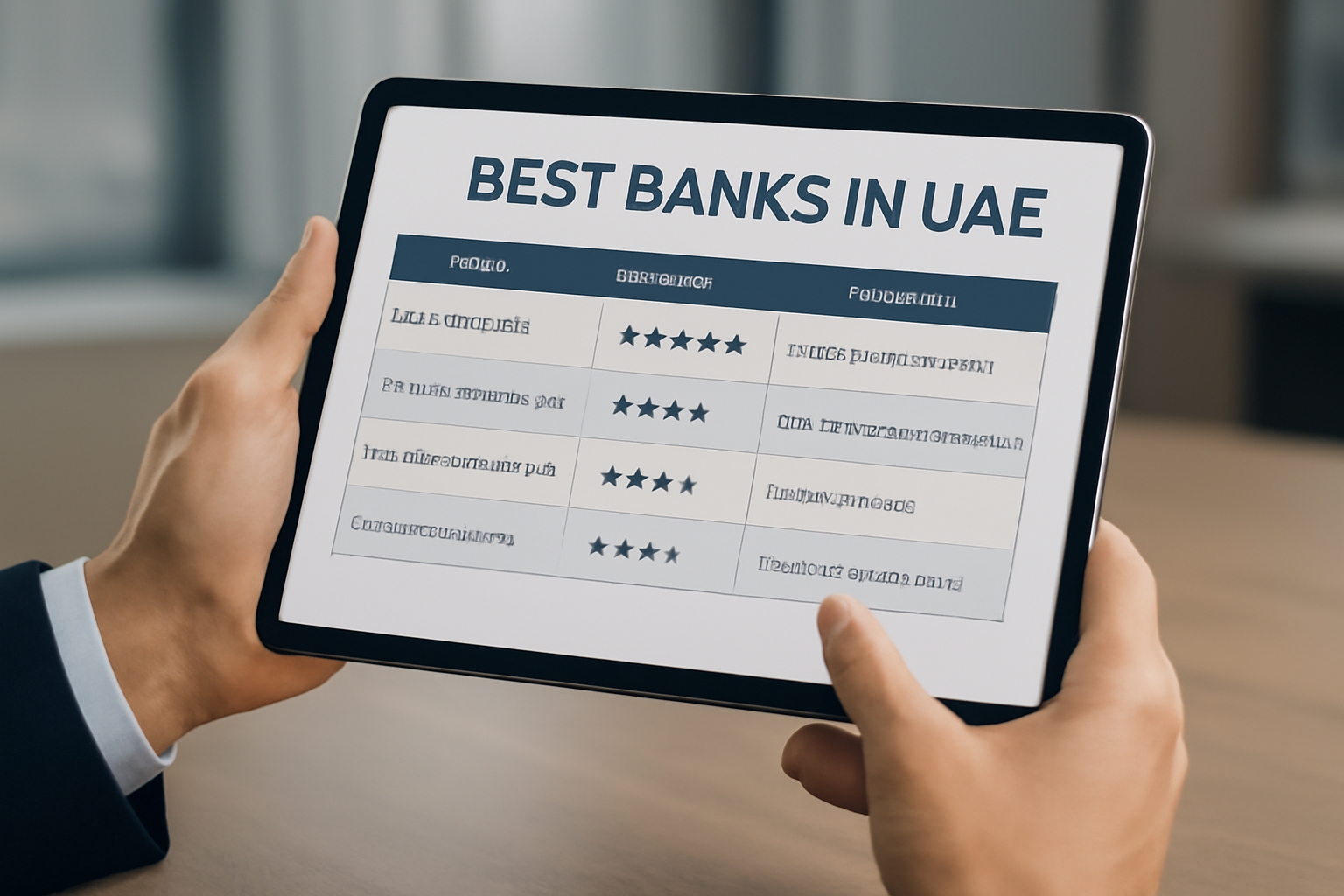
The table below compares the banks most UAE businesses actually approach. It reflects relative positioning rather than quoted figures — minimum balances, monthly fees and FX margins change with the package and with each bank’s current policy, so treat this as a shortlisting tool and confirm exact numbers directly with the bank before you apply.
| Bank | Account opening difficulty | Minimum balance (relative) | Fee structure | International transfers & FX | Digital banking | Suits best |
|---|---|---|---|---|---|---|
| Emirates NBD | Moderate to high for new or small entities; smoother for established mainland firms | Generally higher for business packages | Monthly account fees plus transaction and chequebook charges | Wide correspondent network; compare all-in FX cost, not just the fee | Strong mobile approvals and corporate online banking | Established mainland companies, larger SMEs |
| FAB | Moderate to high; compliance-led review | Generally higher | Package-based monthly fees | Broad global reach; FX margin applies on top of transfer fees | Comprehensive cash management and FX tools | Trading, import/export, larger SMEs |
| ADCB | Moderate | Generally higher | Package-based | Solid regional reach | Capable corporate platform | Mainland firms with payroll and lending needs |
| Mashreq | Moderate; known for digital onboarding | Varies by package | Tiered | Competitive regionally; verify FX margin | Strong digital-first business banking | Startups and SMEs wanting a fast digital setup |
| Dubai Islamic Bank | Moderate | Varies by package | Sharia-compliant fee structure | Regional and international coverage | Improving digital suite | Businesses seeking Islamic finance |
| ADIB | Moderate | Varies by package | Sharia-compliant | Regional coverage | Good mobile tools | Islamic banking, mainland SMEs |
| HSBC | High for smaller entities; easier for larger groups | Generally highest | Relationship-based pricing | Excellent global network and group treasury links | Global platforms | International groups, multi-country operations |
| Standard Chartered | High for small entities | Generally highest | Relationship-based pricing | Strong emerging-markets network | Global platforms | Cross-border groups, trade-heavy firms |
| RAKBANK | Lower to moderate | Lower | Competitive for SMEs | Reasonable; check the FX margin | Good app-based banking | SMEs, freelancers, cost-conscious firms |
| Wio | Lowest — app-first onboarding | Low | Transparent, low-fee | Standard; limited trade products | Excellent, fully digital | Freelancers, free zone consultancies, e-commerce |
FAB, Emirates NBD and ADCB are the three largest banks in the UAE by total assets: the data cited by Wise ranks FAB first at AED 1.21 trillion, Emirates NBD second at AED 1.164 trillion and ADCB third at AED 653 billion. That scale matters for perceived stability and for correspondent banking reach. It does not mean they are the easiest institutions to open a business account with.
This is why rankings alone are not a decision. A mainland LLC with physical premises, staff and two years of audited accounts is a different proposition from a brand-new free zone company operating from a flexi-desk. The first will be welcomed by most banks on this list. The second needs a bank whose risk appetite actually matches its stage — and that is a much shorter list.
How UAE Banks Are Regulated (and Why It Affects Your Business Account)
Banks operating across the UAE are regulated by the Central Bank of the UAE (CBUAE), which sets the compliance standards your account application is assessed against. The Dubai Financial Services Authority (DFSA) is a separate regulator that covers only institutions based within the Dubai International Financial Centre (DIFC) free zone, not the wider UAE banking system. Both points are confirmed in the same Wise overview.
The practical implication is simple. A DIFC-based bank or branch follows a different rulebook than a mainland bank. That affects the documentation they ask for, the products they can offer, and in some cases who they are willing to onboard at all. If you hold a DIFC entity, you are not shopping in the same market as a company licensed in Deira or Sharjah.
Why does this matter to you day to day? Because strict CBUAE compliance expectations are the root cause of most slow applications and rejections — not bank staff being unhelpful. When a relationship manager asks for a second round of documents, a clearer explanation of source of funds, or evidence of a real trading relationship, they are applying a framework they cannot waive. Understanding that turns a frustrating process into a checklist you can complete.
Local Heavyweights vs International Banks: Which Fits Your Business?
Local heavyweights
FAB, Emirates NBD, ADCB, Mashreq, Dubai Islamic Bank, ADIB and RAKBANK offer strong AED and multi-currency coverage, wide branch and ATM networks, local payment rails, and products built around UAE trade and working capital needs.
FAB is a useful illustration of how broad a local bank’s business offering can be. For business customers, FAB offers accounts, cards, loans, trade and working capital solutions, FX services and cash management tools, according to Wise’s bank guide. That breadth — banking, credit, trade and FX in one relationship — is exactly why many mainland companies start local and stay local.
International names
HSBC, Standard Chartered and similar institutions are attractive if you need multi-country banking, global correspondent relationships or group treasury links. Be realistic about the trade-off: they typically expect higher minimum balances and apply a stricter risk appetite to smaller or newly formed entities. For a startup, an international bank is often a later-stage relationship, not a first account.
Digital-first options
Digital-first banks such as Wio offer fast onboarding and low fees, and for many freelancers and service businesses that is genuinely the right answer. What they may lack is trade finance, chequebook facilities, and the physical presence some landlords and government entities expect when they ask for a bank reference or a standing order mandate.
Decision guide by profile
- Startups and freelancers: a digital-first account for day-one operations, with a local bank added as turnover grows.
- Mainland trading companies: a local heavyweight with trade finance and FX capability.
- Free zone consultancies: mid-tier local banks and digital-first options, where the account is straightforward and the volume is modest.
- E-commerce sellers: a bank comfortable with marketplace settlements and multicurrency collections; if you are licensing this activity, our breakdown of E Commerce License Dubai cost covers the permit side.
- Import/export businesses: trade finance, letters of credit and documentary collections belong with a bank that does this daily.
- Holding or investment structures: fewer banks will onboard these, and the ones that will expect a well-explained ownership chain. Our guide to how to set up an offshore company in the UAE for trading explains how these structures are commonly built.
What Free Zone and Mainland Companies Need Before Applying
Mainland company checklist
- Valid trade licence
- Memorandum and Articles of Association
- Establishment card (the immigration file that lets your company sponsor visas)
- Shareholder and manager passports and residence visas
- Emirates ID copies for all signatories
- Proof of address — tenancy contract or equivalent
- Often a minimum share capital or deposit requirement, depending on the bank
If you are setting up the mainland entity itself, our step-by-step guide to how to get an instant license in Dubai mainland walks through the licence stage, and this Arabic walkthrough on كيفية بدء عمل تجاري في دبي خطوة بخطوة covers the wider sequence.
Free zone company checklist
- Free zone trade licence
- Certificate of incorporation
- Share certificates
- Board resolution authorising account signatories
- For some banks, a physical office or flexi-desk lease rather than a virtual address alone
Documents every applicant should expect to provide
Beyond the corporate paperwork, expect to explain your business in plain language: a business profile or activity description, expected turnover and transaction volumes, source of funds and source of wealth evidence, supplier and customer information, and sometimes a business plan. These are the sections where applications are won or lost.
Ownership and residency factors
Some banks are more comfortable with UAE-resident shareholders. Foreign ownership structures may need additional corporate documents, attested and translated where required. If you are opening a company remotely, the Arabic guide هل يمكنني فتح شركة في دبي من الخارج؟ نعم، إليك الطريقة explains how that works, while Remote Work Visa Dubai Requirements: Documents & Process is useful if you are banking as an individual professional before your company is formed.
Why a virtual office can trigger extra scrutiny
A virtual office is legitimate, but banks read it as a risk signal when it is presented without context. If that is your setup, say so clearly, explain where the team actually works, and show that your licence allows the activity you are conducting. Hiding it and hoping nobody asks is the fastest route to a declined application.
Account Opening Ease, Minimum Balance and Fees Compared
Minimum balances across UAE business accounts sit in tiers, and the consequence of falling below the threshold is usually a monthly charge rather than a frozen account. On top of that you should budget for account maintenance fees, chequebook charges, minimum transaction activity requirements, and dormant account penalties if your activity drops for an extended period. Confirm the current numbers for the specific package you are being offered — they are revised regularly.
International transfer cost is where comparisons genuinely pay off. As the Wise guide notes, some UAE banks may charge significant fees on international transfers and may build a margin into the exchange rate itself rather than just charging an upfront fee. That distinction matters enormously. A headline “low transfer fee” can be far more expensive than a slightly higher fee with a tighter FX margin. Always ask for the all-in cost: the fee plus the rate you are actually getting.
Digital banking tools worth evaluating before you commit:
- Mobile payment approvals for authorised signatories
- Bulk payments and WPS payroll files, which should align with your MOHRE obligations on wages and registration
- API and accounting software integrations, so reconciliation is not manual
- Virtual account management for separating client funds or project income
- Multi-user access controls with clear permission levels
Timelines are best understood as ranges. Digital-first accounts can move within days. Mid-tier local banks usually take longer, and large national or international banks take longer still because of the depth of their compliance review. A complete file, a clearly defined activity and a shareholder who responds to queries the same day will always move faster than one that generates follow-up questions.
How Long Does It Take to Open a Business Bank Account in the UAE?
The honest answer is that the bank’s logo matters less than the state of your file. Typical stages look like this: submission, KYC and compliance review, sometimes a site visit or in-person interview, then account activation and cheque book issuance.
What actually drives the timeline:
- Completeness of the file — every missing document resets the clock.
- Clarity of the business activity — a description that matches your licence exactly clears review faster.
- Shareholder residency status — UAE-resident signatories are generally simpler to verify.
- Your response speed — compliance queries answered within hours often save days.
One mistake we see repeatedly: applying to several banks at once with slightly different documents. Banks share risk signals more than most applicants realise, and inconsistent paperwork across simultaneous applications makes every one of them harder to approve. Sequence your applications deliberately instead.
Common Reasons Business Bank Account Applications Get Rejected
- An unclear or high-risk activity description that does not match the trade licence wording.
- Vague source of funds and source of wealth explanations. “Savings and business income” is not an answer.
- Missing, expired or inconsistent documents across the licence, establishment card, visas and Emirates IDs.
- Shareholder or signatory profiles outside the bank’s risk appetite, which can include certain nationalities, jurisdictions or complex ownership layers.
- Unrealistic projected turnover, no demonstrable trading history, and no suppliers or customers to point to.
- Business address problems — a virtual office with no physical presence, or a licensed activity the bank simply does not finance.
After a rejection, the priority is not to apply somewhere else immediately. It is to find out what failed, fix it, and only then approach a bank whose appetite genuinely matches your profile. Repeated failed applications create a pattern that is harder to unwind than a single decline. If you are starting from scratch, the Arabic guide كيف تبدأ مشروعاً صغيراً في الإمارات: دليل المبتدئين is a helpful primer on getting the fundamentals right first.
How Al Ain Business Center Prepares Your Bank File to Improve Approval Odds
We start with your profile, not with a bank name. We review your licence, activity, ownership structure and expected transactions, then shortlist the two or three institutions most likely to approve your specific case.
From there, we prepare the file:
- Document assembly and cross-checking of the full KYC pack, so the names, dates and activity descriptions agree across every page.
- A clear business profile and activity description, written in the language compliance teams expect to read.
- Source of funds and source of wealth explanations, articulated properly rather than left to a one-line answer.
- Turnover and transaction expectations calibrated to be credible for your activity and stage, not aspirational.
- Introductions and follow-through with bank relationship managers, including responding to compliance queries and managing the process through to account activation.
- Supporting services that strengthen the file — trade licence setup, visa processing, virtual office, and accounting and auditing support, so your financials look consistent from day one.
We work with transparent AED pricing and keep full ownership of your company in your hands. And we will always be straight with you: preparation improves your odds and reduces delays, but final approval rests with the bank’s compliance team. No intermediary can override that, and anyone who promises otherwise is selling you something they cannot deliver.
Which UAE Bank Should You Choose? A Simple Decision Framework
Step 1 — Define your banking need. Local AED payments, international transfers, trade finance, payroll, e-commerce collections or multi-currency treasury. Your primary need should determine your primary bank.
Step 2 — Match your entity type. Mainland, free zone or freelancer, and whether you can comfortably maintain the bank’s minimum balance.
Step 3 — Weigh cost of ownership, not just account fees. The FX margin on international transfers frequently outweighs the headline maintenance fee.
Step 4 — Check digital fit. Accounting integrations, mobile approvals and multi-user access matter more than branch proximity for most SMEs.
Step 5 — Prepare before you apply. A complete, consistent and credible file matters more than which bank you pick.
A practical suggestion: run a primary account with a local bank for operations, payroll and local payments, and consider a second account or a digital alternative for international transfers if your FX volumes are high. Splitting your banking this way is normal, not disloyal.
Checklist: Before You Apply to Any UAE Bank
- Licence, incorporation documents and establishment card — valid and consistent across every document
- Shareholder and signatory passports, visas and Emirates IDs, with attested documents where required
- Business profile, expected turnover, supplier and customer details, and source of funds evidence
- Proof of business address acceptable to the bank — confirm this before you apply if you use a virtual office
- A shortlist of two to three banks matched to your entity type, rather than a scattergun approach
Start Your Application From a Position of Strength
The difference between a smooth account opening and a frustrating one is almost never the bank you chose. It is the quality of the file you handed over. When your documents agree, your activity is clearly described and your numbers are credible, you give the compliance team everything they need to say yes — and you stop losing weeks to avoidable back-and-forth.
If you would like a second pair of eyes on your profile before you approach a bank, our team can review your documents, recommend the banks that genuinely fit your business, and manage the process from first introduction to account activation. Book a free consultation with Al Ain Business Center and let us prepare your file properly the first time.
Frequently Asked Questions About Best Banks In Uae
Which bank is best for a business account in the UAE for a free zone company?
There is no single best bank — the right choice depends on your entity type, activity and transaction profile. For free zone consultancies with straightforward, modest volumes, mid-tier local banks and digital-first options such as Wio are commonly a good fit, because onboarding is simpler and fees are lower. A mainland trading LLC or a holding structure should be looking at a different set of institutions entirely.
What is the minimum balance for a business bank account in Dubai?
UAE business account minimum balances sit in tiers rather than a single figure, and they change with the package and each bank’s current policy. Generally, accounts with Emirates NBD, FAB, ADCB, HSBC and Standard Chartered sit at higher relative thresholds, while RAKBANK and Wio sit lower. Falling below the required balance usually triggers a monthly charge rather than a frozen account, so confirm exact numbers directly with the bank before applying.
Why do UAE banks reject business account applications?
Most rejections trace back to a file problem rather than an unhelpful bank: an unclear activity description, weak source of funds evidence, inconsistent documents or unrealistic turnover projections. Strict Central Bank of the UAE compliance standards are the root cause of most slow applications, and relationship managers cannot waive them. A consistent, credible file presented to two or three well-matched banks performs far better than a scattergun approach.
Can a foreigner open a business bank account in the UAE without residency?
Some banks are more comfortable with UAE-resident shareholders, so foreign-owned structures can face a higher bar. Foreign ownership structures may need additional corporate documents, attested and translated where required, and the article notes that opening a company remotely is possible. Your outcome will depend on how well the ownership chain and source of funds are documented for the specific bank.
Do I need a physical office in the UAE to open a corporate bank account?
Not always. Some banks accept a physical office or a flexi-desk lease rather than a virtual address alone, so requirements vary by institution. A virtual office is legitimate, but banks read it as a risk signal when it is presented without context — so state it clearly, explain where the team actually works, and show that your licence covers the activity you are conducting.
Still have a question?
Every situation has its own details. Tell us what you are planning and we will come back to you with the specifics for your case.
Related articles
 Banking
 Banking
 Banking
 Banking
Latest guides
- ID Card Status UAE: Check Emirates ID Online 2024
- 2-Year Residence Visa Renewal UAE Cost: 2026 Fee Breakdown
- Set Up a Company in UAE: Your Step-by-Step Roadmap
- Housemaid Visa Abu Dhabi: Cost, Steps and Requirements
- Green Visa UAE: Requirements, Costs and How to Apply
- UAE Visit Visa Categories for Technology & AI Talent