
So, you're thinking about jumping into Dubai's real estate scene? It's a fantastic ambition, but before you start picturing yourself closing multi-million dirham deals, there are a few essential boxes you need to tick. To even get your foot in the door, you must be at least 21 years old, hold a valid UAE residence visa, and, most importantly, pass the RERA certification exam.
This path isn't just a simple sign-up process. It involves mandatory training to get you up to speed, a formal licensing application, and then finding a registered brokerage to hang your hat. Only then can you legally operate in what is easily one of the most exciting and fast-paced property markets in the world.
Your Gateway to Dubai’s Booming Real Estate Market
Dubai’s property market is more than just a local industry; it's a global magnet for investment, pulling in ambitious professionals from every corner of the planet. This isn't just a random boom. The city's relentless growth is powered by smart government strategies designed to attract foreign capital, plus a steady stream of international buyers looking for luxury, stability, and great returns.
But let's be real—while the gleaming skyscrapers and high-figure deals look great on Instagram, a successful career here is built on sheer grit. It demands a high-energy work ethic, resilience, and the street smarts to navigate a fiercely competitive arena. Ultimately, your success will boil down to how well you can build relationships and how deeply you understand the market's pulse.
Understanding the Opportunity
The earning potential is massive, no doubt. But it's almost entirely commission-based, which means your income is directly tied to the deals you close. If you're new to the game, be prepared for an initial grind. You'll need patience and a solid financial cushion—enough to cover your living expenses for at least six to nine months while you build your client base.
Beyond the money, a real estate career in Dubai offers a lifestyle you won't find anywhere else. You'll be working with a diverse, international clientele and showcasing some of the most incredible properties on earth. It's a fast-paced profession that puts you right at the heart of Dubai's economic engine. For a deeper dive into how the market is structured, you might want to check out our guide covering the introduction to the Dubai property market.
A career in Dubai real estate is a high-stakes, high-reward venture. Your success is not just about selling property; it's about selling a lifestyle and building trust with clients from every imaginable background.
What It Takes to Succeed
Just getting your license doesn't guarantee success. You need the right mindset and a very specific set of skills to thrive here.
- Networking Prowess: Your network is your net worth. Seriously. Building solid connections with developers, investors, and other agents is absolutely critical.
- Market Knowledge: You have to live and breathe the market. Stay on top of pricing trends, new project launches, and any regulatory shifts. Market reports and analyses are your best friends for advising clients, especially as transaction volumes and investment forecasts change.
- Tenacity: This market is tough. You'll face rejection and run into roadblocks. It's just part of the job. The agents who make it are the ones who don't give up.
Before we dive deeper into the step-by-step process, let's quickly summarise the foundational requirements. Think of this as your initial checklist to see if you're ready to start this journey.
Core Requirements for a Dubai Real Estate Agent at a Glance
| Requirement Category | Key Details |
|---|---|
| Minimum Age | You must be 21 years old or older to apply. |
| Legal Status | A valid UAE Residence Visa is non-negotiable. This is often sponsored by the real estate company you join. |
| Educational Prerequisite | A high school diploma or an equivalent qualification is the minimum requirement. |
| Mandatory Training | You must complete the Certified Training for Real Estate Brokers course from the Dubai Real Estate Institute (DREI). |
| Licensing Exam | Passing the RERA (Real Estate Regulatory Agency) examination is the final step to certification. |
| Police Clearance | A Certificate of Good Conduct from Dubai Police is required to prove a clean criminal record. |
Meeting these core requirements is your first major milestone. Once you have these sorted, you can move on to the more detailed steps of training, examination, and finding the right brokerage to launch your career.
Getting Legal: Your Visa and Company Setup
Before you even start dreaming about closing your first big deal, we need to talk about the serious stuff: your legal status in the UAE. This is the bedrock of your entire career here. Getting your visa and business structure sorted isn't just a box to tick; it's the foundation that determines how you can legally operate as a real estate agent in Dubai.
You’ve got two main roads you can go down. The most well-trodden path is getting an employment visa sponsored by an established real estate brokerage. The other, more independent route, involves setting up your own company to secure an investor or freelance visa. Let's break down what each one really means for you.
The Brokerage Route: Getting Sponsored
For most people breaking into the Dubai market, joining a reputable brokerage is the most direct way in. The company sponsors your employment visa and essentially takes care of the mountain of paperwork for you. Their Public Relations Officer (PRO) will be your guide, navigating the applications for your Emirates ID and residency. It simplifies things massively.
This path is perfect if you want to hit the ground running and focus entirely on selling properties, not on the admin of running a business. You'll operate under their trade license, which means your legal status is directly tied to your employment with them.
The Independent Route: Setting Up Your Own Shop
Got more of an entrepreneurial streak? Maybe you're picturing your own brand on those "For Sale" signs one day. If that’s you, then forming your own company in a free zone or on the mainland is the way to go. This gives you total control, allowing you to sponsor your own visa and maybe even sponsor others as you grow.
This quick flowchart lays out the very first decision points on your journey.
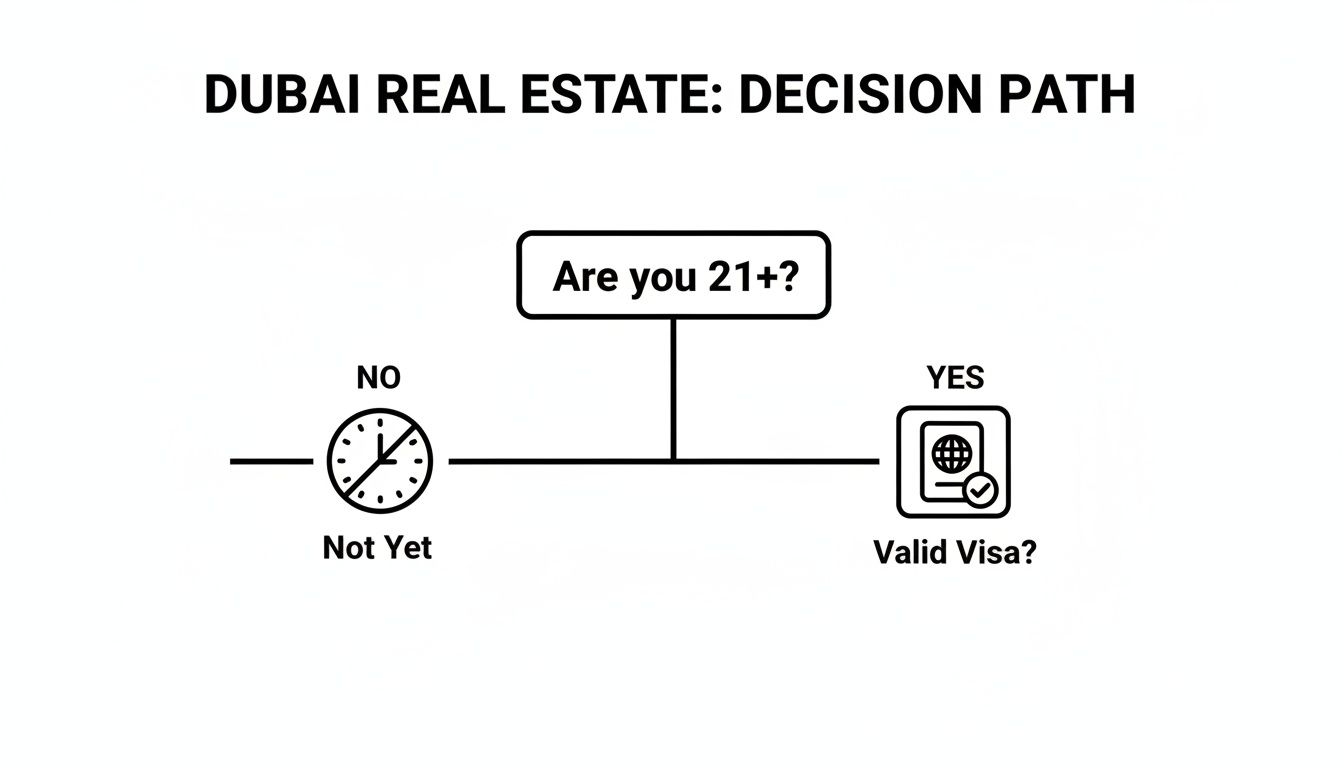
As you can see, being the right age and having a valid visa are the absolute first hurdles. Only then can you move on to getting your RERA certification.
This choice—employment visa versus your own company—is arguably the biggest business decision you'll make at the start of your career. One offers immediate structure and simplicity. The other gives you ultimate freedom and control over your future.
If you're leaning towards the independent route, you need to get familiar with the details. It involves picking a business activity, registering a trade name, and applying for the right license. For a step-by-step guide, check out our deep dive on how to register a company in Dubai.
A Tale of Two Agents: Comparing Your Options
Let's paint a picture. Imagine an agent who joins a big international brokerage. They get instant access to a massive database of listings and a full support team, but they have to work within the company's commission structure and rules.
Now, picture another agent who sets up their own freelance company in a free zone. They have the freedom to set their own commission, build their own brand, and work their own hours. But, they're on the hook for all the setup costs and have to manage every bit of the admin themselves.
Here’s a quick breakdown of the key differences:
- Upfront Cost: An employment visa costs you very little personally, as the company foots the bill. Setting up your own company can run you anywhere from AED 15,000 to AED 25,000 or more.
- Freedom: With your own company, you're the boss. You make all the decisions about your brand and how you operate.
- Support System: A brokerage comes with a built-in safety net—admin support, marketing materials, and a team to bounce ideas off.
At the end of the day, the right path is all about your personal goals, your financial situation, and just how much of a captain you want to be of your own ship.
Getting Your RERA Certification to Legally Operate
Once your visa and legal status are sorted, it's time for the most critical step: earning your official license to operate. This isn't just a piece of paper; it's the key that unlocks your entire career in Dubai real estate.
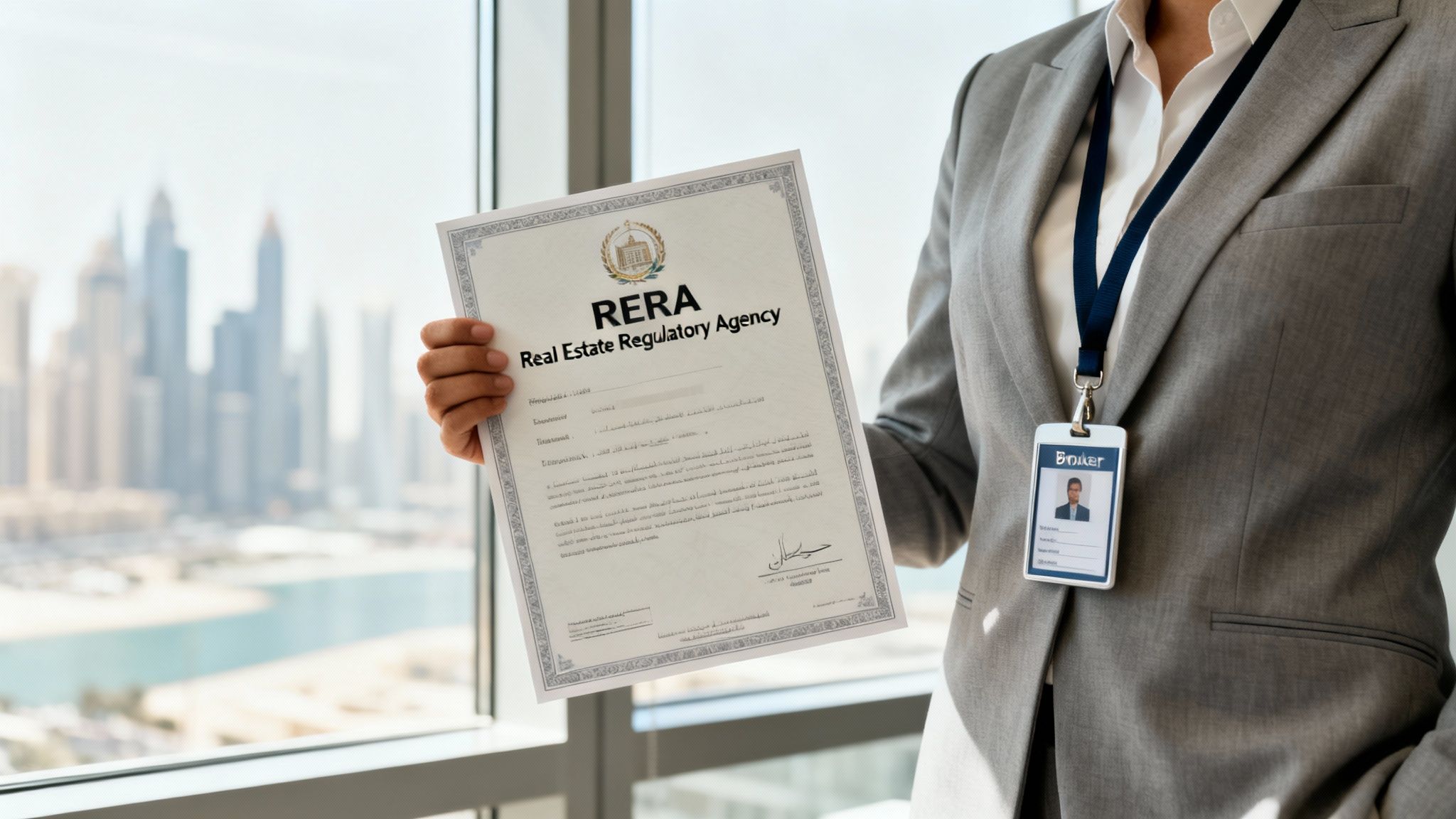
To work as a real estate agent here, you absolutely must be certified by the Real Estate Regulatory Agency (RERA). This certification is your proof that you understand the market’s laws, ethics, and procedures.
Think of the RERA certification as your professional passport. Without it, you can't legally list properties, represent clients, or earn a single dirham in commission. The entire process is managed through the Dubai Real Estate Institute (DREI), the official training arm of the Dubai Land Department.
Enrolling in the Mandatory DREI Training
Your journey to certification kicks off with the mandatory Certified Training for Real Estate Brokers course at DREI. This is a foundational programme designed to get you up to speed with Dubai’s complex property market. You simply cannot sit for the RERA exam without completing this course first.
The training usually spans four to five days and is an intensive deep-dive. Come prepared to absorb a lot of information quickly.
Here’s a snapshot of what the course covers:
- UAE Real Estate Law: The legal framework that governs every property deal.
- Professional Ethics: The non-negotiable code of conduct for every agent.
- Sales and Leasing Processes: Mastering the contractual steps for both buying and renting.
- Dubai Land Department Procedures: Getting familiar with official government processes and systems.
Expect to invest around AED 3,000 to AED 4,000 for the DREI course. This fee covers your training materials and gets you ready for the final examination.
Preparing for and Passing the RERA Exam
With your DREI training complete, the next hurdle is the RERA exam itself. This is where you prove you’ve truly grasped the material. The exam is typically a multiple-choice test with about 100 questions, and you'll need a score of at least 60% to pass.
Don't underestimate this test. I've seen many aspiring agents fail on their first attempt because they didn't prepare properly. The questions get very specific, covering legal articles, contractual obligations, and tricky ethical scenarios.
Pro Tip: Don't just memorise facts from the course. Focus on understanding the why behind the rules. This approach will help you reason through tough exam questions and, more importantly, handle real-world client situations with confidence later on.
Receiving Your Broker Card and Starting Your Career
Passing the exam is a huge milestone! With your results in hand, you can apply for your official Real Estate Broker Card from the Dubai Land Department (DLD). This card is your license to practise.
To finalise everything, you'll need to pull together a few documents:
- A copy of your passport and residence visa
- Your Emirates ID
- The RERA exam pass certificate
- A Certificate of Good Conduct from Dubai Police
Once approved, RERA will issue your Broker Card. This ID contains your unique Broker Registration Number (BRN) and is definitive proof that you are a licensed, legitimate agent. You're now officially ready to join a brokerage and start your journey.
If everything goes smoothly, the entire process—from starting the DREI course to getting your card in hand—can take anywhere from four to eight weeks.
Finding the Right Brokerage and Building Your Network
Passing your RERA exam is a huge milestone, but the real work starts now. In Dubai, your license has to be linked to a registered brokerage. You can't legally operate on your own, which makes choosing your agency one of the single most important decisions you'll make in your new career.
This isn't just about getting a desk and a phone. The brokerage you join provides the foundation—the resources, the culture, the reputation—that will either propel you forward or become a major roadblock. Your first network, your access to leads, and the quality of your training all hinge on this choice.
Large International Brands Versus Boutique Local Firms
Right off the bat, you'll face a big decision: do you go with a globally recognised real estate brand or a smaller, local boutique firm? They each offer a completely different experience.
The big international names bring instant credibility. Walking into a client meeting with a well-known brand behind you can be a massive advantage. These companies usually have well-defined training programmes, serious marketing muscle, and a massive database of properties and contacts. It’s a great environment for new agents who want structure and a clear ladder to climb.
On the flip side, boutique agencies have their own unique appeal. You’ll often find a much closer-knit, collaborative atmosphere where you can get direct mentorship from the top agents in the office. The commission splits can sometimes be better, and there’s often more freedom to build your own personal brand without being constrained by corporate rules.
The best brokerage for you boils down to your personality and what you want to achieve. Ask yourself: Do I need the structure and brand power of a large firm, or do I prefer the agility and personal touch of a smaller one?
Critical Questions to Ask Potential Employers
When you start interviewing, remember this is a two-way street. You are interviewing them just as much as they are interviewing you. Your mission is to find out what it's really like to work there day in and day out.
Don't leave without asking these questions:
- Commission Splits: Get the full breakdown. Is it a fixed percentage, or does it increase with your performance? Are there desk fees, marketing contributions, or any other hidden costs?
- Lead Generation: How are leads handed out? Do new agents get a fair shot at quality leads, or are you thrown in the deep end and expected to generate everything yourself from day one?
- Training and Mentorship: What does the onboarding actually look like? Is there any ongoing training, and will you be paired with a senior agent who can show you the ropes?
- Marketing Support: What marketing resources do they actually provide? Crucially, do they cover the listing fees on major portals like Bayut and Property Finder, or does that come out of your pocket?
- Company Culture: Ask about the team environment. Is it a cut-throat, every-agent-for-themselves culture, or is it collaborative where people help each other succeed?
The Art of Networking in Dubai
Dubai’s property market is built on one thing: relationships. Your success will be directly tied to how well you can build and nurture your network. While some agents might eventually explore options like a freelance visa in Dubai for more independence, your network will always be your most powerful asset, no matter your setup.
Start building connections from the moment you decide to enter the industry. Polish your LinkedIn profile until it screams "Dubai property specialist." Make it a point to attend industry events, open houses, and new property launches. Every single conversation is a chance to find a client, meet a future collaborator, or learn something invaluable. These powerful alliances are the true bedrock of your future success as a real estate agent in Dubai.
Mastering the Skills and Tools of a Top Dubai Agent
Getting your RERA license is like being handed the keys to a high-performance car. But to actually win the race in Dubai's property market, you need to know how to drive it. Thriving here isn't just about sales skills; it’s about a specific blend of cultural awareness, tech fluency, and deep market knowledge that sets the top earners apart.
This isn't a market for generic sales pitches. You have to understand the nuances of a truly global clientele. One morning, you could be dealing with an investor from Singapore who only cares about the ROI on an off-plan villa. That afternoon, you might be helping a family from Germany find the perfect community vibe in a ready apartment. Each client has a unique set of expectations, and your ability to adapt is everything.
Developing Your Dubai-Specific Skill Set
To really make your mark, you need to become an expert on the products and processes that are unique to this city. This isn't just a "nice-to-have"—it's fundamental to building the trust you need to close deals. Clients in Dubai are savvy, well-researched, and have endless options.
Here are the core skills every top agent I know has mastered:
- Off-Plan Property Expertise: You absolutely have to get your head around the world of off-plan. This means understanding everything from complex developer payment plans to explaining the legal safeguards offered by the Dubai Land Department.
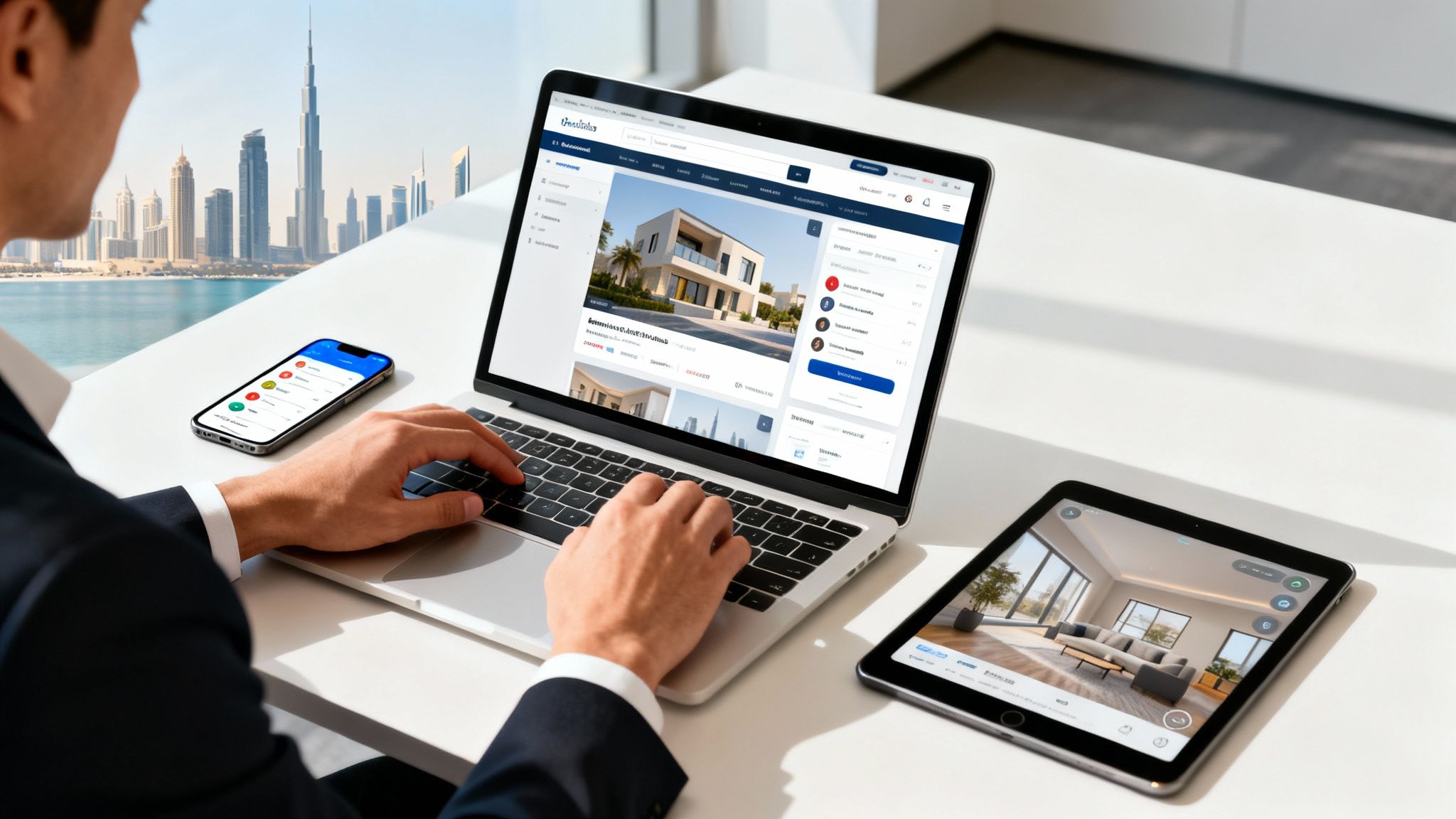
- Virtual Tour Proficiency: A huge chunk of your buyers will be international. Mastering high-quality virtual tours and slick video walkthroughs is no longer optional. It's your single most important tool for engaging clients who can't be here in person.
- Cultural Intelligence: Dubai is a true melting pot. Being able to read the room, adapt your communication style, and understand different negotiation tactics is a massive competitive edge.
The agents who really succeed don't just sell properties; they become trusted advisors. They instinctively know that a client from London has different concerns than one from Mumbai, and they tailor their entire approach to match.
Building Your Essential Tech Stack
In today's market, your smartphone and laptop are your most valuable assets. The right technology doesn't just make you more organised; it gives you the power to handle more clients, generate better leads, and close deals faster. Trust me, your competition is already using these tools.
A modern agent’s tech stack should include, at a minimum:
- CRM System: A Customer Relationship Management (CRM) tool is your second brain. It's where you track every lead, conversation, and follow-up, making sure no opportunity slips through the cracks.
- Property Portal Mastery: You need to become a power user on platforms like Bayut and Property Finder. This goes beyond just posting a listing. It means knowing their algorithms, digging into their analytics, and using their marketing tools to get your properties seen by the right people.
- Social Media Presence: Platforms like Instagram and LinkedIn are non-negotiable now. They are incredibly powerful for building your personal brand, showcasing your best properties, and connecting directly with buyers and sellers.
When you combine deep local knowledge with the right digital tools, you stop being just another agent. You become a go-to market specialist. That's the real formula for building a long-term, successful career in Dubai real estate.
Answering Your Big Questions About a Dubai Real Estate Career
Jumping into Dubai's fast-paced property market is a big move, and it's only natural to have some major questions. Before you take the leap, you need honest, straightforward answers about what this career really looks like on the ground.
Let's break down some of the most common things aspiring agents ask.
How Much Can I Realistically Earn?
This is always the first question, and for good reason. Your income will be almost entirely commission-based, which means there’s no steady salary to fall back on. A typical commission in Dubai is 2% of the property’s sale price. That 2% is then split between the buyer's agent and the seller's agent, and each of them has to share their piece with their brokerage.
So, what does that mean for a new agent? Your first year is all about building your network and learning the ropes, not making a fortune. A realistic income might fall somewhere between AED 100,000 to AED 250,000, but this number can swing wildly depending on your own hustle, your connections, and how the market is performing.
The most critical takeaway here? You absolutely must have enough savings to cover all your living expenses for at least six to nine months. The commissions will come, but not overnight.
What Qualifications Do I Need?
The good news is you don't need a university degree in real estate to get your foot in the door. The core requirements are actually quite simple:
- You have to be at least 21 years old.
- You must hold a valid UAE residence visa.
- You need to get the mandatory RERA certification.
This certification is the one non-negotiable qualification. You earn it by taking a course at the Dubai Real Estate Institute (DREI) and passing their official exam. While that's the only formal training required, any background you have in sales, marketing, or business will give you a massive advantage right from day one.
It is illegal to work in any capacity, including real estate, on a tourist visa. Trying to do so can result in serious penalties, including huge fines and even deportation. Your entire career must be built on the solid foundation of a valid residence visa.
What Are the Initial Setup Costs?
Getting your career off the ground involves a few upfront costs you’ll need to budget for. The DREI course and the RERA exam together will run you about AED 3,000 – AED 4,000.
After that, the costs for your visa and Emirates ID can range anywhere from AED 5,000 to AED 15,000+. This depends on whether you're being sponsored by a brokerage or going through the process of setting up your own company. You’ll also want to set aside funds for things like initial marketing, transportation, and a professional wardrobe.
But honestly, the biggest "cost" isn't an invoice—it's having that financial safety net to support yourself before the commissions start flowing.
Figuring out the legal requirements for your visa and business setup can be the most confusing part of the whole process. For expert help securing the right license and visa, trust Al Ain Business Center to manage every detail perfectly. Check out our services at https://alainbcenter.com to make sure your career starts on a solid, legal footing.
Related articles
 Business Setup
 Business Setup
 Business Setup
 Business Setup
 Business Setup
 Business Setup
Latest guides
- 2-Year Residence Visa Renewal UAE Cost: 2026 Fee Breakdown
- Housemaid Visa Abu Dhabi: Cost, Steps and Requirements
- Green Visa UAE: Requirements, Costs and How to Apply
- UAE Visit Visa Categories for Technology & AI Talent
- Business Visa in UAE 2026: Types, Costs and How to Apply
- Visa-Free Countries for UAE Residents With Pakistani Passports