
Thinking about starting a business in the UAE? The first steps involve picking a jurisdiction (either Mainland or Free Zone), choosing a legal structure for your company, getting the right trade licence, and then sorting out your visa and bank account. The whole system is built for speed, with plenty of government support and professional services ready to help you get off the ground quickly.
So, Why Launch Your Business in the UAE Right Now?
Have you ever wondered what makes the United Arab Emirates such a hotspot for entrepreneurs from all over the world? It’s not just about the incredible skylines and luxury lifestyle; it's the result of a deliberate, decades-long strategy to build a thriving ecosystem where businesses are set up to succeed.
The timing couldn’t be better to put down your entrepreneurial roots here. Let's skip the generic praise and get straight to the real, tangible reasons why this is the perfect moment for your venture.
A Genuinely Pro-Business Government and Policies That Prove It
The UAE government doesn't just pay lip service to supporting businesses; its policies do the talking. One of the biggest game-changers recently was the amendment allowing for 100% foreign ownership of Mainland companies across many sectors. For years, the need for a local Emirati sponsor holding 51% of the shares was a huge factor for foreign investors. That's all changed, offering a level of control and security that was unheard of before.
It goes beyond just ownership rules. Visionary projects are constantly shaping an environment that's perfect for new ideas. Take Dubai's "Area 2071," run by the Dubai Future Foundation. It’s an entire ecosystem built to house the world's most forward-thinking companies, creating a hub of talent and tech aimed at solving global problems. It’s the perfect place for startups to connect, collaborate, and grow.
The UAE’s commitment is crystal clear: cut down on the red tape and open up as many opportunities as possible. This progressive mindset makes it one of the most exciting places to start a company today.
The Undeniable Economic Momentum
The numbers speak for themselves. The SME sector, in particular, is the engine of the nation’s diversified economy. Just imagine stepping into this environment, where starting a company is easier and more rewarding than ever.
By mid-2022, the UAE was home to 557,000 small and medium enterprises (SMEs), which pumped a massive 63.5% into the non-oil GDP. And it's not slowing down—projections point to a staggering 1 million SMEs by 2030. That’s a clear sign of powerful, sustained growth. The government even offers perks like subsidised licensing fees of just AED 1,000 annually for some commercial licences, which makes getting started incredibly accessible. For a deeper dive, check out KPMG's insightful report on the family business landscape and its economic impact.
This robust economic engine creates a market that's both stable and incredibly dynamic for newcomers. Whether you're in tech, e-commerce, professional services, or trading, you're entering a market with high consumer confidence and massive government investment in infrastructure. That combination of stability and growth potential is a rare find. Here, your entrepreneurial ambitions aren't just welcomed—they're actively supported.
Choosing Your Business Jurisdiction: Mainland vs. Free Zone
One of the first, and frankly most critical, decisions you'll make when setting up a business in the UAE is where to base your company. This isn't just about picking an office location; it's a strategic choice between two very different jurisdictions: Mainland and Free Zone. Each path comes with its own set of advantages and limitations that will fundamentally shape your company's operations and growth.
Let’s move beyond generic pro-and-con lists and look at this through a real-world lens. Imagine you're a management consultant aiming to win contracts with UAE government departments or major local corporations. For you, a Mainland setup isn’t just a good idea—it’s the only way you can operate directly within the local economy and access those opportunities.
Now, flip the script. Picture an e-commerce brand that ships products to customers all over the world. A Free Zone is the perfect launchpad for this kind of business. It offers crucial benefits like 100% foreign ownership and simplified customs procedures, making it ideal for international trade. Your business model is the best guide for this decision.
This simple decision tree can help you visualise if you're truly ready to jump into the UAE's business world.
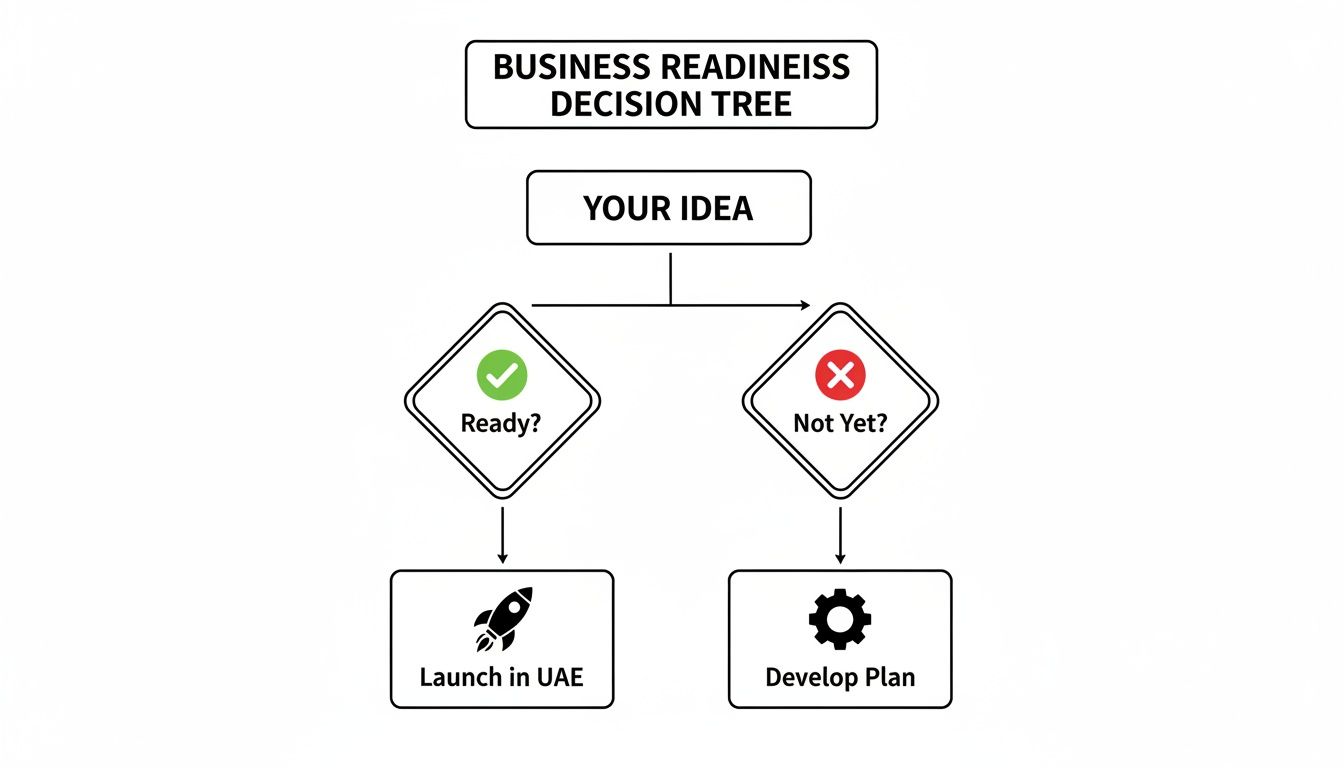
As the visual shows, the path from an idea to a full-fledged launch is clear. Being ready is what pulls the trigger on moving forward with your UAE business setup.
Understanding Mainland Company Formation
A Mainland company, registered with the Department of Economic Development (DED) in its respective emirate, offers the ultimate freedom to do business. You can trade directly with any customer or company anywhere in the UAE—and internationally—without any restrictions holding you back.
This direct market access is the number one reason entrepreneurs opt for a Mainland setup. If your business plan involves opening a retail shop in a busy Dubai mall, offering services straight to the local population, or bidding on government tenders, then Mainland is your only viable path.
Key Takeaway: A Mainland license gives you unrestricted access to the entire UAE market. It is the mandatory choice for businesses that need to trade locally, establish a physical presence in the city, or work with government entities.
While it used to be that a local Emirati partner holding 51% of the shares was a requirement, recent legal changes now allow 100% foreign ownership for a huge number of business activities. This has made the Mainland option more appealing than ever for international investors who want full control of their business.
Exploring the Benefits of Free Zones
Dotted across the UAE are more than 40 specialised Free Zones. Think of them as independent economic areas, each with its own set of rules and regulations specifically designed to attract foreign investment with some very compelling incentives.
What makes them so attractive? Here are the biggest draws:
- Complete Foreign Ownership: You retain full control and ownership of your business without needing a local partner.
- Tax Exemptions: Most Free Zones offer 0% corporate and personal income tax, a massive financial benefit.
- Full Repatriation of Capital: You can send all your capital and profits back to your home country without any restrictions.
- Simplified Import and Export: Customs processes are much more straightforward, a huge advantage for trading and logistics companies.
For a deeper dive into the specifics, our detailed guide comparing Free Zone vs Mainland Dubai provides even more clarity. It’s also worth noting that each Free Zone is often tailored to specific industries—think Dubai Media City for creative agencies or Jebel Ali Free Zone (JAFZA) for logistics and trade.
But there's a catch. A Free Zone company is generally restricted to doing business within its zone or internationally. To trade directly in the Mainland market, you'll typically need to partner with a local distributor or agent.
Here's a quick comparison to help you see the differences side-by-side.
Mainland vs Free Zone: Key Differences at a Glance
Making the right choice between Mainland and Free Zone is fundamental to your success. This table breaks down the most important factors to consider.
| Feature | Mainland Company | Free Zone Company |
|---|---|---|
| Ownership | 100% foreign ownership for most activities. | 100% foreign ownership. |
| Business Scope | Can trade anywhere in the UAE and internationally. | Restricted to the Free Zone and international trade. |
| Office Location | Can rent an office anywhere in the respective emirate. | Must have an office or desk space within the Free Zone. |
| Visas | Number of visas depends on office size. | Number of visas is typically pre-packaged. |
| Regulatory Body | Department of Economic Development (DED). | Respective Free Zone Authority. |
| Government Tenders | Eligible to bid for government projects. | Not directly eligible to bid for government projects. |
| Corporate Tax | Subject to 9% corporate tax on profits over AED 375,000. | 0% corporate tax for qualifying income. |
This table highlights the core trade-offs. Your choice really comes down to what you're willing to compromise on to get the benefits you need most.
Making the Right Strategic Choice
So, how do you make the final call? The answer is rooted in your core business activities and your long-term vision. Start by asking yourself these critical questions:
- Who is my primary target market? If your customers are inside the UAE, Mainland is probably the way to go. If they're international, a Free Zone is incredibly efficient.
- What kind of business am I running? A professional services company could easily thrive in a Free Zone, but a restaurant absolutely must be on the Mainland.
- Do I need a physical office or shop? For most storefronts and offices outside of Free Zone boundaries, a Mainland setup is non-negotiable.
- What's my budget? Free Zone setups often seem more cost-effective at first, with package deals and flexi-desks. However, Mainland costs have become much more competitive recently.
This decision is the very foundation of your company's structure in the UAE. Getting it right from the start positions your business perfectly for growth and success from day one.
Securing the Right License and Legal Structure
Once you’ve settled on either a Mainland or Free Zone setup, the next big decisions are your business license and legal structure. This isn't just paperwork; it’s the legal DNA of your company. These choices will define exactly what your business can do, who’s responsible for its debts, and how it operates under UAE law.
Getting this right from day one is absolutely crucial. A mismatch between your actual business activities and your license can bring fines or even a complete shutdown of operations. Likewise, picking the wrong legal structure could leave your personal assets vulnerable if the business runs into trouble.
Decoding the Different UAE Business Licenses
Think of your business license as your official permission slip from the UAE authorities to carry out specific commercial activities. The type of license you need is directly linked to what your business actually does. It's about choosing the right tool for the right job.
You'll generally come across three main categories of business licenses, and getting your head around them is the first step.
-
Commercial License: This one’s for any company involved in trading. If your business model is built on buying and selling goods—whether that’s through e-commerce, general trading, or even real estate—you’ll need a Commercial License. A business importing electronics to sell locally is a classic example.
-
Professional License: This license is tailor-made for service-based businesses and skilled professionals. We're talking about consultants, marketing agencies, IT specialists, artisans, and auditors. If you’re selling your expertise instead of a physical product, the Professional License is almost always the way to go. A major perk here is that it often allows for 100% foreign ownership, even on the Mainland.
-
Industrial License: Any business that involves manufacturing, production, or other industrial activities needs this license. This covers everything from turning raw materials into finished goods to assembly and processing. For instance, a company that builds furniture or processes food products would require an Industrial License.
Choosing the correct one is non-negotiable. For a more detailed breakdown of how these permits work, our guide on business licenses in the UAE dives much deeper into the specifics of each type.
Choosing Your Company's Legal Structure
Hand-in-hand with your license, you need to select a legal structure—sometimes called a company type or legal form. This is what defines your company as a distinct legal entity and has massive implications for ownership and personal liability. Your decision will hinge on how many shareholders you have and the nature of your business.
Let's walk through the most common structures we see new businesses in the UAE adopt.
Limited Liability Company (LLC)
The Limited Liability Company (LLC) is, without a doubt, the most popular and flexible business structure for entrepreneurs setting up on the UAE Mainland. An LLC can be formed with a minimum of two and a maximum of 50 shareholders.
Its defining characteristic? It shields its owners from liability. This means your personal assets are kept separate from the company's debts. If the business ever faces financial hardship, your personal property, like your home or car, stays protected. This clean separation makes the LLC a secure and reliable choice for most commercial ventures.
Sole Establishment
A Sole Establishment is a business entity owned and run by a single person. This structure doesn't have a separate legal identity from its owner, which means the owner is 100% liable for all the company's debts and obligations.
You'll often see this structure used by professionals operating under a Professional License, like doctors, engineers, or consultants. While it’s simple to set up, that unlimited liability is a huge factor to weigh. It’s a direct route for solo entrepreneurs but comes with a higher degree of personal financial risk.
Expert Tip: For a Sole Establishment owned by a foreigner, a Local Service Agent (LSA) is required. Don't confuse this with the old local sponsor system—an LSA has zero ownership stake and no liability in your company. Their role is purely administrative, acting as your liaison for government tasks in exchange for a fixed annual fee.
Nailing these foundational decisions sets you up for a much smoother journey ahead. It ensures your business is fully compliant with UAE law and is structured to protect your personal interests while supporting your long-term ambitions for growth.
A Practical Guide to Company Registration and Visas
Alright, you've picked your jurisdiction, license type, and legal structure. Now comes the part where your business idea starts to feel real. We’re moving from planning to process, tackling the administrative steps that will formally bring your company to life.
This stage is all about paperwork and procedure, from registering your trade name to getting that all-important residency visa stamped in your passport. It might look like a long checklist, but the system here is surprisingly logical. Let's walk through exactly what you need to do on the ground to turn your business plan into a legally operating UAE entity.

The Core Registration Milestones
First up, let's get your company legally recognized. This phase involves a sequence of approvals and document submissions with the right authority—whether that’s a specific Free Zone or the Department of Economic Development (DED) for a Mainland setup.
Here’s a breakdown of what that journey typically looks like:
- Trade Name Reservation: It all starts with a name. Your company name needs to be unique and follow UAE naming rules. You can't move forward until it’s been approved and officially reserved.
- Initial Approval: Think of this as the preliminary nod from the authorities. It confirms they have no objections to your business concept and is a critical checkpoint before you start signing cheques for major expenses like an office lease.
- Drafting and Notarising Your MOA/LSA: If you're setting up an LLC, you'll need a Memorandum of Association (MOA) that details the company's structure and ownership. For a Sole Establishment owned by a foreign national, you’ll need a Local Service Agent (LSA) agreement. These aren't just templates; they need to be drafted professionally and notarised to be legally valid.
- Securing Office Space: A physical, registered address is non-negotiable. This means signing a tenancy contract and, for Dubai Mainland, getting an Ejari—the official online registration of your lease agreement.
Once these foundational steps are complete and your paperwork is in, you'll be issued your official trade license. That's the moment your company is officially born.
Navigating the UAE Visa Process
For most entrepreneurs from abroad, getting a residency visa is the next major goal. Your new company will be your sponsor, and thankfully, it's a well-defined process that follows a clear sequence.
The visa journey can be broken down into a few key stages:
- Establishment Card Application: First things first, your company needs to be registered with the immigration authorities. This creates an Establishment Card, which is basically your company’s immigration file, giving it the power to sponsor visas for owners and employees.
- Entry Permit (Employment Visa): With the Establishment Card sorted, you can apply for an entry permit for yourself and any staff. This is a temporary visa that allows someone to enter the UAE specifically for employment.
- Status Change: Already in the UAE on a tourist visa when your permit is issued? No problem. You'll just need to do an "in-country status change" to activate the employment entry permit without having to leave.
- Medical Fitness Test: This is a mandatory step for all new residents. It’s a straightforward health screening for certain communicable diseases.
- Emirates ID Biometrics: You'll visit a designated centre to have your fingerprints and photo taken for your Emirates ID card. This will become your primary form of identification across the UAE.
After you've checked off these items, your passport will be stamped with the residency visa, which is usually valid for two years. This visa is your key to truly living and working here—it allows you to rent a home long-term, open a personal bank account, and much more.
Expert Insight: The visa process is extremely detail-oriented. A single error on a form can cause frustrating delays. This is where professional PRO (Public Relations Officer) services are worth their weight in gold, as they manage the submissions and follow-ups for you.
The UAE's drive to create an exceptional business environment is paying off. Recent investor-friendly reforms are making business setups more attractive than ever, cementing the country's role as a global hub. FDI inflows recently hit a staggering US$97 billion, a 33% increase that speaks volumes about the trust in the UAE's open policies. In 2024 alone, foreign investment jumped by 28%, fueled by game-changing policies like 100% foreign ownership and a competitive 9% corporate tax on profits over AED 375,000. These aren't just numbers; they are powerful magnets for entrepreneurs worldwide. You can discover more insights about future business setup trends on.
Opening Your Corporate Bank Account Successfully
You’ve got your trade license and visas sorted. It feels like you’re on the home stretch, right? Well, here’s a reality check that catches many entrepreneurs by surprise: opening a corporate bank account in the UAE can be one of the toughest parts of the whole setup process. It’s a significant hurdle, but with the right preparation, you can clear it without a problem.
This isn't as simple as walking into a local branch and signing a few forms. UAE banks are under immense pressure to comply with strict international Anti-Money Laundering (AML) and Know Your Customer (KYC) regulations. This means they need to be completely sure about who you are, what your business does, and where your money is coming from. Think of it less like an application and more like an in-depth financial interview for your business.

Preparing Your Documentation for Success
My best advice? Be over-prepared. The bank will request a pile of documents, and having everything perfectly organized shows you’re a serious, credible applicant. Most delays I’ve seen come down to missing or incomplete paperwork.
Your core document checklist should look something like this:
- Complete Company Documents: This means your trade license, Memorandum of Association (MOA), share certificates, and your office tenancy contract (Ejari).
- Shareholder and Signatory Information: Get ready passport copies, UAE residency visas, and Emirates ID cards for every single shareholder and authorized signatory.
- A Solid Business Plan: This is absolutely critical. Your plan needs to clearly explain your business model, target audience, realistic financial projections, and the background of your management team. It has to tell a convincing story about why your business will succeed.
- Proof of Business Activity: Banks want to see that your company is real. Have contracts, invoices from prospective clients, or even just a professional business website ready to show that you're operational or about to be.
Don't underestimate the power of a well-written business plan. It's often the deciding factor that convinces a bank you're a low-risk, high-potential client worth partnering with.
Choosing the Right Bank and Making a Strong Case
Not all banks are created equal. Some are much more open to startups or specific industries than others. It pays to do your homework and target banks known for being SME-friendly. Working with a business setup consultant can be a game-changer here, as they often have existing relationships with bank managers who can help move things along. For more specific advice, our comprehensive guide on how to open a bank account in the UAE is a great resource.
Another key piece of the puzzle is the minimum balance requirement. Most corporate accounts in the UAE require you to maintain a minimum monthly average balance, which can be anything from AED 25,000 to over AED 200,000. If you drop below this, you’ll face hefty monthly penalties, so pick an account that matches your realistic cash flow.
Once you're all set up, consider tools for efficient bank statement management to streamline your bookkeeping right from the start. Ultimately, success comes down to being prepared, transparent, and professional. Present your business with the confidence it deserves, and you'll get that account approved without any unnecessary headaches.
Your Post-Setup Checklist for Long-Term Growth
Getting your trade license is a massive milestone, but it's really just the starting line, not the finish. The real work of building a sustainable business in the UAE begins now, shifting your focus from the setup marathon to daily operations and long-term growth.
This checklist is designed to help you look ahead, making sure your new venture not only stays compliant but is primed for success from day one. It’s a balancing act, really—managing your regulatory duties while building the operational muscle to scale.
Mastering Ongoing Compliance
Let’s be direct: staying on the right side of UAE regulations is non-negotiable. Missing a deadline can trigger fines or operational headaches that are completely avoidable with a bit of forward planning. Your compliance calendar should be one of the first things you set up.
Here are the key recurring tasks to track:
- Annual License Renewal: This is your most critical yearly task. Your trade license needs to be renewed with the DED or your Free Zone authority before it expires. No exceptions.
- Visa and Emirates ID Renewals: Keep a sharp eye on the expiry dates for your own visa and those of any employees. Kicking off the renewal process well in advance makes it much smoother.
- Maintaining a UBO Register: Every company in the UAE is required to keep an updated Ultimate Beneficial Owner (UBO) register. This document identifies who ultimately owns or controls the business and must be accurate and available for the authorities.
Pro Tip From the Field: Your first year in business will fly by. Seriously. Set calendar reminders for your license and visa renewals at least 90 days before they're due. This buffer gives you plenty of time to get your documents in order and deal with any surprises without the last-minute panic.
Building Your Operational Engine
Once your compliance is on autopilot, you can pour your energy into what actually moves the needle: growing your business. This is all about putting the right systems and strategies in place to boost efficiency and keep customers happy.
A great place to start is customer relationship management. To keep track of leads and clients effectively, it’s worth exploring the best CRM software options for businesses in Dubai.
Alongside that, you need solid financial management. This goes way beyond just tracking expenses. We're talking about strategic bookkeeping, regular audits, and smart tax planning to keep your company financially healthy. Bringing in professionals for this isn't an expense—it's an investment in your future.
The timing couldn't be better. The SME sector here is buzzing with energy. A recent Mastercard SME Confidence Index showed that 91% of UAE SMEs are optimistic about the future, with 90% expecting to either maintain or grow their revenue. This confidence is fueled by a huge shift to digital tools—92% of SMEs now accept digital payments, and 97% use data analytics for smarter decisions.
Leaning on a corporate services partner for these ongoing tasks frees you up to do what you do best: run your company. When you delegate the administrative load, you can focus your energy on strategy, innovation, and connecting with customers—the real formula for thriving in the UAE’s dynamic market.
Navigating the complexities of business setup and ongoing compliance is what we do best. Let Al Ain Business Center handle the details so you can focus on building your empire. Get your free consultation today!
Related articles
 Business Setup
 Business Setup
 Business Setup
 Business Setup
 Business Setup
 Business Setup
Latest guides
- 2-Year Residence Visa Renewal UAE Cost: 2026 Fee Breakdown
- Housemaid Visa Abu Dhabi: Cost, Steps and Requirements
- Green Visa UAE: Requirements, Costs and How to Apply
- UAE Visit Visa Categories for Technology & AI Talent
- Business Visa in UAE 2026: Types, Costs and How to Apply
- Visa-Free Countries for UAE Residents With Pakistani Passports