
Dubai’s mainland business environment hands you full control over your venture—no local partner share needed. Through the Smart Government portal, approvals move faster, and you gain direct entry to every corner of the UAE market.
Key Benefits Of Mainland Setup
Recent reforms have abolished mandatory local sponsorship. Now, you can complete your licence application entirely online via the Smart Government portal.
- Simplifies ownership by removing sponsor requirements and lengthy agreements
- Accelerates processing, with licence issuance in days rather than weeks
- Unlocks nationwide trade opportunities across all emirates
Dubai’s Smart Government portal brings approvals from multiple departments under one roof. You’ll monitor each stage online, cutting out office visits and wasted travel time.
Common Pitfalls To Avoid
- Choosing a prohibited trade name that fails Department of Economy & Tourism checks
- Submitting an expired or invalid tenancy contract
- Miscalculating visa quotas before finalising your office space
Tackling these issues up front can shave days off your processing timeline.
Consider Sara’s journey: she partnered with Al Ain Business Center, wrapped up her licence in six days, then hired her first team member and launched marketing on day seven.
Prelaunch Checklist
- Reserve a trade name that meets Department of Economy & Tourism standards
- Gather IDs, a valid tenancy contract, and signed financial undertakings
- Budget for licence fees, office rent, and visa deposit costs
Factor in time for document attestation, possible office inspections, and visa clearance—planning a week in advance will keep expectations realistic.
The infographic below visualises the process flow for a Dubai mainland business setup.
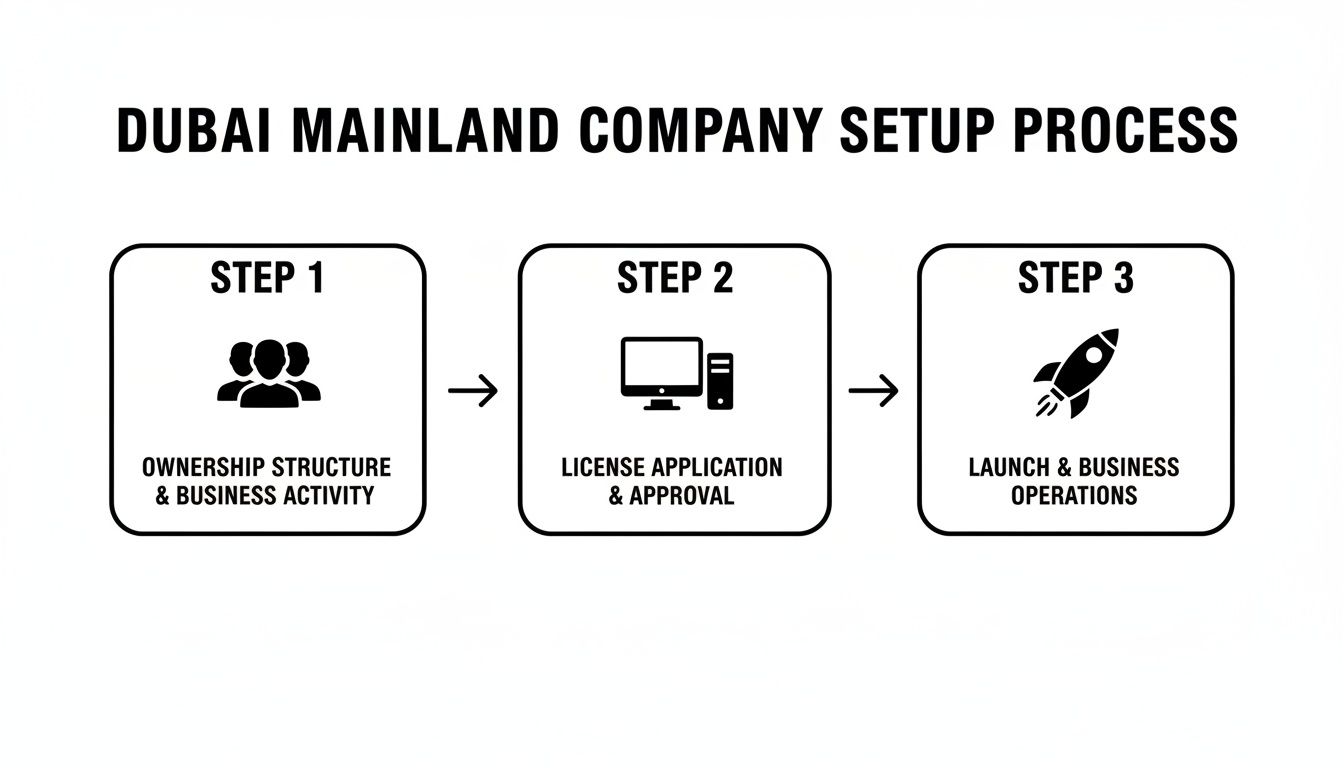
It highlights the three core steps: ownership structuring, licence application, and launch readiness.
Since the 2021 reforms, international investors can hold 100% ownership, ending the old 51% rule. This change triggered a 28% rise in foreign direct investment last year, underscoring strong demand for mainland operations.
Key takeaway: full ownership drives agility and attracts capital.
Key Benefits Comparison
Below is a snapshot comparing Mainland and Free Zone advantages:
| Criteria | Mainland | Free Zone |
|---|---|---|
| Ownership | 100% foreign ownership | 100% within zone only |
| Trade Area | Anywhere in the UAE | Restricted to zone |
| Government Contracts | Allowed | Not allowed |
| Visa Quotas | Unlimited based on capacity | Limited number |
Despite the freedom of free zones, only mainland companies can engage in government contracts and operate unrestricted across all emirates.
Timeline Planning Tips
- Begin gathering documents at least two weeks before submission
- Double-check spelling in trade name applications to avoid rejections
- Schedule tenancy contract attestations at accredited centres early
- Bundle PRO tasks into one trip to reduce costs and delays
These steps helped many founders secure licences in under a week.
Setting Expectations
- Licence processing typically takes 3–7 business days
- Visa approvals follow in 5–10 days after licence issuance
- Track annual renewal deadlines closely to prevent lapses
Check out our guide on Dubai mainland company formation cost for a detailed breakdown of fees and service packages.
In our e-commerce founder example, budgeting AED 20,000 covered her licence, office lease, and PRO services—keeping her launch on schedule.
With this snapshot, you’re ready to chart your path into Dubai’s mainland market confidently.
Upcoming sections unpack entity selection, licence categories, PRO services, and compliance checklists to help you scale smoothly. Stay tuned for actionable strategies today.
Choosing The Right Company Structure
Selecting your legal entity in a Dubai mainland setup can feel overwhelming. Your choice will determine capital requirements, control over decision-making, and how much personal liability you carry. To clear the fog, let’s explore three common options: limited liability companies (LLCs), sole establishments, and branch offices.
Each structure brings its own set of rules on shareholding, permitted activities, and cost. We’ll also share real-founder stories and practical checklists to help you sidestep pitfalls.
Compare Structure Essentials
Here’s a quick look at the core parameters for each entity:
| Criteria | LLC | Sole Establishment | Branch Office |
|---|---|---|---|
| Capital Requirement | AED 300,000 minimum | No minimum; proof of funds required | Mirrors parent company |
| Liability | Limited to share capital | Unlimited personal liability | Liabilities follow parent entity |
| Activities Allowed | Trading, consulting, manufacturing | Professional services only | Parent company activities only |
LLCs attract entrepreneurs eyeing multiple shareholders and greater asset protection. You’ll need to deposit your capital into a corporate bank account and draft shareholder resolutions for every partner.
If you’re a one-person consultancy or freelancer, a sole establishment cuts through much of the red tape. Setup costs stay low, but remember: your personal assets back every business claim.
Branch offices piggyback on the parent firm’s licence, so there’s no fresh capital requirement. They’re perfect for established groups wanting a quick market entry without a full reincorporation.
Founder Experiences
Farah launched her digital marketing agency as a sole establishment to sidestep heavy upfront fees. She wrapped up her licence application in just five days and signed her first client within the week.
"Opting for a sole establishment cut my setup budget by 60%, letting me reinvest in ad campaigns right away."
— Farah, Digital Marketing Founder
Similarly, Kareem, an engineering consultant, chose an LLC to protect his personal assets on large government contracts. Within months, he secured a multimillion-dirham project without risking personal guarantees.
Preparation Checklist
- Valid passport copies for all shareholders: speeds up identity checks.
- Memorandum of Association (MoA) and Articles of Association: define ownership and governance.
- Notarised tenancy contract: proves your physical office meets DED requirements.
- No-Objection Certificate (NOC): required for specialised activities.
Drafting Agreements
A solid partnership or shareholder agreement can save you headaches later. Spell out capital contributions, exit strategies, and voting rights. Assign clear responsibilities so every partner knows exactly what’s expected.
Aligning Structure With Growth Plan
Matching your legal setup to your five-year vision makes all the difference. An LLC gives you unlimited visa quotas—ideal if you foresee rapid staff growth.
On the other hand, a sole establishment might suffice for lean operations that plan to stay small. Branch offices shine when a parent company just wants to test new markets.
Growth Alignment Tips
- Plan visa counts against headcount projections.
- Estimate future capital injections for LLC expansions.
- Revisit liability terms if you branch into new services.
- Use a branch office to pilot unconventional activities.
The ongoing real estate boom in Dubai creates unique opportunities. Property transactions hit AED 431 billion in H1 2025, with 125,538 deals closed.
Scaling Considerations
Dual licensing can be a key advantage if you already operate in a free zone. It lets you serve mainland clients without creating a brand-new entity. Just check the free zone’s rulebook before applying, and confirm your visa quota meets your growth targets.
Branch offices, meanwhile, lean heavily on approvals from the head office—so factor in any potential delays when planning expansions in neighbouring emirates.
Long Term Maintenance
Keeping your company compliant year after year is non-negotiable. DED will expect annual audits, timely licence renewals, and up-to-date financial records.
- Schedule reminders for licence renewals at least three months ahead.
- Keep your accounting aligned with UAE standards.
- Update shareholder agreements after major funding rounds.
Case Study Note
In fast-paced sectors like real estate, an LLC structure can be the key to winning big contracts. One developer used this model to snag a AED 150 million tower deal, bypassing free zone limits and tapping into government tenders directly.
A clear legal setup underpins sustainable growth.
Choosing wisely today streamlines your path to expansion across the UAE. Align your structure with both risk appetite and long-term ambitions, and you’ll avoid surprises as your business scales.
Use this framework to match your five-year forecast with the right entity. Choosing wisely now saves headaches and supports UAE-wide growth.
Review this guide before filing to ensure confidence and clarity.
Obtaining Required Licenses And Sponsorship
Getting the right licence is the next big milestone once you’ve settled on your company structure. It’s what officially unlocks your business activities on the Dubai mainland.
Trading licences let you buy and sell goods across the UAE. Professional licences fit consultants, freelancers and service providers. Industrial licences cover everything from factory setups to full-scale manufacturing lines.
Choosing The Right Licence Type
Each licence comes from a different authority. Pinpointing the right one saves weeks of back-and-forth.
- Department of Economy & Tourism (DET) issues Trading licences for retail, e-tail and wholesale activities
- Department of Economic Development (DED) handles Professional licences for service-oriented ventures
- Ministry of Industry and Advanced Technology approves Industrial licences for manufacturing and processing
Once you know which licence applies, round up these essentials:
- Passport copies of shareholders and your local service agent
- Tenancy contract attested by a UAE notary
- No Objection Certificate for any specialised activity
These core documents let you kick off the submission on the DET e-portal without delay.
Negotiating Your Service Agent Agreement
For a professional licence, you’ll need a local service agent. Getting the right partner can save you headaches—and cash.
- Confirm annual service fees and any performance-based commissions upfront
- Draft a concise agreement outlining termination notices and renewal terms
- Seek candid references from peers who’ve worked with your chosen agent
A transparent contract prevents unexpected charges.
"Securing the right service agent saved us AED 15,000 over five years."
— Business Setup Advisor
With your agreement signed, submit your licence application via the DET e-portal and monitor the status in real time.
License Types Comparison
Here’s a quick overview of the main licence categories to help you decide:
| License Type | Activities Allowed | Fee Range |
|---|---|---|
| Trading | Sales of goods and merchandise across the UAE | AED 5,000–30,000 |
| Professional | Consulting, auditing, marketing and other service activities | AED 7,000–20,000 |
| Industrial | Manufacturing, assembly and packaging operations | AED 10,000–40,000 |
Use this comparison to pinpoint which licence aligns with your business plan.
Check out our guide on Business Licences in the UAE for detailed fee breakdowns.
Avoiding Delays At Economy And Tourism
Missing signatures or unverified NOCs are the top culprits for hold-ups. Prevent that by triple-checking your dossier before submission.
- Verify all shareholder signatures on the Memorandum of Association documents
- Ensure tenancy contracts are attested by a UAE notary
- Upload crisp, clear scans of any bank guarantees or additional approvals
Punctual document revisions can cut processing time by up to 40%.
Keep a local consultant on call for rapid issue resolution. Log into the e-portal daily and set up email alerts to catch any requested updates immediately.
Final Steps And Renewal
When approval lands, pay the licence fee and collect your official permit. Then focus on:
- Arranging visa quota approvals within two weeks of licence issuance
- Storing digital copies of your licence and authorised signatures
- Scheduling renewal at least one month before expiry to avoid fines
Renewal notices appear on the e-portal six weeks in advance—mark your calendar now.
Using E-Portal Tracking And Insights
The DET e-portal provides timestamped logs for each application milestone. Tracking these helps you spot bottlenecks fast.
- Review “Document Verification” dates to catch any missing pages
- Confirm “Payment Confirmation” logs to ensure fees have been received
- Check “Final Approval” entries so you can book collection as soon as it’s ready
Share portal access with your PRO team and set personal reminders for each stage.
Pro tip: Early detection of missing documents can cut re-submission time in half.
By following this roadmap, you’ll secure your licence and set the stage for seamless growth across the UAE mainland.
Managing PRO Services And Visa Applications
Navigating PRO services and visa paperwork can sometimes feel like wandering through a labyrinth. Yet, a few strategic moves—like bundling submissions and choosing the right agent—often shave days off your setup timeline.
Group Submissions For Maximum Efficiency
Many founders unknowingly file investor visas, Emirates IDs and work permits at different times. Instead, take everything in one go. A single trip to the General Directorate of Residency and Foreigners Affairs (GDRFA) can speed things up dramatically.
- Hand in investor visa and Emirates ID documents simultaneously
- Include copies of all staff work permits
- Provide the tenancy contract early to confirm your visa quota
Evaluating PRO Providers With Transparent Pricing
A minor fee difference today can balloon to AED 2,000 in annual charges. So, dive into published rate cards and ask about guaranteed turnaround windows. Customer reviews often reveal the real deal, not marketing spin.
Key takeaway
Compare agents by fee structure and speed to avoid hidden costs
Using Mobile Apps To Skip Office Visits
DED’s smart mobile app lets you upload documents and pay fees in moments. For instance, Farah avoided two extra centre visits by sharing her medical test results through her phone.
- Use the GDRFA UAE app for instant visa-status updates
- Turn on push alerts for any new document requests
- Link the app to your chosen PRO provider
Investor Visas And ID Applications Explained
An investor visa lasts three years and qualifies for renewal. Once your visa is stamped, expect your Emirates ID in around seven working days. You’ll budget AED 1,000 for issuance plus AED 300 for the smart card.
Allow at least two weeks for Emirates ID processing
Securing Employee Work Permits And Family Residency
Staff work permits demand health checks, labour approval and proof of medical insurance. Meanwhile, family sponsorships hinge on marriage or birth certificates plus a minimum salary threshold.
- Complete the health test and apply for the labour card in one go
- Upload all dependent documents to the GDRFA portal
- Schedule visa stamping at an Amer Centre
Bundling employee and family applications can cut overall approval times by 30%.
- Verify salary requirements before you submit
- Arrange certified translations for non-English paperwork
Tracking Submissions With Online Portals
The DET e-portal and GDRFA dashboard show real-time progress on each file. You’ll spot missing documents before the official notice lands.
| Portal | Feature | Benefit |
|---|---|---|
| DET e-portal | Licence status tracking | Reduces manual follow ups |
| GDRFA UAE | Visa quota monitoring | Prevents oversubscription |
| Amer centre | Appointment scheduling | Speeds stamping |
Founder Timelines And Cost Breakdowns
Ahmed wrapped up his investor visa, Emirates ID and family residency in 21 days, paying AED 3,500 in PRO fees. Meanwhile, Sara’s decision to organise medical tests on day one shaved off two days.
Sharp prioritisation can reduce your timeline by up to 40%
- Start health and labour formalities while waiting for visa stamping
- Book fingerprinting on the same day to minimise trips
Budgeting For PRO And Visa Fees
Typical PRO fees combined with government charges may reach AED 10,000 per new hire. Don’t forget medical tests, Emirates ID issuance and any translation or typing service.
- GDRFA visa stamping: AED 700
- Emirates ID issuance: AED 1,300
- Medical fitness test: AED 320
- PRO agent fee: AED 200 per visit
Bundling services into a package deal with your agent often unlocks bulk discounts.
Avoiding Common PRO Pitfalls
The biggest delays come from expired passports, missing signatures and unclear scans. Before you hand over any bundle:
- Double-check all passport and visa expiries
- Confirm bank guarantees carry attested signatures
- Ensure tenancy contracts are legible and signed
A simple final-check list can catch these issues every time.
Streamlining Repeated Submissions
Saving commonly used documents in a shared cloud folder eliminates retyping and extra trips. A clear naming convention means your PRO provider knows exactly what’s what.
- Label each file by type and date
- Maintain a master spreadsheet of previous submission dates
Consistency here slashes hours off each PRO cycle and cuts down on email hunts.
Consistency in document naming prevents duplicate requests
Final Tips For Faster Processing
Plan your Amer Centre appointment for early morning to beat afternoon backlogs. Keep a slim folder ready with original passports, fee receipts and copies.
- Call to reconfirm your slot 24 hours ahead
A quick pre-check call often saves a wasted journey or a last-minute rebooking.
Learn more about document clearance and PRO support in our guide on Documents Clearing Services.
Ensuring Compliance And Planning Growth
Navigating compliance in Dubai’s mainland arena often feels like walking a tightrope. A misstep in corporate tax filings or VAT deadlines can quickly turn into hefty fines. Yet by weaving smart growth tactics into your routine, you build a foundation that lasts.
Key areas to focus on include:
- 9% corporate tax on profits exceeding AED 375,000, complete with official deadlines and forms
- VAT registration triggers and quarterly return schedules to keep penalties at bay
- Annual audit workflows, from your internal review to the external auditor’s final report
Corporate Tax Filings And VAT Registration
Filing your corporate tax return means submitting profit and loss statements through the Federal Tax Authority portal. It sounds simple, but aligning your accounting system with the 9% rate often uncovers overlooked deductions.
Imagine a boutique consultancy that revamped its bookkeeping in days—and discovered AED 120,000 in cost-segregation savings. You can follow a similar approach:
- Prepare audited financial statements by March
- File your corporate tax return by June along with the certified audit report
- If annual revenue crosses AED 375,000, ensure your VAT registration covers every licensed activity
This prevents surprise liabilities and keeps the FTA satisfied.
Monthly Returns And Annual Audits
Missing a monthly return on your DED licence is a common slip-up. One late submission can trigger fines up to AED 20,000—a hefty price for a few minutes’ delay.
To stay ahead:
- Track utility bills, payroll numbers and sales data for precise monthly declarations
- Automate reminders in your accounting software so no deadline slips by
Bringing in an external auditor isn’t just box-ticking. A fresh pair of eyes often spots inefficiencies that boost investor trust.
Regular audits not only ensure compliance but also improve investor confidence (28% growth in foreign direct investment last year).
Sample Board Resolution Language
Crafting precise resolution wording accelerates board approvals. A quick template might read:
“Resolved That [CompanyName] engages [AuditorName] to conduct the 2025 audit and submit findings by June 30, 2025.”
Swap in your company’s details, circulate the draft, and watch the board sign off in record time.
Renewal Checklists And Governance Templates
Six weeks before expiry, the Smart Government portal flags your licence renewal. But waiting until the last moment often sparks stress—and late-fee penalties.
A governance checklist should cover:
- Renewal of the DED licence and topping up visa quota fees
- Re-signing tenancy contracts and booking mandatory quality inspections
- Drafting board resolutions for budget approvals or branch licences
One consultancy we advised slashed AED 5,000 in penalties simply by syncing renewal dates to a shared calendar. Additional tips:
- Monitor FTA announcements for shifting tax thresholds
- Consult legal counsel before structural moves like mergers
- Review directors’ and officers’ insurance to manage liability
Having these templates at your fingertips saves days when deadlines collide.
Scaling Through Government Contracts And Branch Expansion
Winning government tenders can skyrocket your revenue. A Dubai tech startup clinched a AED 5 million deal by pairing dual licensing with a local partner.
Before you pitch:
- Secure any NOC from your home emirate’s DED to keep licences in harmony
- Confirm bid bonds and performance guarantees per the government entity’s rules
- Use portals like DubaiNow to submit and track proposals
- Align your local service agent and legal counsel to vet contract clauses
When you’re ready to expand into Abu Dhabi or Sharjah, a single corporate entity can span multiple emirates—once the NOC process is complete.
| Emirate | Minimum Capital | Licence Fee Range |
|---|---|---|
| Dubai | AED 50,000 | AED 10,000–30,000 |
| Abu Dhabi | AED 30,000 | AED 8,000–25,000 |
| Sharjah | AED 20,000 | AED 7,000–20,000 |
Business confidence in Dubai hit a BCI of 114.9 in Q1 2025. For a deeper dive, see the Composite Business Confidence Index findings.
With 100% foreign ownership reforms and dual licensing options, mainland companies can pivot fast as markets shift. Branch openings and contract wins then become stepping stones for global expansion—provided you keep compliance front and centre.
Frequently Asked Questions
When you’re mapping out your Dubai mainland company, a few details always pop up. Below, we clear up the most common queries on capital, timelines and visas.
What Are the Minimum Capital Requirements for a Mainland Company
It really comes down to your business activity. A trading LLC typically starts at AED 300,000, while a professional licence can begin from AED 50,000. Always verify the exact figures on the Department of Economy & Tourism portal and have your signed financial undertaking ready.
How Long Does a Dubai Mainland Business Setup Take
With all documents in order, expect your licence in 5–10 business days. If you bundle PRO and visa services on the Smart Government portal, you can often wrap up every approval in under two weeks—provided no special clearances are needed.
Portal Links to Watch
- Department of Economy & Tourism portal
- Smart Government portal
- GDRFA UAE dashboard
What Visas Can I Sponsor Under a Mainland Licence
Every partner qualifies for an investor visa, and you can bring dependents on board. Need staff? Issue work visas according to your office size. Pro tip: start medical tests and Emirates ID applications right after licence issuance to avoid delays.
Can I Run Free Zone Activities on a Mainland Licence
Absolutely. Dual licensing lets your free-zone entity operate on the mainland. You’ll apply for a supplementary licence through your free-zone authority, pay the mainland trade licence fee and appoint a service agent if required. This setup preserves free-zone incentives while unlocking full UAE-wide market access.
Key Takeaway: Mainland licences deliver flexible visa quotas and direct market reach, all while bridging free-zone benefits with UAE-wide operations.
Our consultants track every regulatory update—so you don’t have to.
Looking to launch with confidence? Partner with Al Ain Business Center for expert guidance on Dubai mainland setup and PRO services. Visit https://alainbcenter.com to get started today.
Related articles
 Visas
Visas Visas
Visas Visas
Visas Visas
Visas Visas
VisasLatest guides
- ID Card Status UAE: Check Emirates ID Online 2024
- Set Up a Company in UAE: Your Step-by-Step Roadmap
- Medical Leave in UAE Labour Law: Your Rights Explained
- Abu Dhabi Labour Court Claims: Steps, Fees and Timelines
- Abu Dhabi PRO Services: What They Do and Why You Need Them
- Mission Visa UAE: How to Get One and Who Qualifies in 2026