
When you first enter the UAE, whether as a tourist or with plans to stay longer, you're assigned a unique 9-digit identification code. This is your Unified Number (UID), and it becomes your permanent reference within the country's immigration system. It’s the single thread connecting all your visa-related activities into one lifelong record.
Understanding Your Digital Fingerprint in the UAE
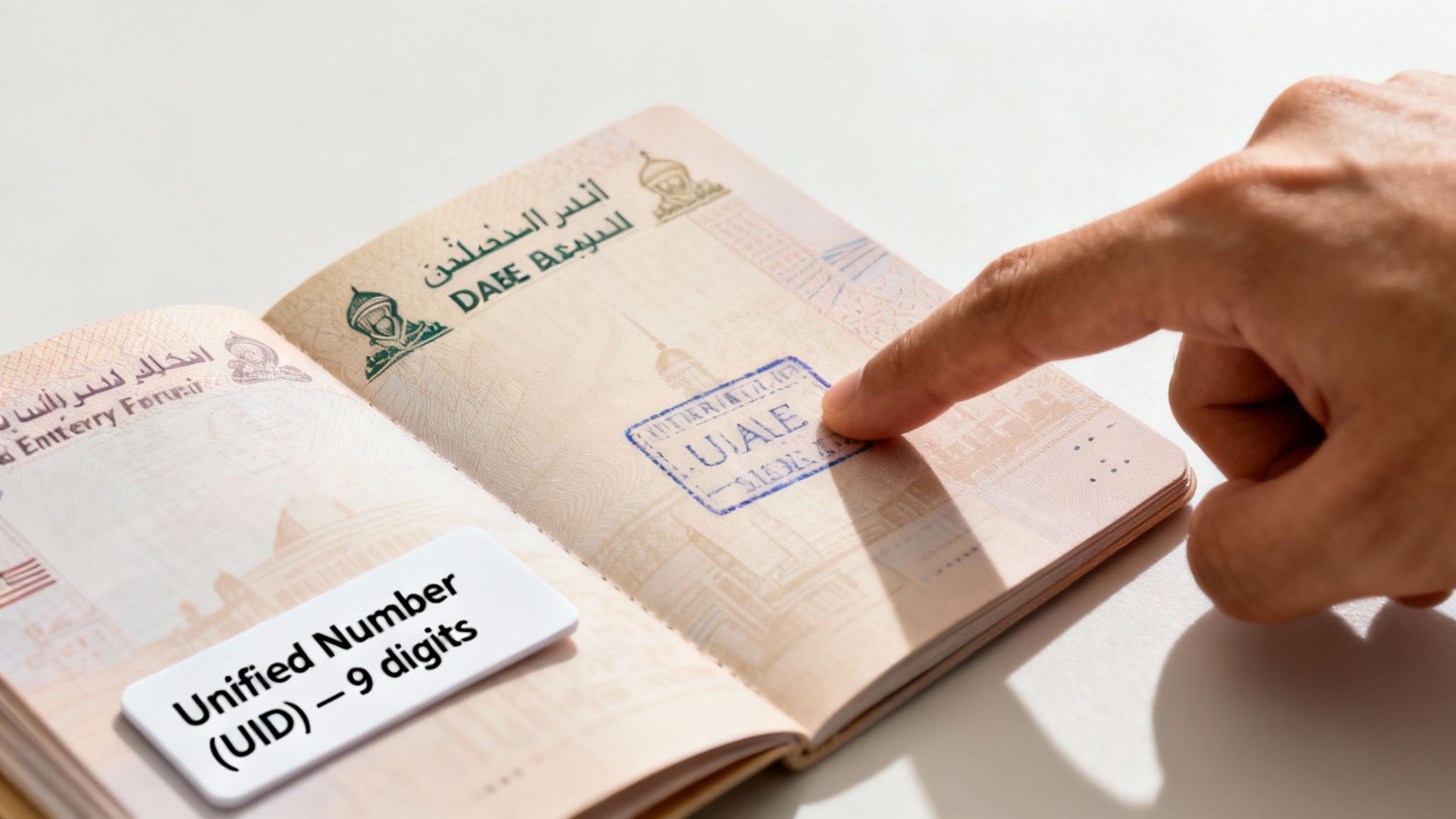
Think of the Unified Number as a digital fingerprint for your entire journey in the UAE. From that very first tourist visa to your long-term residency and even future business ventures, this single number ties everything together. It’s issued the moment you cross the border for the first time and stays with you for life, even if you leave the country and come back years later.
This system is the backbone of how the UAE manages residency and immigration with such remarkable efficiency. By giving every individual a permanent identifier, authorities can maintain a clear, consolidated history, which is absolutely vital for security and keeping administrative records accurate.
Unified Number vs Emirates ID: A Quick Comparison
It's really common for newcomers to mix up the Unified Number with other important IDs, especially the Emirates ID. Getting the difference is key to navigating administrative processes without a hitch. While both are critical, they serve very different primary functions in your day-to-day life and official transactions.
The Unified Number is your permanent link to the immigration system, tracking your visa history. The Emirates ID, on the other hand, is your primary physical identification for daily life and accessing services within the UAE. Both are essential, but you can't use one in place of the other.
To clear things up, here’s a straightforward table breaking down the key differences between your UID and your Emirates ID. This distinction is crucial for everything from renewing a visa to setting up a new company.
Unified Number vs Emirates ID: A Quick Comparison
| Feature | Unified Number (UID) | Emirates ID |
|---|---|---|
| Primary Purpose | Immigration tracking and visa history management. | Daily identification for residents to access services. |
| Format | A 9-digit number. | A 15-digit number. |
| Issuing Authority | Federal Authority for Identity & Citizenship (ICP). | Federal Authority for Identity & Citizenship (ICP). |
| When It's Issued | Upon your first entry into the UAE. | After your residency visa is approved and stamped. |
Understanding these two identifiers and when to use each one will save you a lot of time and potential headaches. The UID is for the system, the Emirates ID is for you.
What Exactly Is the UAE Unified Number?
Let’s cut through the jargon. The simplest way to understand the Unified Number is to think of it as your permanent ID file for all of the UAE's immigration systems. It’s a unique 9-digit code that the General Directorate of Residency and Foreigners Affairs (GDRFA) or the Federal Authority for Identity and Citizenship (ICP) assigns to you. This isn’t just some random number; it's the digital anchor that ties your entire presence in the country together.
This number gets created the very first time you enter the UAE, whether you’re on a tourist visa, a work permit, or an investor visa. And once you have it, it’s yours for life. Even if you leave the country, cancel your visa, and come back years down the road, you'll still have the same Unified Number. It's designed to create a single, unbroken record of every interaction you have with the immigration authorities.
The Foundation of Administrative Efficiency
So, why is this one number so incredibly important? It’s the backbone of the UAE's famously efficient government services. By linking every individual to one permanent identifier, the government can run things smoothly and securely.
This system is crucial for:
- Preventing Identity Duplication: It makes sure no single person can have multiple, conflicting immigration files. This keeps the data clean and accurate.
- Enhancing National Security: It allows authorities to keep a clear, continuous record of everyone's entry, exit, and visa status over time.
- Creating a Seamless User Experience: It lets different government departments pull up your core immigration data instantly, which speeds up everything from renewing your visa to applying for your Emirates ID.
Think of the Unified Number as the master key to your official records. Every visa you apply for, every renewal, every amendment—it all gets logged against this one permanent code, guaranteeing a clear and consistent history.
A Permanent Link to Your UAE Journey
Imagine your time in the UAE as a story with many chapters: your first visit, landing your first job, sponsoring your family, or launching a business. The Unified Number is the single thread that connects all these chapters into one cohesive story.
Every action you take builds on the last, all linked back to your UID. That’s why it’s an absolute must-have for nearly every important government transaction. It instantly confirms your legal status and history, paving the way for quick and accurate processing. Without it, you effectively don’t exist in the official system, making it impossible to move forward with residency, business setup, or getting essential services. It truly is the first official step to building your life or business in the Emirates.
How to Find Your Unified Number
So, you need to find your Unified Number, or UID. Don't worry, it's a straightforward process once you know where to look. Whether you've got your documents in hand or prefer to check online, that crucial 9-digit number is easy to access. Knowing how to find it is a must for almost any official task here in the UAE.
The quickest method is simply to check your visa documents. Your UID is printed right on your entry permit for tourism or, if you're a resident, on the visa stamped inside your passport. On the residence visa, it’s often labelled as the ‘File No.’, sitting right at the top of the stamp.
Checking Your Official Documents
For residents, the first and easiest place to check is the visa page in your passport. It's clearly displayed and hard to miss once you know what you’re looking for.
- Residence Visa: Take a look at the top section of the visa stamp. You'll see a number broken into parts, and one of these is your 9-digit UID.
- Entry Permit or Tourist Visa: If you came into the UAE on an e-visa or a paper entry permit, the UID is printed on there too, usually close to your personal details.
This really boils down to a simple, three-step journey that starts the moment you first enter the country.
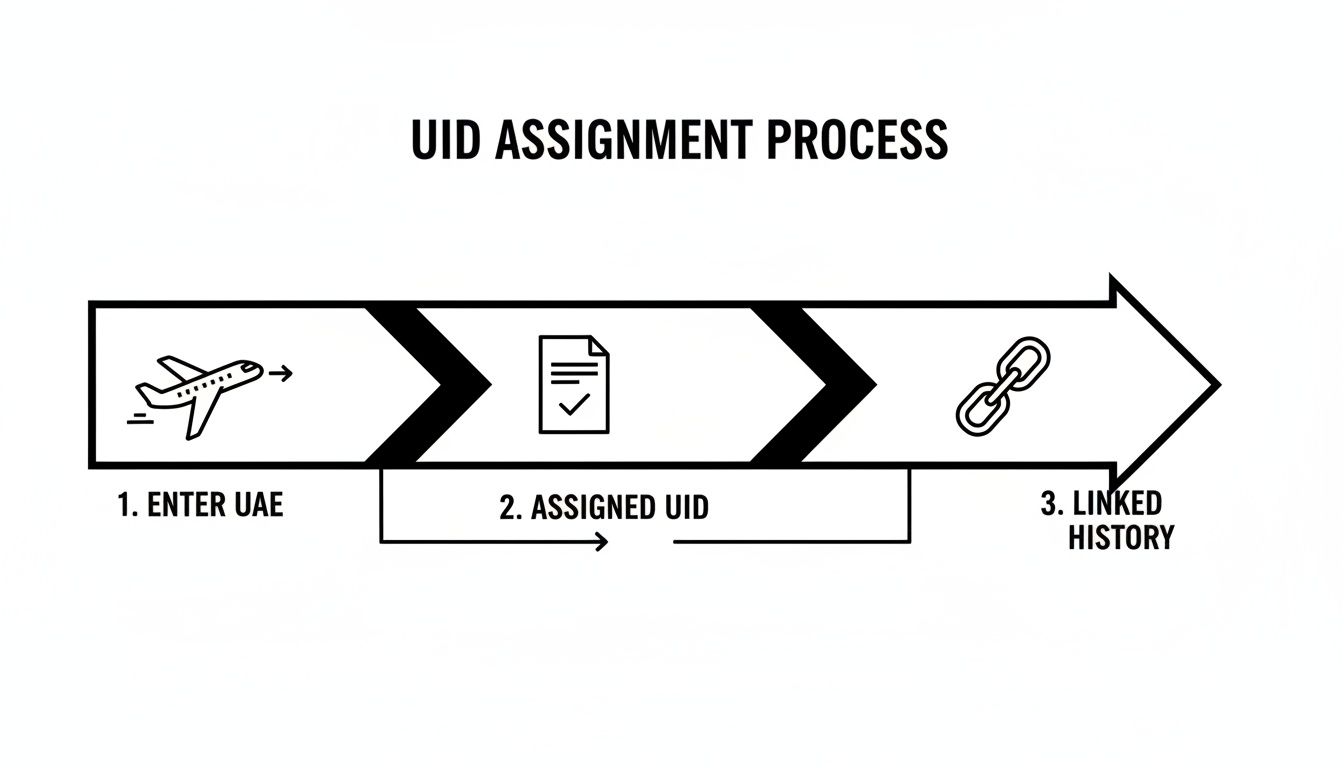
As you can see, the UID is assigned on your very first arrival. From that point on, it acts as your lifelong digital anchor for every immigration-related activity in the UAE.
Using Online Government Portals
What if you don't have your documents nearby, or the number is smudged and unreadable? No problem. You can pull up your UID online through the official government channels.
Your go-to portals are the General Directorate of Residency and Foreigners Affairs (GDRFA) for Dubai-issued visas, or the Federal Authority for Identity, Citizenship, Customs & Port Security (ICP) for visas from any other emirate.
Key Takeaway: Both the GDRFA and ICP websites have an online service to find your UID. You’ll just need your passport number, nationality, and date of birth to run the search.
These user-friendly online systems are a huge part of what makes interacting with government departments so efficient here. This digital-first approach extends to business, too, which is a major reason the UAE now has over 1.5 million active commercial licences. For investors, this translates into much faster processing times and less paperwork.
The GDRFA website, for instance, provides a simple interface for these kinds of enquiries. Once you're logged in, you can access a whole range of e-services, including finding your UID.
Many other government transactions, like those related to the Ministry of Human Resources and Emiratisation, are also handled online. If you need help with those, you can learn more in our guide on MOHRE enquiry services. By using these official platforms, you can find your number in just a few minutes, making sure you always have the right information ready for any application or service you need.
Why the Unified Number Is Critical for UAE Business Setup

For anyone looking to set up a business in the UAE, the Unified Number (UID) is far more than just an administrative detail. It's the absolute cornerstone of your entire journey. Think of it as the foundational key that unlocks the whole company formation process. Without it, your ambition to launch a new venture simply can't get off the ground.
When you apply for a trade licence—whether with the Department of Economy and Tourism (DET) in Dubai or a free zone authority—the UID is the first piece of information they check. It’s how they verify the identity and, crucially, the legal immigration status of every single shareholder and manager involved in the new company.
The Bedrock of Your Corporate Identity
This number is the primary link connecting you, the individual, to your new corporate structure. It’s the proof the authorities need to see that you are legally present in the country and eligible to own or manage a company.
A trade licence application without a valid Unified Number for each founder is an automatic non-starter. It is the non-negotiable prerequisite that validates your legal standing before any other documents are even considered.
This system is central to the UAE's integrated National Economic Registry, which keeps track of nearly 1 million active commercial licences. This growth reflects the world-class infrastructure and digital reforms that make business setup here so efficient.
The UID ensures every business is tied to legally verified individuals, which is fundamental to maintaining the integrity and security of the entire economic system.
Avoiding Delays and Rejections
One of the most common reasons we see for delays or outright rejections during company formation is a problem with a founder’s UID. This could be a missing number, a duplicated record from a previous visa, or incorrect data floating in the system. Small issues like these can stall a new venture for weeks, leading to serious frustration and lost opportunities.
This is where professional PRO services become absolutely invaluable. An experienced team will ensure every shareholder and manager has a valid, correct, and verified UID before the application is even submitted. They can dig into the system to retrieve missing numbers or merge duplicate records, clearing the path for a smooth and swift approval.
Navigating these requirements is a fundamental first step. For a detailed walkthrough of the entire process, check out our comprehensive guide on how to start a business in the UAE. Getting this foundational element right from the very beginning sets your new company up for a successful and timely launch.
When You Will Need Your Unified Number
Think of your Unified Number (UID) as the master key to your life in the UAE. Once you have it, you'll find it's needed for nearly every significant administrative step you take. It's much more than just a number for your company formation file; it's the primary way government departments and even private companies verify who you are and confirm your legal status in the country.
Without it, you simply can't move forward with many of the most essential processes. It’s the foundational piece of data that plugs you into the entire UAE system.
Key Scenarios Requiring Your UID
You'll be asked for your UID more often than you might think. Whenever you apply for a service, this number allows the relevant authority to instantly access your immigration record, ensuring you're legally entitled to proceed.
Here are just a few of the most common situations where you absolutely must have it:
- Applying for or Renewing a Residence Visa: From your very first application to every renewal down the line, your UID is non-negotiable.
- Getting Your Emirates ID: You can’t even start the Emirates ID application process without a valid Unified Number. It's the first thing they ask for.
- Opening a Bank Account: Whether it’s for your business or personal use, banks depend on your UID to verify your residency status and meet regulatory requirements.
- Setting Up Utilities: Need to get your lights and water connected with DEWA? Your UID is used to confirm your identity as a legal resident.
- Registering a Vehicle: The Roads and Transport Authority (RTA) will need your UID to link your car registration directly to your official residency file.
To give you a clearer picture, here’s a quick rundown of where this number plays a critical role.
Key Government Services Requiring Your Unified Number
The table below summarises some of the essential transactions where you will be required to provide your Unified Number. It's the central piece of information that connects different government services together.
| Service/Transaction | Purpose of UID Requirement | Governing Authority |
|---|---|---|
| Emirates ID Application | To initiate the application and link it to your visa file. | Federal Authority for Identity & Citizenship (ICP) |
| Residency Visa Stamping | To finalise your visa and confirm legal residency. | General Directorate of Residency & Foreigners Affairs (GDRFA) |
| Driving Licence Application | To verify your residency status before issuing a licence. | Roads and Transport Authority (RTA) |
| Utility Connections | To register as a resident for electricity and water services. | DEWA, SEWA, ADDC, etc. |
| Tenancy Contract (Ejari) | To officially register your rental agreement as a resident. | Real Estate Regulatory Agency (RERA) / Municipalities |
As you can see, the UID is the common thread tying all these critical administrative tasks together.
Each of these transactions relies on the UID to instantly pull your immigration record. This simple number confirms your identity and legal standing, preventing fraud and making the entire process faster and more secure for everyone involved.
Understanding when this number is needed helps you stay prepared for various administrative steps. Managing these requirements can be complex, which is why many individuals and businesses rely on professional support. Our expert team can help you navigate these processes smoothly with our dedicated PRO services in the UAE, ensuring all your documentation is handled correctly and efficiently from the start.
Got Questions About the Unified Number? We’ve Got Answers.
When you're dealing with the paperwork of living or doing business in the UAE, a few questions are bound to pop up. We get it. To make things crystal clear, here are some quick, straightforward answers to the most common queries we hear about the Unified Number.
Think of this as your go-to guide for getting the details right and avoiding any common hiccups.
Is the Unified Number the Same as an Emirates ID Number?
Nope, not at all. They are two completely different numbers that do very different jobs.
The Unified Number (UID) is your 9-digit immigration file number, which is all about tracking your history of entries, exits, and visas in the UAE. Your Emirates ID number, on the other hand, is a 15-digit identity number you use for daily life here—think opening a bank account, getting medical care, or signing a tenancy contract. While they are linked in the government's systems, you can't use one for the other.
Does My Unified Number Change if I Get a New Visa?
Absolutely not. Your Unified Number is for life. It’s assigned to you the very first time you enter the UAE and sticks with you, no matter how many times you change your visa, switch jobs, or even leave and come back to the country.
This consistency is exactly what makes it such a reliable identifier for the immigration authorities.
Key Insight: Think of your Unified Number as your lifelong digital anchor in the UAE's immigration database. It guarantees a complete, unbroken record of your time here, regardless of how your residency status might change over the years.
What Should I Do if I Can't Find My Unified Number?
First thing's first: don't panic. Take a close look at your current and any old visa documents. It’s usually printed right on your residence visa stamp or the initial entry permit you received.
If you’ve checked everywhere and still can't spot it, the official websites and mobile apps for the GDRFA (if your visa is from Dubai) or ICP (for all other emirates) are your next stop. These portals have a feature that lets you search for your UID using your passport information. If you're still stuck, a professional PRO service can track it down for you in no time, saving you the headache.
Can I Apply for a Trade Licence Without a Unified Number?
That’s a hard no. It’s completely impossible to even start a trade licence application without a UID. A valid Unified Number is a non-negotiable requirement for every single shareholder, partner, and manager who will be listed on a new business licence.
The authorities use this number to verify that you have a legal and valid status in the country before they’ll even think about issuing a licence. Getting your UID sorted is one of the very first, foundational steps in setting up any company in the UAE.
Navigating the complexities of business setup, from verifying a UID to getting that final trade licence approval, can feel like a maze. The expert team at Al Ain Business Center handles every single detail, making sure your company formation is smooth, compliant, and totally efficient.
Let us worry about the paperwork so you can get back to what you do best—building your business. Contact us today to get started.