
Value-Added Tax, or VAT, might sound complicated, but at its heart, it’s a straightforward consumption tax. It’s applied whenever value is added to a product or service as it moves through the supply chain, right from production to the final sale. In the UAE, the standard rate for VAT is a flat 5%.
Understanding How VAT Works in the UAE
Think of it like a relay race. Each business involved in creating and selling a product carries the tax “baton” for a part of the journey. They add a small amount of tax based on the value they’ve contributed before passing it on. In the end, it’s the final customer who pays the total tax collected along the entire route.

Before VAT was introduced on 1 January 2018, the UAE and its GCC neighbours heavily depended on oil revenues. Bringing in VAT was a major strategic move to diversify the economy and establish a more reliable, long-term source of government income.
This new revenue stream isn’t just about numbers on a spreadsheet; it directly pays for the public services we all rely on—hospitals, schools, roads, and other essential infrastructure projects that benefit everyone living and working in the country.
The core idea is simple: tax is only applied to the value a business adds. Let’s take a local bakery as an example. The baker buys ingredients like flour, sugar, and eggs from a supplier and pays VAT on those raw materials. This is called Input VAT.
Then, the bakery turns those ingredients into a cake, adding value through skill, labour, and branding. When a customer buys that cake, the bakery charges VAT on the final price. The tax collected from the customer is known as Output VAT. The bakery doesn’t pocket all of this; it simply subtracts the Input VAT it already paid on ingredients and sends the remaining amount to the Federal Tax Authority (FTA).
A Practical Example of the VAT Flow
Let’s follow a simple wooden chair on its journey to see this in action:
- The Lumber Mill: A mill sells AED 100 worth of raw wood to a furniture maker. It adds 5% VAT (AED 5), making the total bill AED 105. The mill then pays this AED 5 to the FTA.
- The Furniture Maker: The furniture maker buys the wood for AED 105, paying AED 5 in Input VAT. They craft a chair and sell it to a retail shop for AED 300, adding 5% VAT (AED 15) to the invoice.
- Calculating the Remittance: The furniture maker collected AED 15 in Output VAT but already paid AED 5 in Input VAT. They only need to send the difference (AED 15 – AED 5 = AED 10) to the FTA.
- The Retail Shop: The retailer buys the chair for AED 315, which includes AED 15 of Input VAT. They display it in their showroom and sell it to a customer for AED 500, plus 5% VAT (AED 25).
- The Final Transaction: The customer pays a total of AED 525. The retailer collected AED 25 in Output VAT and paid AED 15 in Input VAT. They remit the difference (AED 25 – AED 15 = AED 10) to the FTA.
In this chain, the total VAT collected by the FTA is AED 5 + AED 10 + AED 10 = AED 25. Notice how this is exactly 5% of the final AED 500 price the customer paid. The tax is collected in stages, but the final consumer ultimately bears the cost.
This multi-stage collection is what makes VAT such an efficient and broad-based tax. To really get to grips with the concept, it helps to understand the general principles behind it. A good starting point is a guide that explains what Value-Added Tax (VAT) is in broader terms. Mastering this core mechanism is the first step toward managing your VAT compliance successfully.
Getting Started with VAT: Registration and Thresholds
Getting your Value-Added Tax (VAT) registration sorted is one of the first, most critical steps for any business operating in the UAE. Think of it less as a bit of admin and more as a legal cornerstone that shows your company is compliant with the country’s tax laws. Trust me, you don’t want to get this wrong—failing to register on time can bring some hefty penalties, so understanding the thresholds isn’t just important, it’s essential.
The whole process kicks off by figuring out if your business even needs to register. The Federal Tax Authority (FTA) has laid out some very clear financial benchmarks based on your turnover from taxable supplies and imports.
Do You Need to Register? Understanding the Thresholds
The registration thresholds are what determine if and when you must register for VAT. In the UAE, there are two main categories: mandatory registration and voluntary registration. This tiered system is smart—it ensures larger businesses are definitely in the system while giving smaller enterprises the flexibility to join if it makes financial sense for them.
Let’s break down the current thresholds:
- Mandatory Registration: If the total value of your taxable supplies and imports has gone over AED 375,000 in the last 12 months, you must register for VAT. The same rule applies if you have good reason to believe you’ll cross that line in the next 30 days.
- Voluntary Registration: Did your turnover from taxable supplies and imports fall between AED 187,500 and the mandatory AED 375,000 threshold? If so, you have the option to register. This can be a really strategic move, as it lets you claim back the input VAT you pay on your business purchases.
To make it even clearer, here’s a quick summary of the thresholds.
UAE VAT Registration Thresholds at a Glance
This table breaks down the key figures and who they apply to, helping you quickly identify where your business stands.
| Registration Type | Annual Taxable Supplies & Imports Threshold (AED) | Who It Applies To |
|---|---|---|
| Mandatory | Exceeds AED 375,000 | Any business whose turnover has crossed this threshold in the past 12 months or expects to in the next 30 days. |
| Voluntary | Between AED 187,500 and AED 375,000 | Smaller businesses that want to reclaim input VAT on their expenses and appear more established. |
Staying on top of these thresholds is crucial for compliance. Missing your registration window can lead to unwanted penalties, so regular monitoring is key.
A Quick Word of Advice: It’s vital to keep a constant eye on your revenue. That 12-month period is a rolling window, not just the calendar year. This means you should always be looking back over the last 12 months to make sure you don’t accidentally sail past your registration deadline.
Since its introduction, VAT has become a huge part of the UAE’s financial strategy, helping to create a more stable and diverse economy. For businesses, this has meant getting used to new processes, especially for those with taxable supplies over the AED 375,000 mark. This often means serious updates to accounting and invoicing systems. To help with this, the government has been pushing digital solutions, like the phased rollout of e-invoicing that kicked off in 2023. You can get a better sense of this shift by exploring e-invoicing trends across the Middle East.
The VAT Registration Process Itself
Once you’ve established that you need to register, the next step is to get your application done on the FTA’s online portal. The whole thing is digital, which is great, but you’ll need to have a few specific documents ready to go.
Here’s what you’ll need to have on hand:
- A copy of your business’s trade licence.
- Passport and Emirates ID copies for the business owner and any partners.
- Your company’s contact details and physical address.
- The official bank account details for the business.
- An income statement covering the last 12 months.
- A declaration stating your expected turnover for the next 30 days.
Should You Consider a VAT Tax Group?
For businesses that own or are linked to multiple entities, forming a VAT Tax Group can be a very clever move. This allows two or more associated legal persons, both resident in the UAE, to register as a single entity for VAT purposes.
The biggest win here is simplified admin. Instead of each company filing its own VAT return, the group files one consolidated return. Even better, any transactions between the members of the tax group are completely disregarded for VAT purposes, which can be a real boost for your cash flow. The main condition is that one entity must control the others, or all the entities must be controlled by the same party.
Understanding all your obligations is key, and our experts are always here to provide detailed guidance on all tax-related matters in the UAE.
VAT Rates: Zero-Rated vs Exempt Supplies
While the standard 5% VAT rate is what most people see day-to-day, the UAE’s VAT system has some critical details that every business owner needs to grasp. Not all transactions are treated equally, and two categories that often cause confusion are zero-rated and exempt supplies.
At first glance, they seem the same. In both cases, your customer doesn’t pay any VAT. But for your business, they are worlds apart. The difference all comes down to whether you can reclaim the Input VAT you paid on your business costs. Getting this wrong is a common and surprisingly costly mistake.
The Power of Zero-Rated Supplies
Think of a zero-rated supply as a transaction that’s still very much inside the VAT system, but it’s simply taxed at 0%. Because it’s technically a taxable supply, you can reclaim the Input VAT paid on any costs associated with making that sale.
This is a huge advantage. It means the VAT doesn’t become a hidden cost eating into your profit margins. The government often applies this 0% rate to support key sectors of the economy, like international trade, helping UAE businesses stay competitive on a global stage.
Common examples of zero-rated supplies in the UAE include:
- Exports of Goods and Services: Selling a product or service to a customer located outside the GCC implementing states.
- International Transportation: This covers services for transporting passengers and goods that either start or end in the UAE.
- Certain Educational Services: Services provided by qualified nurseries, preschools, and schools, along with the goods directly related to them.
- Specific Healthcare Services: This includes preventive and essential healthcare services and related medical goods.
Before you can even classify your supplies, your business needs to be in the VAT system. This flowchart breaks down the registration thresholds.
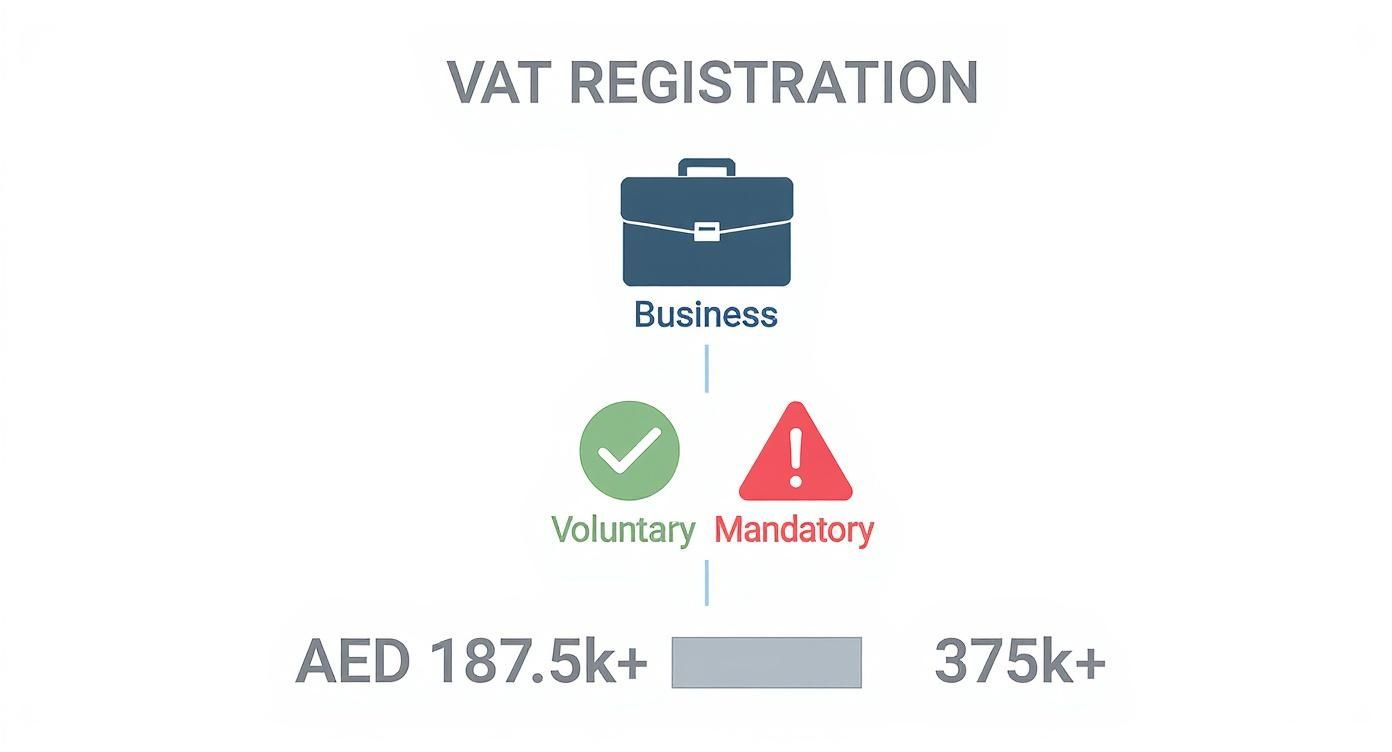
As you can see, registration becomes mandatory once your turnover hits AED 375,000, with a voluntary option available from AED 187,500. This is the gateway to managing your VAT obligations.
Understanding Exempt Supplies
Now, let’s look at exempt supplies. These transactions are completely outside the scope of VAT. You don’t charge VAT on the sale, but here’s the catch: you also cannot recover any of the Input VAT you paid on costs related to that supply.
That unrecovered VAT becomes a direct cost to your business, which you’ll likely have to absorb or build into your pricing. Exemptions are usually applied for social policy reasons to sectors where charging VAT might be complicated or inappropriate.
A simple way to remember it: Zero-rated supplies are IN the VAT system (at 0%), which is why you can reclaim Input VAT. Exempt supplies are OUT of the VAT system, which is why you can’t.
In the UAE, the main categories of exempt supplies are:
- Certain Financial Services: Think loans, mortgages, and issuing credit. This doesn’t include services provided for a clear fee, like financial advisory.
- Bare Land: The sale or lease of undeveloped land is exempt.
- Local Passenger Transport: Services like a local bus or taxi ride within the UAE.
- Residential Properties: While the very first sale of a new home can be zero-rated, any subsequent sales or leases are typically exempt.
A Head-to-Head Comparison
For any business dealing with a mix of standard-rated, zero-rated, and exempt goods or services, meticulous bookkeeping is non-negotiable. You have to correctly track and apportion your input tax to figure out exactly what you can claim back. A mistake here could lead to an incorrect VAT return and unwelcome penalties from the Federal Tax Authority (FTA).
Here’s a clear breakdown to keep things straight:
| Feature | Zero-Rated Supplies | Exempt Supplies |
|---|---|---|
| VAT Rate Charged | 0% | Not applicable (outside VAT scope) |
| Input VAT Recovery | Yes, input tax is fully recoverable. | No, input tax is not recoverable. |
| Inclusion in Return | Must be reported on the VAT return. | Must be reported on the VAT return. |
| Impact on Business | No VAT cost to the business. | VAT paid on costs becomes a business expense. |
Calculating Your Net VAT Payment
This is where the rubber meets the road—where VAT theory turns into a practical, day-to-day task for your business. Figuring out your net VAT payment is the absolute core of your compliance duties. Think of it as a simple balancing act between the tax you’ve collected and the tax you’ve already paid out.
The whole process boils down to two key components: Output VAT and Input VAT. Getting a solid grip on how these two interact is essential for filing your returns accurately and keeping your cash flow healthy. Let’s break it down with a scenario we can all relate to.

Output VAT: The Tax You Collect
Imagine you own a bustling coffee shop in Dubai. Every time you sell a cappuccino, a croissant, or a bag of specialty beans, you add 5% VAT to the customer’s bill. This amount you collect on behalf of the government is your Output VAT.
Essentially, you’re acting as a temporary tax collector for the Federal Tax Authority (FTA). This money isn’t yours to keep; you’re simply holding onto it until it’s time to file your VAT return.
Let’s say in one month, your coffee shop pulls in total sales of AED 100,000 (before VAT). The Output VAT you’d collect on these sales looks like this:
- AED 100,000 (Total Sales) x 0.05 (5% VAT Rate) = AED 5,000 (Output VAT)
For that month, you’ve collected AED 5,000 in Output VAT that belongs to the FTA. Simple enough.
Input VAT: The Tax You Pay (and Get Back!)
Now, while you were busy serving customers, you were also buying things to keep the business running. You bought coffee beans from your supplier, milk from the dairy, and paper cups from a packaging company. On every single one of these business-related purchases, you paid 5% VAT. This is your Input VAT.
Here’s the good part. As a VAT-registered business, you get to reclaim this Input VAT. It’s the clever mechanism that ensures tax is only paid on the “value added” at each step of the supply chain.
Let’s say during that same month, your total business expenses came to AED 40,000 (before VAT). The Input VAT you paid would be:
- AED 40,000 (Total Expenses) x 0.05 (5% VAT Rate) = AED 2,000 (Input VAT)
This AED 2,000 is the amount you can claim back from the FTA.
The Final Calculation: What You Actually Owe
Time to bring both sides of the equation together to see what you actually need to pay. The formula is beautifully simple and is the foundation of your VAT return.
Net VAT Payable = Output VAT – Recoverable Input VAT
Using our coffee shop example, the numbers are:
- Output VAT Collected: AED 5,000
- Input VAT Paid: AED 2,000
So, the calculation is just: AED 5,000 – AED 2,000 = AED 3,000.
This AED 3,000 is the net amount your coffee shop owes the FTA for that tax period. It’s the straightforward difference between the tax you collected from customers and the tax you paid to your suppliers.
Keeping meticulous records of both is non-negotiable for getting your filings right. For businesses handling tons of invoices, tools like Intelligent Document Processing (IDP) can be a lifesaver, automating the heavy lifting of pulling VAT data from your documents.
Nailing this calculation is central to smart financial management. To see how this fits into the bigger picture, check out our detailed guide on business accounting services.
Filing VAT Returns and Avoiding Penalties
Getting your head around VAT calculations is one thing, but it’s only half the battle. The next critical step is filing your VAT return correctly and on time with the Federal Tax Authority (FTA). This is where your diligent bookkeeping meets official compliance, and mastering this process is essential to avoid some hefty—and completely avoidable—penalties.
Staying on the right side of the FTA isn’t just about paying what you owe; it’s about sticking to their deadlines. For most businesses here in the UAE, this means settling into a regular reporting rhythm.
Understanding Tax Periods and Deadlines
The standard tax period for VAT returns in the UAE is quarterly. That means you’ll be filing a return and squaring up any payments once every three months. However, for some larger businesses, particularly those with a very high annual turnover, the FTA might put them on a monthly cycle. It’s crucial to log into your FTA portal and confirm which schedule applies to you.
The deadline for filing your VAT return and settling the bill is firm.
You must submit your VAT return and pay any tax due no later than the 28th day of the month that follows the end of your tax period. This applies whether you’re on a quarterly or monthly schedule.
Let’s say your quarter ends on 31 March. Your VAT return and payment must be with the FTA by 28 April. Missing that date, even by a day, triggers automatic penalties.
What Information Goes into a VAT Return?
Think of your VAT return as a summary of all your business’s VAT-related activities for that period. It demands a clear trail of every sale and purchase you’ve made. On the FTA’s e-services portal, you’ll need to report the following figures for each Emirate you operate in:
- Total Sales and All Outputs: The full value of all goods and services you’ve sold.
- Standard-Rated Supplies: All your sales that are subject to the 5% VAT rate.
- Zero-Rated Supplies: Things like exports and other sales that are taxed at 0%.
- Exempt Supplies: Any sales that are completely exempt from VAT.
- Total Purchases and All Inputs: The total value of goods and services you’ve bought for the business.
- Standard-Rated and Recoverable Inputs: Your business expenses where you paid 5% VAT and are eligible to claim it back.
This breakdown makes it crystal clear why organised bookkeeping is non-negotiable. Without accurate records, filling out your VAT return correctly is next to impossible. Getting this right is a cornerstone of good financial compliance and keeps your business protected.
The Cost of Non-Compliance: Penalties
The FTA has a very straightforward penalty system. It’s not there to punish businesses but to ensure the system runs smoothly and fairly for everyone. Knowing what’s at stake is often the best motivation to get things right from the start.
Common Penalties Include:
- Late Registration: If you fail to register for VAT within the required timeframe, there’s a fixed penalty of AED 20,000.
- Late Filing: Forgetting to file on time will cost you AED 1,000 the first time. If it happens again within 24 months, that fine doubles to AED 2,000.
- Late Payment: This is a percentage-based penalty. It starts at 2% of the unpaid tax amount immediately after the due date and climbs the longer the amount remains unpaid.
By understanding these timelines and what’s required, you can build a solid process for managing your VAT filings. This will give you the confidence that you’re staying in good standing with the FTA and keeping your business on the right track.
Handling Special VAT Scenarios
Once you’ve got the basics of VAT down, you’ll find there are a few special situations that pop up, especially for businesses dealing with international trade or operating in the UAE’s unique economic landscape. These scenarios aren’t day-to-day for every business, but for those they affect, getting them right is non-negotiable for staying compliant and avoiding some nasty surprises from the tax authority.
Three of the most common curveballs you’ll encounter are the Reverse Charge Mechanism, dealing with Designated Zones (often just called Free Zones), and the rules around exporting goods and services. Each one has its own playbook, and understanding it can seriously change how you handle your VAT accounting.
The Reverse Charge Mechanism Explained
Normally, business is simple: the supplier charges VAT, and the buyer pays it. The Reverse Charge Mechanism flips this completely. It’s mainly used when a UAE-based business buys goods or services from a supplier outside the country. Since that international supplier isn’t registered for VAT here, they can’t very well charge it.
So, what happens? The responsibility to account for the VAT reverses and lands on the buyer—the UAE business. You essentially act as both the supplier and the buyer in your own books. You calculate the VAT on the import and declare it on your return as an output tax (like you charged it) and an input tax (like you paid it).
For most businesses that make taxable sales, these two entries perfectly cancel each other out. The net cash impact is AED 0. The whole point is to make sure VAT is collected on imports, which levels the playing field so international suppliers don’t have an unfair price advantage over local ones.
A Practical Example of Reverse Charge
Let’s make this real. Imagine your marketing agency in Dubai hires a brilliant freelance graphic designer from the UK for a project costing AED 10,000. The UK designer, not being registered here, sends an invoice for AED 10,000 flat—no UAE VAT.
Here’s how you, the Dubai agency, handle the VAT on your end:
- Calculate the VAT: First, you figure out the 5% VAT on the service. That’s AED 10,000 x 0.05 = AED 500.
- Report as Output Tax: On your VAT return, you declare that AED 500 as output tax you owe.
- Report as Input Tax: In the very same return, you claim that AED 500 back as recoverable input tax.
The end result? You don’t actually pay anything extra to the FTA for this transaction, but you’ve reported it transparently and correctly. Forgetting to apply the reverse charge is a common slip-up that can lead to compliance issues.
Navigating Designated Zones and Exports
The UAE’s Designated Zones have their own special set of VAT rules that make them different from mainland operations. For VAT purposes, these zones are treated as if they are outside the UAE, which leads to some interesting situations.
- Goods Moved Between Designated Zones: Transferring goods from one Designated Zone to another is generally not subject to VAT, as long as you follow the proper customs procedures.
- Goods Sold Inside a Designated Zone: A sale of goods within the same zone can also be outside the scope of VAT, but it depends on what the goods are and how they’ll be used.
- Services Provided to Designated Zones: This is where it gets tricky. Services are treated differently. If you provide a service to a company inside a Designated Zone, the standard UAE VAT rules usually apply.
The key takeaway for Designated Zones is that the VAT treatment depends heavily on whether you are dealing with goods or services and where the transaction takes place. It is not a blanket exemption from VAT.
On the other hand, when your business exports goods or services to a customer outside the GCC implementing states, the sale is often zero-rated. This is fantastic news for exporters. It means you charge 0% VAT but can still claim back all the input VAT you paid on your costs related to making that sale. It’s a powerful incentive designed to make UAE businesses more competitive on the world stage.
To qualify for this zero-rating, you absolutely must have solid proof that the goods or services actually left the country. This means keeping meticulous records, like official exit certificates, customs declarations, and transport documents. Without this paper trail, the Federal Tax Authority (FTA) could decide your sale was standard-rated after all, leaving you with an unexpected and unwelcome tax bill.
Answering Your Most Common VAT Questions
Even after you get the hang of the basics, VAT can throw some tricky situations your way. Let’s tackle some of the most frequent questions we hear from business owners, breaking them down into clear, practical answers.
Zero-Rated vs. Exempt: What’s the Real Difference?
This is a big one, and it all boils down to whether you can reclaim the VAT you’ve paid on your business expenses (your input tax).
With zero-rated supplies, like goods you export outside the UAE, you charge your customer 0% VAT. The crucial part is you can still claim back all the VAT you paid on costs related to making that sale. This keeps your business from absorbing tax costs on international sales.
On the other hand, exempt supplies, such as certain local financial services, mean you don’t charge VAT to the customer. However, the catch is you also cannot recover the VAT you paid on your expenses. That VAT becomes a sunk cost, eating directly into your profit margin.
What Records Do I Absolutely Need to Keep for an Audit?
Think of your records as the ultimate proof of your VAT compliance. The Federal Tax Authority (FTA) is serious about record-keeping and requires you to hold onto everything for a minimum of five years. If they come knocking for an audit, you’ll need these documents ready.
Here’s a quick checklist of the essentials:
- Every tax invoice you’ve issued and every one you’ve received.
- All credit and debit notes.
- Clear records of all goods imported and exported.
- Documentation for any goods or services you’ve used or provided.
- A complete log of all your sales and purchases.
Help! I Made a Mistake on a Past Return. What Now?
Don’t panic—it happens. If you find an error on a VAT return you’ve already filed, the correct step is to submit a voluntary disclosure to the FTA.
This is essentially a formal notice where you transparently correct the mistake. It’s far better to be proactive about it. Bringing the error to the FTA’s attention yourself shows good faith and can help you avoid or reduce the penalties that would likely be applied if they discovered it first.
The UAE was a pioneer in the region, rolling out its VAT system on 1 January 2018, as part of a wider GCC initiative to diversify government revenue. It was a major shift for businesses here. For a deeper dive into this journey, you can read more about the lessons learned from the GCC’s VAT implementation on accaglobal.com.
Getting VAT right, from the initial registration to the final filing, takes time and know-how. Let Al Ain Business Center take the tax and accounting burden off your shoulders. We’ll ensure you stay fully compliant, so you can pour your energy into what you do best—growing your business. Get expert VAT assistance today.