
So, you're thinking about a career in the United Arab Emirates? It's an incredible prospect, but the first thing you need to get your head around is the UAE work visa requirements.
The good news is your employer acts as your legal sponsor and handles most of the heavy lifting. They’ll kick things off with an entry permit, and once you’re in the country, you'll complete the necessary medical tests and give your biometrics for an Emirates ID. This guide will walk you through the entire journey, breaking it down into clear, manageable steps.
Starting Your Journey to Work in the UAE
A work visa in the UAE is more than just a stamp in your passport; it's your ticket to legally live and work in one of the most dynamic economies on the planet. For nearly every expat, the journey doesn't start with filling out a visa form, but with landing a job offer. Your future employer is your sponsor, and it's their job to initiate and navigate the whole administrative process for you. Think of them as the captain steering your ship through all the necessary approvals.
For a long time, the standard two-year employment visa, which ties you directly to your sponsoring company, was the main path. But the UAE's approach to attracting talent has grown far more sophisticated.
A New Landscape of Opportunity
The government has really leaned into the global shift towards flexible work, recognizing the need to attract and keep specialized talent. As a result, they've rolled out several alternative pathways that offer more long-term stability and autonomy for skilled individuals.
The main visa categories you'll hear about now include:
- Standard Employment Visa: The classic two-year, employer-sponsored permit.
- Green Visa: A five-year, self-sponsored visa designed for skilled professionals, freelancers, and investors who want more flexibility.
- Golden Visa: A prestigious ten-year visa for top-tier professionals, scientists, entrepreneurs, and investors.
- Virtual Work Visa: A one-year permit that lets you live in the UAE while working remotely for a company based somewhere else.
This isn't just a random assortment of new rules; it's part of a bigger strategy to make the UAE a global talent magnet. Between 2021 and 2025, the country significantly broadened its visa options. This move happened right as the expat population was hovering around 88-89% in 2021. Pushing new categories like the Green and Golden Visas is a clear signal that they want to attract professionals who are looking to build long-term careers in the region. You can dig deeper into how these immigration laws are shaping the UAE's talent market.
The Core Process at a Glance
No matter which visa you're aiming for, the fundamental process follows a pretty logical sequence. It all starts while you're still outside the UAE, with your employer securing an entry permit. This is what allows you to travel to the country in the first place.
Your entry permit is not the final visa. It’s a temporary pass that gets you into the UAE so you can complete the rest of the steps. This is a crucial distinction that often trips up first-time applicants.
Once you land, a 60-day clock starts ticking. During this window, you have to complete the in-country formalities. This means a mandatory medical fitness test to screen for certain communicable diseases and a biometrics appointment where your fingerprints and photo are taken for your Emirates ID. Only after you’ve successfully cleared these hurdles will the official residence visa be stamped into your passport, making your status as a resident official.
Your Step-by-Step Visa Application Timeline
Navigating the UAE work visa requirements can feel like you're trying to assemble a complex puzzle. The good news? Once you see it as a clear, step-by-step timeline, it all starts to make sense. The whole process is a team effort between you and your new employer, who acts as your sponsor.
Getting a handle on each stage helps you know what's coming next and avoid those common, frustrating delays.
The journey kicks off the second you accept that job offer. From there, your employer takes the lead, handling the critical first steps from within the UAE. This is all about getting the foundational approvals sorted before you even think about packing your bags.
Stage 1: The Pre-Arrival Preparations
Before you can fly into the UAE to start your new role, your employer needs to lock in two key approvals from the Ministry of Human Resources and Emiratisation (MoHRE).
- Work Permit Approval: First up, your employer applies for a work permit, sometimes called a visa quota approval. This is basically the government confirming that the company is a legitimate, registered business in the UAE with the green light to hire a foreign national for your specific position. The ministry is essentially checking that all the corporate paperwork is in order.
- Signed Employment Contract: Once that permit is approved, your employer will draft the official employment contract. This document, which has to follow UAE Labour Law, gets sent over to you for your signature. It’s absolutely vital to review it carefully before signing, as this is the contract that gets filed with MoHRE.
With these two things in hand, your employer can now apply for your Employment Entry Visa. You might hear this called a "pink visa." This is your official permission slip to enter the UAE for the specific purpose of starting your job. It's typically valid for 60 days from the issue date, giving you a solid two-month window to make the move.
Stage 2: Arriving and Starting the Clock
The moment you land in the UAE, a critical clock starts ticking. That 60-day validity on your entry permit is now a countdown timer for getting all the in-country procedures done. You really want to get moving on this next phase right away to make sure everything is wrapped up in time.
This flowchart breaks down the three main things you'll do once you're in the country: get the entry permit stamped, go for your medical fitness test, and get your Emirates ID biometrics done.
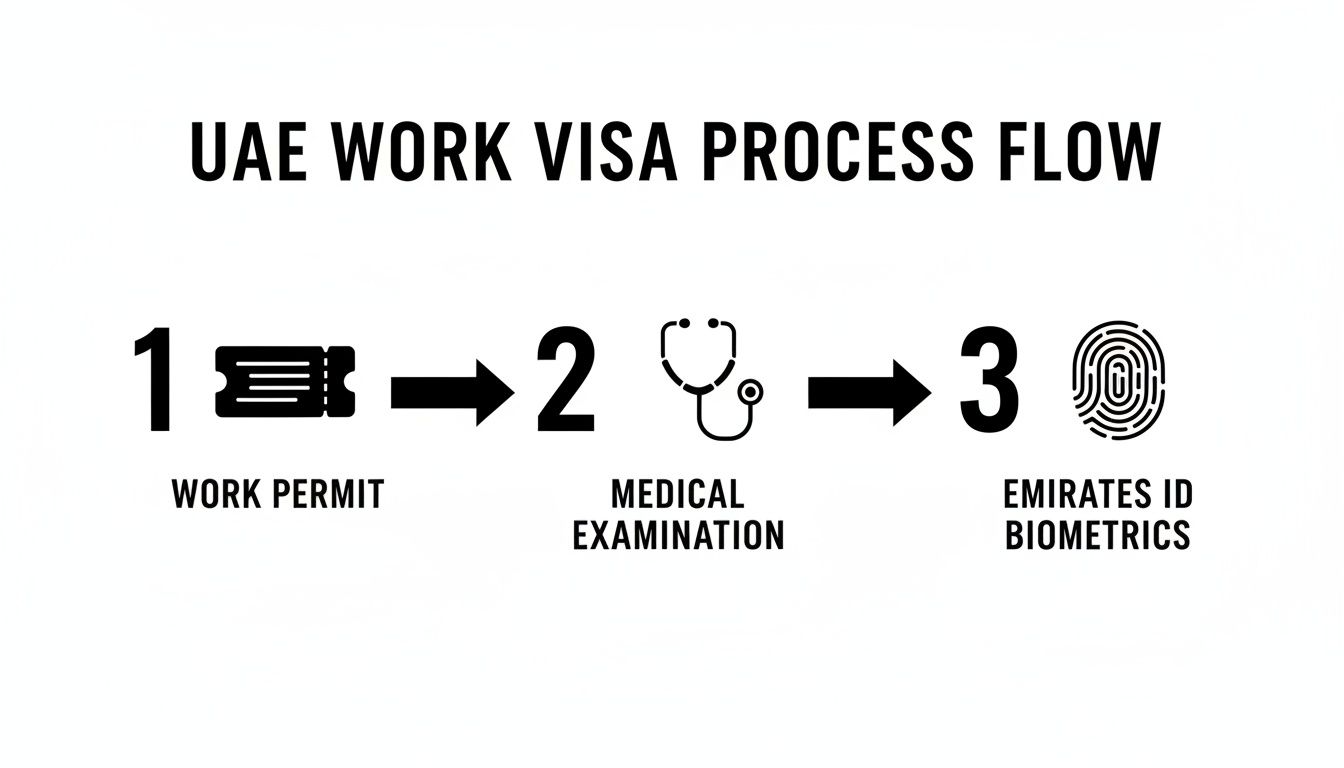
This visual shows how you progress from entering the country to becoming an official resident, with each step unlocking the next one.
Your employer, or their Public Relations Officer (PRO), will be your guide through these appointments. The first step is usually applying for your Emirates ID.
Your Emirates ID is a legal must-have for all residents. You can't even move on to the medical screening without it. You'll need to visit an official center to give your biometric data—that means fingerprints and a photograph.
Stage 3: Finalizing Your Residency
With your biometrics in the system, the next checkpoint is the mandatory medical fitness test. This is done at a government-approved health center where they'll screen for certain communicable diseases. The results are sent electronically straight to the immigration authorities, usually within 24-48 hours.
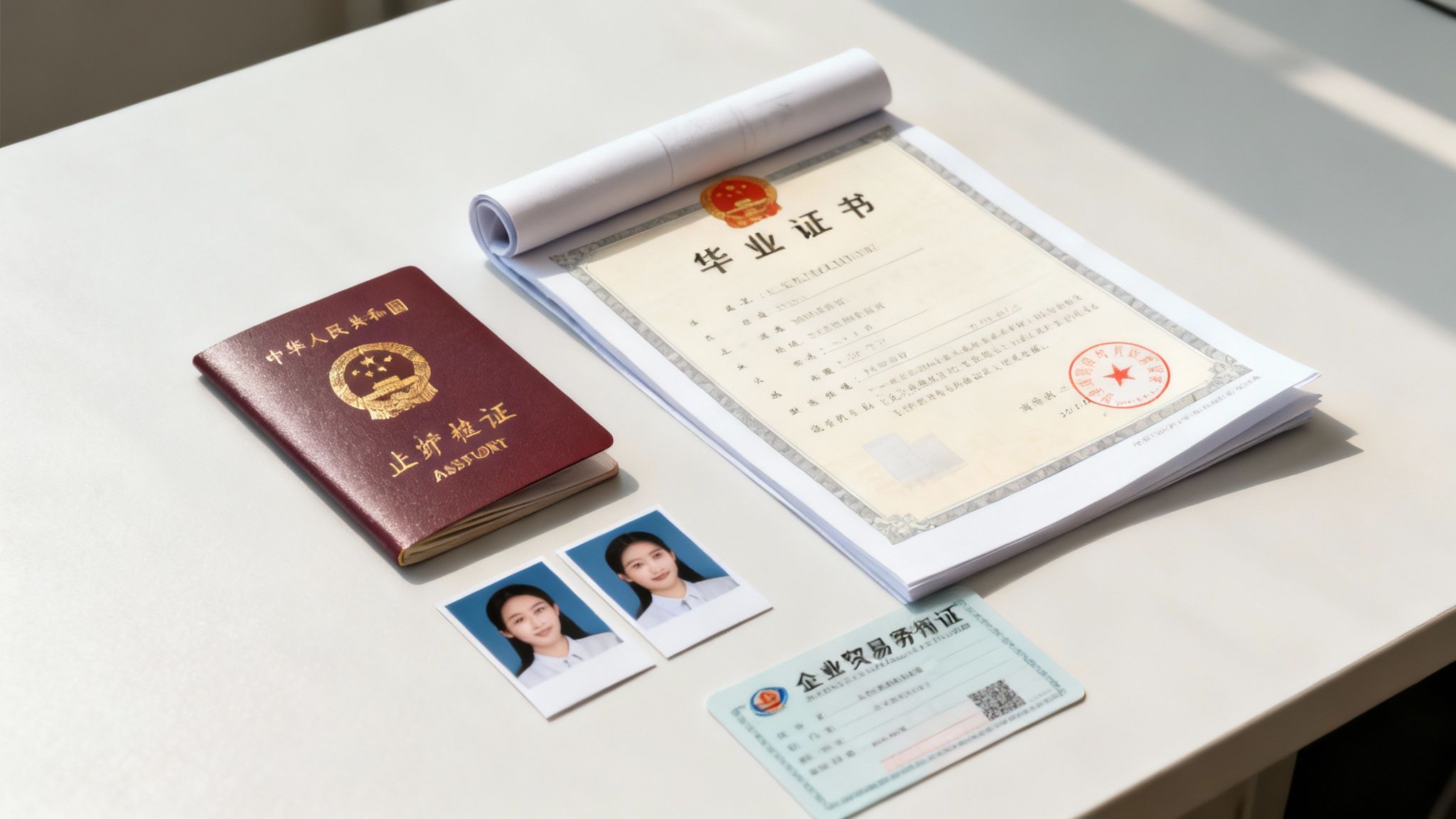
Once you get the medical all-clear, your employer gathers up all the paperwork and submits it to the immigration authorities. This final bundle includes:
- Your original passport
- The entry permit
- Your medical fitness certificate
- The Emirates ID application receipt
- Passport-sized photos
- Copies of the employer's trade license and establishment card
This final application is for your Residence Visa. If you want to dive deeper into this part of the journey, our complete guide on how to get a residence visa in Dubai breaks it all down.
The last, most rewarding step is getting your passport back with the official residence visa stamped inside. That stamp is your legal right to live and work in the UAE. Shortly after that, your physical Emirates ID card will arrive, which will become your go-to identification for everything from opening a bank account to renting an apartment.
The Essential Document Checklist For Your Application
Getting your paperwork in order is hands-down the most critical step in the UAE work visa process. I can't stress this enough. Think of it like a pre-flight check before a long-haul flight; missing even one small item can ground the entire operation before it even takes off. From my experience, simple mistakes or forgotten documents are the number one reason for frustrating and costly delays.
This section is your definitive checklist to get everything right the first time. We’ll break it down into two simple categories: the documents you, the employee, need to sort out, and the ones your new employer will handle.
Nailing this part ensures a much smoother journey through the Ministry of Human Resources and Emiratisation (MoHRE) and immigration channels.
Documents Required From The Employee
Alright, this is your part of the deal. As the applicant, you’re responsible for a handful of key personal documents that prove who you are, what you've accomplished, and that you're fit to live and work here. Treat this list as your personal action plan.
To help you stay organized, here’s a quick rundown of the essential documents you'll need to prepare for your UAE work visa. Each one has specific requirements, so it's worth double-checking the details.
Employee Document Checklist for UAE Work Visa
| Document | Key Requirements and Notes |
|---|---|
| Valid Passport | Must have at least six months of validity left from your planned entry date. You'll also need a minimum of two blank pages for stamps. |
| Passport-Sized Photos | Recent, high-quality photos with a plain white background are a must. Don't try to print these at home; go to a professional who knows the specific UAE visa photo standards. |
| Educational Certificates | For most professional roles, you'll need your highest degree (e.g., Bachelor's, Master's). This isn't just a photocopy—it needs to be officially attested. |
That last point—attestation—is a big one. It's a formal verification process that often catches people off guard if they haven't been through it before.
What is Attestation?
Think of attestation as an official chain of stamps that confirms your educational degree is the real deal. It usually starts with a verification from the Ministry of Foreign Affairs in your home country, followed by a stamp from the UAE Embassy there. The final seal of approval comes from the Ministry of Foreign Affairs (MoFA) here in the UAE.
Documents Required From The Employer
While you're busy gathering your personal papers, your employer—your sponsor—has its own set of corporate documents to get ready. These files prove the company is a legitimate, legally operating business with the green light to hire foreign talent.
Their checklist usually includes things like:
- A valid copy of the company’s Trade Licence.
- A copy of the firm's Establishment Card from the immigration authority.
- The signed employment contract or offer letter that has been officially approved by MoHRE.
Your employer’s Public Relations Officer (PRO) will be the one submitting these corporate documents along with yours. While the process has its unique UAE quirks, it's interesting to see how it lines up with other international systems. For a broader perspective, this guide on general work permit application requirements offers some great insights into common global standards.
This teamwork between you and your employer is what gets the application moving. Once everything is compiled, this package forms the foundation for your entry permit, medical test, and, finally, your Emirates ID. For a deep dive into what comes next, you can learn how to get an Emirates ID in our dedicated guide.
What to Expect for Costs and Processing Times
When you’re budgeting for a move to the UAE, it’s easy to focus on the big-ticket items like flights and a new apartment. But the costs and timelines for your work visa are just as important. Getting a handle on these numbers helps you and your employer set realistic expectations and sidesteps any last-minute financial surprises.
Legally, your sponsor is on the hook for these expenses, but knowing what’s involved gives you a much clearer picture of the investment they're making. Think of it as a series of small, predictable steps. Each stage, from the initial entry permit to getting that final visa sticker in your passport, has its own government fee and a typical waiting period. These can shift a bit depending on which emirate you’re in (Dubai is often a little different from Abu Dhabi, for example) or if your company pays extra for fast-track services.
A Breakdown of Typical Visa Costs
Figuring out the fees for a UAE work visa can seem a bit opaque at first, but they usually fall within a standard range. The final bill is just the sum of several smaller government charges that are paid at different points in the process.
Here’s a quick look at where the money goes:
- Entry & Work Permit: This is the first hurdle. It’s the initial fee to get the process started and secure your official permission to enter the UAE for work.
- Medical Fitness Test: The cost for your mandatory health check-up depends on how quickly you need the results. The standard option is the most affordable, but you can pay a premium for 24-hour or VIP services.
- Emirates ID Application: There’s a fixed fee to issue your Emirates ID, the essential resident identification card that's usually valid for two years.
- Visa Stamping: This is the last fee paid to immigration. It covers the cost of physically placing the official residence visa into your passport.
While your employer will be the one footing the bill, the total cost for a standard two-year work visa generally lands somewhere between AED 3,000 and AED 7,500. This estimate covers all the government fees, medical tests, and related administrative charges.
Mapping Out the Processing Timeline
Just as crucial as the cost is knowing how long it all takes. Getting from the initial application submission to having your Emirates ID in hand isn’t an overnight thing. It takes a bit of patience and good coordination.
The whole timeline can be split into a few key phases, each with its own average waiting game.
Estimated Time for Each Stage
-
Getting the Entry Permit: Once your employer submits the application with your signed offer letter, it usually takes about 5 to 7 working days for your entry permit (often called the "pink visa") to be issued.
-
In-Country Steps: The moment you land in the UAE, a new clock starts ticking. You'll get your medical test done, with results typically ready in just 24 to 48 hours. Soon after, you can book your biometrics appointment for the Emirates ID.
-
Final Stamping and ID Card: After all the paperwork is in—including your medical clearance—the final visa stamping in your passport takes another 5 to 7 working days. Your physical Emirates ID card is usually delivered a few days after that.
All in all, the process is pretty efficient. From start to finish, you can expect the entire journey for a standard work visa in Dubai to take about 1 to 2 months. That timeline covers everything from the initial ministry approval right through to the final issuance of your Emirates ID. You can find more details on the specific Dubai work visa costs and timelines to see how it all adds up.
Having these timeframes in mind makes planning your actual move much smoother. It helps you coordinate leaving your home country, booking temporary accommodation, and organizing your first few weeks in the UAE without the added stress of the unknown.
Exploring Visa Options Beyond the Standard Path
The standard two-year employment visa is a well-trodden path, but it's far from the only route into the UAE. The government has rolled out several innovative, long-term visa options, recognizing that top-tier professionals, freelancers, and remote workers need more flexibility. These pathways move away from the traditional employer-sponsorship model, offering greater independence and stability.
This shift caters to a new era of work where skilled individuals want more control over their careers and residency. If you're a seasoned professional, a digital nomad, or an entrepreneur with long-term ambitions in the UAE, one of these alternative visas might be a perfect fit.

The Green Visa: A Five-Year Self-Sponsored Permit
Imagine having a residence visa that isn’t tied to your current employer. That’s the core benefit of the Green Visa, a five-year, self-sponsored permit designed for skilled employees, freelancers, and investors. It provides a huge layer of security and freedom, allowing you to switch jobs or take on independent projects without worrying about how it affects your visa status.
To qualify as a skilled employee, you generally need:
- A valid employment contract in the UAE.
- To be classified in the first, second, or third occupational level by the Ministry of Human Resources and Emiratisation (MoHRE).
- A minimum of a bachelor’s degree or equivalent.
- A salary of at least AED 15,000 per month.
The requirements for freelancers focus more on professional independence and financial stability. If this sounds like the path for you, we break down the specifics in our detailed guide on how to get a freelance visa in Dubai.
The Golden Visa: The Pinnacle of Long-Term Residency
The Golden Visa is the UAE's most prestigious long-term residence permit, offering an incredible 10-year validity. It’s reserved for individuals who have made significant contributions in their fields—think investors, entrepreneurs, scientists, outstanding students, and top-tier professionals.
Holders of the Golden Visa get some amazing benefits, like sponsoring family members and support staff without restriction and staying outside the UAE for long periods without their visa becoming invalid. Eligibility is tough, often requiring substantial investment, patented inventions, or exceptional academic and professional achievements.
The Golden Visa is more than just a residency permit; it's a recognition of excellence. It grants its holders a deep sense of stability, making the UAE a true long-term home for them and their families.
The Virtual Work Visa: For The Global Remote Worker
What if you could live in the vibrant city of Dubai while still working for your company based in London, Singapore, or New York? The Virtual Work Visa makes that a reality. This one-year permit is specifically for remote workers, allowing them to legally reside in the UAE while being employed by a company overseas.
This visa is perfect for the modern digital nomad who wants the lifestyle benefits of the UAE without changing their current job.
To be eligible, you have to prove you work remotely for an employer outside the UAE and meet a minimum income level. The main requirements include:
- Proof of employment with a contract valid for at least one year.
- A minimum monthly salary of $3,500 USD (or its equivalent).
- Payslips from the last three months and corresponding bank statements.
This program is a clear nod to the global shift towards remote work, positioning the UAE as a top destination for location-independent professionals. While many countries now offer various skilled visa categories, the UAE's innovative options really put it at the forefront of this trend.
Comparison of UAE Long-Term and Remote Visas
To help you see how these options stack up, here’s a quick comparison of their key features.
| Visa Type | Validity | Sponsorship | Ideal Candidate |
|---|---|---|---|
| Standard Work Visa | 2 Years | Employer-Sponsored | Traditional employees working for a UAE-based company. |
| Green Visa | 5 Years | Self-Sponsored | Skilled professionals, freelancers, or investors seeking stability and independence. |
| Virtual Work Visa | 1 Year | Self-Sponsored | Remote workers employed by an overseas company who want to live in the UAE. |
Each of these visas serves a different purpose, offering unique advantages over the standard work permit. Choosing the right one depends entirely on your professional circumstances and long-term goals in the UAE.
Got Questions About Your UAE Work Visa? We’ve Got Answers.
Even with the most detailed guide, it's completely normal to have a few lingering questions about the UAE work visa process. Think of this final section as your go-to spot for clear, direct answers to the most common queries we hear from people just like you.
We've laid everything out to tackle the practical concerns that pop up along the way—from visa validity and rejection reasons to your rights once you’re officially a resident. Getting these details straight can help you sidestep potential headaches and finish your journey with confidence.
Can I Change Jobs on a Standard Work Visa?
Yes, you can absolutely change jobs, but it’s not as simple as just handing in your notice and starting somewhere new. Your standard two-year work visa is tied directly to your employer, who is your official sponsor. If you decide to move to a new company, your current visa has to be formally cancelled before the new employer can kick off the application for your new one.
Here’s how that typically plays out:
- Resignation and Notice Period: First, you’ll need to serve the notice period spelled out in your MoHRE labor contract.
- Visa Cancellation: Your current employer is legally required to cancel your work permit and residence visa.
- New Application: Your new employer then starts the entire visa process from scratch. This means getting a new entry permit and going through the in-country medical tests and biometrics all over again.
After your visa is cancelled, you'll usually have a grace period (often 30 days) to either get the new visa process started with your next employer or exit the country.
What Are the Most Common Reasons for Visa Rejection?
While the UAE’s immigration system is known for its efficiency, rejections do happen. Knowing the common pitfalls is the best way to make sure your application sails through smoothly.
Believe it or not, most rejections come down to simple administrative errors or missing paperwork, not serious issues. The most frequent culprits include:
- Incomplete or Incorrect Application: Things like missing signatures, typos in names or passport numbers, or just failing to fill out every required field.
- Unclear Passport Photo: Submitting a photo that doesn't meet the very strict requirements can cause a rejection. Think wrong background color, shadows, or using a picture that isn't recent.
- Failed Medical Test: A positive test for certain communicable diseases, as defined by UAE federal law, will lead to an automatic rejection.
- Previous Ban or Absconding Case: If you have a past immigration ban or a previous employer filed an absconding case against you, it will almost certainly cause a problem.
- Security Reasons: All applications go through a security check. An application might be rejected based on these confidential screenings without a specific reason ever being provided.
The surest way to avoid rejection is meticulous preparation. Double-check every single document for accuracy and completeness before your employer or PRO submits anything. One small mistake can cause major delays.
Do I Need to Attest My Documents if My Degree Is From the UAE?
Good news—no, you don't. If you earned your degree or other qualifications from an accredited university right here in the United Arab Emirates, you can skip the whole attestation process. The UAE Ministry of Education has already given these institutions its stamp of approval, so their certificates are recognized locally without needing any extra verification.
Attestation is a process specifically for degrees and certificates issued outside the UAE. It’s the official method for verifying that your foreign qualification is legitimate, which involves getting stamps from both the Ministry of Foreign Affairs in your home country and the UAE Embassy there.
How Do Policy Changes Affect Visa Applications?
The UAE's immigration policies are anything but static; they're regularly adjusted to meet the country's economic needs and strategic goals, like the push for Emiratisation. These changes can have a direct impact on who is eligible for a visa and even the volume of applications from certain countries.
While employer-sponsored visas are still the main pathway for professionals moving to the UAE, policy shifts can definitely alter labor migration flows. For example, reports have shown how tightened eligibility criteria can cause significant fluctuations. In one instance, while over 64,000 employment visas were issued to Pakistani nationals in one year, that figure dropped to just 13,865 in the first seven months of the following year. You can read more about how regulatory adjustments reshape labor migration to get a better sense of these dynamics.
This is exactly why staying current on the latest UAE work visa requirements is so critical. What was true six months ago might not be the case today. This is where working with a knowledgeable PRO or business setup consultant becomes invaluable for navigating these changes without a hitch.
Navigating the complexities of UAE work visa requirements is much easier with an expert partner. Al Ain Business Center has over a decade of experience and a 100% success rate in handling everything from trade licenses to employee and Golden Visas. Our dedicated PRO services ensure your application is accurate, compliant, and processed efficiently, saving you time and preventing costly delays.
Ready to start your business or secure your visa with confidence? Explore our business setup and visa solutions.