
So, you're an expatriate living and working in the UAE, and you want your partner to join you. The key to making that happen is the UAE spouse visa. Think of it as a residence permit that lets you sponsor your spouse, allowing them to legally live with you here in the Emirates.
Your Essential Guide to the UAE Spouse Visa
Navigating the spouse visa process might seem a bit overwhelming at first, but it's a well-trodden path designed to keep families together. The whole system is a cornerstone of life for the UAE's massive international community.
Essentially, this visa links your spouse’s legal residency directly to yours. Their visa will be valid for the same duration as yours—usually one to three years. When it's time for you to renew your visa, you can renew theirs at the same time. Simple as that.
UAE Spouse Visa At a Glance
To get started, it helps to see the big picture. The government has put clear rules in place, mostly to ensure that sponsors can comfortably support their families. Here’s a quick rundown of what you’ll need to have in order.
| Requirement | Details |
|---|---|
| Sponsor's Status | You (the sponsor) must have a valid UAE Residence Visa and Emirates ID. |
| Marital Status | A legally attested marriage certificate is non-negotiable. |
| Minimum Salary | AED 4,000/month (or AED 3,000/month + company accommodation). |
| Visa Validity | Mirrors the sponsor's visa, typically 1-3 years. |
| Gender Rules | A husband can sponsor his wife. A wife can sponsor her husband, but may face stricter salary/profession requirements. |
This table gives you a solid foundation, but let's break down some of the most important elements, especially the financial side.
The sponsor’s financial capacity is a key factor in the approval process. It demonstrates to the authorities that the sponsored family member will be well-cared for during their stay in the country.
Understanding the Financial Criteria
The UAE government is serious about making sure sponsors are financially stable. This isn't about creating barriers; it's about protecting families and ensuring they have the resources to thrive here.
To sponsor your spouse, you’ll need to meet a minimum salary of AED 4,000 per month. If your employer provides accommodation, this threshold drops to AED 3,000 per month. This rule is central to the family residence visa process and shows the government's commitment to the well-being of its expatriate residents. You can always check the official family residence visa rules to see exactly how they apply to your specific situation.
The journey involves quite a few steps—from getting documents attested to completing medical tests—but with the right help, what seems like a complicated checklist can become a clear and manageable path for you and your family.
Decoding Eligibility: Can You Sponsor Your Spouse?
Before you dive into paperwork, the first big question is: are you eligible to sponsor your spouse? Think of it as the foundation of your application—if this isn't solid, nothing else matters. The UAE authorities need to see one thing above all else: that you can financially support your partner without any issues.
This whole process really boils down to proving your financial stability. The government wants to be sure that your spouse will be well cared for and won't become a burden on the state. The rules around this are pretty black and white.
The All-Important Salary Threshold
The main yardstick for eligibility for most people is their monthly salary. The government has set a clear minimum to ensure you have the means to support another person.
- The Standard Requirement: You'll need a minimum monthly salary of AED 4,000.
- With Company Accommodation: If your employer provides your housing, the threshold drops to AED 3,000 per month.
You can't just say you earn this amount, of course. You'll need to back it up with an official salary certificate from your employer and, often, recent bank statements to prove the income is consistent. If you're a business owner or investor, the proof looks a little different—you might use company profit statements or show you have enough personal savings.
Do Sponsoring Rules Differ by Gender?
While the UAE is always updating its visa policies, some traditional differences in sponsorship rules still exist. Both husbands and wives can sponsor their spouses, but the goalposts can shift slightly depending on who is sponsoring whom.
A husband sponsoring his wife is the most common path. It’s generally a straightforward process, as long as he meets the salary and professional criteria. The steps are well-established and follow the standard application route.
For a wife sponsoring her husband, the requirements have historically been a bit stricter. Often, she needed to be in a specific professional field like engineering, medicine, or teaching. While things are getting more flexible, you might find a higher salary requirement is applied—sometimes around AED 10,000 per month. This can vary depending on the emirate and your specific profession, so it's always worth checking the latest rules.
Key Insight: At the end of the day, it’s all about demonstrating stability. Whether it's your salary, your profession, or your business's success, the UAE government simply wants to see that your spouse is joining a secure and supportive household.
Special Cases to Keep in Mind
Beyond the usual scenarios, there are a few unique situations with their own rules.
For example, a Muslim resident wanting to sponsor more than one wife can do so under UAE law, but it comes with extra checks. The sponsor has to prove he can provide adequate housing and has the financial capacity to support multiple dependents fairly and equally. Each application gets a very close look to make sure every condition is met.
Ultimately, figuring out your eligibility means lining up your personal situation—your job, salary, and living arrangements—with the official government requirements. Getting this right from the very beginning is the secret to avoiding delays and setting yourself up for a successful UAE spouse visa application.
The Complete UAE Spouse Visa Document Checklist
Putting together your documents for the UAE spouse visa can feel a bit like a major project. Get it right the first time, and the whole process is a breeze. Miss one small detail, and you're looking at frustrating delays. Think of this as your project plan, breaking down the task into simple, manageable pieces so you have every single paper perfectly in order.
We've organised the list into three clear groups: documents from the sponsor, documents from the sponsored spouse, and the all-important proof of your relationship. This way, you can tackle the checklist without feeling overwhelmed.
Documents Required from the Sponsor
As the sponsor, your job is to prove you're a legal resident with the financial stability to support your spouse in the UAE. The authorities need to see that you're well-established here.
- Passport and Residence Visa Copies: You'll need clear, colour copies of your passport's information page and your current UAE Residence Visa. This is the foundation of your application.
- Original Emirates ID: Your physical Emirates ID card is needed for verification, so keep it handy.
- Labour Contract or Salary Certificate: You need to provide an official, up-to-date salary certificate from your employer (or the relevant free zone authority). This document has to clearly state your monthly income to prove you meet the salary requirements.
- Tenancy Contract (Ejari) or Proof of Accommodation: A registered tenancy contract (Ejari in Dubai) is essential to show you have a suitable home for your family. If your company provides housing, an official letter from them confirming this will do the trick.
- Recent Utility Bill: Your latest DEWA, SEWA, or another utility bill helps confirm your address.
- Bank Statements: You'll typically need your bank statements from the last three to six months. This shows consistent salary deposits and reinforces your financial stability.
Documents Required from the Sponsored Spouse
The next set of documents is all about identifying your spouse and making sure they're eligible to enter and live in the country. Accuracy is everything here.
- Passport Copy: A high-quality colour copy of your spouse's passport is non-negotiable. Double-check that it has at least six months of validity left on it.
- Passport-Sized Photographs: Get recent, high-resolution photos with a plain white background. The UAE has specific standards for visa photos, so it's always wise to use a professional service to avoid them getting rejected.
- Entry Permit or Current Visa: If your spouse is already in the UAE on a visit or tourist visa, you'll need a copy of it for the "status change" process. If they're outside the UAE, you'll first apply for an entry permit to bring them in.
Important Takeaway: Every single document must be crystal clear, valid, and match the information on your application form exactly. Even a tiny mismatch in names or dates can lead to rejection, forcing you to start all over again.
Essential Proof of Relationship Documents
This is arguably the most critical part of your application. These documents are what legally validate your marriage for the UAE authorities, and there's no way around them.
The centrepiece is your attested marriage certificate. This isn't just a simple photocopy. It needs to go through a formal attestation process, first by the authorities in the country where you got married (like the Ministry of Foreign Affairs) and then by the UAE Embassy in that country.
Once the certificate arrives in the UAE, it has to be attested again by the Ministry of Foreign Affairs (MOFA) here. If your certificate isn't in Arabic, you'll also need it legally translated by an official translator in the UAE. It's a multi-step process, but it's how the government confirms the document's authenticity.
The rules around sponsorship are constantly being updated to support residents and their families. For example, recent changes for family visit visas now require a sponsor salary of AED 4,000 for immediate family—a standard that aligns with the residence visa requirements for spouses. This ensures that anyone sponsoring family, whether for a short trip or a long-term stay, meets the same financial stability criteria.
Finally, once your spouse arrives and finishes their medical test, they will need to apply for their Emirates ID. For a detailed walkthrough of that specific process, you can check out our guide on how to get an Emirates ID.
Your Step-by-Step Application Journey
Getting a spouse visa in the UAE isn't a single action but a sequence of steps. Think of it less like a sprint and more like a well-planned relay race, where each stage hands off smoothly to the next. Let's break down the entire path, from the initial application right through to the final visa stamp in the passport.
I find it easiest to split the process into two major phases. Phase one is all about getting the green light for your spouse to enter the UAE for residency purposes. Phase two covers all the necessary tasks you need to complete once they are here to finalise their legal status.
Stage 1: Securing the Entry Permit
First things first: you need an entry permit for your spouse. This isn't a tourist visa; it's a specific document that officially allows them to come into the UAE with the intention of becoming a resident under your sponsorship. It's the key that unlocks the whole process.
You'll apply for this permit through the official government portals, either the General Directorate of Residency and Foreigners Affairs (GDRFA) for your specific emirate or the Federal Authority for Identity, Citizenship, Customs and Port Security (ICP). Most of this is done online or through an approved typing centre.
After submitting your core documents—like your salary certificate and attested marriage certificate—the authorities will review your file. Assuming everything is correct, they'll issue the entry permit. It's an electronic document, usually ready in a few days, which you simply send to your spouse. Critically, this permit is typically valid for 60 days, so they need to travel to the UAE within that window.
Stage 2: In-Country Procedures and Status Change
Once your spouse arrives in the UAE on their new entry permit, the clock officially starts on finalising the residency visa.
Now, what if your spouse is already here on a tourist or visit visa? Great news. You can apply for a "change of status" from within the country. This avoids the need for them to fly out and back in again, which is a massive relief in terms of both cost and convenience. You pay a fee for this service, but it's well worth it for the seamless transition.
The diagram below really simplifies how the documents from you (the sponsor), your spouse, and your attested marriage certificate all come together to form the foundation of the application.
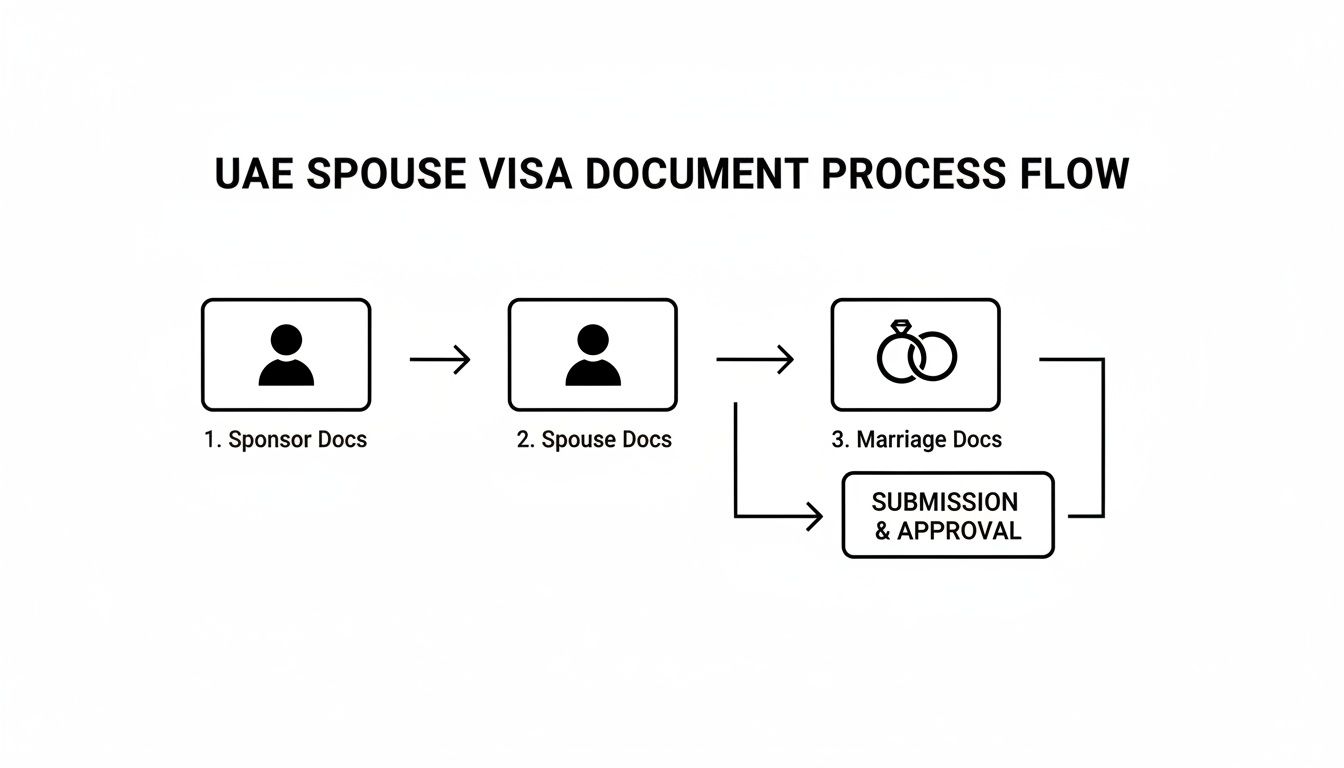
This visual shows why having all your paperwork organised from the start is so important for a smooth application.
Stage 3: The Medical Fitness Test
This is a non-negotiable step for anyone over 18 applying for a residence visa in the UAE. The medical fitness test is a standard government procedure designed to screen for specific communicable diseases, protecting public health.
Your spouse will need to visit a government-approved health centre to get this done. It's a very routine process, typically just a blood test and a chest X-ray. The results are usually ready within 24 to 48 hours and are linked electronically to your visa application file with the immigration authorities.
Expert Tip: If you're in a hurry, most medical centres offer a VIP or fast-track service. It costs a bit more, but you can often get the results back in just a few hours, which can really speed up the final steps.
Stage 4: Emirates ID and Visa Stamping
With the "medically fit" certificate in hand, you're on the home stretch. The next immediate step is the Emirates ID application. This requires a visit to an authorised centre for biometrics—basically just fingerprints and a photo. This application runs in parallel with the final visa processing.
Once the medical is passed and the biometrics are done, you submit everything for the most rewarding part of the whole process: visa stamping. This is the moment the official residence visa sticker is physically placed inside your spouse's passport, making their residency official.
This entire sequence is quite similar to other residency visas in the country. For a wider look at the general framework, our guide on how to get a residence visa in Dubai offers some great parallel insights.
After the final approval, the visa gets stamped, and the physical Emirates ID card is printed and delivered. With that visa in their passport and the ID card in their wallet, your spouse is officially a UAE resident, ready to build a life here with you.
Understanding Costs, Timelines, and Renewal Rules
When you get down to the practical side of the UAE spouse visa, two big questions always come up: how much will it all cost, and how long is it going to take? Getting a clear handle on your budget and the timeline is key to keeping the whole process stress-free.
Think of the costs less like one big, scary fee and more like a series of smaller, predictable payments for specific services along the way. The total can shift a bit depending on things like whether your spouse is applying from inside or outside the UAE, or if you decide to pay extra for urgent processing. But generally, you can expect to pay for the entry permit, changing their status in-country, the medical fitness test, their Emirates ID application, and the final visa stamping.
A Transparent Breakdown of Costs
To give you a clearer picture, it helps to see the fees broken down by each stage of the application. While these are solid estimates, remember that government fees can change, but this provides a reliable baseline for your budget.
Here’s a look at what you can typically expect to pay.
Estimated Costs for a UAE Spouse Visa
| Service | Estimated Cost (AED) |
|---|---|
| Entry Permit Application | AED 500 – AED 1,200 |
| In-Country Status Change | AED 600 – AED 700 |
| Medical Fitness Test | AED 300 – AED 750 (depending on urgency) |
| Emirates ID Application | AED 270 – AED 370 (for 2-year validity) |
| Visa Stamping Fee | AED 500 – AED 700 |
All in, you're looking at a total somewhere between AED 2,170 and AED 3,720. It’s always a good idea to budget a little extra to cover any small administrative charges or typing centre fees that might pop up.
Mapping Out the Visa Timeline
From the moment you hit 'submit' on that first application to getting the final visa stamped in the passport, the entire process usually takes between 15 to 30 working days. This is assuming all your paperwork is in perfect order and there are no unexpected hold-ups.
- Entry Permit Issuance: This is usually quite quick, taking about 2-5 working days.
- Medical Test Results: You can get these in as little as 4 hours with the VIP service, or up to 48 hours with the standard option.
- Emirates ID Biometrics: The appointment can often be booked within a few days.
- Final Visa Stamping: Once everything is submitted, this final step takes around 5-7 working days.
Important Note: These timelines are purely for the government processing part. They don't include the time it takes you to gather your documents and get them attested, which can easily add several weeks to your preparation phase.
Renewal and Cancellation Rules
Your spouse's visa is directly tied to yours, meaning it will have the same validity period—usually one to three years. The good news is that renewing the visa is a much simpler affair than the first time around.
You'll need to repeat the medical fitness test and provide updated documents like your renewed employment contract and current tenancy agreement (Ejari). For a full walkthrough of what's involved, our guide on the UAE visa renewal process covers every detail.
If your situation changes—maybe you switch jobs, or in the unfortunate event of a divorce—the visa needs to be officially cancelled. The UAE provides a grace period after cancellation, often up to six months. This gives your spouse enough time to either find a new visa sponsor or leave the country without facing any overstay fines, ensuring you always stay on the right side of immigration law.
Golden Visas and Other Pathways for Spouses

While the typical route for getting a UAE spouse visa is through your employer, it’s certainly not the only game in town. The UAE has rolled out several premium, long-term residency options to attract top talent, investors, and entrepreneurs from around the globe. These pathways offer families a level of flexibility and stability that the standard visa just can't match.
Think of it this way: instead of your spouse's residency being tied directly to your job, alternatives like the Golden and Green Visas link their status to your long-term investment or professional standing in the country. This simple shift provides a much stronger sense of security for your family's future here.
The Prestigious Golden Visa
The Golden Visa is a real game-changer for anyone looking at long-term residency. It’s a renewable 10-year visa for investors, entrepreneurs, and highly skilled professionals, and one of its biggest perks is the ability to sponsor your family—including your spouse and children—for the same decade-long period.
This completely removes the hassle of frequent renewals and isn't dependent on any single employment contract. As a Golden Visa holder, you become your family’s direct sponsor, giving both you and your spouse far greater freedom and peace of mind.
The programme's popularity speaks for itself. Since its launch in 2019, the number of Golden Visas issued in Dubai shot up from 47,150 in 2021 to almost 158,000 by 2023. It’s a clear sign of its appeal for families seeking long-term stability. You can dig deeper into these data-driven trends and the programme's growth.
The Flexible Green Visa
Another fantastic alternative is the Green Visa. This option provides a 5-year, self-sponsored residency for skilled professionals, freelancers, and investors who want more independence than a standard work visa offers.
Just like the Golden Visa, the Green Visa makes sponsoring your family incredibly straightforward. As a holder, you can easily sponsor your spouse and children for the same five-year term, once again without being tethered to a specific employer.
Key Takeaway: Both the Golden and Green Visas put the power of sponsorship directly in your hands, based on your own merit, investments, or skills. This creates a more secure foundation for family life in the UAE, completely independent of your current job status.
Opting for one of these routes means you’re looking beyond the usual one-to-three-year visa cycle. It's a strategic move towards a more stable, long-term future for you and your spouse in the Emirates, complete with premium benefits and fewer bureaucratic hoops to jump through.
Common Questions About the UAE Spouse Visa
Even with the clearest roadmap, a few questions always seem to pop up during the UAE spouse visa journey. We get it. To help clear up any last-minute uncertainties, we’ve put together answers to the most common queries we hear from clients.
Can I Sponsor My Spouse If I Work in a Free Zone?
Yes, absolutely. If you're an expatriate working in one of the UAE's many free zones, you can definitely sponsor your spouse. The main eligibility rules, especially the minimum salary requirement, are the same whether you're on the mainland or in a free zone.
The process is almost identical. The only real difference is where your employment documents come from. Instead of being issued by the Ministry of Human Resources and Emiratisation (MOHRE), your salary certificate and contract will be issued by your specific free zone authority.
What Happens to My Spouse's Visa If I Lose My Job?
This is a big concern for many families. If you lose your job, your employer will cancel your residence visa. Because your spouse's visa is tied to yours, its cancellation is automatically triggered as well.
However, the UAE government provides a generous grace period—sometimes up to six months. This gives you a decent window to find a new job and transfer the sponsorship without facing overstay fines.
A lot of people wonder if the sponsored spouse is allowed to work. The answer is a definite yes. They can take up a job once their new employer gets them a work permit (also known as a labour card) from MOHRE. Your spouse stays under your sponsorship, so they don't need a whole new visa from their company. You'll just need to provide a No Objection Certificate (NOC) to their new employer.
What Are the Most Common Reasons for Visa Rejection?
Visa rejections are frustrating, but they usually boil down to a handful of avoidable mistakes. The most common culprits we see are:
- Not meeting the minimum salary threshold.
- Submitting incomplete or improperly attested documents (the marriage certificate is a frequent issue).
- Small inconsistencies, like name spellings or dates, between the application and your official documents.
To sidestep these issues, be meticulous. Double-check your salary certificate, make sure every attestation stamp on your marriage certificate is correct and from the right authority, and ensure all your details are perfectly consistent across every single paper.
As you get your plans in order, it's also smart to look into the practical details of life and connectivity in the United Arab Emirates to make your arrival as smooth as possible.
Trying to figure out the UAE spouse visa process can feel overwhelming, but you don't have to navigate it on your own. The team at Al Ain Business Center are experts in handling the paperwork, attestations, and submissions flawlessly, making sure your application gets approved without any delays.
Let us manage the details so you can focus on starting your new life together. Get in touch with us today to see how our visa services can help at https://alainbcenter.com.