
Thinking about getting a trading license in Dubai? The first question on everyone's mind is always: "What's the real cost?"
You'll see a wide range of figures thrown around, but a realistic budget for your total trading license cost in Dubai will typically fall between AED 15,000 and AED 50,000. This initial outlay gets you through the door, covering the essential government fees and approvals. However, the final number on your invoice really depends on the path you choose—your specific business activity, the legal structure you go for, and whether you set up on the mainland or in a free zone.
The Real Cost of a Dubai Trading License
When you're budgeting for a trading license here, don't think of it as a single price tag. It's more like building a custom PC—the final cost is the sum of all the components you select. Every choice, from your company's legal form to its physical address, adds a different line item to the bill.
Getting your head around this from day one helps manage expectations and sidesteps any nasty surprises down the road. For instance, a straightforward general trading license in a cost-effective free zone is a completely different financial ballgame than a mainland LLC company in the UAE that needs a physical office and approvals from multiple external bodies. This flexibility is what makes Dubai’s business environment so dynamic.
One-Time vs Recurring Financial Commitments
A classic rookie mistake is fixating only on the initial setup fees. The true cost of keeping your business running includes both the one-time payments to get started and the annual recurring charges to stay compliant. If you overlook those yearly costs, you could find your business on shaky financial ground come year two.
The spectrum of costs reflects the diversity of business regulations in Dubai, balancing affordability with the operational requirements for different types of enterprises. Getting this balance right is key to a sustainable launch.
In 2025, the cost to get your trade license sorted generally lands between AED 15,000 and AED 50,000 (that's about USD 4,083 to USD 13,613). This estimate doesn't just cover the license itself; it also anticipates extra fees for things like DED registration, Dubai Chamber membership, and government innovation fees.
To give you a clearer picture, let's break down these expenses.
Summary of Dubai Trading License Costs
Here’s a quick overview to help you distinguish between the costs you'll pay once and the ones you'll need to budget for every year.
| Cost Category | Description | Frequency |
|---|---|---|
| Initial Setup Fees | These are the upfront costs to get your company registered. Think trade name reservation, initial approval, and various government service fees. | One-Time |
| Annual Recurring Fees | These are the ongoing costs to keep your license active and your business in good standing. This includes license renewal, office rent, and Establishment Card renewal. | Annual |
Understanding the difference is crucial. Digging into the structure of an LLC, particularly for a mainland setup, can shed more light on how these costs are applied. This knowledge is power—it lets you build a far more accurate and sustainable budget for your trading venture in the long run.
Choosing Your Path: Mainland vs. Free Zone Costs
When it comes to the trading license cost in Dubai, the very first question you need to answer will have the biggest impact on your budget: will you set up on the Mainland or in a Free Zone? This is the classic fork in the road for every entrepreneur starting out here, and your choice dictates everything that follows.
Think of it like choosing a retail location. A Mainland license is like opening a flagship store on a busy high street. You get maximum exposure and the freedom to trade with anyone, anywhere across the UAE, without a middleman. This complete market access is its main draw, but it often means a higher price tag and more direct paperwork with government bodies like the Department of Economy and Tourism (DET).
A Free Zone, on the other hand, is more like setting up shop in a specialised, state-of-the-art business park. These zones are designed as self-contained commercial hubs. They offer streamlined setup, 100% foreign ownership, and big tax advantages. The trade-off? Your direct access to the local UAE market might be limited.
The Mainland Route: Unrestricted Trading at a Premium
Opting for a Mainland license means you’re registering your company directly with the DET. This gives you unparalleled freedom to operate anywhere in the Emirate, bid on lucrative government contracts, and open physical shops or offices wherever you please. This flexibility, however, is naturally reflected in the costs.
Mainland setups tend to have more itemised costs and can involve a few extra steps. You’ll likely be looking at separate fees for things like:
- Initial approval and reserving your trade name.
- Getting your Memorandum of Association (MOA) attested.
- Securing a mandatory physical office space, proven with an Ejari registration.
- Various government service charges and potential external approvals, depending on your specific business activity.
While recent reforms have made 100% foreign ownership possible for most activities, the total cost can still creep up due to these different requirements. The reward for this investment is direct, unrestricted access to the entire UAE domestic market.
The Free Zone Advantage: Cost-Effective and Bundled
Dubai has more than 40 Free Zones, each one often geared towards specific industries. For traders, their biggest appeal is the simple, all-in-one package deals they offer. These packages frequently bundle registration, licensing, and even basic office solutions (like a flexi-desk) into a single, predictable annual payment.
Free Zones are purpose-built to attract foreign investment by cutting through the red tape and offering seriously compelling financial perks. For a lot of international traders, this makes them the go-to choice for their first step into the Dubai market.
This bundled approach makes budgeting much more straightforward. You’re far less likely to be hit with unexpected government fees because the Free Zone authority handles most of the admin for you. If you want to get into the nitty-gritty, our guide on Dubai Freezone company setup cost breaks down exactly what you get in these packages.
This infographic gives a great visual breakdown of the costs, splitting them into one-time setup fees and recurring annual payments.
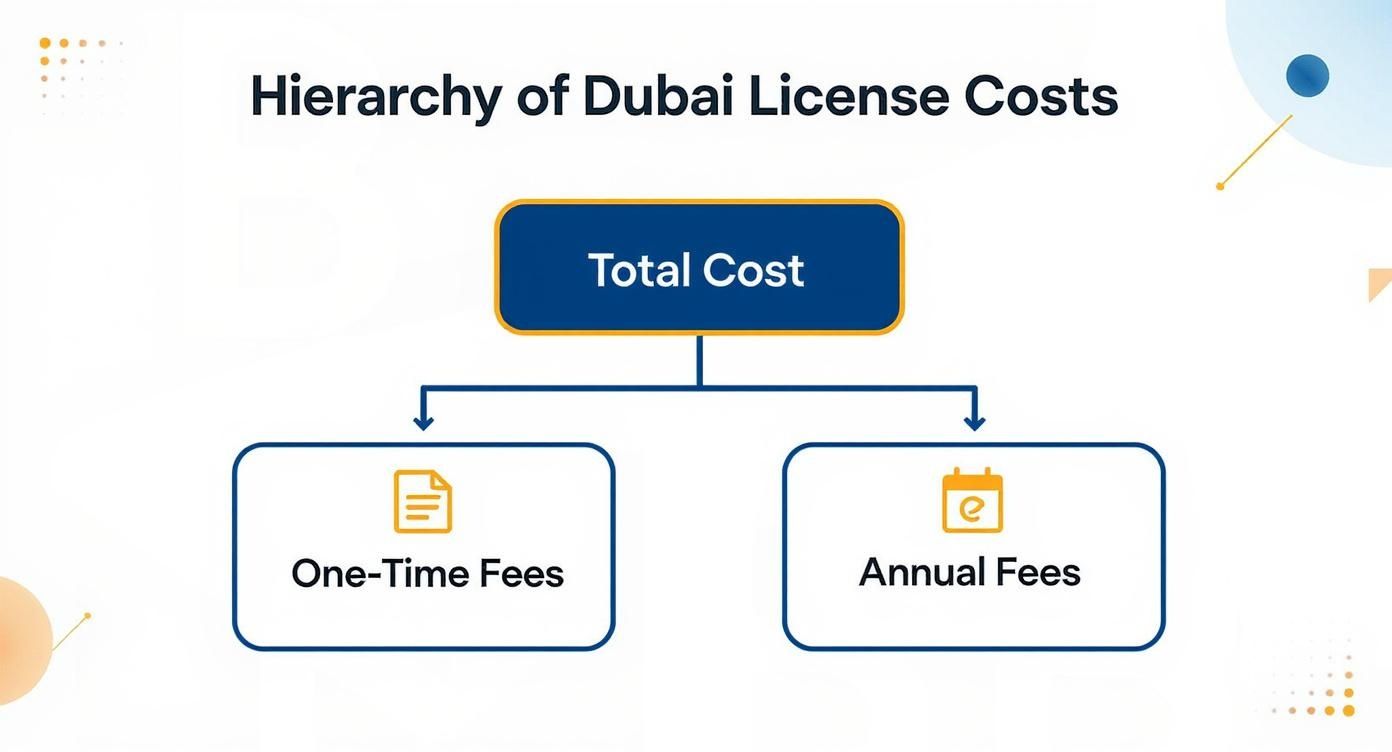
As you can see, solid financial planning means accounting for both the initial outlay to get your doors open and the ongoing costs needed to keep your business running legally year after year.
The main catch with a Free Zone license is that you generally can't trade directly with customers on the Mainland. To reach that market, you'll usually need to partner with a local distributor or agent, which adds another layer of complexity and cost.
But for businesses focused on international trade or re-exporting goods, this is rarely an issue. The choice really boils down to your target audience. If your customers are inside the UAE, the Mainland is likely your best bet. If they're global, a Free Zone provides a powerful and highly cost-effective launchpad.
Breaking Down Your One-Time Setup Fees
Securing your trading license is the big milestone, but it's just the first in a series of one-time setup fees. Think of it like building a house: the license is your architectural plan, but you still need to pay for the foundation, permits, and inspections before you can actually start building. These initial costs are the essential groundwork for your new venture.
A lot of new entrepreneurs get a bit of a shock when their first invoice lands. It’s never just one big number for the license. Instead, it’s an itemised list of smaller government service charges that, together, make up a significant chunk of your initial investment. Knowing what these are upfront is the key to turning a confusing bill into a predictable budget.
Your Foundational Cost Checklist
Let's walk through the main line items you can expect to see. The exact amounts will shift depending on where you set up (Mainland vs. Free Zone) and your business activity, but this checklist covers the usual suspects you need to plan for.
-
Trade Name Reservation Fee (Approx. AED 600 – 800): This is the fee to lock in your business name. It’s more than just a name; it’s your company’s legal identity, and this fee ensures it's unique and follows all UAE naming rules.
-
Initial Approval Fee (Approx. AED 150 – 250): Before anything else, the government needs to review and give a thumbs-up to your proposed business activities. This is that first, essential green light before the license can be issued.
-
Memorandum of Association (MOA) Fees (Approx. AED 1,500 – 3,500): If you're starting a company with partners, like an LLC, you’ll need an MOA. This is the legal rulebook for your business, outlining ownership and how you'll operate. The costs here cover drafting, official translation, and notarisation.
-
Office Lease Registration (Ejari) (Approx. AED 220): For anyone setting up on the mainland, this is a non-negotiable step. It officially registers your tenancy contract with the authorities and serves as concrete proof of your physical business address.
Additional Government and Service Charges
Beyond those big-ticket items, you'll find a handful of smaller charges on your final setup invoice. They might seem small on their own, but they all add up to your total trading license cost in Dubai. Think of them as the nuts and bolts holding your business structure together—small, but absolutely critical.
These can include:
- Market Fees: Usually calculated as a small percentage of your office rent.
- Government Service Taxes: Minor admin fees for processing all your paperwork.
- Knowledge and Innovation Dirham Fees: A small fee tacked onto most government transactions that goes towards supporting innovation projects.
- Establishment Card Fee (Approx. AED 600 – 2,000): This is a key document that registers your company with the immigration and labour departments. Without it, you can't start applying for employee visas.
A common mistake is underestimating just how much paperwork is involved. Every single one of these fees corresponds to a specific document or approval. Keeping everything organised is the secret to a smooth, stress-free setup.
The sheer variety of trade licenses in Dubai—from Commercial to Professional—means the fee structure is tailored to what you actually do. While the official license fees can start as low as AED 12,000, costs like trade name registration and memorandum notarisation quickly push the total higher. The good news? Dubai’s business-friendly environment offers powerful incentives like no mandatory paid-up capital and 100% profit repatriation, which helps balance out these initial setup costs.
Honestly, managing all this documentation can feel like a full-time job. Professional https://alainbcenter.com/documents-clearing-services/ can take this off your plate entirely. They handle the submissions, prevent costly delays from incorrect paperwork, and make sure every fee is paid and every form is filed correctly. It lets you get back to what really matters: launching your business.
Understanding Your Annual Recurring Costs
Getting your business off the ground with the initial setup fees is a huge milestone, but it's the annual recurring costs that truly keep it in the air. It’s helpful to think of your trading license less like a one-time purchase and more like a yearly subscription. Just like your Netflix account, you’ve got to renew it to keep the service going and, in this case, to operate legally.
This change in mindset is crucial for the long-term financial health of your business. A common pitfall for new entrepreneurs is forgetting to budget for these ongoing expenses, which can quickly lead to compliance headaches and unexpected financial strain. To build a sustainable company, you need to account for these predictable, repeating charges right from day one.
The Core Annual Renewals
Every year, a set of core fees will pop up to keep your company in good standing with the authorities. These aren't optional; they are directly tied to your legal right to do business in Dubai. While the exact figures can shift depending on your setup, the components are pretty consistent across both mainland and free zone companies.
Here are the main recurring costs to expect:
-
Trade License Renewal Fee: This is your biggest annual expense. It's the government's charge for keeping your business legally active for another year. The cost is often quite similar to your initial license fee, though some government charges might be slightly lower on renewal.
-
Establishment Card Renewal: Think of this card as the link between your company and the immigration and labour departments. It must be renewed every year, typically costing between AED 600 and AED 2,000, and is essential for sponsoring visas for yourself and any employees.
-
Office Rental Costs: Whether you have a physical office on the mainland with an Ejari contract or a flexi-desk package in a free zone, rent is a major recurring item. Mainland leases are renewed annually, while free zones often bundle this cost into their all-in-one renewal invoice.
Ongoing Visa and Operational Costs
Beyond the core government renewals, your day-to-day operational needs will bring other significant annual expenses. Visas are a perfect example—a critical recurring cost tied directly to your ability to live and work in the UAE, not to mention hiring staff.
Understanding that your total trading license cost in Dubai is an ongoing commitment is the first step toward building a financially resilient business. Annual planning prevents cash flow crises and ensures you remain compliant without any last-minute surprises.
Don't forget to factor in these essential operational renewals:
-
Investor and Employee Visa Renewals: Your own investor visa, plus any visas for staff you bring on board, typically need renewing every two to three years. It's a smart move, however, to budget for these costs on an annual basis to spread out the financial impact.
-
Sponsor Fees (if applicable): For certain mainland business activities that still require a Local Service Agent (LSA), you'll have an annual sponsorship fee to pay.
By mapping out these recurring costs, you shift your financial planning from being reactive to proactive. You’ll be able to see your yearly obligations coming, set aside the funds, and focus on what really matters—growing your trading business in Dubai.
A Real-World Cost Example from Meydan Free Zone
Abstract figures and vague ranges are one thing, but nothing beats seeing a real invoice when you're trying to nail down the trading license cost in Dubai. To bring things down to earth, let’s pull apart a typical, all-inclusive trading license package from Meydan Free Zone. This will give you a solid benchmark to compare other offers against.
Think of a free zone package like a set menu at a restaurant. Instead of picking every dish à la carte (which is closer to how mainland setup works), you get a full package—starter, main, and dessert—all for one bundled price. It makes budgeting so much more straightforward.
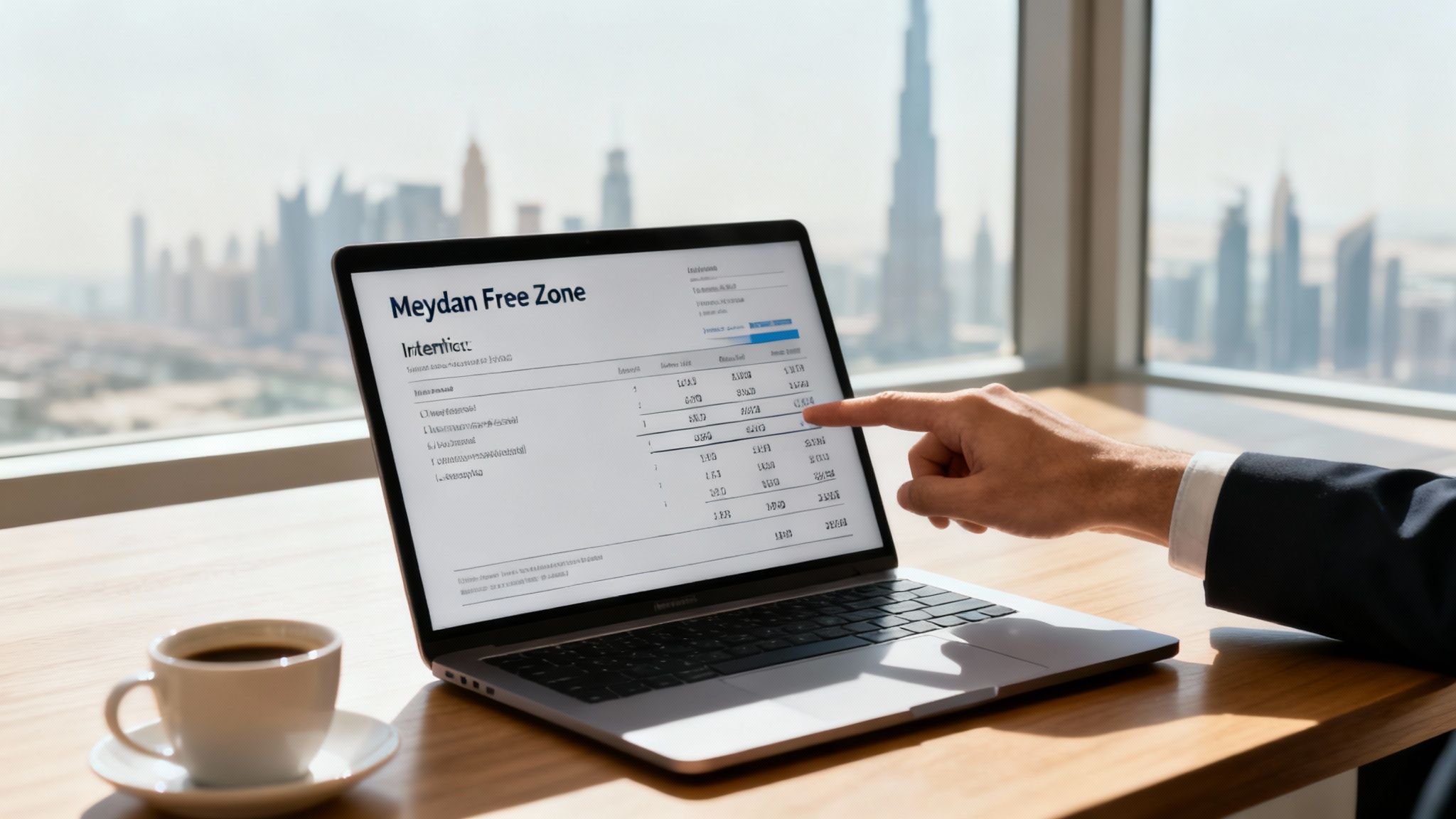
Unpacking a Meydan Free Zone Invoice
A standard one-year trading license from Meydan serves as a perfect case study. It bundles nearly all the essential costs into one clear, itemised bill, so let's break down what you're actually paying for when you see that all-in price.
Meydan Free Zone is a magnet for entrepreneurs, and for good reason. It offers a massive list of over 3,500 business activities and flexible packages designed to keep your overheads in check. Even within this structured setup, several components make up the final bill.
To give you an idea, a typical Meydan Trading License package for 2025 might look something like this: an application fee of around AED 1,000, the main license fee at AED 12,000, a mandatory office space rental starting from AED 5,000, plus other service fees hovering near AED 1,500. Do the maths, and you’re looking at a total of roughly AED 19,500. This model is pretty standard across many free zones—the license fee is just one piece of a much larger, service-inclusive puzzle. You can learn more about how Meydan Free Zone fees are structured.
A key takeaway here is that the 'license fee' is rarely the final number. The mandatory inclusion of services like office space is what creates a comprehensive, ready-to-operate business setup, but it also significantly influences the total cost.
Sample Cost Breakdown for a Meydan Free Zone License
This table gives you a much clearer, line-by-line look at what a sample invoice actually contains. It shows exactly how the individual costs stack up to form the final package price, painting a realistic picture for a basic trading setup.
| Cost Component | Estimated Cost (AED) | Notes |
|---|---|---|
| One-Time Registration Fee | 1,850 | This is a one-off fee for processing the initial company registration documents. |
| Annual Trade License Fee | 12,000 | This is the core annual fee for your chosen business activities under the trading license. |
| Establishment Card Fee | 2,000 | A mandatory annual fee that registers your company with the immigration authorities, allowing you to apply for visas. |
| Flexi-Desk Office Rental | 5,000 | This fee covers your mandatory physical presence in the free zone, a key requirement for compliance. |
| Miscellaneous Admin Fees | 150 | Includes minor government charges like the 'Knowledge Dirham' and 'Innovation Dirham' fees. |
| TOTAL ESTIMATED COST | 21,000 | This is a realistic, all-in figure for your first year of operation with a basic trading license and one visa eligibility. |
By digging into a real package like this one, the abstract concept of "trading license cost" suddenly becomes much more concrete. You can see how each component is essential for a legal and functional business, which helps you plan your budget with far greater confidence.
Practical Ways to Lower Your License Costs
Knowing the typical costs is the first step, but actively bringing down your startup expenses is where smart business planning really shines. While you can't negotiate government fees, a lot of the other costs are more flexible than you might think. With the right strategy, you can seriously reduce your total trading license cost in Dubai without cutting corners on compliance or stunting your company's growth.
Think of it like packing for a trip. You could drag along three massive suitcases filled with everything you own, "just in case." Or, you could pack a single, smart carry-on with just the essentials you actually need. Our goal is to get your business launched with that lean, efficient, carry-on approach.
Be Smart About Your Office Space
One of the biggest wins for slashing your annual costs is to rethink the traditional office. For most new trading companies, a dedicated physical office is an expensive luxury in the first year. It's often just not necessary.
Instead, check out these much smarter alternatives:
- Go for a Flexi-Desk or Co-working Space: Nearly every free zone includes flexi-desk options in their license packages. This ticks the legal box for having a physical address but costs a tiny fraction of what a private office would, saving you thousands of dirhams in rent each year.
- Use a Virtual Office: A virtual office gives you a professional business address and someone to handle your mail, all without the massive overheads of a lease. It’s a brilliant way to maintain a polished image while keeping your expenses rock bottom.
Get Strategic with Your Business Activities
The number and type of business activities you list on your license have a direct impact on the price. It’s tempting to add every possible service you might offer down the line, but a focused approach is much kinder to your wallet.
Start with just your core trading activities—the one or two things that will bring in money right away. You can always amend your license to add more activities later as your business finds its feet and starts to grow. This simple tactic can lower your government fees and stops you from paying for permissions you're not even using yet.
Getting your paperwork right the first time isn't just about following the rules; it's a huge cost-saver. A single mistake on an application form can mean resubmission fees and frustrating delays, which burns through both your time and your money.
Choose the Right Time and Place
Timing can be everything. Many free zones and business setup consultants run special offers and seasonal discounts at different times of the year.
Keep your eyes peeled for these deals. They can include big discounts on registration fees, cheaper rates for multi-year license packages, or even waived processing fees. Picking a free zone that’s actively looking to attract new businesses often gives you the best bang for your buck on that initial investment.
Finally, resist the urge to do it all yourself to save a few dirhams, especially if you're new to the process. It might seem cheaper upfront, but hiring a reputable business setup consultant often saves you money in the long run. Their experience helps you sidestep common mistakes, handle the complex paperwork correctly, and make sure you aren’t paying for extras you don’t need. It just makes the whole launch smoother and more financially sound from day one.
Frequently Asked Questions
Setting up a business in Dubai for the first time naturally brings up a lot of questions. Getting clear, practical answers is the key to moving forward with confidence and making sure there are no surprises down the road. Here are some of the most common things entrepreneurs ask about the trading license cost in Dubai.
Can I Get a Trading License Without a Physical Office?
Yes, you absolutely can. This is actually one of the smartest ways to keep your initial setup costs in check. Both mainland and free zone authorities understand that many modern businesses simply don't need a four-walled office to operate.
Instead of locking into a pricey annual lease, you have a couple of great options:
- A Flexi-Desk: Think of this as a hot-desking facility within a professional business centre. It satisfies the legal requirement for a registered address without the high overhead of a private office.
- A Virtual Office: This gives you a prestigious business address and mail-handling services, but no physical workspace. It's the perfect low-cost solution for consultants, freelancers, or businesses that are fully remote.
These aren't loopholes; they are legitimate, widely-used options that make launching your business far more affordable.
What Are the Most Common Hidden Costs?
While any good business setup consultant will be transparent, some costs can still pop up unexpectedly. They aren't "hidden" in a deceptive sense, but they are often variable and sit outside the main license package.
It's wise to keep a buffer in your budget for things like:
- Memorandum of Association (MOA) Translation: If your MOA isn't drafted in Arabic, it needs to be legally translated, and that comes with a fee.
- Document Attestation: Any official corporate or personal documents coming from outside the UAE (like university degrees or certificates of incorporation) have to be officially attested. This is a multi-step process with costs at each stage.
- Third-Party Approvals: Some business activities need a special sign-off, or No Objection Certificate (NOC), from other government departments. These approvals almost always have their own processing fee.
As a rule of thumb, setting aside a contingency fund of 10-15% of your total setup cost is a savvy move. It gives you a cushion to absorb these variable expenses without stressing your budget.
How Much Does Annual Trade License Renewal Cost?
Your yearly renewal cost is usually quite close to what you paid for the initial license, but often a little less. The big government fees—the core license fee and Establishment Card—remain, but you won't have to pay the one-time registration charges again.
The main items on your renewal bill will be the license fee itself and whatever office solution you have (flexi-desk, virtual, or physical space). Make it a point to ask your consultant for a clear renewal cost estimate from day one. Knowing what to expect for year two and beyond is crucial for the long-term financial health of your business.
Ready to get a clear, no-obligation quote for your Dubai trading license? The expert team at Al Ain Business Center provides transparent, end-to-end business setup solutions to get you launched quickly and affordably. Start your UAE business journey today.