
Renewing your trade license isn't just a box-ticking exercise; it's the annual health check that keeps your business legally alive and kicking in the UAE. This yearly trade license renewal is an absolute must-do for staying compliant, dodging fines, and making sure your operations run without a hitch.
Why Your Annual Trade License Renewal Matters
Think of your trade license as the very pulse of your company. As long as it's valid, you can legally operate, sponsor employee visas, and keep your corporate bank accounts active. The second it expires, all of that is on the line. Letting that deadline slide can set off a domino effect of serious operational and financial headaches.
The UAE's booming business scene is built on a solid foundation of clear rules. This structured approach is essential, especially with the number of active businesses constantly on the rise. In fact, by the end of September 2023, the UAE was home to 1.23 million active business licenses, a figure that shows just how routine—and critical—this process is for the massive business community here.
The Governing Bodies and Jurisdictions
So, who do you deal with for your renewal? It all comes down to where your company is registered. The process isn't a one-size-fits-all affair; it's dictated by specific authorities depending on your jurisdiction.
- Mainland Companies: If your business is set up on the UAE mainland, especially in Dubai, your go-to authority is the Department of Economy and Tourism (DET).
- Free Zone Companies: For businesses nested within one of the UAE’s many free zones, the renewal is handled by that zone's specific authority, whether it's DMCC, IFZA, JAFZA, or another.
The difference between these two setups is huge. A mainland license gives you the freedom to trade directly within the entire UAE market. A free zone license, on the other hand, typically confines your operations to that specific zone and international trade. Understanding this distinction is key, not just for setup but for ongoing compliance like your annual renewal. For a deeper dive, check out our guide on Free Zone vs Mainland Dubai.
To make it even clearer, here’s a quick rundown of the main differences you’ll encounter during the renewal process.
Mainland vs Free Zone Renewal Key Differences at a Glance
| Aspect | Mainland Renewal (e.g., Dubai DET) | Free Zone Renewal (e.g., IFZA, DMCC) |
|---|---|---|
| Governing Body | Department of Economy and Tourism (DET) or equivalent in other Emirates. | The specific Free Zone Authority (e.g., DMCC, JAFZA, RAKEZ). |
| Office Requirement | An active tenancy contract (Ejari in Dubai) is mandatory and must be valid. | Varies. Some zones require physical office space, while others permit flexi-desks or virtual offices. |
| External Approvals | May require approvals from other government bodies depending on the business activity (e.g., Dubai Municipality, RTA). | Approvals are generally contained within the free zone's ecosystem, simplifying the process. |
| Process Platform | Primarily done through the DET’s official online portal or approved service centres. | Each free zone has its own dedicated online portal for renewals. |
| Fees | Includes DET fees, Chamber of Commerce fees, and costs related to the tenancy contract. | A single, consolidated renewal fee is often charged by the free zone authority. |
As you can see, while the goal is the same—maintaining your legal status—the path to get there can look quite different depending on your company's jurisdiction.
Consequences of Non-Renewal
Letting your renewal deadline slip is a costly mistake. The penalties aren't just a slap on the wrist; they're designed to enforce compliance and can quickly spiral from a minor issue into a major business crisis.
Neglecting your trade license renewal can lead to daily fines, the blacklisting of your company, an immediate halt to all visa processing, and even the freezing of corporate bank accounts. It’s a risk no serious business can afford to take.
To stay ahead of the game, many businesses are looking into automating company approval workflows. This helps streamline the internal checks and balances, reducing the administrative load and preventing costly oversights. A proactive approach like this ensures everything is in order well before the final deadline, making the whole renewal process far more efficient and predictable.
Your Renewal Document Checklist
A speedy trade license renewal comes down to one thing: preparation. I've seen it time and time again—almost every delay or snag can be traced back to a missing, outdated, or incorrect document. Getting your paperwork in order before you start transforms the process from a potential headache into a simple administrative task.
This isn't just about ticking boxes on a list. It’s about knowing why each document is needed and making sure it meets the exact standards of the authority you're dealing with. Let's walk through what you'll need to have ready.
Core Company Documents
First things first, let's gather the foundational documents for your business. These items prove your company's identity and legal standing. Think of them as the non-negotiable starting point for your renewal file.
Make sure you have clear, valid copies of the following:
- Original Trade License: A copy of the current trade license you're about to renew.
- BR/1 Form: This is your official application form. It needs to be typed, not handwritten, and must have the company stamp and the signature of an authorised partner.
- Passport and Visa Copies: You’ll need copies of the passports and residence visas for every business partner on the license. Double-check that none are close to expiring.
The Crucial Role of Your Tenancy Contract
Your registered office address is a cornerstone of your license, and the authorities need solid proof that it's legitimate. For mainland companies in Dubai, this means your tenancy contract absolutely must be registered with Ejari. A standard rental agreement won't cut it.
The system is designed to catch this. The economic department's online portal links directly with the Ejari system. If your contract has expired or isn't properly registered, your renewal application will be automatically blocked. It’s a hard stop—there’s no way around it.
Pro Tip: I always advise clients to align their tenancy contract renewal to be at least one month before their trade license expires. This simple bit of scheduling saves you from a last-minute scramble, trying to finalise a lease while your license deadline is breathing down your neck.
What if you've moved offices? You must first amend your current license to reflect the new address before you can renew. Trying to renew with an old address is a classic mistake that guarantees rejection.
Navigating External Approvals
This is where many businesses get caught off guard. Depending on what your company actually does, you might need a No Objection Certificate (NOC) or specific approval from another government ministry. These aren't optional—they are a prerequisite before the economic department will even look at your renewal.
The required approvals are tied directly to your listed business activities. For instance:
- An education or training centre needs a green light from the Knowledge and Human Development Authority (KHDA).
- A restaurant or food trading company requires clearance from the Dubai Municipality's Food Safety Department.
- A transport or logistics firm will need an NOC from the Roads and Transport Authority (RTA).
- A pharmacy or clinic must get approval from the Dubai Health Authority (DHA).
Getting these external approvals can take time, sometimes days or even weeks. It's vital to figure out if you need one and start that process long before your license is due to expire. Waiting until the last minute is a recipe for disaster, as the economic department won't proceed without these supporting documents. It’s a key step, just like the initial research you did when first learning how to get a trade license in Dubai.
Renewing Your Mainland Company License
When it comes to renewing a mainland license, especially in a place like Dubai, the process is pretty well-defined. At first, it can look a bit intimidating, but once you break down the steps, it’s actually quite straightforward. Whether you decide to use the slick online portal from Dubai Economy and Tourism (DET) or you prefer talking to someone in person at a Tasheel service centre, the fundamental requirements don't change.
It all starts with your paperwork. Specifically, your office tenancy contract. The whole renewal system is linked, which means a valid Ejari is the absolute first thing you need before you can even think about starting the application. Honestly, this is where most businesses hit their first roadblock.
Kicking Off the Renewal Process
With your documents in order, you can formally apply for the renewal. This usually means filling out the necessary forms and uploading your documents through the official portal or handing them over at a service centre. Once that's done, the system will generate a payment voucher, which is essentially the invoice for all your renewal fees.
Don't expect a single line item on that voucher. It will break down all the different government charges that add up to your final renewal cost. It's a good idea to give it a proper look so you know exactly what you're paying for.
I often get asked about the smaller, sometimes confusing, fees on the payment voucher. Things like a 'Knowledge Fee' or an 'Innovation Fee' for a couple hundred dirhams can throw people off. These are just standard government charges that fund various public initiatives and are a completely normal part of doing business here.
Knowing what these small but mandatory fees are for helps clear up any confusion about the total amount and saves you from any surprises at the payment stage.
This infographic gives you a quick visual summary of the key pieces you need to get your mainland license renewal started.
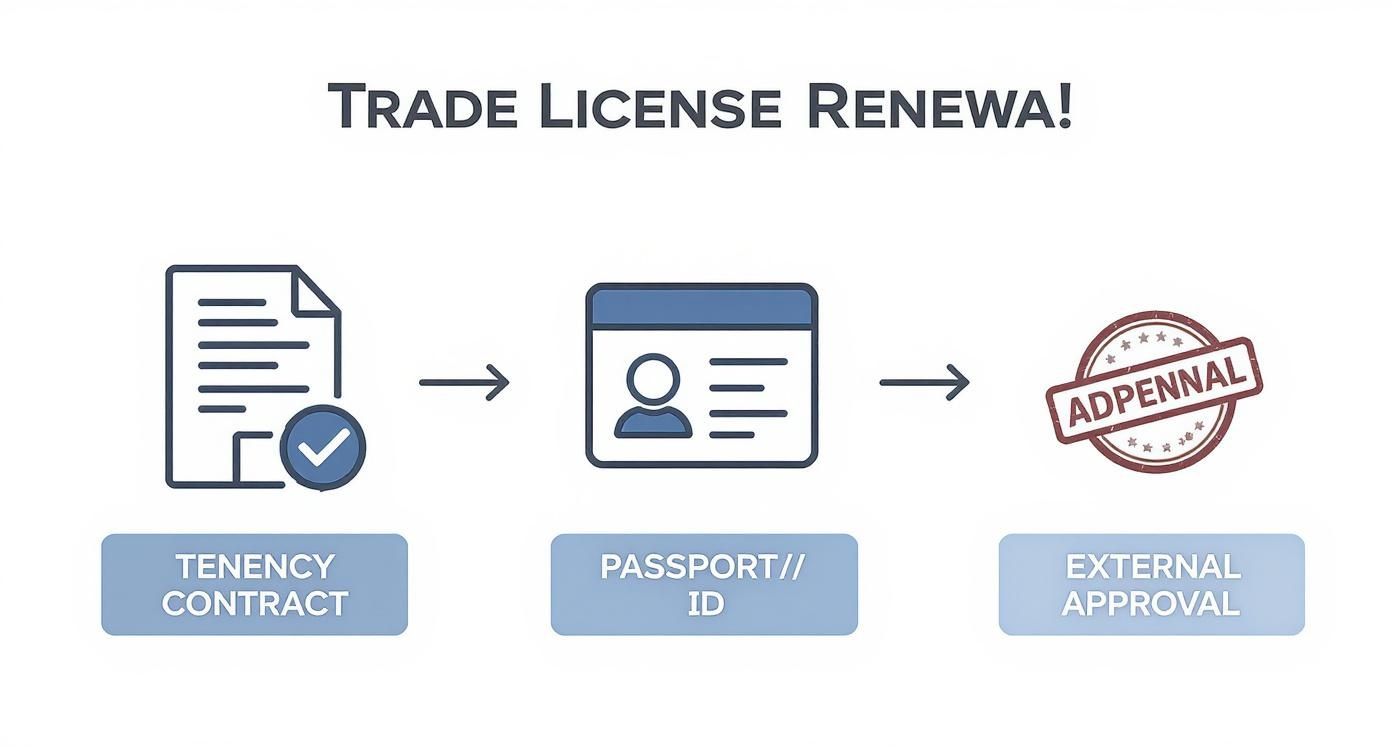
As you can see, your tenancy contract, personal IDs, and any external approvals are the three pillars holding up a successful application.
Payment and Finalisation
Once you have that payment voucher, the last step is simply to pay the fees. You've got plenty of options—online payment gateways, bank transfers, or paying directly at the service centre. The key here is to act quickly. If you let the voucher expire, you might have to start the whole application over again.
After a successful payment, your renewed trade license is issued almost instantly. You'll get a digital copy, which is your official proof that your company can legally operate for another year. Make sure you download it right away and save it somewhere safe for your records.
Handling Amendments During Renewal
But what if you need to change something on your license? It's a common scenario—maybe you want to add or remove a business activity. A lot of people assume they have to renew first and then apply for a separate amendment.
Luckily, it's not that complicated. You can usually do both at the same time.
Here's a real-world example:
- The Business: A marketing agency in Dubai is up for renewal and wants to add "event management" to its services.
- The Process: Instead of a standard renewal, they'll apply for a "license amendment." As part of that process, they'll select the new activity and provide any extra documents needed for it.
- The Result: The final payment voucher will include the usual renewal fees plus the fee for adding the new activity. Once paid, the new license is issued with the updated activity list.
This integrated approach saves a ton of time and paperwork compared to treating them as two separate tasks.
Common Pitfalls and How to Avoid Them
Even with a clear path, there are a few common tripwires that can cause delays. Being aware of them will help ensure your trade license renewal is a smooth affair.
- Forgetting About Auto-Renewal: Many online portals have an "auto-renewal" setting. If it's switched on, the system might generate a payment voucher automatically as your expiry date approaches. If you're planning to make changes to your license, you need to get ahead of this.
- Bad Timing on External Approvals: Does your business need an NOC from an authority like the Dubai Municipality? You need to start that process weeks in advance. Seriously, underestimating how long this takes is one of the biggest reasons for renewal delays.
- Using an Old Stamp or Signature: Make sure the BR/1 form is signed by someone who is currently an authorised partner and stamped with the official company seal. Any discrepancy here will get your application rejected on the spot.
By staying organised and keeping these points in mind, you can turn your annual mainland license renewal into a predictable, stress-free task.
Navigating Free Zone License Renewals
If you think renewing a mainland license is straightforward, stepping into the world of free zones is like visiting a different country for each jurisdiction. With over 40 free zones in the UAE, a one-size-fits-all approach is simply a recipe for frustration.
Each free zone authority acts as its own independent regulator. This means the process you follow in the Dubai Multi Commodities Centre (DMCC) will have some key differences from the one in Jebel Ali Free Zone (JAFZA) or the International Free Zone Authority (IFZA). Their autonomy means they set their own documentation requirements, fee structures, and submission timelines.
Your first, and most critical, move is to treat your specific free zone's official portal as the ultimate source of truth. Forget what you did last year; check their website or speak directly with their representatives well before your license expires.
The Typical Free Zone Renewal Workflow
While the fine print differs, most free zone renewals follow a similar digital path. The entire process is almost always managed through the free zone's dedicated online portal—a hallmark of their administration, built for efficiency.
Generally, you can expect the workflow to look something like this:
- Document Upload: You'll log into your company’s portal and upload the required documents. This usually means a valid lease agreement for your office, copies of shareholder passports, and any other zone-specific forms.
- Application Review: The free zone authority reviews your submission. If there are any gaps or missing documents, they’ll notify you right there on the portal.
- Invoice Issued: Once your application gets the green light, the authority generates a renewal invoice. This typically bundles the license fee, registration, and any other administrative charges into one payment.
- Payment and Download: After you settle the payment, the renewed license is issued and becomes available for download directly from your portal. Simple.
The Rise of Mandatory Financial Reporting
Here's a trend that has caught many business owners off guard: the increasing demand for financial reporting during the renewal cycle. Free zones are tightening their compliance and due diligence, and asking for proof of financial standing is quickly becoming standard practice. This isn't just red tape; it's about promoting transparency and ensuring the businesses within their jurisdiction are financially sound.
One of the most significant recent shifts came from IFZA. Previously, submitting financial statements wasn't a standard requirement for every company there. That has now completely changed.
Starting from September 30, 2025, IFZA has made it mandatory for every company to submit financial statements during its trade license renewal. It gets stricter: for businesses with a turnover exceeding AED 3 million or those with more than 9 employees, a full set of audited financial statements, prepared by a licensed UAE auditor, is required. You can find more details on how these new audit rules impact the trade license renewal process.
This move by IFZA is a clear signal to the market. Free zones are no longer just focused on attracting businesses; they are actively building credible, transparent, and well-regulated commercial ecosystems. Businesses must now factor annual accounting and potential audit costs into their operational planning from day one.
Mastering Your Free Zone's Compliance
To avoid that last-minute panic, proactive management is everything. Don't wait for the renewal reminder email to pop into your inbox. Months beforehand, you should be on your free zone authority's website, confirming the latest requirements.
Get specific with your questions:
- Has the required format for our office lease changed?
- Are there new financial reporting obligations we need to meet, like an audit?
- Have any of the renewal fees been adjusted since last year?
For example, some free zones might require you to maintain a certain balance in your corporate bank account, while others are more focused on your physical presence and operational activity. Understanding these unique nuances is what separates a smooth, predictable renewal from a stressful, last-minute scramble. By truly mastering the specific compliance landscape of your chosen free zone, you ensure your business stays in good standing, year after year.
Understanding Renewal Costs and Avoiding Penalties

The financial side of your trade license renewal needs just as much focus as the paperwork. Seriously. Miscalculating costs or missing deadlines can quickly turn a simple administrative task into a major financial headache. Getting a handle on the fee structure is your first step to a predictable, budget-friendly renewal.
Don't think of renewal costs as a single, flat fee. They're actually a combination of different government charges that are tied directly to your company's specific profile. The final bill you receive is a direct reflection of your business setup.
Breaking Down the Renewal Fees
Several key factors will determine the final number on your payment voucher. Knowing what these are ahead of time lets you forecast your expenses and avoid any nasty surprises when the invoice lands.
Here’s what really moves the needle on costs:
- Jurisdiction: A mainland renewal through Dubai's DET has a totally different cost structure compared to a free zone like DMCC or IFZA. They each have their own fee schedule.
- Legal Structure: The fees for a Sole Establishment are not the same as those for a Limited Liability Company (LLC). Different legal forms come with varying administrative and legal overheads.
- Business Activities: Certain activities, especially those that need extra approvals from bodies like the RTA or DHA, almost always come with additional fees.
- Office Size and Type: This is a big one for mainland companies. The renewal cost is directly linked to your tenancy contract's value. A larger office in a prime spot means higher renewal fees.
For a clearer picture, it’s always a good idea to check out resources that break down the specific trade license Dubai cost based on these variables. A little preparation here removes all the guesswork from your financial planning.
The High Cost of Procrastination
Letting your trade license expire is easily one of the most expensive mistakes you can make in the UAE. The consequences aren't just financial—they can completely cripple your company's ability to operate. The penalties are harsh for a reason; they're designed to enforce strict compliance.
Ignoring that expiry date sets off a chain reaction of problems that can quickly spiral. The authorities have a zero-tolerance policy for unlicensed operations, and the penalties reflect that.
A simple oversight can lead to daily accumulating fines, a company 'blacklist' that blocks all government transactions, and an immediate halt on processing any new employee visas. It’s a fast track to operational paralysis.
Imagine trying to hire a critical new team member, only to discover your company's immigration file is frozen because your license is just a week overdue. This isn't a hypothetical; it's a real-world scenario that can stop your business growth in its tracks.
Real-World Consequences of a Late Renewal
The penalties aren't just abstract threats; they are very real problems with immediate impact. The moment your license expires, you enter a short grace period. Once that's over, the fines start piling up.
And we're not talking about one-off penalties. They are often calculated on a monthly, or even daily, basis. A delay of just a few weeks can easily result in thousands of dirhams in fines. But the financial hit is just the beginning.
- Company Blacklisting: An expired license can get your company blacklisted in government systems. This means you can't apply for new visas, sponsor dependents, or do business with any government department until the license is renewed and all fines are cleared.
- Frozen Bank Accounts: Banks perform regular compliance checks. If they find your trade license has expired, they have every right to freeze your corporate bank accounts, completely cutting off your company’s financial lifeline.
- Shareholder and Partner Liability: In some situations, the penalties can even extend to individual partners or shareholders, potentially blocking them from being involved in other companies in the UAE.
Ultimately, renewing on time is one of the smartest financial moves you can make all year. It protects your capital, keeps your business running smoothly, and maintains your company's good standing with every UAE authority.
Got Questions About Your Trade License Renewal? We Have Answers.
When it’s time for that annual trade license renewal, it’s natural for the same questions and headaches to pop up. The process can feel like a maze, but once you understand the logic behind the rules, it’s actually quite straightforward. We’ve pulled together the most common queries we get from clients to give you clear, direct answers.
These aren't just textbook questions; they're the real-world curveballs that can derail your renewal, from mismatched contract dates to sudden audit report demands. Getting this right is the key to keeping your business running smoothly.
What if My Tenancy Contract Expires Before My Trade License Does?
This is easily the most frequent snag mainland businesses hit, and the answer is simple: you have to renew your tenancy contract first. The economic department's system is synced directly with the Ejari portal here in Dubai. If your lease isn't valid, the system will put an immediate stop to your trade license renewal application.
It’s a classic stumbling block that can cause serious delays if you’re not prepared. The trick is to think ahead and get your dates in sync.
My advice to every client is to renew your tenancy contract at least one month before your trade license is set to expire. This simple bit of planning builds in a crucial buffer, saving you from a last-minute panic and potential downtime while you sort out your lease.
Can I Renew Our License if a Partner's Visa Has Expired?
Technically, yes, you can usually still renew the trade license itself. The license is attached to the company as a legal entity, not to a single partner’s visa. But—and this is a big but—solving that one problem immediately creates another urgent one you can't afford to ignore.
This situation puts both the partner and the company in a very risky spot.
- For the Partner: They are now illegally residing and working in the UAE and will start racking up overstay fines from day one.
- For the Company: Your immigration file will be blocked. This means you can't process any new employee visas or make any amendments until that partner's visa is sorted out.
You absolutely must tackle both renewals at the same time. Don't think of them as separate tasks; in the eyes of the authorities, they are completely intertwined.
Is an Audit Report Mandatory for My License Renewal?
This is where things can get tricky, as the requirement for an audit report depends entirely on your jurisdiction. For most mainland companies, an audit report isn't needed for the license renewal itself, though you'll still need one for your corporate tax filings.
However, the game is changing in the free zones. More and more authorities are making financial reporting a mandatory part of the renewal process to improve transparency and governance.
A perfect example is IFZA, which now requires all its companies to submit financial statements. If you meet certain thresholds for revenue or number of employees, a full, externally audited report becomes compulsory. Always check the latest regulations with your specific free zone authority well ahead of your renewal date to avoid any nasty surprises.
How Long Does the Renewal Process Actually Take?
The timeline for a trade license renewal can be anything from minutes to weeks, depending on how prepared you are and where your company is registered. If you have all your documents lined up and don't need any new external approvals, a standard mainland renewal can be incredibly quick. It's not unheard of to get the payment voucher in minutes and have the digital license in hand as soon as it's paid.
But if there are any hiccups, the clock starts ticking.
- If you need new external approvals or have issues with your documents, the process can easily stretch to several days or even a couple of weeks.
- Free zone renewals generally take a bit longer, typically between 2 and 10 business days, depending on that authority’s internal workflow and how complex your license is.
The lesson here? Preparation is everything. A well-organised application flies through the system, while a messy one is guaranteed to get stuck.
Trying to figure out the specifics for your own renewal can be a challenge, but you don’t have to do it alone. The expert team at Al Ain Business Center has spent over a decade making sure trade license renewals are seamless and successful for businesses all over the UAE. We handle the paperwork and the process so you can stay focused on what you do best. Contact us today to keep your company compliant and operational, completely stress-free.