
Starting an online business in Dubai is one of the smartest strategic moves you can make right now. It's not just about getting a licence; it’s about positioning your venture in a booming digital economy with incredible government backing, right in one of the world's fastest-growing e-commerce hubs.
Why Dubai Is a Launchpad for Digital Ventures
Forget the postcards of futuristic skyscrapers for a moment. Behind all the glamour, Dubai has been quietly and methodically building a powerful ecosystem designed to attract and nurture digital entrepreneurs. It’s a calculated strategy, not just a lifestyle pitch, aimed at becoming a global hub for innovation and online commerce.
Launching an online business in Dubai is a deliberate, strategic decision. The city’s leadership has been incredibly proactive, creating fertile ground for tech businesses that goes way beyond just offering fast internet. We're talking about a fundamental commitment to a knowledge-based economy, and you can see it in the policies that actively favour tech startups and digital nomads.
The E-commerce Boom Is Your Opportunity
The sheer momentum of Dubai's e-commerce market is probably the biggest draw. The numbers alone tell a compelling story of a market that’s not just growing but exploding, with plenty of room for new players. Thanks to sky-high internet penetration, a population that lives on their phones, and growing trust in online payments, the digital marketplace is absolutely thriving.
Dubai's e-commerce market is set to rocket from AED 32.3 billion (USD 8.8 billion) in 2024 to an estimated AED 50.6 billion (USD 13.8 billion) by 2029. This growth is massively fuelled by mobile commerce, with over 75% of purchases now happening on smartphones, often directly through platforms like Instagram Shopping. You can explore more about this rapid expansion and what it means for new businesses.
And this isn't just a local game. Dubai’s strategic location and unbelievable logistics infrastructure make it the perfect basecamp for businesses targeting the wider Middle East, North Africa (MENA), and even South Asia.
Unpacking the Government Support and Infrastructure
Honestly, the government's role here can't be overstated. These aren't just empty promises; the initiatives provide real, tangible benefits that remove a lot of the usual headaches for new entrepreneurs.
Here’s what really makes the difference on the ground:
- Specialised Free Zones: Authorities have set up dedicated free zones like Dubai CommerCity and Dubai Internet City, which are built specifically for tech and e-commerce businesses. Think 100% foreign ownership, zero personal or corporate income tax, and ridiculously simple import-export rules.
- Simplified Setup: The business registration process, which used to be a bureaucratic nightmare, has been completely overhauled. Digital portals and clear, step-by-step guidelines mean getting a licence is more straightforward than ever before.
- World-Class Connectivity: This is non-negotiable for any online business, and Dubai delivers. The city boasts some of the fastest and most reliable internet infrastructure on the planet. This digital backbone ensures your business can run smoothly, whether you're managing a high-traffic website or serving customers across different time zones without a hitch.
Choosing Your Business Setup: Mainland or Free Zone
This is the first major fork in the road you'll hit when setting up an online business in Dubai, and it’s a big one. The decision between a mainland and a free zone setup will shape everything from your ownership structure to your market access for years to come.
There's no single "best" choice here. It's all about what aligns perfectly with your specific business model. Getting this wrong can lead to surprise costs, annoying operational limits, and headaches you just don't need. Let's walk through some real-world scenarios to make this crystal clear.
The fundamental difference comes down to two things: where you're allowed to trade and who owns the company. A mainland company, registered with the Dubai Department of Economy and Tourism (DED), can trade directly with any customer across the UAE. A free zone company, on the other hand, is tied to a specific jurisdiction and is built for operating within that zone or, more commonly, internationally.
Understanding the Mainland Option
Going for a mainland setup throws the doors wide open to the entire UAE market. If your target customers are right here in Dubai and the other Emirates, this is almost always the path you'll want to take.
Let’s say you’re launching an e-commerce brand that sells handcrafted leather goods. You plan to hold stock in a Dubai warehouse, use local delivery services like Aramex, and maybe even host a pop-up shop in a mall during the busy season. For this kind of business, a mainland licence is essential. It gives you the freedom to trade anywhere, manage logistics within the country without a hitch, and connect directly with the local market.
Exploring the Free Zone Advantage
On the flip side, free zones are a fantastic option for entrepreneurs whose businesses are primarily digital and serve a global audience. The UAE has over 40 free zones, many of them specialising in specific industries like tech, media, or e-commerce.
Picture this: you're a digital marketing consultant with clients in Europe, North America, and Australia. You don't handle physical products; your services are delivered entirely online. For this type of online business in Dubai, a free zone setup is a perfect match.
The benefits are compelling:
- 100% Foreign Ownership: You keep full control of your business. No need for a local Emirati sponsor.
- Tax Exemptions: Most free zones offer 0% corporate tax and personal income tax, a huge financial plus.
- Full Repatriation of Profits: You can send all your profits and capital back to your home country, no questions asked.
- Simplified Processes: Free zones have their own governing authorities, which often makes the setup and renewal processes faster and more straightforward.
This visual guide quickly breaks down why Dubai is such a hotspot for digital ventures.
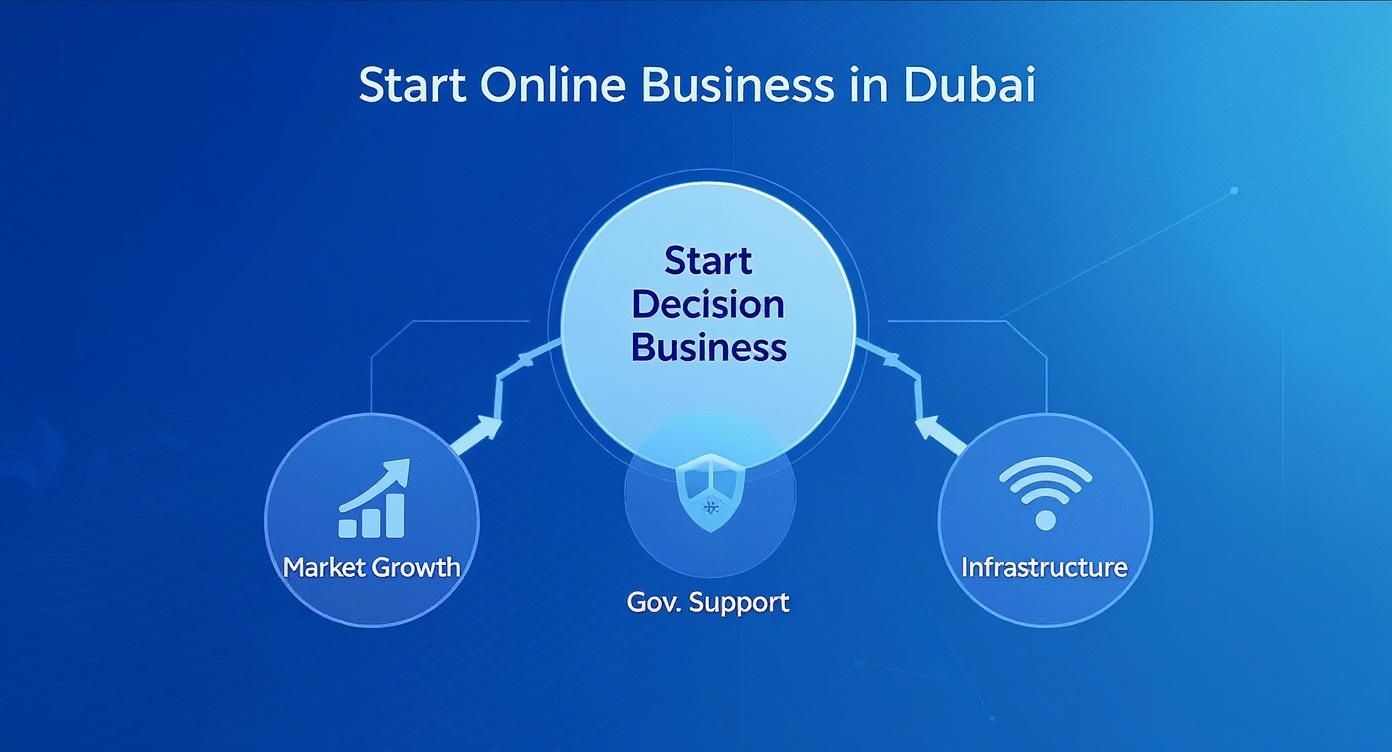
As the infographic shows, strong market growth, solid government support, and top-tier infrastructure create the ideal launchpad for entrepreneurs.
To help you choose the right path for your online business, here is a quick comparison table:
Mainland vs Free Zone Comparison for an Online Business
| Feature | Mainland Company | Free Zone Company |
|---|---|---|
| Market Access | Unrestricted access to the entire UAE market. | Primarily for international trade; local trade requires a distributor. |
| Ownership Structure | Previously required a local sponsor, but now 100% foreign ownership is possible for most activities. | 100% foreign ownership is standard. |
| Office Space | Physical office space is usually mandatory. | Flexible options, including virtual offices and flexi-desks. |
| Government Approvals | Requires approvals from the DED and other relevant ministries. | Approvals are handled by the specific free zone authority. |
| Taxation | Subject to UAE Corporate Tax, but with generous exemptions. | Typically offers 0% corporate and personal income tax for a set period. |
| Visas | Visa eligibility is often linked to the size of the office space. | Visa packages are usually included with the licence. |
This table gives you a snapshot, but the best choice always comes down to your unique business needs. A free zone offers unmatched freedom for global businesses, while the mainland connects you directly to the lucrative local UAE market.
Making the Right Decision for Your Business
To put it simply, ask yourself these questions:
- Who am I selling to? Are my customers primarily in the UAE, or are they international?
- Do I need a physical footprint? Will I have a warehouse, an office, or a shop in Dubai?
- Will I bid on government contracts? Mainland is often required for this.
- Is 100% foreign ownership a must-have?
Your answers will point you in the right direction. For a more granular look, we’ve put together a detailed guide. You can learn more about the specific differences in our guide on free zone vs mainland business setup in Dubai.
Ultimately, if your online business in Dubai serves an international clientele—think a SaaS company, a freelance copywriter, or a global e-learning platform—a free zone is almost certainly your best bet. If your model involves local sales, logistics, or other activities within the UAE, a mainland setup is the way to go.
Finding the Right E-Commerce Licence for Your Business
Okay, so you've weighed up a mainland versus a free zone setup. The next big hurdle? Getting the right e-commerce licence. This isn't just a bit of admin; it's the entire legal backbone of your online business in Dubai. It dictates what you can sell, how you operate, and basically sets the stage for your future growth. It can feel like a maze, but it really just boils down to matching your business activities to the right permit.
Picking the wrong licence can bring your operations to a grinding halt or, even worse, land you in legal hot water. For example, if you get a licence to sell physical products, you can't just decide to start offering digital services tomorrow. You have to think beyond your launch day—where do you see this business in a year? Three years? Five?
Starting Small with an E-Trader Licence
For many entrepreneurs just testing the waters, the E-Trader licence is the perfect starting point. It's issued by Dubai's Department of Economy and Tourism (DED) and is tailor-made for individuals and home-based businesses running on social media platforms like Instagram and Facebook, or through a personal website.
It's a fantastic, low-cost way for UAE or GCC nationals—freelancers, artists, or social media influencers—to start selling legally from home without the overhead of a physical office. But you need to be aware of its limits. This licence won't let you open a corporate bank account or sponsor employee visas, which will quickly become a problem as your business starts to grow.
Comprehensive E-Commerce Licences for Growth
When your plans are bigger than just a solo hustle on social media, you’ll need a proper commercial e-commerce licence. You can get these from both mainland authorities and various free zones, and each comes with its own set of perks suited to different business models.
This is the real deal—the licence that turns your side project into a legitimate, registered company. With it, you can:
- Open a corporate bank account, which is absolutely vital for credibility and managing your money properly.
- Sponsor residence visas for yourself, your family, and any employees you hire.
- Import and export goods freely (within customs regulations, of course).
- Hire a team to help you scale your operations.
Take a free zone like Dubai CommerCity, for instance. It’s literally built from the ground up for e-commerce, offering everything from warehousing and fulfilment centres to payment gateway support, all in one place. Other free zones like IFZA or Meydan also have really competitive e-commerce packages that are perfect for anyone in digital services or running a drop-shipping business.
Choosing a specialised free zone often means you're plugging into an entire ecosystem of similar businesses. The networking and partnership opportunities alone can be incredibly valuable. The whole setup is designed to help your online business thrive.
Documents and Costs You Need to Prepare
No matter which licence you go for, you'll need to get a standard set of documents ready. The exact list can change slightly depending on the jurisdiction, but the core requirements are pretty much the same everywhere. Having this paperwork sorted beforehand will make everything go much more smoothly.
You'll almost certainly need:
- Passport Copies: Clear, colour copies for every shareholder involved.
- Visa and Emirates ID Copies: If you're already a UAE resident.
- A Detailed Business Plan: Many authorities want to see this. It should outline your business model, who you're selling to, and your financial forecasts.
- Application Forms: The official, completed forms from either the DED or your chosen free zone.
Now, let's talk money. The costs can vary wildly. An E-Trader licence is your most budget-friendly option, often just over AED 1,000 a year. A full-blown free zone e-commerce licence package is a much bigger investment, usually starting from AED 15,000 and going up to over AED 30,000 for the first year. This typically includes your licence fee, registration, establishment card, and may come with visa eligibility. To get a better feel for the whole process, have a look at our complete guide on how to get a trade license in Dubai.
The e-commerce market here is exploding, which makes it an unbelievably exciting space to be in right now. The market was valued at USD 11.05 billion in 2025 and is projected to hit USD 20.54 billion by 2030—that's a compound annual growth rate of 12.39%. While consumer retail is huge, the B2B sector is actually set to grow even faster. The opportunity is massive.
This incredible growth is exactly why getting the licence right from day one is so critical. You need a licence that not only works for your business today but gives you the room to scale tomorrow. Whether you're a one-person show on Instagram or building the next big online retail empire, the right legal framework is your launchpad for success in Dubai.
Managing Visas, Banking, and Staying Compliant
Getting your trade licence is a huge milestone, but honestly, it’s just the starting pistol. The real race begins now. What comes next—sorting out your residence visa, tackling the corporate bank account, and getting a grip on your ongoing compliance duties—is what actually turns your online business in Dubai from a piece of paper into a living, breathing company.
This is where a lot of entrepreneurs hit a wall. It's less about big-picture strategy and more about meticulous execution. We're talking paperwork, appointments, and a healthy dose of patience. Nail these steps from the get-go, and you’ll build a rock-solid legal foundation, freeing you up to focus on what really matters: growing your business.
Securing Your UAE Residence Visa
For most foreign business owners, the company licence is your direct pathway to a UAE residence visa. This is your key to legally living and working in the country, and thankfully, the process is pretty methodical. Once your company's establishment card is issued, you can kick off your own visa application.
It's a multi-stage process, but it breaks down like this:
- The Entry Permit: Your company applies for this first. It allows you to be in the UAE specifically for the visa process. If you’re already in the country on a tourist visa, you can do what’s called an "in-country status change."
- Medical Fitness Test: This is non-negotiable for all residents. It’s a straightforward blood test and a chest X-ray done at a government-approved medical centre.
- Emirates ID Biometrics: You’ll need to visit a Federal Authority for Identity & Citizenship (ICA) centre. Here, they'll take your fingerprints and photo for your Emirates ID card, which is your primary identification in the UAE.
- Visa Stamping: Once your medical results come back clear, your passport is handed over for the final visa to be stamped inside.
From start to finish, you can expect this to take a couple of weeks. My advice? Using a professional PRO (Public Relations Officer) service is a total game-changer here. They handle the document runs and guide you through each appointment, saving you an incredible amount of time and potential headaches.
Navigating the Corporate Bank Account Opening
Let’s be blunt: this is often the single biggest hurdle for any new online business in Dubai. UAE banks have tightened their compliance and due diligence checks significantly. Long gone are the days of just walking in and opening an account. It now requires serious preparation.
Simply showing up with a trade licence won't cut it. Banks need to see a legitimate, well-documented business with a clear purpose and a genuine footprint in the UAE.
To give yourself the best shot at approval, put together a complete file with these documents:
- Full Company Papers: Your trade licence, Memorandum of Association (MOA), share certificates, and establishment card.
- Personal Documents: Passport, visa, and Emirates ID copies for all shareholders and the company manager.
- Proof of Business Activity: This is absolutely critical. You need a solid business plan, a professional website, supplier invoices, or even contracts with potential clients. Anything that proves you're a real business.
- Proof of Address: Your personal tenancy contract (Ejari) in Dubai is a must.
Here's a pro tip from my experience: actively seek out banks that get the digital business world. Some of the more traditional banks are still wary of models like drop-shipping or digital marketing services. Do your homework, look into newer digital-first banks, or find ones with dedicated SME programmes. And be ready to explain exactly where your money will be coming from and going to.
Staying Compliant with Renewals and Taxes
You're finally up and running—great! But the work doesn't stop. Ongoing compliance is what keeps your business legitimate and out of trouble. This isn't a one-and-done setup; it's an annual cycle. Dropping the ball here can lead to heavy fines and major problems with your visa and bank account.
Your two main focus areas will be annual renewals and corporate tax.
Annual Licence Renewal: Your trade licence has a one-year expiry date. You must renew it annually with your issuing authority (the DED for mainland or your specific free zone). This renewal is usually tied to your virtual office or flexi-desk lease as well. Set a calendar reminder and start the renewal process at least a month early to avoid any last-minute panic.
UAE Corporate Tax: Since June 2023, the UAE has a federal Corporate Tax. For most small online businesses, the key number to remember is AED 375,000. If your annual net profit is below this, you're in the 0% tax bracket. Anything above that is taxed at a flat rate of 9%.
Crucially, every single business must register for Corporate Tax with the Federal Tax Authority (FTA). You'll also need to file an annual tax return, even if you owe 0% tax. The best advice I can give is to keep clean, organised accounting records from day one. It will make tax season infinitely less stressful.
Assembling Your Digital and Operational Toolkit
With the legal side of your company sorted, it's time to build the engine that will actually drive your online business in Dubai. This is where we get practical. You'll be picking the technology and tools that define your customer experience and, just as importantly, your own day-to-day efficiency. Getting this part right is absolutely crucial for making a mark in the UAE's buzzing digital marketplace.
Your first big decision is your digital storefront. It needs to be solid, easy for customers to use, and ready to plug into the local payment and delivery systems. This is where you choose your e-commerce platform.
And it’s a massive market you’re tapping into. In 2024, the UAE's e-commerce scene was valued at a staggering USD 125.0 billion, with projections hitting USD 776.2 billion by 2033. The two heavyweights powering this growth are Shopify, which hosts nearly 42% of UAE online stores, and WooCommerce, sitting at around 36%.
Choosing Your E-Commerce Platform
The Shopify versus WooCommerce debate is just as real here in Dubai as it is anywhere else. Shopify is famous for its all-in-one, incredibly user-friendly setup. It’s perfect if you want to get launched quickly without getting tangled up in technical weeds. You get great themes, a reliable app store, and top-notch security, all out of the box.
WooCommerce, on the other hand, is a beast of a plugin for WordPress. It offers endless customisation, but it definitely has a steeper learning curve. With WooCommerce, you're in charge of your own hosting, security, and maintenance. This gives you ultimate control, but also a lot more responsibility.
So, how do you choose?
- Go with Shopify if: You value ease of use and speed. It’s ideal if you don't want the headache of managing your own hosting or security.
- Go with WooCommerce if: You need deep, specific customisations, you're already on WordPress, and you're comfortable handling the technical side of things.
Once you’re legally set up and your store is live, keeping operations smooth is key. For those running a dropshipping model, it’s worth learning how to fulfill orders on your Shopify dropshipping store efficiently from day one.
Integrating Local Payment Gateways
Don't assume your international payment gateway will be enough. To build trust and cater to how people in the UAE actually prefer to pay, integrating a local payment gateway is non-negotiable. When customers see familiar, trusted payment options at checkout, their confidence soars.
The top choices here are Telr and PayTabs. Both are well-established, support multiple currencies (including AED, of course), and have strong fraud protection. They integrate seamlessly with major platforms like Shopify and WooCommerce, making the checkout process smooth for your customers. To get set up, you'll go through an application process where you’ll need to provide your new trade licence and corporate bank account details.
From experience, a smooth payment process can significantly reduce cart abandonment. A customer who sees a familiar and trusted payment option like PayTabs is far more likely to complete their purchase than one who is redirected to an unfamiliar international processor.
Logistics and Building Credibility
Okay, your store is built and you can take payments. Now, how do you get products to your customers and convince them you're a legitimate, professional business?
Logistics Partners
In e-commerce, reliable delivery is everything. Partnering with a reputable courier is essential for managing customer expectations and protecting your brand's reputation. Companies like Aramex, Fetchr, and Shipa are the leaders in the region. They offer robust e-commerce solutions, including cash-on-delivery services, real-time tracking, and simple integrations with your online store.
The Virtual Office Advantage
Even if your business is 100% online, having a credible business address is vital for building trust. It’s a signal to customers, banks, and potential partners that you are a serious, established company. This is where a virtual office comes in.
A virtual office gives you a prestigious business address and mail handling services without the hefty price tag of a physical office. It ticks a crucial box for your licence and bank account application while projecting a professional image right from the start. To see what’s available, have a look at our guide on securing a virtual office in Dubai.
Got Questions About Starting Your Online Business in Dubai?
Even with a step-by-step guide, you’re bound to have questions pop up. I get it. The rules for setting up an online business in Dubai can feel like a maze, so I’ve pulled together the most common questions I hear from entrepreneurs just like you. Let's clear up these sticking points so you can move forward.
Can I Run an Online Business in Dubai Without a Licence?
Let’s be direct: the answer is a hard no. In Dubai, it’s illegal to conduct any kind of commercial activity—whether you're selling products on Instagram or offering services through a website—without a valid trade licence. Trying to fly under the radar can lead to hefty fines, having your business shut down, and a whole lot of legal headaches you don't need.
Every single legitimate online business here has a licence. It might be a simple E-trader licence for a one-person social media shop, or a full-blown e-commerce licence from a free zone for a bigger operation. This isn't just bureaucracy; it's a system designed to protect customers and business owners, creating a fair and regulated market for everyone.
How Much Does It Cost to Start an Online Business in Dubai?
This is the big question, and the honest answer is: it varies. A lot. There's no one-size-fits-all price tag, so it’s best to think in terms of a range.
- E-Trader Licence: This is your most budget-friendly starting point. At just over AED 1,000 a year, it’s perfect for individuals selling through social media.
- Free Zone E-Commerce Licence: If you need a more formal company structure with visa eligibility, you’re looking at a first-year investment of anywhere from AED 15,000 to over AED 30,000. This usually bundles the licence, registration, and establishment card.
- Mainland E-Commerce Licence: Costs here can be similar to free zones, but sometimes higher depending on your specific business activities and any special approvals you might need.
Don't forget to factor in other costs like visa processing fees, a virtual office package, and any deposits required to get that all-important corporate bank account open.
Do I Really Need a Physical Office?
This is a huge misconception that stops a lot of people. The short answer is no, you don't need a traditional office with a front door and a water cooler. The authorities in the UAE are well aware of how digital businesses work and have created flexible options.
Most free zones, and even some mainland authorities, offer flexi-desk or virtual office packages. This is a brilliant, cost-effective solution that gives you what you actually need: a legitimate, registered business address. This address is mandatory for your licence application and for opening your bank account, but it doesn't come with the high overheads of a physical lease.
A registered business address does more than just tick a legal box. It immediately builds trust. Customers, suppliers, and banks see it as a sign that you’re a serious, properly established business in the UAE.
Can I Get a Residence Visa with My Licence?
Absolutely. This is one of the single biggest advantages of setting up a proper company here. Most e-commerce licences, particularly those from free zones, come with visa eligibility built right into their packages. The number of visas you can apply for usually depends on the package you choose.
This visa allows you, the owner, to live and work legally in the UAE. It also gives you the power to sponsor residence visas for your family members. As your business grows, you can sponsor your employees, too. This is a massive step up from a basic freelance permit, which comes with far more restrictions.
Once you're set up and running, the next challenge is growth. For a deeper dive into what comes next, check out these proven strategies for growing an online business.
Ready to stop dreaming and start building your online business in Dubai? It can feel overwhelming, but you don’t have to figure it all out on your own. The expert team at Al Ain Business Center lives and breathes this stuff. We handle every detail—from finding the perfect licence to sorting your visa and bank account—so you can focus on what you do best. Let us handle the red tape. Get your free consultation with Al Ain Business Center today!