
Opening a non-resident bank account in Dubai isn't just a possibility—it's a savvy move for global investors and entrepreneurs. For anyone who understands Dubai's unique financial landscape, the process is surprisingly straightforward, offering a secure and tax-efficient base for managing international wealth.
Why Dubai Is the Premier Hub for Global Banking
Dubai has cemented its reputation as a world-class financial centre, pulling in individuals and companies looking for stability, growth, and a banking system that’s truly ahead of the curve. The city's appeal goes far beyond its impressive skyline; it's built on a solid regulatory foundation and a business-first ecosystem designed for global commerce.
A huge part of the draw is the UAE's commitment to creating a secure banking environment. The Central Bank of the UAE is known for its strict compliance and anti-money laundering (AML) regulations, which builds incredible trust and protects the integrity of its financial institutions. This gives non-residents real peace of mind that their assets are well-protected.
Economic and Logistical Advantages
Dubai’s strategic position as a bridge between East and West makes it a natural hub for international trade and investment. For non-residents, this brings some very real, tangible benefits:
- A Tax-Friendly Environment: The absence of personal income tax, capital gains tax, and withholding tax makes it a powerhouse for preserving and growing wealth.
- Economic Stability: The UAE Dirham (AED) is pegged to the US Dollar. This provides crucial currency stability and minimises exchange rate risks—a major plus for international transactions.
- Digital-First Banking: Banks here have poured money into advanced digital platforms. This means you get sophisticated online and mobile banking that lets you manage your finances from literally anywhere in the world.
This powerful mix of security, economic stability, and modern infrastructure makes opening a non-resident bank account in Dubai a logical next step for anyone managing global finances. It's also a practical way to establish a foothold in the region without needing immediate residency, especially when paired with flexible solutions like a virtual office in Dubai.
The city's reputation as a safe harbour for capital isn't just talk; it's reflected in hard data. A well-regulated environment, coupled with powerful economic incentives, continues to attract significant foreign investment.
Evidence of Growing Confidence
The numbers speak for themselves. The increasing flow of foreign capital into the UAE's banking sector is a clear sign of its growing importance on the world stage.
As of early 2025, non-resident bank deposits were on a significant upward trend, underscoring the system's appeal. According to the Central Bank of the UAE, these deposits shot up by 5.1% between January and February 2025 alone, hitting approximately AED 249.1 billion (around $67.8 billion).
To put that in perspective, this growth rate far outpaced the 0.8% rise in resident deposits during the same period. It’s a clear confirmation of strong international trust in Dubai's financial stability. You can dig into more data on the UAE's banking growth over at Khaleej Times.
Getting Your Paperwork in Order for a Smooth Approval
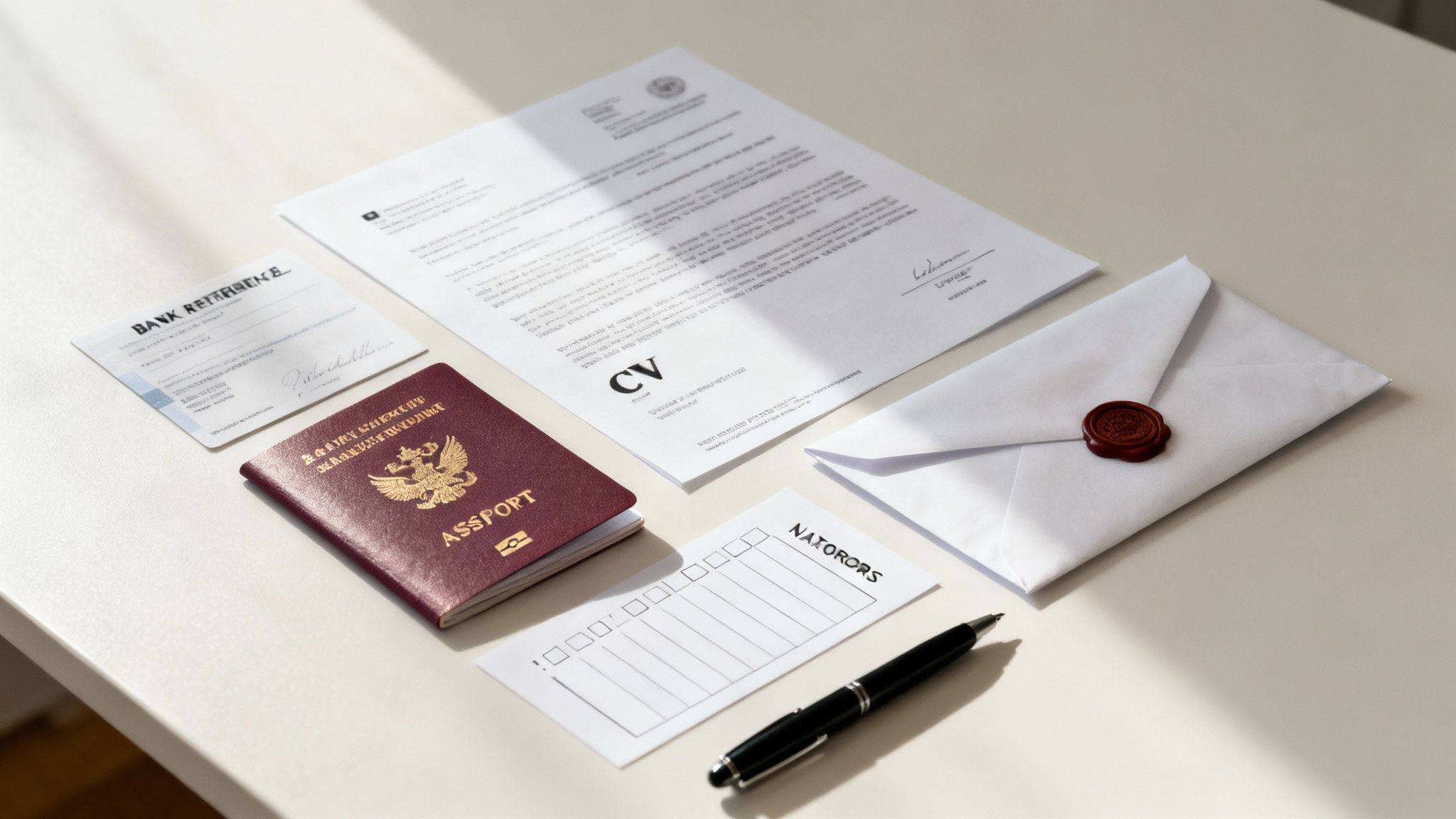
Let's be blunt: your success in opening a non resident bank account in Dubai comes down to one thing—your paperwork. UAE banks are incredibly thorough with their Know Your Customer (KYC) and due diligence checks. A perfectly organised document file isn't just a good idea; it's non-negotiable.
Think of it this way: your application package tells the story of who you are and why you need a bank account here. Every single document needs to work together to paint a clear, trustworthy picture. Submitting a messy or incomplete file is the quickest way to face delays or an outright rejection.
The Core Documents Every Applicant Needs
No matter if you're an individual or applying for a company, there's a foundational set of documents that every bank will ask for. This is the bedrock of your application and the first thing a compliance officer is going to scrutinise.
Here’s your essential checklist:
- A Clear Copy of Your Valid Passport: This needs to show your photo, personal details, and, crucially, your UAE entry stamp. It's your main proof of identity.
- A Recent Utility Bill: Make sure it's from the last three months and clearly displays your name and residential address in your home country. This verifies where you live.
- Original Bank Reference Letter: This is a formal letter from your current bank (outside the UAE) confirming you have a well-maintained account with them. It proves you have an established financial history.
- Personal CV (Curriculum Vitae): This gives the bank a snapshot of your professional background and work experience.
- Source of Funds Declaration: A straightforward statement explaining where your wealth comes from and the source of the funds you plan to deposit.
That last point is a big one. Banks are legally required to understand the origin of your money to comply with anti-money laundering (AML) regulations. Be ready to provide evidence to back up your declaration, like payslips, documents proving business ownership, or investment statements.
Why Document Attestation Matters
For certain documents, especially corporate ones, you’ll run into the term "attestation." This is a formal process where government bodies and embassies verify that a document is authentic. While your personal passport usually won't need this, company registration papers almost certainly will.
Navigating the ins and outs of document legalisation can be a real headache. A mistake here can bring your application to a dead stop, as banks simply won't proceed with improperly verified paperwork.
Making sure every document is correctly prepared and, if needed, attested is a vital step. For anyone not familiar with these procedures, using professional document clearing services in Dubai can save you from making costly mistakes and speed things up considerably. This is where getting expert help turns a confusing task into a simple tick on your checklist, helping you submit a file that sails through compliance without any friction.
Comparing the Best Banks for Non-Residents
Choosing the right bank for your non resident bank account in Dubai is about much more than just fees. It’s about finding a perfect match for your financial needs. Not every bank welcomes non-resident applicants with open arms, and you'll find big differences in their requirements and digital banking tools.
A few key players tend to dominate the scene, known for their experience with international clients. Banks like Emirates NBD, Mashreq, and Abu Dhabi Commercial Bank (ADCB) are often the top choices, but each has its own distinct personality. Your decision should really boil down to practical things like minimum balance requirements, multi-currency options, and how good their online banking platform is.
The Major Players and What They Offer
Emirates NBD is one of the biggest and most established banks in the region, with a massive range of products. Think of them as a solid all-rounder, boasting a reliable digital app and a huge network of branches and ATMs. The catch? Their minimum balance for non-residents can be on the steep side.
Mashreq, on the other hand, is widely praised for its digital-first mindset. Their online platforms are sleek, user-friendly, and packed with modern features—a major advantage if you plan to manage your money from overseas. This makes them a great fit for tech-savvy entrepreneurs and investors.
ADCB sits somewhere in the middle, blending traditional banking with modern convenience. They’re known for excellent customer service and are often a top pick for those who appreciate having a dedicated relationship manager to call on.
The real secret is to look past the glossy brochures. A bank might advertise a "global account," but you need to dig into the actual costs, see how easy international transfers are, and check if their digital tools genuinely let you do everything you need without having to step into a branch.
A Side-by-Side Look at Key Features
Dubai's appeal to international investors is clear from the numbers. By March 2024, deposits from non-residents in UAE banks skyrocketed to AED 221 billion (around $60.2 billion), a 3.5% jump from the year before. This shows just how much confidence global investors have in the UAE's financial system.
To help you get a clearer picture, we've put together a simple comparison of what to expect from the top banks.
Feature Comparison of Leading Dubai Banks for Non-Residents
Here's a quick breakdown to help you see how the main players stack up against each other for non-resident accounts.
| Bank Name | Minimum Balance (Avg.) | Multi-Currency Options | Best For |
|---|---|---|---|
| Emirates NBD | Often starts from AED 100,000+ | Yes, strong options in major currencies like USD, EUR, GBP. | Individuals and businesses seeking a large, established bank with a full suite of services. |
| Mashreq Bank | Varies, can be more flexible (e.g., AED 75,000) | Excellent, with a focus on seamless digital foreign exchange. | Digitally-focused entrepreneurs and investors who prioritise online account management. |
| ADCB | Typically in the AED 100,000 – 200,000 range. | Available, particularly for premium account holders. | Those who value personalised service and relationship management. |
Ultimately, the best bank is the one that fits your specific profile. A property investor might lean towards ADCB for its personalised touch, while the owner of a new LLC company in the UAE might find Mashreq’s slick digital tools perfect for managing business transactions.
Think about your primary banking activities. Will you be making lots of international transfers, holding different currencies, or just parking funds? Answering that question will point you straight to the right choice.
Navigating the Account Opening Process
Opening a non-resident bank account in Dubai isn’t just about filling out forms; it’s about starting a trusted relationship with your chosen bank. The whole thing kicks off with an initial meeting with a relationship manager, which really sets the tone for the entire application. You can think of it as a professional introduction where you lay out your financial story.
This first chat is your chance to clearly explain why you need an account in Dubai. It could be for international investments, managing funds from a UAE-based property, or simplifying global business transactions. Whatever the reason, be ready to state your purpose clearly. The relationship manager's job is to understand your profile and see if you’re a good fit for the bank.
The All-Important Compliance Interview
After your initial discussion, you'll move on to the compliance interview. This is a more formal, structured conversation, usually with a compliance officer. Their goal is to satisfy the bank's strict Know Your Customer (KYC) and due diligence requirements. Expect direct and specific questions that dig into the source of your wealth and how you plan to use the account.
You’ll need to be ready to talk about:
- Source of Funds: Have a detailed and verifiable story of how you accumulated your wealth. This isn't the time to be vague. Back it up with salary slips, business ownership documents, or investment portfolio statements.
- Transaction Patterns: They’ll want to know the expected volume, frequency, and nature of your transfers. For instance, will you be receiving large, one-off payments from property sales, or will it be regular monthly income from a business?
- Business Activities: If you're applying for a corporate account, prepare for a deep dive into your company’s operations, its main clients, and its suppliers.
My best advice here? Be transparent and organised. Having all your documents ready to support your claims shows you're professional and helps the compliance team build a clear picture of your financial standing. This alone can seriously speed up the approval process.
This visual guide breaks down the core factors you should weigh when choosing a bank.
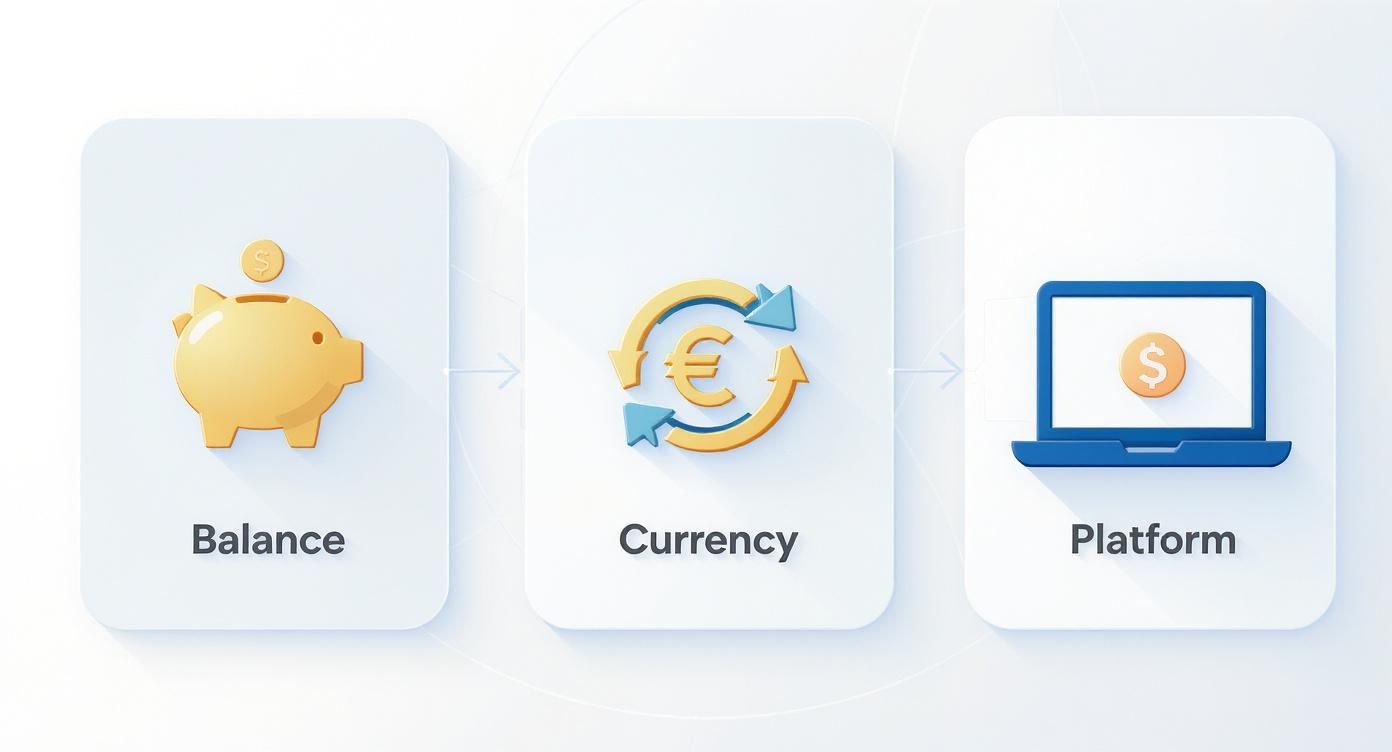
As the infographic shows, the final decision really comes down to balancing your available capital, your need for currency flexibility, and how you want to manage your account on a day-to-day basis.
Personal vs Corporate Account Processes
While the core KYC principles are the same, the actual application process is quite different for personal and corporate accounts. A personal account application is all about you—your individual financial history and professional background.
For a corporate account, the bank’s scrutiny expands to the entire business structure. They will meticulously analyse your trade licence, Memorandum of Association (MoA), and shareholder documents. They need to understand your business model inside and out to properly assess its risk profile. This process is naturally more detailed and almost always takes longer because of the extra layers of verification. Getting through this successfully means having a perfectly prepared file that leaves zero room for doubt about your company’s legitimacy and operations.
Common Mistakes That Lead to Rejection
Successfully opening a non resident bank account in Dubai often comes down to sidestepping a few common, but totally avoidable, mistakes. Getting an application rejected isn't just a simple "no." It's lost time, wasted effort, and a potential roadblock for your business and financial plans.
From our experience helping clients, we’ve seen where things usually go wrong. Understanding these pitfalls is the absolute best way to make sure your own application sails through.
Incomplete or Poorly Prepared Documentation
This is, without a doubt, the number one reason we see applications get turned down. It’s not just about submitting the documents on the required list; they have to be flawless.
We’ve seen applications stumble over simple things: a utility bill that’s just a week over the three-month limit, a bank reference letter that’s too generic, or a passport copy that’s even slightly blurry.
Think about it from the bank's perspective. Imagine you submit a six-month bank statement where your name is spelled slightly differently from your passport. To a compliance officer, that isn't a minor typo—it's a discrepancy that immediately raises questions about your identity.
Another classic mistake is not taking your CV seriously. Banks aren't just being nosy; they use it to build a picture of your professional background and verify that your income sources make sense for your career. A hastily written CV can make your entire profile look less credible.
An Unclear Source of Funds Story
Simply writing "business profits" on the source of wealth form just won't cut it anymore. UAE banks need a detailed, verifiable story of how you built your capital, backed by solid proof. An application is almost guaranteed to fail if the source of funds declaration is vague or can't be supported by evidence.
For instance, if your wealth comes from selling property, you need to have the sale agreements ready to go. If it's from selling a business, the share purchase agreement and completion statements should be on hand. It's all about creating a clear, easy-to-follow paper trail.
Banks think in terms of risk. An application with a clear, well-documented, and logical financial history presents low risk. An application with gaps, inconsistencies, or unverified claims presents high risk—and is almost always declined.
Misalignment With the Bank's Risk Appetite
Here’s something many people don't realise: not every bank is the right fit for every person. Each bank has its own internal "risk appetite," and some are simply more cautious about certain business activities or clients from specific countries they deem high-risk.
Applying to a bank whose risk profile doesn’t match your business is a fast track to rejection.
For example, a conservative, traditional bank might be hesitant to open an account for a business involved in cryptocurrency trading, even though it's a completely legal and regulated activity. It's not personal; it's just not a fit for their risk model.
Doing your homework upfront to choose a bank that is genuinely comfortable with your line of business is one of the most important steps. This single piece of strategy dramatically increases your chances of a smooth and successful application.
Let Us Handle the Hard Part for You
Navigating the ins and outs of opening a non-resident bank account in Dubai can feel like a full-time job. It’s a path filled with tricky compliance hurdles and endless paperwork. But it doesn't have to be your problem.
When you work with Al Ain Business Center, you’re not just hiring a service; you're gaining a partner who will manage the entire journey for you, from the first document to the final account approval.
We dive into the details so you don't have to. Our team meticulously prepares, correctly attests, and organises every single piece of paper to meet the notoriously strict standards of UAE banks. More importantly, we pre-screen your entire application, catching and fixing those small red flags that often lead to instant rejections before a bank’s compliance officer ever sees them.
We’ve Built the Relationships, So You Don’t Have To
Over the years, we've built strong, trusted relationships with key decision-makers and relationship managers at major banks across Dubai. This isn't something you can do overnight.
This means we don’t just blindly submit your paperwork into a black hole. We make a warm introduction, ensuring your application gets the attention it deserves from people who understand the unique challenges non-residents face. This direct line of communication often speeds up the review process and significantly boosts your chances of a quick approval.
When you partner with us, your application isn't just another file in a massive pile. It's a professionally prepared, strategically positioned case designed to maximise your odds of success on the very first try. We take the guesswork out of the equation and give you back your most valuable asset: your time.
Common Questions About Non-Resident Banking in Dubai
When you're looking to open a non-resident bank account in Dubai, a lot of practical questions come up. We get these all the time from international clients, so let's tackle the most common ones head-on.
Can I Really Open a Dubai Bank Account Remotely?
This is probably the number one question we hear. While it would be convenient, fully remote account opening has become a thing of the past due to much stricter KYC (Know Your Customer) regulations.
The good news is that most of the heavy lifting can be done from your home country. A specialist consultant can prepare your entire file, get it submitted, and even secure a pre-approval from the bank. This means your trip to Dubai is just for the final, quick formalities – meeting a bank representative and signing the paperwork. It turns a potentially lengthy process into a short, efficient visit.
What's the Minimum Balance I Need to Keep?
There's no single answer here, as the minimum balance requirement can vary wildly from one bank to another and depends heavily on the account type.
For a basic non-resident savings account, you might see figures ranging from AED 3,000 all the way up to AED 100,000 (or the equivalent in another currency). If you're looking at premium or priority banking, expect those numbers to be significantly higher. Corporate accounts also typically have much higher thresholds than personal ones.
Always confirm this figure directly with your chosen bank before you apply. Failing to maintain the minimum balance can trigger surprisingly high monthly penalty fees that you definitely want to avoid.
How Long Does the Whole Process Take?
The timeline can be anything from a few days to a few weeks. It all comes down to the quality of your application.
If all your documents are perfectly in order and your profile is straightforward, you could be looking at a turnaround of just 2-5 working days after your in-person meeting.
However, if the bank's compliance team flags anything or needs more information about your source of funds, the process can easily stretch to 3-4 weeks. The best way to speed things up is to make sure your application is complete, clear, and compliant right from the start.
Navigating Dubai's banking world can feel complicated, but you don't have to figure it out alone. The team at Al Ain Business Center knows the process inside and out. We handle everything from preparing your documents to getting that final approval, making sure your application is set up for success from day one. Let us manage the paperwork so you can focus on what's next.
Start your hassle-free bank account opening journey with us today.