For a long time, Dubai was seen primarily as a hub for trade and tourism. But that picture is changing, and fast. The emirate has been making a deliberate and powerful shift, transforming itself into a serious global player in the world of manufacturing. This isn't happening by chance; it's the result of ambitious government initiatives and massive investments in world-class infrastructure, creating the perfect environment for businesses looking to set up production in the Middle East.
Exploring Dubai's Manufacturing Landscape
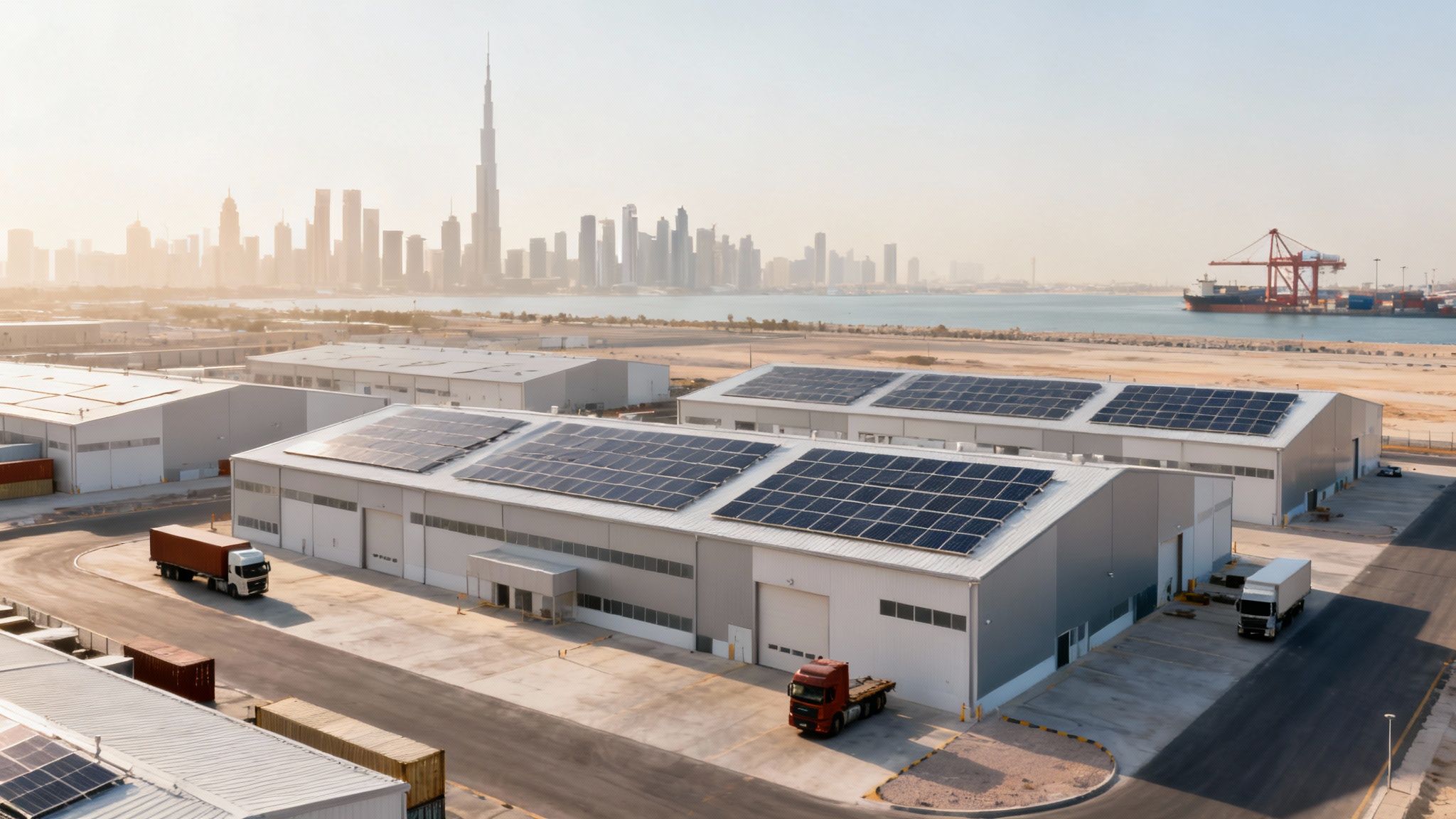
Think of Dubai's manufacturing growth like its iconic skyline—it's strategic, ambitious, and rising quickly. The emirate is purposefully building an industrial powerhouse, moving far beyond its reputation for commerce and luxury.
At the heart of this transformation is the Dubai Economic Agenda (D33), a clear roadmap to double the city's economy by 2033. Manufacturing isn't just a piece of this plan; it's a central pillar. The focus is squarely on moving away from traditional sectors and embracing high-value, tech-driven production.
Key Pillars of Dubai's Industrial Sector
What you'll find today is a dynamic mix of well-established industries working alongside cutting-edge, high-tech fields. This diversity builds a resilient and opportunity-rich environment for investors and entrepreneurs. The key areas gaining serious momentum include:
- Advanced Materials and Metals: This covers everything from producing aluminium and steel to advanced composites for the aerospace, construction, and automotive sectors.
- Food and Beverage (F&B): A sector that is absolutely booming, driven by the UAE's food security goals and Dubai’s critical role as a major re-export hub for the region.
- Machinery and Equipment: Manufacturing industrial machinery, complex equipment, and essential spare parts that fuel the wider industrial ecosystem.
- 3D Printing (Additive Manufacturing): Dubai is making a bold play to become a global leader here, with an incredible goal for 25% of its buildings to be 3D printed by 2030.
As you explore these opportunities, it's also helpful to get your head around the different production approaches by understanding OEM and ODM models. Choosing the right one can make a huge difference to your setup costs and operational strategy, as it dictates how involved you are in the design and production process.
Dubai's industrial strategy isn't just about building factories. It's about creating a fully integrated ecosystem where innovation, logistics, and business-friendly policies all come together to drive sustainable growth and global competitiveness.
This clear, strategic direction means that when you set up a manufacturing business in Dubai, you're not just entering a new market. You're joining a well-supported, future-focused industrial community. The combination of incredible infrastructure and solid government backing paints a clear picture of the opportunity here, showing exactly why global investors are increasingly choosing Dubai as their foundation for operations.
Why Dubai Is a Strategic Manufacturing Hub
Dubai's competitive advantage in the global market isn’t down to just one thing. It's a powerful mix of smart, deliberate choices that come together to create an ecosystem built for manufacturing success. When you set up shop here, you're not just getting a factory space; you're plugging into a system designed for growth. It all starts with the one thing you can't build or buy: location.
Sitting right at the crossroads of Asia, Europe, and Africa, Dubai acts as a natural bridge between major world economies. This isn't just a convenient spot on the map—it’s a massive business asset. It slashes shipping times and logistics costs, getting your products into the hands of billions of consumers faster than almost anywhere else on the planet.
The Logistics and Infrastructure Powerhouse
A great location is only as good as the infrastructure that backs it up, and this is where Dubai truly shines. The emirate has created a supply chain environment that is practically seamless, with world-class air and seaports working in perfect harmony.
The heart of this system is Jebel Ali Port, one of the biggest and busiest ports in the world. It’s far more than just a place for ships to dock; it’s a high-tech logistics hub connecting to over 150 ports globally. Working hand-in-hand with this maritime giant is Al Maktoum International Airport (DWC), a cornerstone of the Dubai World Central logistics district, built to handle huge volumes of air cargo at incredible speeds.
- Integrated Logistics Corridor: A special customs-bonded corridor links Jebel Ali Port directly to Al Maktoum Airport. This means cargo can be moved from sea to air in just a few hours, creating an unmatched sea-air freight solution.
- Advanced Road Networks: State-of-the-art highways ensure your raw materials and finished goods get from the factory to the port or airport without a hitch, keeping delays to a minimum.
- Specialised Industrial Zones: These areas are purpose-built for manufacturers, offering ready-to-go facilities and direct access to major transport links, making your entire supply chain smoother.
This incredible synergy means your business can run like a well-oiled machine, getting materials in and products out with predictable speed and reliability.
Think of it like this: setting up your manufacturing in Dubai is like placing your factory right in the centre of a global distribution network. You get immediate, high-speed access to both established and emerging markets, all powered by infrastructure that simply removes friction from your supply chain.
A Supportive and Forward-Thinking Business Environment
It’s not just about the physical infrastructure. Dubai has painstakingly built a business environment that actively encourages industrial growth and welcomes foreign investment. The rules are clear, stable, and incredibly attractive for international companies looking to set up here. This supportive climate rests on a few key pillars that make it easier to launch, run, and grow a manufacturing business.
One of the biggest draws is the favourable tax policy. Companies in Dubai enjoy 0% corporate tax on profits up to AED 375,000, and a highly competitive rate of just 9% on anything above that. On top of that, there's no personal income tax, which is a massive advantage when it comes to attracting top talent from all over the world.
Another game-changer has been the shift in ownership rules. Recent reforms now allow for 100% foreign ownership of businesses on the Dubai Mainland across a huge range of industrial activities. This completely removes the old requirement of having a local Emirati partner, giving you full control over your operations and profits. This policy, once a unique perk of free zones, is now a major incentive for setting up anywhere in Dubai and shows just how committed the government is to creating an open and inviting landscape for manufacturers.
Choosing Your Jurisdiction: Mainland vs. Free Zone
One of the first, and most important, decisions you'll make when setting up a manufacturing business in Dubai is choosing your jurisdiction. This isn't just about picking a location on a map; it's a strategic choice that dictates who you can sell to, your ownership structure, and the rules you operate by.
A simple way to think about it is this: setting up on the Dubai Mainland is like opening a flagship store on a busy high street. You have complete, unrestricted access to the entire local UAE market. You can trade with any person or business in the country, no strings attached.
A Free Zone, on the other hand, is more like a specialised industrial park. It’s a self-contained ecosystem designed for global trade, with its own set of rules and incentives geared towards import and re-export.
This infographic lays out the core advantages of manufacturing in Dubai, from its strategic global position to its world-class logistics.
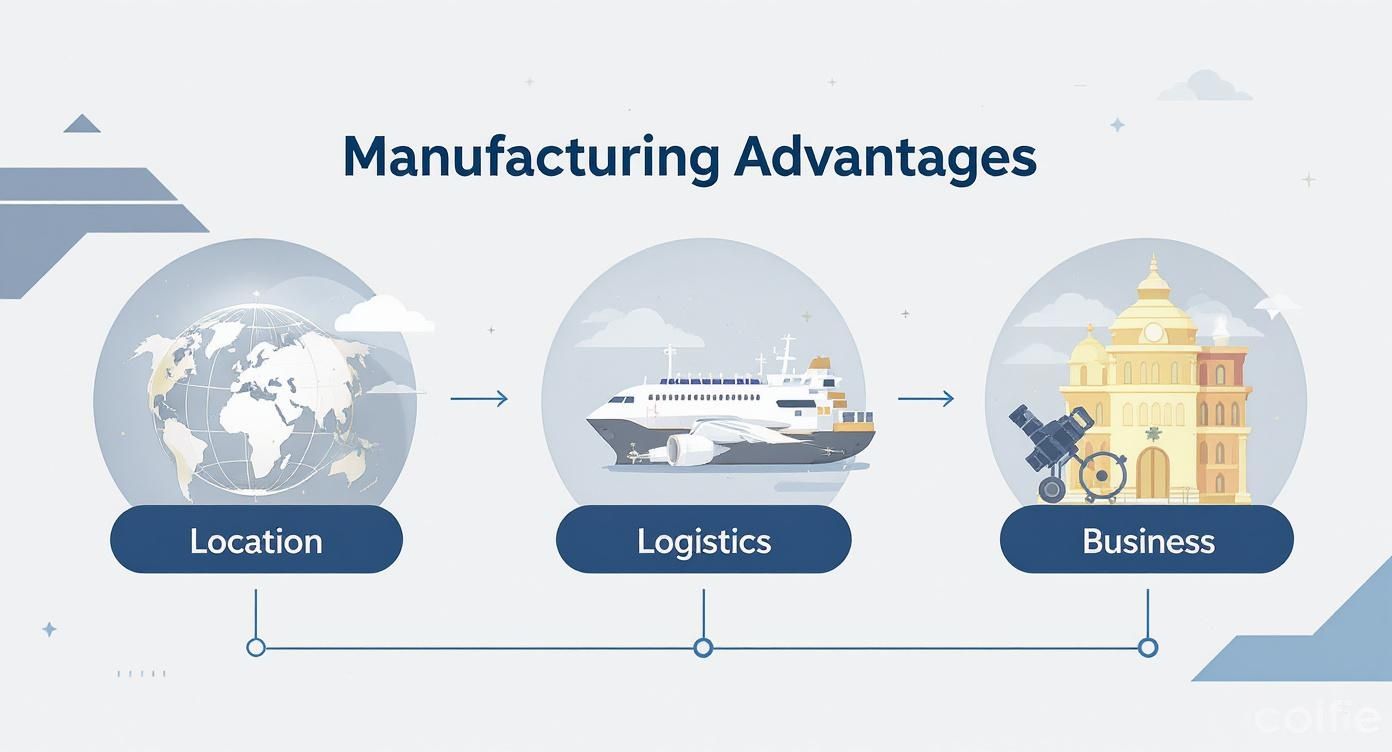
What’s crucial to see is how these elements work together, creating a powerful environment that supports industrial growth and makes global trade far simpler.
Understanding Dubai Mainland Operations
A Mainland company, registered with the Department of Economy and Tourism (DET), gives you the ultimate freedom to operate within the UAE. The biggest draw is the ability to conduct business anywhere in the local market without needing a local agent or distributor.
Recent legal changes have made the Mainland incredibly appealing. It now allows for 100% foreign ownership for most industrial activities—a huge shift that was once a benefit exclusive to free zones. For businesses aiming to build a strong local presence, a Limited Liability Company (LLC) is often the best route. You can get the full picture by reading our guide to forming an LLC company in the UAE.
Exploring Manufacturing Free Zones
Dubai's free zones are purpose-built industrial hubs, each managed by its own independent authority. They are designed specifically to attract foreign investment by offering powerful incentives that simplify international trade. Think of them as complete ecosystems with state-of-the-art infrastructure, including warehouses, industrial plots, and ready-to-go factory units.
The main benefits of setting up in a free zone are crystal clear:
- 100% foreign ownership and the ability to repatriate all your capital and profits.
- Full exemption from customs duties on imports and re-exports.
- Simplified setup processes with one-stop-shop services for all your licensing and permit needs.
For manufacturers, some free zones are better suited than others, thanks to their specialised focus and infrastructure.
To help you decide, let's break down the key differences between a Mainland and a Free Zone setup in a simple table.
Mainland vs Free Zone Comparison for Manufacturing
| Feature | Mainland Company | Free Zone Company |
|---|---|---|
| Market Access | Unrestricted access to the entire UAE domestic market. | Primarily focused on international trade; requires a local agent to sell in the UAE. |
| Ownership Structure | Now offers 100% foreign ownership for most activities. | 100% foreign ownership has always been a core benefit. |
| Customs Duties | 5% customs duty on imported goods for local sale. | 0% customs duty on imports and re-exports. |
| Office/Warehouse Space | Can be located anywhere in Dubai. | Must operate within the specific free zone's boundaries. |
| Regulatory Authority | Governed by the Department of Economy and Tourism (DET). | Governed by the respective Free Zone Authority. |
| Best For | Businesses targeting the local UAE market for sales. | Businesses focused on assembly, import, and re-export to global markets. |
Ultimately, the best choice depends entirely on your business model and target market.
Key Insight: The question isn't which option is "better," but which is better for your business. If your main goal is to sell within the UAE, the Mainland offers a direct path. If your focus is on international exports and assembly, a free zone provides a powerful, cost-effective platform.
Leading Free Zones for Manufacturing in Dubai
Not all free zones are the same, especially when it comes to industrial operations. Two stand out as powerhouses for manufacturing in Dubai: Jebel Ali Free Zone (JAFZA) and Dubai Industrial City (DIC).
- Jebel Ali Free Zone (JAFZA): As one of the largest free zones in the world, JAFZA is a global logistics giant. Its direct connection to Jebel Ali Port and close proximity to Al Maktoum International Airport provide unmatched connectivity for import and export. It's the ideal choice for large-scale manufacturers and global brands that depend on a flawless supply chain.
- Dubai Industrial City (DIC): This is a dedicated industrial hub built for the entire manufacturing value chain. DIC is zoned by industry—with areas for food and beverage, base metals, machinery, and more. It offers a huge range of facilities, from industrial land to high-tech warehouses, making it perfect for a diverse mix of manufacturing activities.
Choosing the right jurisdiction is a foundational decision. It will impact your company's costs, compliance, and market potential for years to come.
Breaking Down the Costs of Manufacturing in Dubai
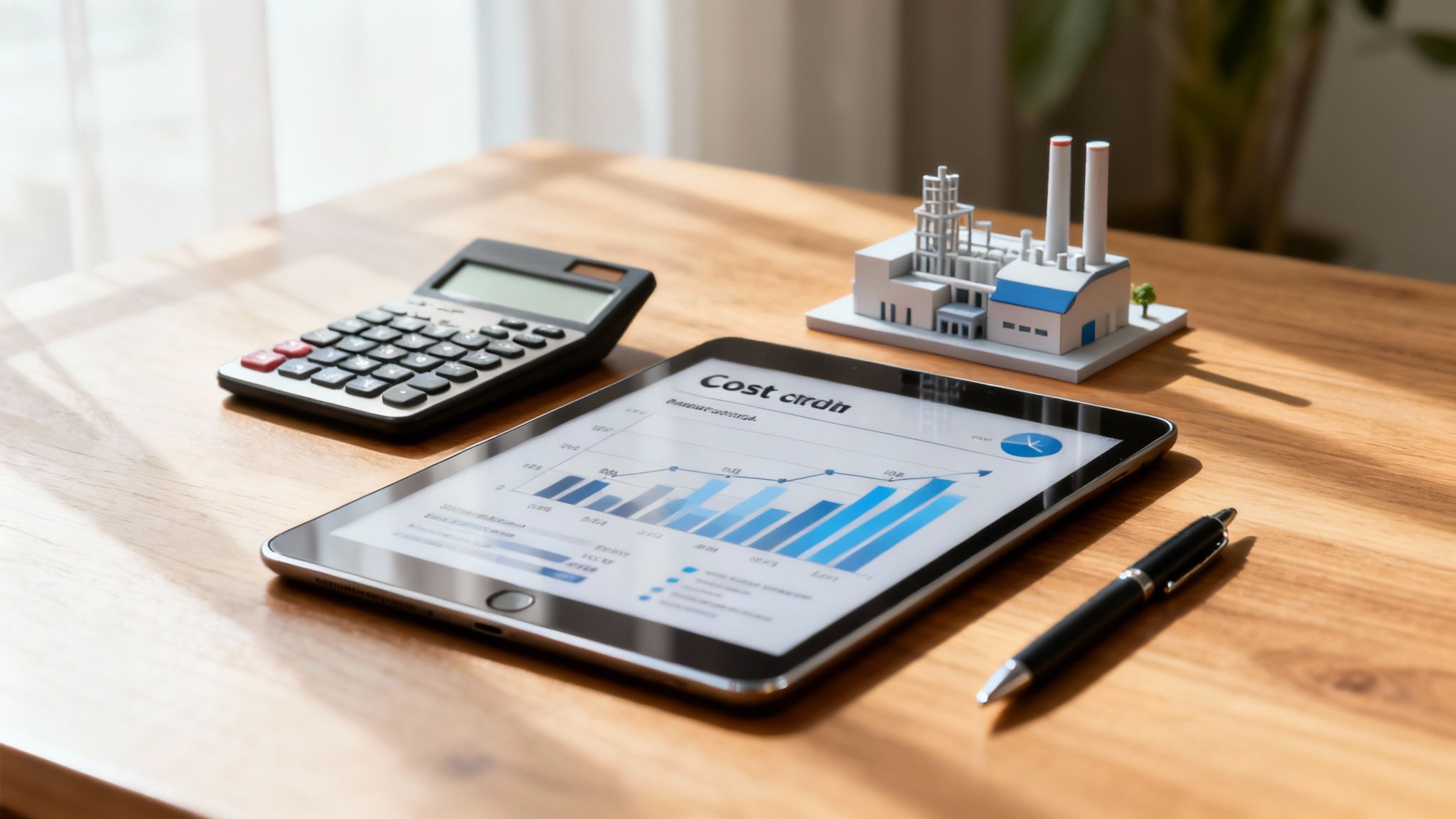
Before you jump into launching your manufacturing venture, it’s crucial to get a realistic picture of the finances involved. While Dubai offers incredible long-term value, understanding both the initial and ongoing costs is the key to building a business that lasts. Think of it in two simple categories: the one-time setup fees and the recurring operational costs.
Your initial investment will cover a few core essentials. This starts with securing your industrial trade licence—the fundamental legal key to operating. You’ll also need to budget for visa applications for yourself, any partners, and your key team members, plus the various administrative and government service fees that are part of the setup journey.
A huge slice of your initial capital will naturally go towards equipment. Getting a handle on specialised plant and machinery valuation services in Dubai can be a game-changer here, helping you manage these expenses whether you're buying new or figuring out the value of assets you already own.
Initial Setup and Licensing Fees
The first major expense on your list will be the industrial licence. Its final price tag isn't a single number; it's a combination of charges that depends on where you set up (Mainland vs. Free Zone), your specific manufacturing activity, and your company's legal structure.
These costs typically include:
- Trade Name Reservation: The fee to secure your unique business name.
- Initial Approval Fees: Getting the first green light from the authorities.
- Licence Registration and Issuance: The final payment to get that official licence in your hands.
- Office/Facility Lease Agreement: A non-negotiable requirement for your licence, this cost can vary dramatically.
Juggling these different payments can feel a bit overwhelming. For a clearer picture, check out our detailed guide on the trade license Dubai cost, which breaks down all the government fees you can expect.
Facility and Operational Costs
For any manufacturer, your facility is going to be one of the biggest items on your budget. This means leasing a warehouse, a factory, or an industrial plot of land. The cost here is driven by the classic factors: location, size, and the quality of the infrastructure.
Demand for industrial space in Dubai is incredibly strong right now, which is a fantastic sign of a healthy sector. Of course, that high demand has pushed rental prices up. In fact, industrial rents in Dubai shot up by 19% year-on-year, a trend that reflects just how robust the economic activity is.
Key Takeaway: The rising cost of industrial real estate is a double-edged sword. Yes, it's a significant upfront expense, but it also signals a thriving, in-demand market where a well-positioned manufacturing business can truly flourish.
Once you’re set up, you have to shift your focus to the ongoing operational costs. These are the recurring expenses that form the backbone of your daily financial management and are absolutely critical for long-term survival.
Key ongoing costs you need to budget for include:
- Utilities: Your bills for water, electricity (DEWA), and telecommunications.
- Staffing: Salaries, benefits, and the all-important visa renewals for your workforce.
- Logistics and Supply Chain: The costs tied to transport, warehousing, and customs clearance.
- Maintenance: Keeping your machinery and facilities in top shape to ensure everything runs smoothly.
By carefully planning for both the one-time and recurring expenses, you can build a solid financial foundation for your manufacturing operations in Dubai and position your business for sustained growth.
Where the Real Growth Is: Dubai's Hottest Manufacturing Sectors
While the big picture of Dubai's manufacturing industry is impressive, the smartest entrepreneurs know to look for the pockets where growth isn't just steady—it's explosive. Several key areas are buzzing with activity, powered by ambitious government strategies, changing consumer tastes, and Dubai's unmatched position as a global trade crossroads. Pinpointing these sectors can make all the difference for your return on investment.
It’s about more than just looking at the surface numbers. You need to understand the powerful currents shaping the market and spot the gaps where a new business can really take off. When we talk to entrepreneurs about manufacturing in Dubai, three sectors come up again and again for their current momentum and future promise: Food & Beverage, Chemicals, and Machinery & Equipment.
The Booming Food and Beverage Sector
The Food and Beverage (F&B) industry is hands down one of the most dynamic and promising fields for manufacturing in Dubai right now. This isn't a coincidence; it's fuelled by two massive drivers: the UAE's national Food Security Strategy and Dubai's role as the go-to re-export hub for the whole region. The government is actively pushing for more local production to cut down on import dependency, which opens up incredible opportunities for food processing, packaging, and Agrotech companies.
This strategic government backing has created incredibly fertile ground for new businesses. While the overall manufacturing contribution to Dubai's economy saw a modest real GDP growth of 0.26% in 2022, the F&B sub-sector is in a league of its own. It's projected to skyrocket by an unbelievable 210% between 2018 and 2031 under the UAE's Operation 300bn strategy. You can dive deeper into the numbers in this overview of the UAE manufacturing sector.
Key Opportunity: Dubai's incredibly diverse, multicultural population means there's a huge appetite for specialised food products. We're seeing major gaps in the market for everything from plant-based alternatives and organic goods to convenient ready-to-eat meals and ethnic foods that cater to specific communities.
Chemicals and Advanced Materials
The chemicals sector is another pillar of Dubai’s industrial scene, but it's evolved far beyond basic petrochemicals. The real action is now in specialised chemicals for industrial use, construction materials, and everyday consumer goods. This covers everything from industrial coatings and adhesives to water treatment chemicals and advanced polymers.
The growth here is tied directly to the boom in other major industries. As construction and infrastructure projects continue to expand across the emirate, so does the demand for high-tech building materials and chemical additives. In the same way, as other manufacturing businesses grow, they create a steady need for locally produced industrial chemicals, which helps them cut costs and secure their supply chains.
- Construction Chemicals: Think high-performance materials like sealants, waterproofing compounds, and concrete admixtures.
- Consumer Goods: A massive market for producing cleaning products, sanitisers, and personal care items for the entire region.
- Industrial Polymers: Creating specialised plastics and composites needed for packaging, automotive, and even aerospace applications.
Machinery, Equipment, and the 3D Printing Revolution
Dubai’s vision to be a global tech leader is carving out exciting new paths in machinery and equipment manufacturing. This sector is the backbone of the entire industrial ecosystem, producing the tools, parts, and machines that other factories depend on. It’s a foundational industry that grows right alongside the wider manufacturing base.
A particularly hot niche here is 3D printing, also known as additive manufacturing. Dubai isn't just adopting this technology; it's championing it. The government has set a massive goal to have 25% of all new buildings constructed using 3D printing by 2030. This isn't a vague ambition—it's a policy that creates guaranteed demand for businesses in this space.
This opens the door not just for construction-focused 3D printing but also for producing complex prototypes, on-demand spare parts, and custom components for high-tech industries like aerospace and medicine. By focusing on these high-growth sectors, you're not just starting a business; you're placing it at the very heart of Dubai's industrial future.
Your Step-by-Step Setup Guide
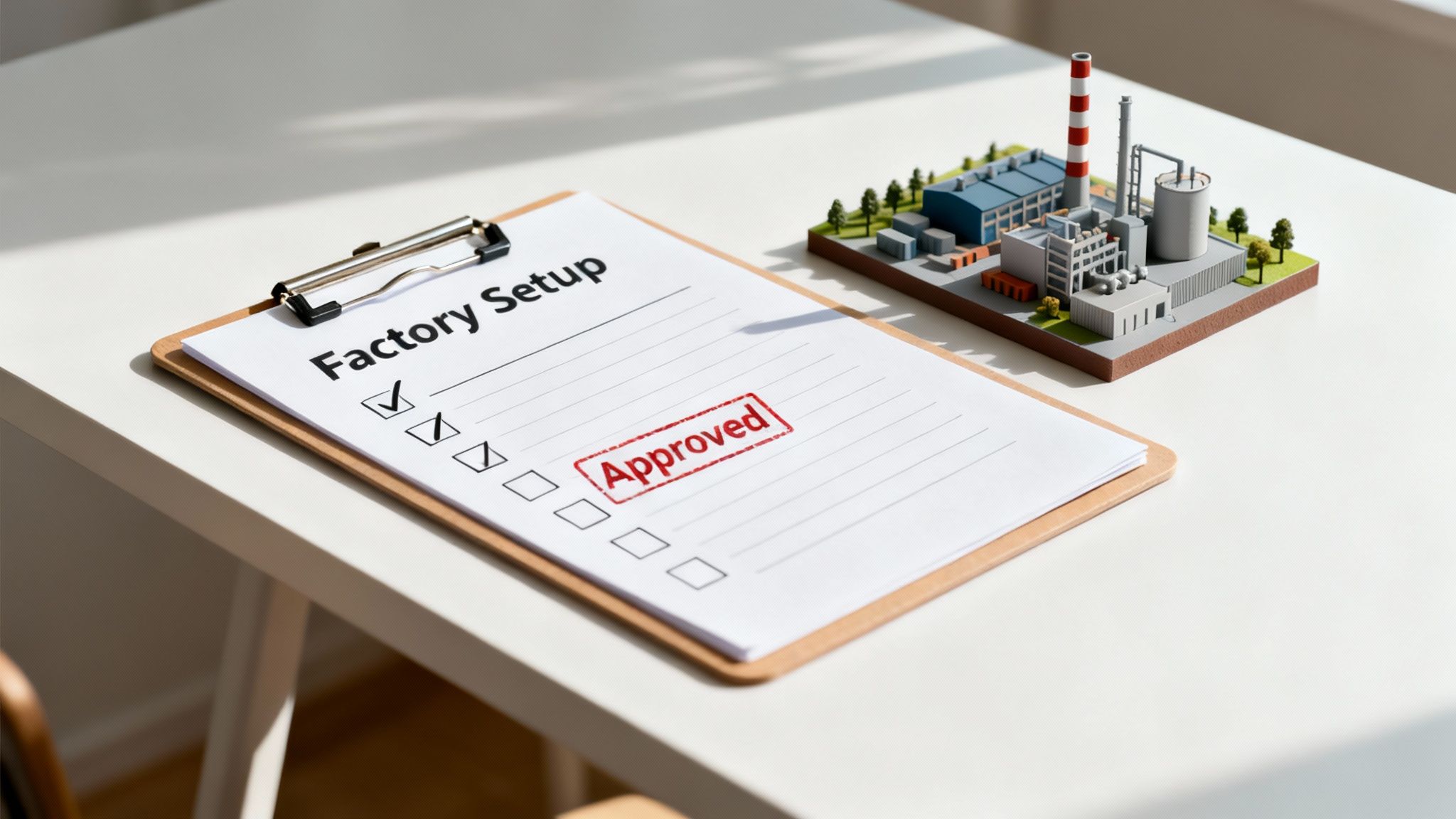
Bringing your manufacturing vision to life in Dubai is a clear, structured process. Think of it as building your factory brick by brick; each step is essential for a strong foundation. This guide breaks down what can feel like a complex journey into a series of straightforward, manageable stages.
It all starts with a solid plan. Before a single piece of paperwork is filed, you need absolute clarity on your objectives—from the exact products you'll create to the market you want to serve. This initial planning phase is where a business setup specialist provides immense value, helping you navigate the early decisions that will shape your company's entire future.
Stage 1: Define Your Business and Legal Structure
The first official move is to define your manufacturing activity with precision. This can't be a general statement. It has to align perfectly with the approved activities listed by the Department of Economy and Tourism (DET) or your chosen free zone authority. Your choice here directly impacts your licence type and even the kind of facility you’ll need.
Next, you have to decide on your company's legal structure. For most entrepreneurs on the mainland, a Limited Liability Company (LLC) is the go-to choice because it effectively protects your personal assets. This decision, along with choosing between a mainland or free zone setup, is fundamental to how you'll operate.
Stage 2: Secure Your Industrial Licence
With your activity and structure locked in, the next big milestone is getting your industrial licence. This is the official permit that gives you the legal green light to operate a manufacturing business in Dubai. The process involves submitting a detailed application supported by all the necessary corporate documents.
This licence is more than just paper; it’s the key that unlocks everything else. For a closer look at the nuts and bolts, our guide on how to get a trade license in Dubai breaks down all the requirements and procedures involved.
The process usually follows these key steps:
- Initial Approval: Getting a preliminary nod from the authorities based on your business plan.
- Trade Name Registration: Officially reserving your company's name so no one else can use it.
- Document Submission: Providing all the required legal and shareholder paperwork.
Partnering with a business setup firm like Al Ain Business Center can seriously speed things up here. Our experts make sure your application is spot-on, helping you avoid the common mistakes that lead to frustrating delays and rejections.
Stage 3: Find a Facility and Get Final Approvals
Once you have initial approval for your licence, you need to find a suitable industrial facility. This could be a warehouse, a dedicated factory unit, or an industrial plot of land. Your signed lease agreement (known as Ejari on the mainland) is a mandatory document needed to finalise your licence.
The home stretch involves getting approvals from various external authorities. This is a non-negotiable step for any manufacturing operation in Dubai, as it confirms your facility meets all the required safety, environmental, and public health standards.
You'll likely be dealing with key authorities such as:
- Dubai Municipality: For building permits and ensuring environmental compliance.
- Dubai Civil Defence: To sign off on your fire safety and emergency response plans.
- DEWA: For connecting your facility to water and electricity.
Successfully clearing these approvals is the last major hurdle. Once all the clearances are in hand, your industrial licence is officially issued, and you're ready to start manufacturing in Dubai.
Frequently Asked Questions About Manufacturing
Setting up a manufacturing operation in Dubai can feel like navigating a maze. A lot of questions pop up along the way. To clear the air, here are some straight answers to the most common queries we get from entrepreneurs just like you.
What Is the Minimum Capital to Start a Manufacturing Company?
This is a big one, and the answer has changed for the better. For a Dubai Mainland LLC, there is no officially mandated minimum share capital anymore. The government has moved away from a rigid, one-size-fits-all number.
Instead, the focus is now on practicality. Regulators want to see that your declared capital is "sufficient" to get your specific manufacturing business off the ground. Your business plan needs to show that the amount you've committed can realistically cover your initial setup and operational costs. It’s a much more logical approach. Just remember, free zones often have their own specific capital rules depending on the licence type and facility size.
Can a Foreigner Own 100% of a Manufacturing Business?
Yes, you absolutely can! This has been a game-changer for international investors. For the vast majority of industrial activities, you can now have 100% foreign ownership of your company right on the Dubai Mainland.
For years, you needed a local Emirati partner who held a majority stake, but that's no longer the case. This major policy shift brings the mainland in line with the free zones, which have always offered this perk. It means you have complete control over your business, its profits, and its direction—making Dubai an incredibly compelling hub for global manufacturing players.
Key Insight: Allowing 100% foreign ownership on the mainland wasn't just a small tweak. It was a massive signal of Dubai's commitment to building an open, competitive, and investor-first industrial economy. It gives you maximum freedom in how you structure your company.
How Long Does It Take to Get an Industrial Licence?
The timeline can be a bit elastic. While the initial steps like getting your trade name reserved can be sorted out in a few weeks, the full end-to-end process takes a bit longer. It’s not just one application; it's a sequence of approvals.
The most time-consuming part involves getting the green light from several external authorities after you've secured your initial approval. This includes:
- Finalising the lease for your industrial warehouse or factory.
- Getting the thumbs-up from Dubai Municipality on your building plans and environmental standards.
- Passing fire and safety compliance checks with Dubai Civil Defence.
Being realistic, the whole journey can take several months. This is where working with a business setup expert really pays off. We know the potential roadblocks and can help you avoid common mistakes, ensuring all your paperwork is correct the first time to keep things moving as smoothly as possible.
Ready to launch your manufacturing business in Dubai without getting tangled in the complexity? The expert team at Al Ain Business Center handles every single step of the process, from licensing and approvals to visas and ongoing support. Start your journey today with Al Ain Business Center.