
Getting your Emirates ID is a rite of passage for anyone living in the UAE. It's the key that unlocks pretty much everything, from opening a bank account to getting your Wi-Fi set up. The process isn't complicated, but it does have a few key stages: getting your documents in order, submitting the application, going for your biometrics appointment, and finally, collecting your new card.
This guide will walk you through exactly what to expect.
Your Essential Guide to the Emirates ID Process
Think of the Emirates ID as more than just a piece of plastic; it's your all-access pass to daily life here. Without it, you’ll find that even simple tasks can turn into major headaches.
This little card is your go-to for:
- Banking: You'll need it to open a bank account or apply for any kind of financing.
- Healthcare: It's essential for registering with clinics and getting health insurance.
- Government Services: From paying fines to accessing official online portals, this card is a must.
- Utilities: Setting up your internet, electricity (DEWA), or phone contract all starts here.
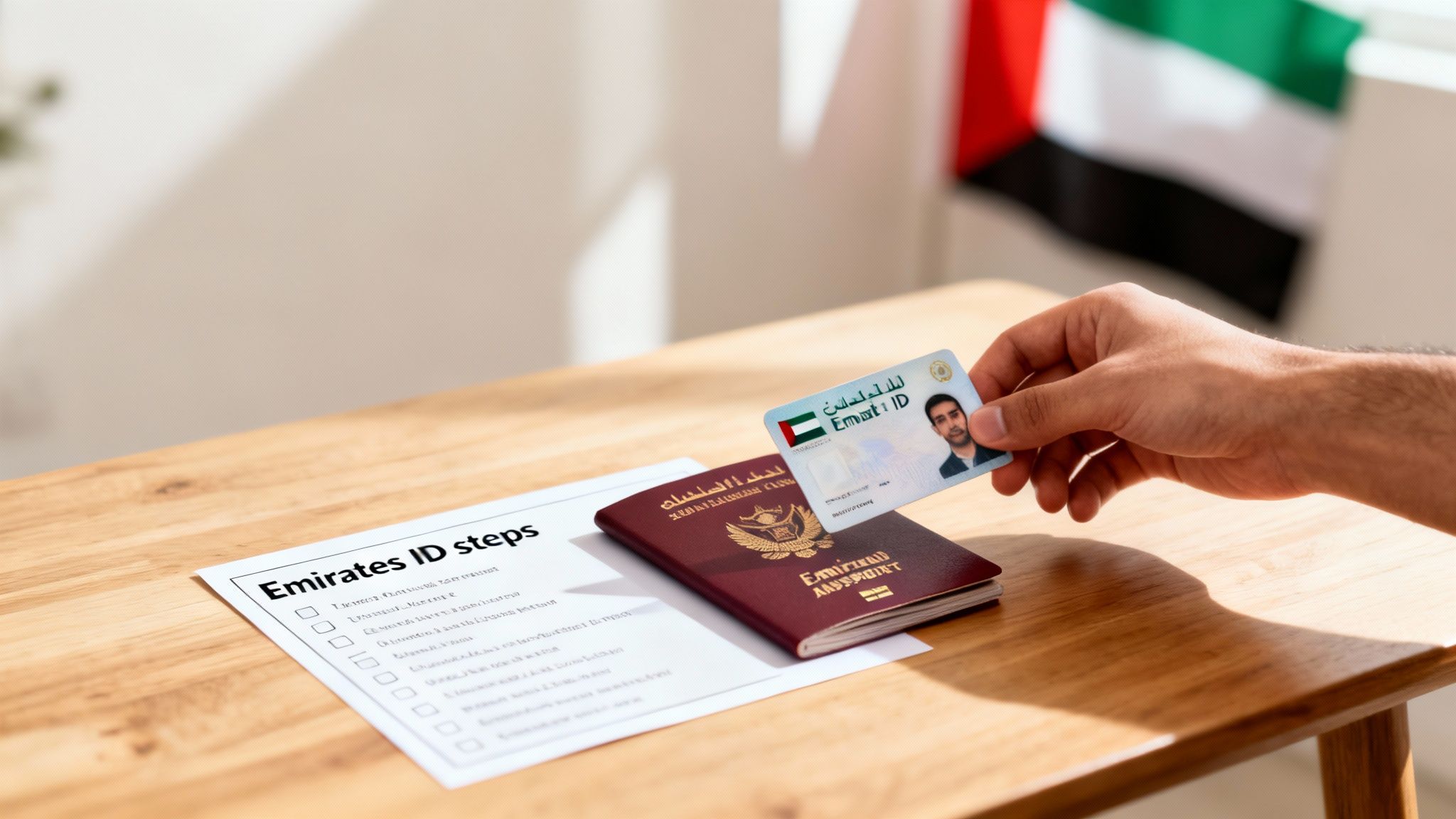
Why This Card Is Non-Negotiable
Ever since it was introduced, the Emirates ID has become absolutely central to the country's infrastructure. To give you an idea of how quickly it was adopted, by the end of 2011, the Emirates Identity Authority had already registered around 5.2 million people. At its peak, they were processing roughly 23,000 applications a day!
That tells you just how vital this system is.
For a really deep dive into every single requirement and document, be sure to check out our comprehensive guide on how to get an Emirates ID. The next sections will give you the practical, step-by-step advice you need to get yours without a fuss.
To make things even clearer, here’s a quick overview of what the journey looks like.
Emirates ID Application at a Glance
| Stage | Key Action | Where to Go |
|---|---|---|
| Application | Fill out the form & upload documents | ICP Website or a Typing Centre |
| Payment | Pay the required government fees | Online during application |
| Biometrics | Get your photo, fingerprints & signature taken | ICP Customer Happiness Centre |
| Collection | Receive your physical ID card | Delivered via Emirates Post |
Each of these stages has its own nuances, but don't worry—we'll break them all down for you.
Getting Your Documents Ready for a Smooth Application
The secret to a stress-free Emirates ID application? It's all in the prep work. Honestly, having your paperwork perfectly lined up from the get-go is the single biggest thing you can do to avoid headaches. A missing document or a photo that doesn't meet the strict standards can send you right back to the start, and nobody wants those kinds of delays.
Think of it this way: you wouldn't start cooking a complex dish without having all your ingredients measured and ready. The same logic applies here. Getting everything right now will save you a world of frustration later on. Your application's success really boils down to a few key documents.
Your Core Document Checklist
Before you even touch an application form, make sure you have these essentials in hand:
- Original Passport: This is the absolute must-have. Make sure it has at least six months of validity left on it.
- Valid Residency Visa or Entry Permit: If you're a new resident, that initial entry permit (often called the "pink visa") is what you'll need. The entire Emirates ID process is tied directly to your legal residency status.
- Passport-Sized Photo: This is where so many people trip up. The photo needs to be recent (taken within the last three months), high-resolution, and set against a pure white background. Keep your expression neutral and make sure your face is completely visible.
A word of advice from experience: Don't just grab an old passport photo from your drawer. The authorities are incredibly strict about the photo specifications, and a rejected photo is one of the most common reasons we see for application delays.
Getting these items organised is the most important part of the process. If you're looking at this list and feeling a bit overwhelmed, you're not alone. Many people choose to get professional help to make sure everything is perfect. You can learn more about how expert documents clearing services can guarantee your application is spot-on from the very beginning.
What About Special Cases or Extra Paperwork?
Your specific situation will determine if you need any extra documents. For example, if you're applying for your newborn's first ID, you'll need their original, attested birth certificate, along with copies of both parents' passports and Emirates IDs.
Renewing your ID is much simpler. In most cases, all you need is your current Emirates ID. The system already has your biometric details on file, which makes the whole thing much faster.
No matter your situation, it's always a smart move to double-check the latest requirements on the official ICP website before you start. Guidelines can and do change, and a quick check ensures you have everything you need for a seamless process.
Navigating the Application and Biometrics Appointment
Once your paperwork is neatly stacked and ready to go, it's time to tackle the application itself. The UAE gives you two main ways to get this done, depending on whether you prefer a hands-on digital approach or a bit of expert assistance.
You can go directly through the official ICP Smart Services portal online or visit an accredited typing centre for in-person help.
The online route via the ICP portal is the most direct. You’ll set up an account, carefully fill out the digital form, and upload your documents. It gives you complete control, but you have to be meticulous to avoid any slip-ups. On the other hand, popping into a typing centre means an experienced agent will handle all the data entry for you. This is a brilliant option if you're a little unsure about the process or just want a second pair of expert eyes on your submission.
Whichever route you take, the core document requirements remain the same.
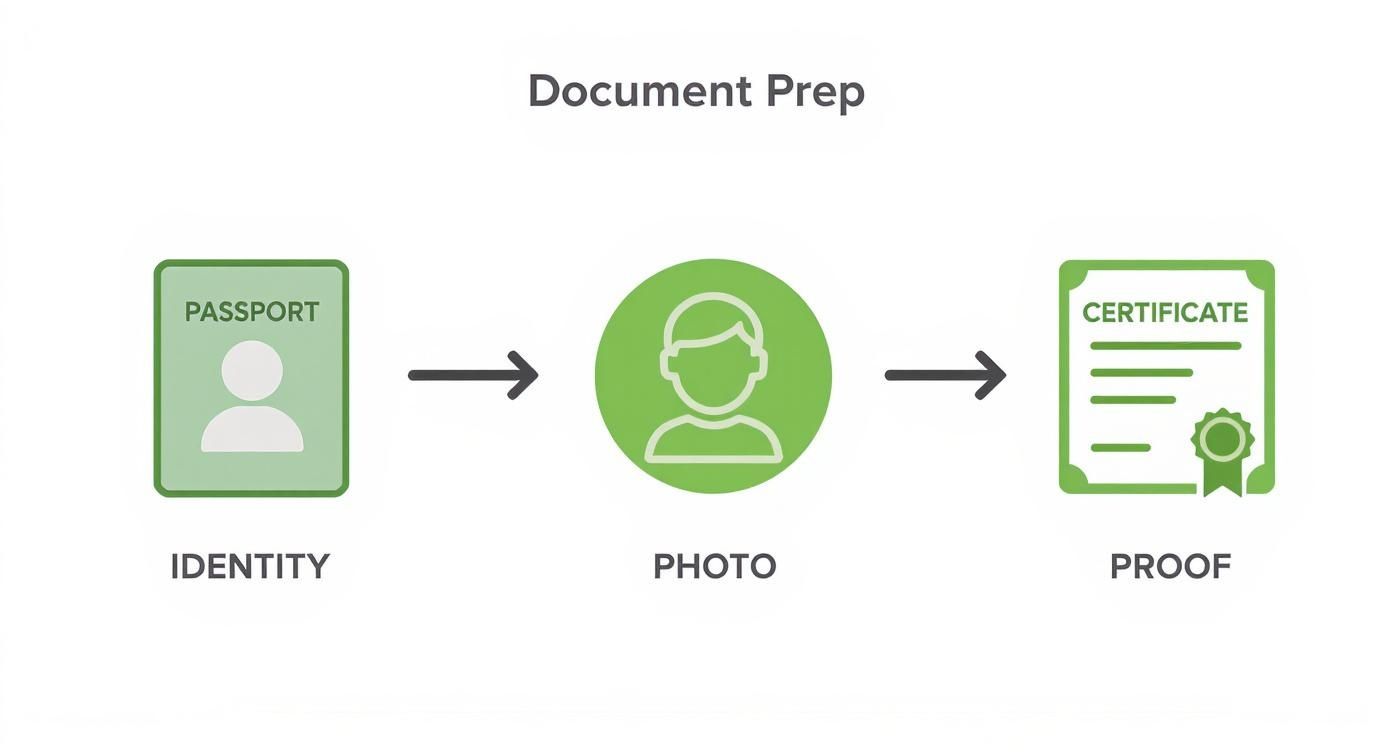
This flowchart really simplifies it, showing the three pillars of your application: your identity (passport), your photo, and your proof of status (visa).
Scheduling and Attending Your Biometrics Appointment
After your application is in and the fees are paid, keep an eye on your phone. You'll get an SMS prompting you to book your biometrics appointment. This is a mandatory, in-person step for most applicants over the age of 15. It's where the authorities capture your fingerprints, an iris scan, and a final photograph that will go on the ID card.
You can book your slot at an ICP Customer Happiness Centre. My advice? Be punctual. These centres are always buzzing with activity, so arriving on time makes a huge difference.
When you head to your appointment, you’ll need to bring a few key items:
- Your original passport.
- Your entry permit or current residence visa.
- The application receipt (the typing centre will give you this, or you can print it from the ICP portal).
The Emirates ID application is tied directly to your residency status. For new residents, this all happens alongside getting your visa stamped. To see how it all fits together, have a look at our detailed guide on how to get a residence visa in Dubai.
The appointment itself is surprisingly quick and efficient. The staff are great at guiding you through each station, and the whole thing usually takes less than 30 minutes. Once your biometrics are captured, you're officially over the biggest hurdle. Your application then moves into the final review and card printing stage, bringing you one big step closer to holding your new Emirates ID.
Cracking the Code on Costs and Timelines
When you're sorting out your Emirates ID, the last thing you want are surprises, especially when it comes to time and money. Getting a handle on the costs and waiting periods from the get-go means you can budget properly and plan around the process, making everything much smoother.
The final price tag isn't just one single number. Think of it as a mix of official government fees, service charges, and what the typing centre adds on. These amounts shift depending on your visa status and how long your ID will be valid for, which is usually tied directly to your residency visa's duration.
Understanding the Fee Structure
So, what are we actually looking at? The core cost for an Emirates ID can vary quite a bit. For Emirati citizens, you're looking at a range of AED 140 to AED 270 for a card that’s valid for 5 or 10 years. For residents from other GCC countries, the fee for a 5-year card is typically around AED 540 to AED 570.
Remember, these are just the base figures. Service fees and typing charges will be added on top, which can bump up the final amount you pay. You can get a more detailed look into these fee structures by checking out this guide on Emirates ID card costs.
My best piece of advice? Always, always ask for an itemised bill at the typing centre. This simple step ensures you see exactly where your money is going, from the official ICP fees down to the centre's own administrative charges. No hidden costs, no confusion.
To give you a clearer picture, here’s a quick breakdown of what you can generally expect.
Emirates ID Fee Structure Overview
| Applicant Type | Typical Fee Range (AED) | Standard Timeline | Urgent Service (Fawri) |
|---|---|---|---|
| UAE National | 140 – 270 (5/10 years) | 5 – 10 working days | Within 24 hours |
| GCC National | 540 – 570 (5 years) | 5 – 10 working days | Within 24 hours |
| Expat Resident | 100 per year of visa validity | 5 – 10 working days | Within 24 hours |
Keep in mind that these are typical ranges. Your final cost will also include service fees (around AED 70) and typing centre charges (often around AED 30), so be sure to factor those in.
Standard Versus Urgent Processing
Once you’ve submitted your application and had your biometrics taken, the waiting game begins. Under the standard process, it usually takes between 5 to 10 working days for your card to be printed and ready. You’ll get an SMS from Emirates Post letting you know when it’s on its way or ready for pickup.
But what if you're in a pinch? Maybe you're finalising a tenancy agreement or starting a new job and can't wait that long.
That’s where the 'Fawri' urgent service comes in. It's an absolute lifesaver. For an extra fee, this service gets your card into your hands within 24 hours. It’s the perfect solution for those times when you just can't afford to wait.
How to Collect and Use Your New Emirates ID
Once you’ve completed your biometrics, you're on the home stretch. All that's left is to wait for the notification that your new Emirates ID card is ready for you.
You can track your application's status on the ICP website using the reference number from your receipt, but the official heads-up will come via an SMS. This message will confirm that your card has been printed and is waiting for you, usually at a designated Emirates Post office. Just bring your original passport and the application receipt to collect it.
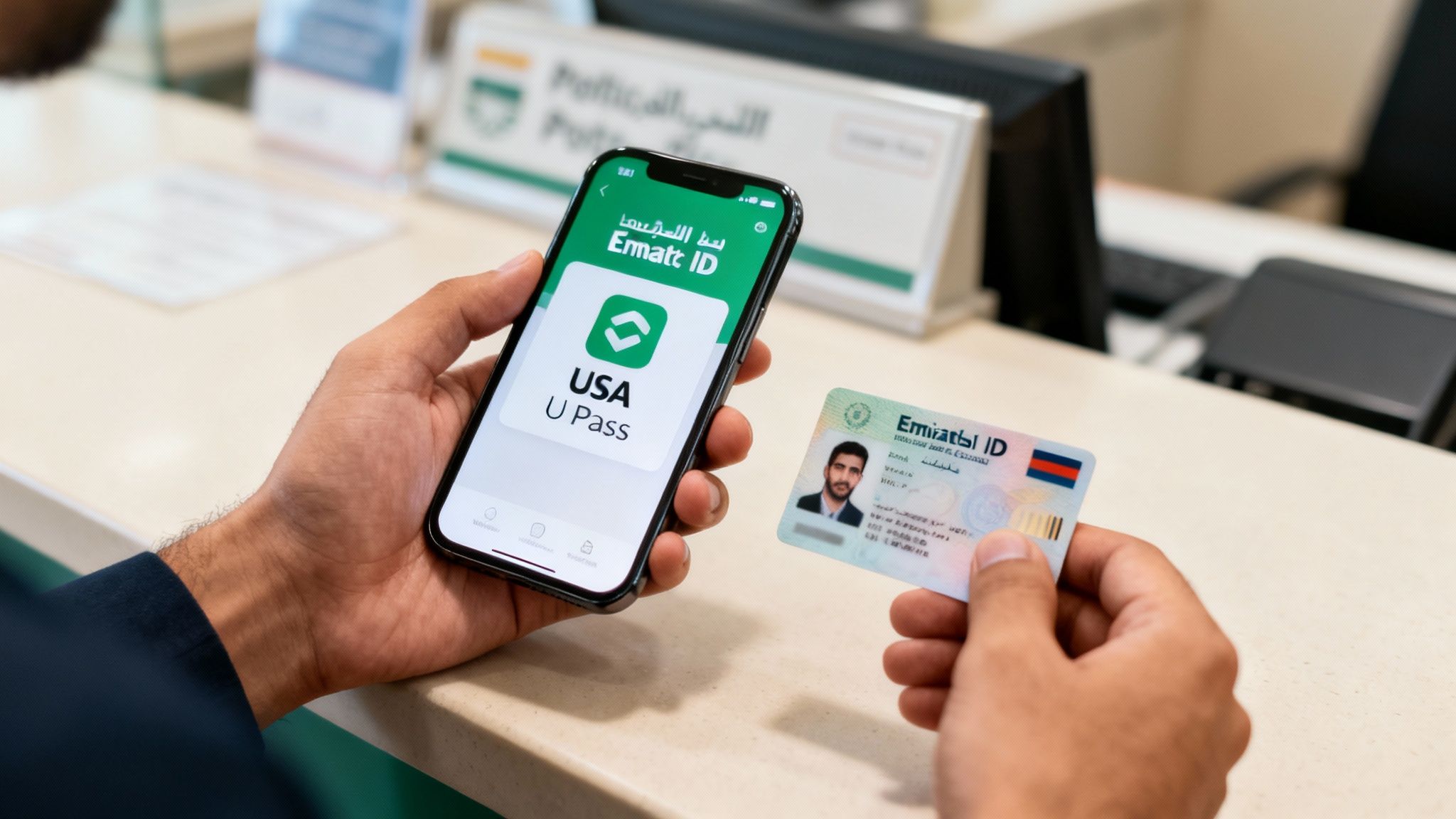
Access Your Digital ID Immediately
The great thing is, you don't actually need the physical card in hand to start using your new ID details. The UAE's digital infrastructure is incredibly efficient, allowing you to access a digital version almost instantly.
- UAEICP App: As soon as your ID is issued, a digital version pops up in this official app.
- UAE Pass: This national digital identity app also pulls in your Emirates ID, giving you secure access to countless government services online.
This digital version is officially recognised for most transactions. That means you can get on with setting up bank accounts, utility connections, or other essential services without any delay.
Your Emirates ID is more than a simple identity card; it's a core component of the UAE’s national data infrastructure. This system allows for precise demographic management and supports national planning. You can discover more insights about how the ID network supports national statistics.
When you finally have the physical card, its advanced chip unlocks even more capabilities for secure digital payments and identity checks. If you run into any issues or need further assistance, you might need to visit a service centre. We've put together the ultimate guide to ICA happiness centers in Dubai to help you find locations and services.
Common Questions About the Emirates ID
Even with a clear plan, you might still have a few questions buzzing in your mind about the Emirates ID process. It’s completely normal. Getting these last few uncertainties cleared up will help you move forward with total confidence.
Below, we’ve tackled some of the most frequent queries we hear, giving you direct, practical answers to help you navigate whatever comes up.
What Should I Do If My Emirates ID Expires?
Once your Emirates ID expires, the clock starts ticking. You have a 30-day grace period to get it renewed without facing any penalties. If you miss this window, late fees of AED 20 per day will start to add up, with a maximum fine of AED 1,000.
The best approach? Be proactive. Start the renewal process before your current card expires. This way, you sidestep any fines and ensure you don’t lose access to essential services that depend on a valid ID.
It's a common misconception that you need to wait for the expiry date. In reality, you can start the renewal process for your residence visa and Emirates ID up to six months in advance. This gives you plenty of breathing room to get everything sorted without any last-minute stress.
Can I Apply for My Emirates ID from Outside the UAE?
The short answer is no. You absolutely must be physically present in the UAE for the most critical parts of the application.
The biometrics appointment—where your fingerprints and photo are taken—has to be done in person at an official ICP Customer Happiness Centre inside the country. Plus, the entire Emirates ID application is tied directly to your residence visa, which also requires you to be in the UAE for medical tests and final stamping. There's just no way around being here for these key steps.
What is the Process If I Lose My Emirates ID?
Losing your ID can send you into a bit of a panic, but the recovery process is straightforward if you act fast.
- Report it Immediately: Your first move should be to visit the nearest ICP Customer Happiness Centre to report the card as lost or stolen. This deactivates it instantly, preventing anyone else from misusing it.
- Apply for a Replacement: Next, you'll need to apply for a replacement. This involves filling out a form, paying the fees (around AED 300 plus application charges), and submitting documents like your passport and visa copy.
- Receive Your New Card: A new card will be issued with the same details and validity period as the one you lost.
Taking these steps promptly isn't just about getting a new card; it's crucial for your security.
Navigating the complexities of document processing and visa services can be challenging, but you don't have to do it alone. At Al Ain Business Center, we specialise in making these processes seamless, ensuring you get everything right the first time. Let our experts handle the paperwork so you can focus on what matters. Discover our full range of services and start your journey with confidence.