
Getting a residence visa for Dubai isn't just one single path. It's more like a series of steps that starts with figuring out which route fits you best—whether that’s through a job, a property investment, or sponsoring yourself. From there, your sponsor (which could be your new employer, or even you) kicks things off by applying for an entry permit.
Once you land in the UAE with that permit in hand, a few key things need to happen. You'll go through a straightforward medical test, get registered for your Emirates ID, and finally, have the residence visa stamped right into your passport.
Decoding Dubai's Residence Visa Options
Before you get bogged down in paperwork, it's really important to grasp that Dubai’s visa system isn't a one-size-fits-all deal. Think of it as a framework built to attract specific talent and investment. What this means for you is that the perfect visa pathway depends entirely on your personal situation and professional goals.
For most people, the most familiar route is the standard employment visa. This is where a Dubai-based company hires you and handles the sponsorship process. Simple enough.
But the options go way beyond a typical job offer. Getting to know the different pathways is the first real step in figuring out how to secure a residence visa that actually supports what you want to achieve in Dubai long-term.
Exploring the Main Visa Pathways
Dubai has carved out several distinct residency routes, each tailored for different circumstances. Just thinking about which bucket you fall into will make the whole journey a lot clearer.
To give you a better idea of what's out there, here's a quick look at some of the most common visa types.
Quick Overview of Dubai Residence Visa Types
| Visa Type | Primary Eligibility | Typical Validity |
|---|---|---|
| Employment Visa | Secured a job with a UAE-based company. | 2 years |
| Property Investor Visa | Purchased property worth at least AED 750,000. | 2 years |
| Entrepreneur/Company Visa | Founder or partner in a UAE-registered company. | 2-3 years |
| Green Visa | Skilled professional, freelancer, or investor. | 5 years |
| Golden Visa | Investor, entrepreneur, exceptional talent, scientist, top student. | 10 years |
As you can see, your reason for being in Dubai directly shapes your visa options.
- For the Professional: Landed a job offer? Your employer will sponsor a standard work visa, which is usually valid for two years.
- For the Investor: Buying a property valued at AED 750,000 or more opens the door to a property investor visa. This is a very popular choice for people looking to set down some real roots in the city.
- For the Entrepreneur: If you're launching your own business, you can sponsor yourself through your company, whether it's set up on the mainland or in one of Dubai's many free zones.
- For the Freelancer or Skilled Talent: The five-year Green Visa is a game-changer, allowing skilled professionals and freelancers to sponsor themselves. This offers a level of freedom you just don't get with an employer-tied visa.
The Rise of Long-Term Residency
Over the last few years, Dubai has made a clear shift towards encouraging people to build a real, long-term future here. The star of this initiative is the 10-year Golden Visa, aimed at high-net-worth individuals, exceptional talents in various fields, and outstanding students.
It’s a powerful visa that offers significant stability and a host of benefits, reflecting Dubai's commitment to holding onto the world's best and brightest.
This push to attract and retain global talent is hardly surprising. The city's economy is built on its vibrant expatriate community. In fact, expats make up around 75% of Dubai's population—a statistic that really highlights the city's international appeal and its reliance on foreign residents. You can discover more insights about Dubai's unique demographic landscape and see how it shapes these forward-thinking visa policies.
Obtaining Your Entry Permit to Start the Process
Your journey to becoming a Dubai resident officially kicks off with one crucial document: the entry permit. Think of it as your golden ticket, the approved pass that lets you enter the UAE specifically to finalise your residency. Without it, everything else grinds to a halt.
This first major step is almost always handled by your sponsor. This could be your new employer, the free zone authority where your company is based, or even yourself if you're going down a self-sponsored route like the Green Visa. Their job is to get this permit for you through the official immigration channels.
The Sponsor's Role in Kicking Things Off
To get the ball rolling, your sponsor will only need a couple of basic things from you. The initial request is usually very straightforward:
- A high-quality, colour copy of your passport. Make sure it has at least six months of validity left.
- A recent passport-sized photo with a white background that meets the specific UAE standards.
With these documents in hand, your sponsor submits the application to the General Directorate of Residency and Foreigners Affairs (GDRFA). The system is incredibly digitised now, which makes things much smoother. If you're curious about the mechanics behind it, you can learn about the secrets to swift e-channel UAE visa processing. This efficiency is a real hallmark of how the UAE handles immigration.
One of the most common questions I get is, "Do I need to be inside or outside the UAE for this?" It really depends. If you're outside the country, the permit is what lets you in. If you're already here on a tourist visa, a "change of status" process is triggered once the permit is approved.
From Application to Approval
Getting an entry permit is generally quite fast, often taking anywhere from a few business days to a couple of weeks. As soon as it's approved, your sponsor will forward you a digital copy. It is absolutely vital that you print this out and have it ready for the immigration officer when you land at the airport in the UAE.
This infographic gives you a simple overview of how to think about your visa path from the very beginning.
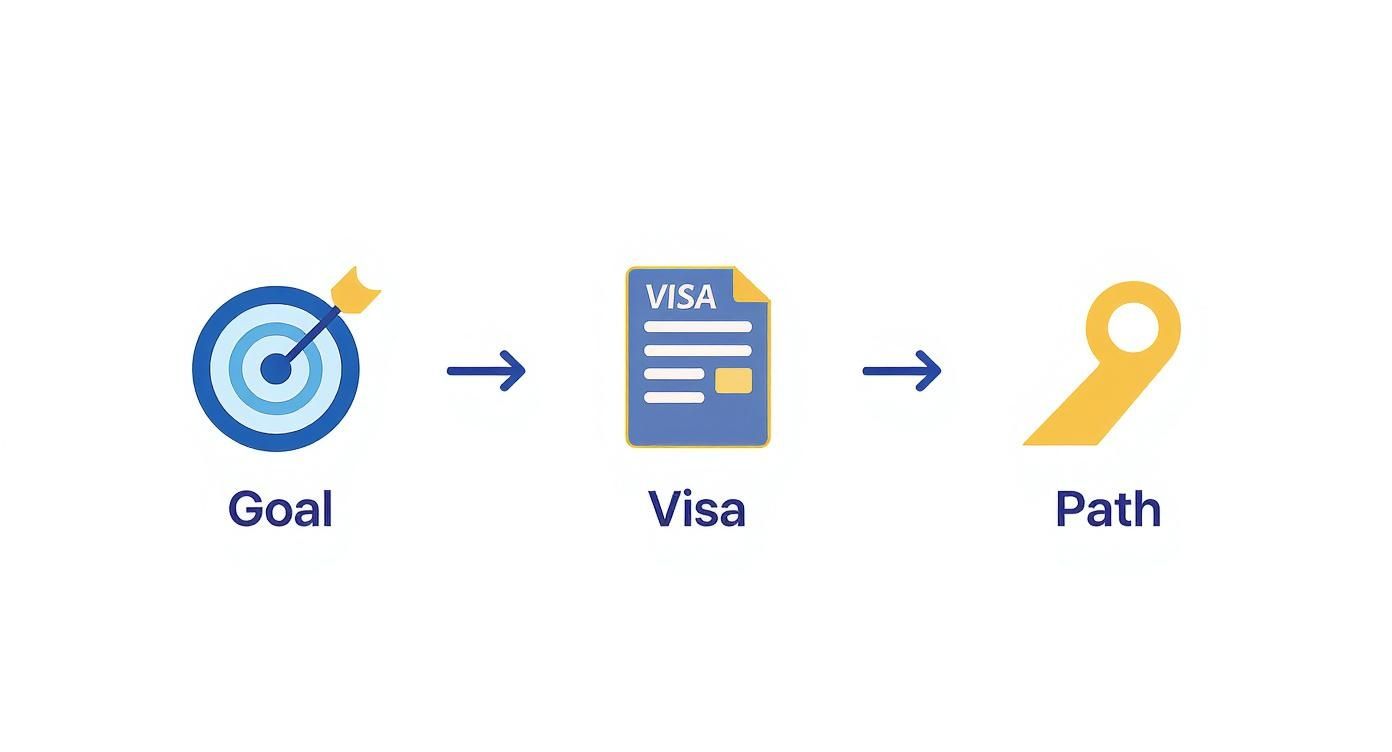
As you can see, the foundational step, even before an application starts, is aligning your personal goals with the right type of visa.
Once you have the permit, the clock starts ticking. You typically have 60 days to enter the UAE. This is your window to travel and kick off the next phase of the process, which involves your medical test and Emirates ID application. Don't let that time slip away—this permit is your gateway to everything that follows.
Time for Your Medical Test and Emirates ID Biometrics
Once your entry permit is in hand, you’ve cleared the first big hurdle. Nicely done. Now, you’ll tackle two absolutely essential steps at the same time: the medical fitness test and your Emirates ID biometrics registration. These are non-negotiable government procedures every future resident must complete to keep the process moving.
The medical test is just a standard health screening required by the UAE government to ensure public health and safety. It’s a very straightforward process that usually involves only a blood test and a chest X-ray. The screening looks for certain communicable diseases, and getting the all-clear is vital for your visa application to proceed.
Choosing Your Medical Test Centre
You can't just pop into any local clinic for this; you have to visit a government-approved medical fitness centre. Thankfully, Dubai has plenty of them, and they offer different service tiers to fit various budgets and timelines. Knowing your options beforehand can save you a world of stress.
To help you decide, here’s a quick breakdown of what you can typically expect.
Comparison of Medical Test Service Types
| Service Level | Typical Turnaround Time | Approximate Cost Range |
|---|---|---|
| Standard | 24 hours | AED 250 – AED 350 |
| Urgent | 48 hours | AED 350 – AED 450 |
| VIP | 4 hours | AED 700+ |
For most people, the standard 24-hour service works just fine. There's usually no need to pay for a faster option unless your sponsor is on a particularly tight schedule. If that's the case, the VIP service is a lifesaver, delivering your results in just a few hours.
Getting Your Emirates ID Biometrics Done
While the medical test is underway, you also need to get your Emirates ID application sorted. This little card is your official key to life in the UAE—you'll need it for everything from opening a bank account to signing a tenancy agreement. The process kicks off at a typing centre where they'll fill out the application for you. After that, you'll get an appointment to provide your biometrics, which is just a fancy way of saying your fingerprints and a photo.
A crucial tip from my experience: book your biometrics appointment as soon as you possibly can. The waiting times can sometimes stretch to a week or more. Getting it on the calendar early prevents it from becoming a major bottleneck in your visa timeline.
These official steps are a direct response to Dubai's staggering growth. Think about it: the city's population shot up from just 1.5 million in 2008 to an expected 3.9 million by 2025. This kind of expansion demands robust systems to process new residents efficiently, especially with official forecasts predicting the city will hit 7.4 million people by 2040.
For your biometrics, you'll visit a designated government centre, often called a "Happiness Centre." They are designed to be efficient, but knowing what to bring makes things go that much smoother. For an in-depth look at what to expect, check out our ultimate guide to ICA Happiness Centers in Dubai.
Don't forget to bring your original passport and entry permit to the appointment. Once your biometrics are in the system, you’re another big step closer to getting that residence visa stamped in your passport.
Finalising Your Application and Getting Your Visa Stamped
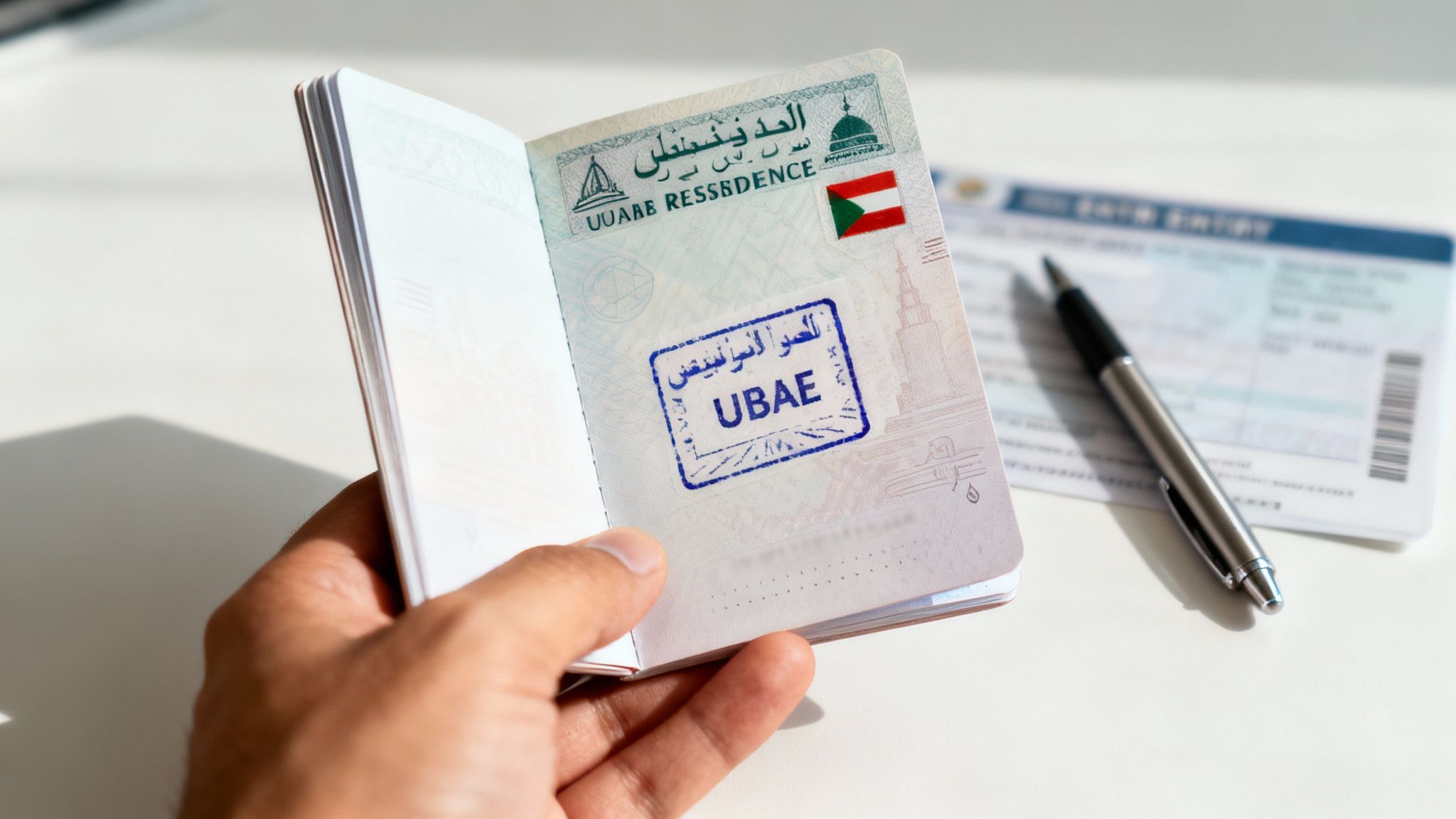
You’ve made it through the medical test and wrapped up your biometrics for the Emirates ID. Believe it or not, you're on the home stretch now. The final piece of the puzzle is getting that official residence visa stamped into your passport, a step that solidifies your legal status in Dubai.
This last phase is mostly out of your hands. Your sponsor's Public Relations Officer (PRO)—a specialist in navigating government processes—will take the lead, submitting your complete file to the immigration authorities. Your job is simple but crucial: get them all the required original documents as quickly as possible.
Assembling the Final Document Package
Your sponsor's PRO will bundle your personal documents with the company's own paperwork, like their trade licence, to create the final submission file for the General Directorate of Residency and Foreigners Affairs (GDRFA).
Here’s exactly what you’ll need to hand over to them:
- Your original passport. This is non-negotiable. They need the physical book because the visa is a sticker that gets placed directly onto one of its pages.
- The original entry permit. This is the document you used to enter the UAE when you first started this whole process.
- Your medical fitness test certificate. The official "PASSED" result you received from the approved medical centre.
- The Emirates ID application receipt. That piece of paper they gave you right after you finished your biometrics appointment.
- Several passport-sized photos. It's always a good idea to have a few spares ready, all with a clean white background.
The Visa Stamping and Final Checks
Once the PRO submits the complete application, the GDRFA gets to work reviewing everything. The approval time can fluctuate, but you should generally expect it to take between five to seven working days. Some PROs have excellent contacts and can occasionally speed things up, but it’s best to plan for a week.
A critical piece of advice: The moment you get your passport back, open it up and double-check every single detail on the visa sticker. Scrutinise your name, passport number, and the visa expiry date. Even the smallest error needs to be corrected immediately to prevent major headaches down the line.
That freshly stamped visa in your passport is the official confirmation of your residency. It legally allows you to live in the UAE for its validity period, which is typically two years for a standard employment visa.
Shortly after your visa is stamped, you'll get a notification that your physical Emirates ID card is ready for collection. With your stamped passport and Emirates ID in hand, you've officially completed the process of how to get a residence visa in Dubai. You are now a legal resident, ready to open a bank account, sign a lease, and truly start your new life in the city.
Securing Long-Term Residency with the Golden Visa
While the standard two-year residence visa is a fantastic way to get your footing in Dubai, there's a more prestigious path for those looking to plant deeper roots: the 10-year Golden Visa. This isn't just another stamp in your passport; it's a powerful statement from the UAE, designed to attract and hold onto the world's most brilliant minds, savvy investors, and exceptional talents.
Think of it as the VIP lane of residency. It grants you and your family the freedom to live, work, and study here for a full decade, with the option to renew. Perhaps the biggest draw? It completely cuts the cord from a national sponsor, giving you a level of independence that's simply unheard of with other visas.
Who Exactly Qualifies for the Golden Visa?
The criteria for the Golden Visa are quite specific, targeting individuals who are poised to make a real, tangible contribution to the UAE's economy and society. The good news is that the programme has broadened its horizons in recent years, making it more accessible than ever before.
Let's break down the main categories:
- Real Estate Investors: This is for anyone who purchases a property worth at least AED 2 million (around $545,000). It doesn't matter if it's off-plan or already built, and you can even mortgage it through certain local banks.
- Entrepreneurs: If you're a founder or partner in a UAE-registered startup pulling in annual revenues of at least AED 1 million, you're in. You can also get your foot in the door with an approved startup idea from an official business incubator.
- Exceptional Talents: This is a wider net cast for distinguished individuals in fields like art, culture, sports, and digital technology. Getting this usually means you need a recommendation or accreditation from a relevant government authority.
- Scientists and Professionals: High-flyers in fields like medicine, science, and engineering with advanced degrees and a solid track record can qualify. You'll typically need to meet specific salary thresholds and hold certain professional certifications.
This visa has quickly become a cornerstone of Dubai's global talent strategy. The numbers speak for themselves. After issuing 47,150 Golden Visas in 2021, the figure skyrocketed to 158,000 in 2023—a massive vote of confidence in the programme's appeal. You can actually see more data on Dubai's Golden Visa issuance trends to get a sense of its impact.
The Real-World Perks That Go Beyond the 10 Years
The decade-long validity is just the headline. The Golden Visa is packed with benefits that provide a level of security and freedom that a standard residence permit just can't match. For many people I've spoken to, these perks are the real game-changers.
The single biggest advantage, from my experience, is the ability to stay outside the UAE for as long as you want without your visa being cancelled. Standard residence visas become void if you're out of the country for more than six months. Golden Visa holders don't have that worry.
Here are a few other major benefits:
- Sponsor your family members without any age limits, including your spouse, children, and parents.
- Bring on unlimited domestic help, like maids or drivers.
- In the unfortunate event of the primary visa holder's death, their family can stay in the UAE until the visa naturally expires.
Sure, the application process is a bit more involved compared to a standard employment visa, as it requires a closer look at your qualifications or investments. But for anyone serious about making Dubai a long-term home, the stability and freedom it unlocks are well worth the effort. For a complete walkthrough of the paperwork and steps, check out our detailed guide on the specific Golden Visa requirements in Dubai.
Got Questions About Dubai Visas? We've Got Answers.
Getting a handle on the Dubai residency process often throws up a few common questions. Let's be honest, it can feel a bit overwhelming at first, but getting clear answers makes the whole thing feel much more manageable. We're here to cut through the noise and tackle the queries we hear most often.
How Long Does It All Take?
This is usually the first thing people ask. Once your entry permit is in hand, a typical employment visa process will take about three to four weeks from start to finish. That timeframe gives you enough breathing room for the medical tests, Emirates ID biometrics, and the final visa stamping in your passport.
If you're on a tighter schedule, you can always opt for the urgent or VIP services. These can seriously speed things up, often wrapping everything up in around 10 to 15 working days.
Can I Get a Visa Without a Company Sponsoring Me?
Absolutely. It's a common myth that you must be tied to a company sponsor. While that’s the traditional route for an employment visa, Dubai has rolled out some fantastic self-sponsorship options that offer a lot more freedom.
Here are the main ones:
- The Green Visa: This is a five-year residency aimed at skilled professionals and freelancers who tick certain boxes.
- The Retirement Visa: A great option for people over 55 who can show they are financially secure.
- The Golden Visa: The big one—a 10-year residency for investors, entrepreneurs, and people with exceptional talents.
These routes let you sponsor yourself, which is a huge advantage for anyone not working for a single employer.
What's the Real Difference Between a Golden and a Green Visa?
It’s easy to get these two mixed up, but they're designed for very different people. Think of the Golden Visa as the top-tier, 10-year residency. It's built for high-net-worth investors and individuals with truly extraordinary skills. The biggest perk? You can stay outside of the UAE for as long as you want without your visa being cancelled.
The Green Visa is a five-year, self-sponsored visa that's perfect for skilled professionals and freelancers. It offers a lot more flexibility and a longer term than the standard two-year work visa, making it a brilliant middle ground for experienced people who want more control over their residency status.
One thing you absolutely need to know is that the medical fitness test is non-negotiable. If you fail the screening for certain communicable diseases, the residence visa application will be denied. Unfortunately, this means you will be required to leave the country.
This isn't just red tape; it's a core part of the UAE's public health and safety policy. It's always a good idea to be aware of your health status before you even start the application to avoid any disappointment down the line.
Navigating the complexities of business setup and visa applications in Dubai can be challenging. Al Ain Business Center offers expert guidance to ensure your journey is smooth and successful. Start your Dubai business journey with us today.
Article created using Outrank