
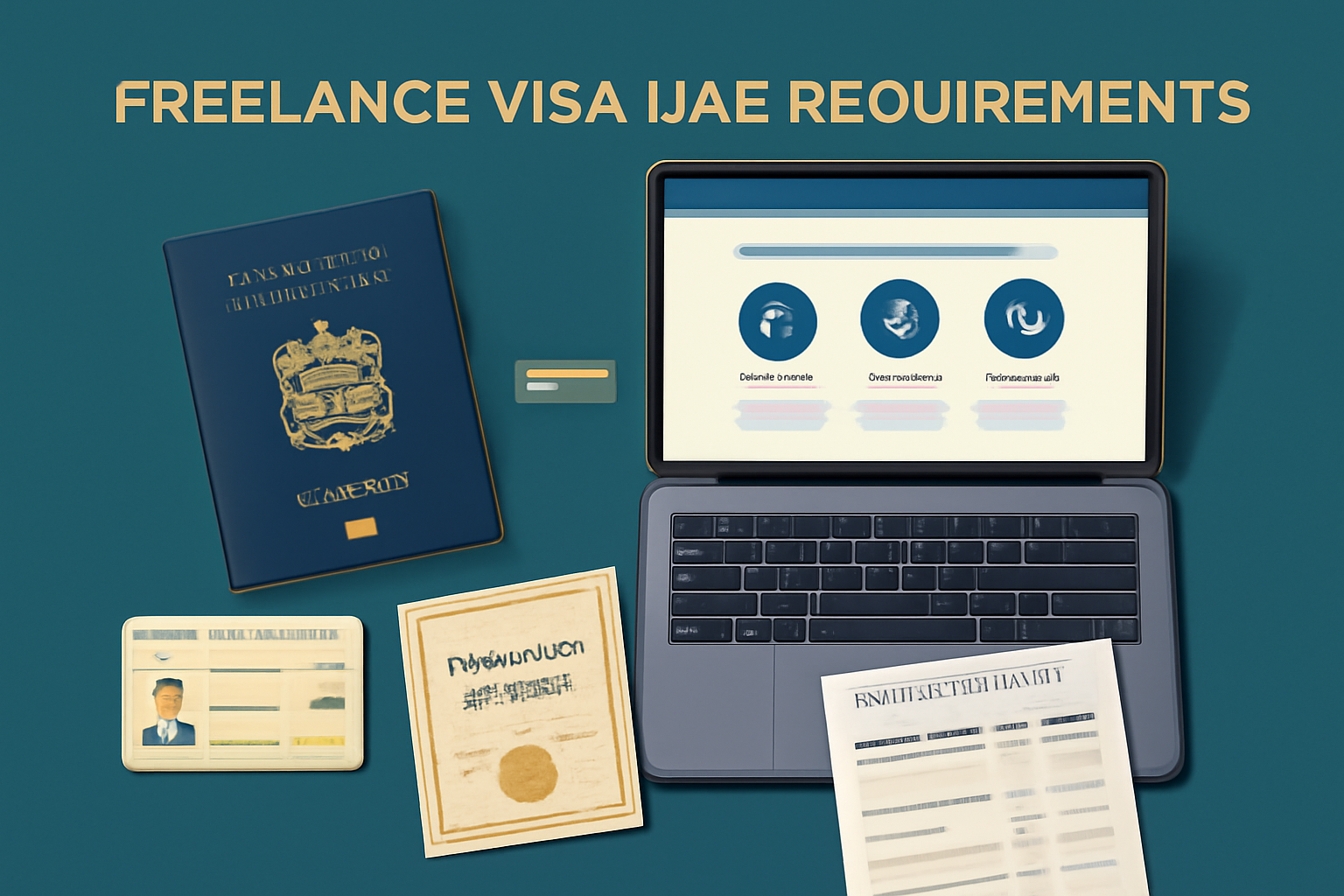
A UAE freelance visa is not one single document — the freelance visa UAE requirements actually combine a work permit (issued by a free zone or the Ministry of Human Resources and Emiratisation) with a residence visa granted under self-sponsorship or Green Visa rules. You qualify if your profession sits on an approved activity list, you can prove the right qualifications or income, and your paperwork is complete and correctly attested. Most rejections happen not because someone is unqualified, but because a document was missing a stamp, an attestation step was skipped, or the wrong free zone was chosen for the activity in question.
Key Takeaways
- Meeting the freelance visa UAE requirements means satisfying two separate approvals at once: a freelance permit (work authorisation) and a self-sponsored residence visa.
- Core documents: passport valid 6+ months, attested qualifications or documented experience, 3–6 months of bank statements, and UAE-compliant health insurance.
- First-year all-in costs typically run AED 15,000–30,000; renewals are usually cheaper, at AED 5,000–15,000 every 1–3 years.
- With clean, correctly attested documents, the full process — permit to Emirates ID — usually takes 2–4 weeks.
- Choosing the wrong free zone and submitting unattested certificates cause more rejections than any real skills gap.
What Is a UAE Freelance Visa? (Freelance Permit vs Residence Visa)
The phrase “freelance visa” is shorthand for two linked approvals, and understanding this distinction is the first step in meeting the freelance visa UAE requirements correctly. The first approval is a freelance permit — a licence that lets you legally invoice clients for a defined activity such as media, technology, education, design, or consultancy. The second is a residence visa, which gives you the right to live in the UAE and, in most cases, is tied directly to that permit.
Free zone freelance permits are the most common route. They typically bundle a 1–3 year residence visa with the permit itself, and the free zone acts as your sponsor for immigration purposes even though you remain fully self-employed and keep 100% ownership of your work and income. You can review the general visa framework on the UAE government’s own portal, u.ae, which outlines the categories of entry permits and residence visas available under federal law.
The Green Visa for freelancers and self-employed individuals is a separate, increasingly popular option. It offers a 5-year residence visa with no employer or free zone sponsor at all. To qualify, you need to show either annual self-employment income of at least AED 360,000 or enough savings to support yourself for the visa’s full duration. Abu Dhabi’s residents’ office publishes further detail on eligibility for this route at tamm.abudhabi.ae, and Dubai’s General Directorate of Residency and Foreign Affairs echoes similar criteria for applicants based there.
A third path — the mainland freelance permit via MOHRE — exists for a shorter list of professions, including some consulting, teaching, and engineering roles. It usually requires a local service agent: a UAE national who liaises with government departments on your behalf. The agent doesn’t own your business or take a cut of your income; it’s a licensing formality specific to this jurisdiction. This route tends to suit people already resident in the UAE who are moving from an employment visa into self-employment, rather than first-time applicants abroad.
Who actually needs this visa? Anyone who wants to legally invoice UAE and international clients, sponsor family members, renew their own residency independently, and stop relying on a tourist visa or an employer-sponsored visa that doesn’t permit outside work. The core benefit is flexibility: you can work with multiple clients, set your own rates, and skip the overhead of setting up a full company with office space and a trade licence.
| Route | Issuing Authority | Typical Residence Duration | Key Requirement | Best For |
|---|---|---|---|---|
| Free zone freelance permit | Free zone authority (e.g. RAKEZ, Shams, twofour54) | 1–3 years | Approved activity + qualification/experience proof | Creatives, consultants, tech professionals wanting fast setup |
| Green Visa (self-employment) | GDRFA / ICP federal system | 5 years | AED 360,000 annual income or equivalent savings | Established freelancers with strong income history |
| Mainland freelance permit | MOHRE | 2–3 years | Local service agent + eligible profession | UAE residents transitioning from employment visas |
UAE Freelance Visa Eligibility Criteria: Are You Qualified?
Eligible professions differ slightly by authority, but most free zones and MOHRE recognise a similar core list: media and content creation, marketing, IT and web development, graphic design, education and training, business consulting, photography, and event management. If your work doesn’t fall into a listed activity, you may need to apply under a related category or consider a different jurisdiction altogether.
Academic requirements are where many applicants get tripped up. Most free zones ask for a bachelor’s degree or an equivalent professional diploma. Some — particularly for creative or technical roles — will accept five or more years of documented professional experience instead of a degree, but this isn’t universal, so it’s worth confirming with the specific authority before you commit to a package.
For the Green Visa self-employment route, the income bar is explicit: AED 360,000 per year from self-employment activity, or proof of sufficient savings to cover the 5-year visa period if your income doesn’t meet that threshold. Free zone freelance permits are less rigid; most simply want to see 3–6 months of bank statements or a signed client contract that demonstrates you can support yourself, though the exact minimum balance isn’t always published.
Basic eligibility also includes:
- Minimum age of 18
- Medical fitness, confirmed via the mandatory UAE medical test
- No criminal record
- Passport valid for at least 6 months from the date of application
If you’re already inside the UAE on an employment or tourist visa, the process changes slightly. You’ll typically need either a No Objection Certificate (NOC) from your current sponsor, or you’ll go through a status change rather than applying for a fresh entry permit from outside the country. Getting this sequencing wrong is one of the more overlooked freelance visa UAE requirements, and it can cost you weeks if you apply for the wrong process first.
Required Documents for a UAE Freelance Visa: Complete Checklist
This is the section that decides whether your application sails through or bounces back for correction. Here’s the full document list, in the order most authorities request it:
- Passport copy — minimum 6 months validity, plus recent passport-size photos on a white background.
- Attested academic certificates — your degree or diploma needs attestation from your home country’s Ministry of Foreign Affairs, the UAE embassy in that country, and finally the UAE’s own Ministry of Foreign Affairs (MOFA UAE). Skipping any one of these three steps is the single most common reason applications are rejected.
- CV or portfolio — a detailed work history, ideally supported by reference letters or client testimonials, especially if you’re relying on experience rather than a degree.
- Bank statements — the last 3–6 months, or an income certificate from clients showing consistent freelance earnings.
- UAE-compliant health insurance — many free zones won’t stamp your visa until this is in place, so arrange it early rather than at the last step.
- Tenancy contract or Ejari registration — required if you’re applying for the residence visa while already inside the UAE.
- NOC from your current employer or sponsor — needed if you’re switching from an employment visa.
- Free zone application form and any activity-specific NOC — for example, media freelancers often need a letter from the National Media Council alongside their free zone paperwork.
- MOHRE application and service agent agreement — for the mainland route only.
- Certified translations — any document not already in Arabic or English must be legally translated and attested before submission.
A quick but important note: if your passport name doesn’t exactly match the name on your academic certificates — a common issue after marriage or a naming convention difference — you’ll need a legal affidavit explaining the discrepancy. Otherwise the mismatch alone can stall your file for weeks, regardless of how strong the rest of your application is.
UAE Freelance Visa Costs in 2025: Fees, Renewals, and Hidden Charges
Cost is the question we’re asked most often, and it’s also where “too good to be true” packages tend to hide problems. Here’s a realistic breakdown of what meeting the freelance visa UAE requirements actually costs, line by line.
| Cost Item | Typical Range (AED) | Notes |
|---|---|---|
| Free zone freelance permit | 6,100 – 20,000 | RAKEZ and Ajman are budget-friendly; Dubai Media City and twofour54 sit at the higher end |
| Mainland freelance permit (MOHRE) | 9,000 – 15,000 | Includes service agent fee and establishment card — a mainland business registration document |
| Residence visa processing | 3,000 – 5,000 | Covers entry permit, status change, Emirates ID, medical test, and stamping |
| Health insurance | 700 – 2,500/year | Depends on age and coverage tier |
| Document attestation | 300 – 1,500 | Per document, varies by country of origin |
| Certified translation | 100 – 400 | Per document |
Realistic first-year total: AED 15,000–30,000, depending on the free zone, whether you need translations and attestations from scratch, and the insurance tier you choose. Renewals are typically lighter — budget AED 5,000–15,000 every 1–3 years for permit and visa renewal combined, since you’re not repeating attestation or medical steps from zero in most cases.
The “hidden costs” that catch people out aren’t usually fraud — they’re omissions. A package advertised at AED 6,500 might cover the free zone permit only, with medical testing, Emirates ID, insurance, and typing centre fees billed separately. Always ask for the landed cost — everything included — before comparing quotes side by side.
Step-by-Step Application Process: From Application to Emirates ID
- Choose your authority. Base this on your profession, budget, and whether you need physical office access or just a flexi-desk or virtual workspace.
- Prepare and attest documents. Start this early — attestation chains involving your home country’s foreign ministry can take the longest of any step.
- Submit the freelance permit application through the free zone’s portal or via an accredited consultant.
- Pay permit and visa fees, then receive permit approval.
- Apply for an entry permit if you’re outside the UAE, or initiate a status change if you’re already inside the country on a valid visa.
- Complete the medical fitness test and Emirates ID biometrics appointment.
- Receive visa stamping in your passport, followed by your physical Emirates ID.
| Step | Typical Timeframe |
|---|---|
| Permit approval | 7–15 working days |
| Entry permit issuance | 3–5 working days |
| Medical test, Emirates ID, stamping | 10–15 working days |
| Total typical turnaround | 2–4 weeks |
Some free zones offer expedited processing for an extra fee, but in our experience, the single biggest time-saver is simply having every document attested and translated correctly before submission. A same-day rejection over a missing MOFA stamp costs you far more time than the expedite fee would have saved.
Freelance Visa vs Employment Visa vs Investor Visa: How to Choose
| Factor | Employment Visa | Freelance Visa | Investor/Partner Visa |
|---|---|---|---|
| Sponsor | Employer | Free zone or self (Green Visa) | Your own company |
| Client flexibility | None — one employer only | Multiple clients allowed | Unlimited, but through the company |
| Setup cost | Low (employer pays) | AED 15,000–30,000 first year | Higher — full licence, office costs |
| Hiring staff | Not applicable | Not permitted under most permits | Yes |
| Best for | Salaried professionals | Independent consultants and creatives | Founders scaling a company |
The right choice usually comes down to a few honest questions: How many clients do you actually have? Do you need to hire staff, or is it just you? What’s your budget for setup versus ongoing overhead? And how broad does your business activity need to be — a single defined service, or a wider commercial scope? If you think you’ll eventually want to hire a team or trade more broadly, it’s worth comparing this against a full mainland company setup before you commit to the freelance route.
On tax: personal income in the UAE is not taxed. But if your freelance turnover exceeds AED 1 million per year, you may fall under the UAE’s corporate tax regime at 9% on profits above that threshold. Below AED 1 million, most freelancers remain effectively outside corporate tax obligations, though registration rules can still apply — it’s worth checking your specific position rather than assuming.
Family sponsorship is generally available to freelance visa holders, provided you meet a minimum income requirement — typically around AED 4,000–5,000 per month plus suitable accommodation, though this is assessed case by case by GDRFA or ICP depending on your emirate.
Common Mistakes That Delay or Reject Freelance Visa Applications
- Un-attested or incorrectly attested certificates. This is the number one cause of rejection, full stop.
- Wrong free zone for your activity — applying for a media licence in a zone with no media activity permissions, for instance.
- Bank statements that don’t cover the full 3–6 month window, or that show an inconsistent balance.
- Overstaying a tourist visa while the application is in process, which triggers fines and can block the freelance application entirely.
- Misunderstanding the mainland service agent requirement — it adds real cost and a compliance relationship many applicants don’t expect.
- No valid health insurance at the point of stamping — this alone can halt an otherwise complete file.
- Name mismatches between passport and certificates without a supporting legal affidavit.
- Missed renewal deadlines, which carry fines of AED 125–500 per day depending on the authority.
- Using unverified agents who quote unrealistically low prices and then submit incomplete files, leaving you to fix the mess later.
Almost every one of these mistakes is preventable once you know the freelance visa UAE requirements in advance — which is exactly why document preparation, not eligibility, is where most applicants should focus their attention.
How to Choose the Right Free Zone or Mainland Authority for Your Freelance Visa
Different zones specialise in different activities, and that specialisation matters more than the headline price. A few well-known options: Dubai Development Authority (DDA) for media and tech freelancers; Abu Dhabi’s twofour54 for media and creative professionals; RAKEZ for cost-effective general freelancing; Ajman Free Zone as another budget option; Dubai Internet City and Dubai Academic City for tech and education specialists; and Sharjah Media City (Shams) for creative and media activities.
The MOHRE mainland freelance permit suits specific professions — engineering, teaching, certain consulting roles — but the local service agent requirement and generally longer processing time mean it’s rarely the fastest route for first-time applicants. You can confirm profession-specific rules directly through MOHRE’s official services portal.
Practical decision factors worth weighing: annual renewal cost, permitted activities list, processing speed, whether an NOC from a professional body is required, physical presence obligations, how easily the free zone’s bank partners open freelancer accounts, and family visa eligibility.
As a rough guide by profession: media and creative work points toward Shams, twofour54, or DDA; tech and IT toward Dubai Internet City or DDA; education and consultancy toward RAKEZ, Ajman, or the mainland route; and general budget-conscious freelancing toward RAKEZ or Ajman.
Be cautious of packages that look unusually cheap — they often exclude mandatory medical testing, Emirates ID, or insurance, and those costs resurface later as “extras.” Our team helps clients compare the full landed cost across zones, not just the headline permit fee, so there are no surprises once you’re already committed. If you’d like a hand navigating government touchpoints along the way, our PRO services team handles the liaison work directly with each authority.
Freelance Visa UAE Requirements: Final Checklist and Recommendation Framework
Before you submit anything, run through this final checklist against the freelance visa UAE requirements covered above:
- Your profession appears on an approved activity list
- Your degree is attested, or you have sufficient documented experience as an alternative
- You have 3–6 months of consistent bank statements
- Your passport has at least 6 months validity
- You’ve arranged UAE-compliant health insurance
- You’re applying through the correct authority for your specific activity
A simple action plan:
- Confirm your profession is eligible before paying any fees.
- Gather and attest every document — start this in parallel with everything else, since it’s the slowest step.
- Get quotes from at least three free zones and compare landed cost, not just permit price.
- Apply through a licensed consultant to avoid the common paperwork errors listed above.
- Complete your medical test and Emirates ID appointment as soon as your entry permit or status change is approved.
Quick recommendation framework:
- Budget under AED 10,000 → RAKEZ or Ajman freelance permit
- Media or creative profession → Shams or twofour54
- Need a mainland presence → MOHRE freelance licence with a service agent
- Planning to sponsor family soon → confirm income proof and tenancy contract before you apply
If your document history is complicated, your visa status is time-sensitive, or you’ve already faced one rejection, it’s worth getting professional help rather than resubmitting blind. At Al Ain Business Center, we handle freelance visa processing end to end — document review, attestation coordination, free zone comparison, and PRO support — with transparent AED pricing starting from AED 5,750 for select services.
If you’re ready to start your journey, book a free consultation with our team and we’ll map out the fastest, most cost-effective route for your specific profession before you spend a single dirham on fees.
Frequently Asked Questions
How much does a UAE freelance visa cost?
First-year all-in costs typically run AED 15,000–30,000, depending on the free zone, insurance tier, and document attestation. Renewals are usually cheaper at AED 5,000–15,000 every 1–3 years. Key line items include the freelance permit (AED 6,100–20,000), residence visa processing (AED 3,000–5,000), and health insurance (AED 700–2,500/year).
Can I get a freelance visa in Dubai without a degree?
Yes, in some cases. Most free zones ask for a bachelor’s degree or equivalent professional diploma, but some—particularly for creative or technical roles—will accept five or more years of documented professional experience instead of a degree. This is not universal, so confirm with the specific authority before applying.
How long does it take to get a freelance visa in UAE?
The full process usually takes 2–4 weeks with clean, correctly attested documents. Permit approval takes 7–15 working days, entry permit issuance 3–5 working days, and medical test, Emirates ID, and stamping 10–15 working days.
Can a freelance visa holder sponsor family in UAE?
Yes, a UAE freelance visa holder can sponsor family members. The article lists family sponsorship as one of the benefits of the freelance visa, allowing you to renew residency independently and stop relying on employer sponsorship. Exact eligibility and income requirements for sponsorship may vary by authority.
What is the difference between a freelance permit and a freelance visa?
A freelance permit is a licence that lets you legally invoice clients for a defined activity, while a freelance visa is a residence visa giving you the right to live in the UAE. In practice, the ‘freelance visa’ combines both approvals: the permit (work authorisation) and the self-sponsored residence visa.
Do I need to be in the UAE to apply for a freelance visa?
No, you can apply from outside the UAE or from within. If you are outside, you apply for an entry permit; if you are already inside on a valid visa, you initiate a status change instead. The process differs depending on your location and current visa status.
Related articles
 Visas
Visas Visas
Visas Visas
Visas Visas
Visas Visas
VisasLatest guides
- ID Card Status UAE: Check Emirates ID Online 2024
- Set Up a Company in UAE: Your Step-by-Step Roadmap
- Medical Leave in UAE Labour Law: Your Rights Explained
- Abu Dhabi Labour Court Claims: Steps, Fees and Timelines
- Abu Dhabi PRO Services: What They Do and Why You Need Them
- Mission Visa UAE: How to Get One and Who Qualifies in 2026