
So, you're wondering about the real cost of a Dubai trading license. Let's get straight to it. The total you can expect to pay for your first year typically falls somewhere between AED 15,000 and AED 50,000. This initial investment gets the ball rolling, covering all the essential government fees, registration, and initial approvals.
But why such a wide range? Think of it like building a custom car. The price isn’t a fixed sticker price; it’s a sum of its parts. The final figure really depends on the model you pick (Mainland or Free Zone), the engine you need (your specific business activities), and all the extras you add on (like investor visas or a physical office). There's simply no one-size-fits-all number.
This first-year investment is made up of several different components, each with its own cost and purpose. Getting a handle on these individual pieces is the key to building a budget that makes sense for your new venture.
The Major Factors Influencing Your License Cost
The final bill for your business setup is shaped by a handful of critical decisions you'll make right at the start. These choices really set the financial foundation for your launch.
Here’s what moves the needle the most:
- Jurisdiction Choice: This is the big one. Deciding between a Mainland or Free Zone setup will have the single largest impact on your costs. A Mainland license gives you unrestricted access to the entire UAE market, while Free Zones are known for 100% foreign ownership and often come in convenient, all-in-one packages.
- Business Activities: What you plan to trade absolutely matters. Some activities, like general trading, come with higher fees than more specialised services. Others might need special (and sometimes costly) approvals from various ministries or regulatory bodies.
- Legal Structure: The legal form your company takes—whether it’s a Sole Establishment or a Limited Liability Company (LLC)—also plays a part. Different structures have different documentation requirements and, you guessed it, different fees.
- Visa Requirements: Every visa has a price tag. The number of investor or employee visas you need will directly add to your total cost, with each one incurring its own government fees for processing, medical tests, and Emirates ID issuance.
The real cost of a trading license in Dubai is a dynamic figure, not a static one. Your business goals and operational needs are the primary drivers of the final investment. By understanding the variables, you can strategically plan your setup to align with your budget.
Ultimately, it’s best to see the process as an assembly of necessary parts. While the base fee for the trade license itself generally starts from AED 15,000 to AED 50,000 (that’s about USD 4,083 to USD 13,613), this is just your starting point. You can learn more about the detailed cost of a trade license in Dubai to see how these elements combine.
In the next sections, we'll break down each component piece by piece—from one-time setup fees to recurring annual costs—to give you a clear financial roadmap.
Quick Summary of Key Cost Factors for a Dubai Trading License
To give you a clearer picture, here’s a quick overview of the main elements that will influence the final cost of your Dubai trading license. Think of this as your cheat sheet for budgeting.
| Cost Factor | Description | Typical Impact on Cost |
|---|---|---|
| Jurisdiction | The choice between Mainland and Free Zone. | High: This is often the most significant cost driver. |
| Business Activities | The specific type of trading you'll be doing. | Medium to High: General trading costs more; some activities require expensive external approvals. |
| Number of Visas | How many investor or employee visas you need. | Medium: Costs scale directly with the number of visas required. |
| Office Space | Your physical office requirement (virtual, flexi-desk, or physical). | Low to High: Ranges from affordable virtual offices to significant annual rent for a physical space. |
| Legal Structure | The legal form of your company (e.g., LLC, Sole Establishment). | Low to Medium: Primarily affects initial documentation and registration fees. |
| External Approvals | Special permissions from ministries or regulatory bodies. | Variable: Can range from minor fees to substantial costs, depending on the industry. |
Understanding these factors from the get-go allows you to make strategic choices that align your business ambitions with your budget, preventing any unwelcome surprises down the line.
Mainland vs Free Zone: Your First Major Cost Decision
Right out of the gate, you’ll face a choice that will single-handedly have the biggest impact on your total Dubai trading license cost: setting up on the Mainland or in a Free Zone. This isn’t just a small detail; it’s the foundation for your entire business structure, who you can sell to, and, most importantly, your startup and running costs.
Let's think of it this way. A Mainland license is like opening a retail shop on a bustling city street. You have direct, unfettered access to the entire local UAE market. You can trade with any customer or business, anywhere in the country. But this prime real estate means you’ll be dealing directly with government bodies like the Department of Economy and Tourism (DET) for approvals.
A Free Zone license, on the other hand, is like setting up in a specialised, high-tech business park. These zones are designed to pull in foreign investment with perks like 100% foreign ownership and neat, all-in-one setup packages. The trade-off? Your direct business activities are typically restricted to within that zone or international markets.
This visual guide breaks down the two paths and what they mean for your setup costs.
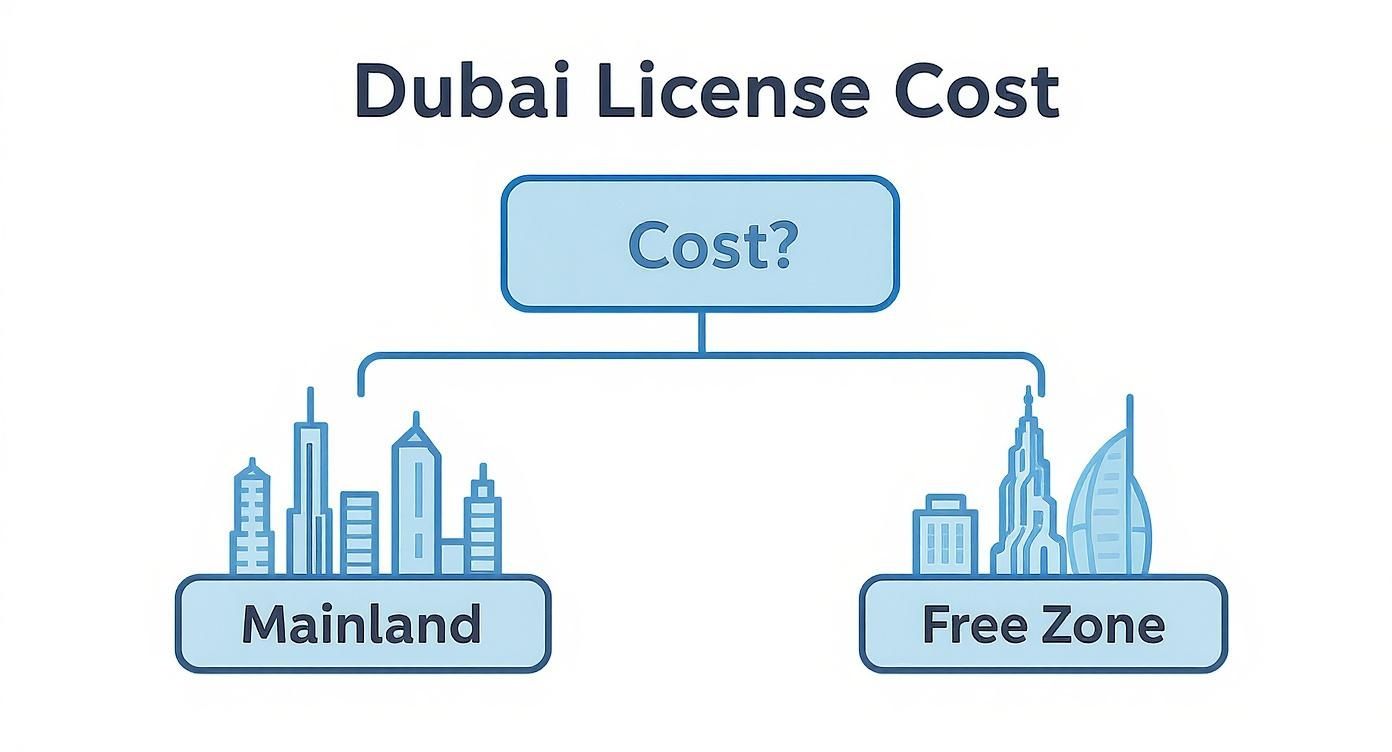
As you can see, your choice sends you down a completely different track in terms of costs, rules, and market opportunities.
Understanding Mainland License Costs
If you go for a Mainland license, get ready for a more itemised cost breakdown. You'll be working with several government departments, and each part of the process has its own fee. Think of it as an à la carte menu—it gives you flexibility, but you need to budget carefully to keep track of every individual payment.
Some of the key costs you'll see with a Mainland setup include:
- Initial Approval Fee: A required payment to the DET to get the green light for your business activity.
- Trade Name Reservation Fee: For securing your unique business name so no one else can use it.
- Memorandum of Association (MOA) Attestation: This makes your company's foundational document legally official.
- Office Rent and Ejari: A physical office is often mandatory, and the Ejari registration is the legal record of your lease.
- Local Service Agent (LSA) Fee: While 100% foreign ownership is now the norm for many activities, some professional licenses might still need an LSA.
These separate fees add up to your total. For a deeper dive, check out our complete guide on the differences between Free Zone vs Mainland Dubai.
Unpacking Free Zone License Costs
Free Zones operate on a totally different financial model. They're famous for their all-inclusive packages that bundle many of the required fees into a single upfront payment. This makes budgeting a breeze and the whole setup process much quicker.
The biggest draw of a Free Zone is cost predictability. Packages often roll the license, registration, and a flexi-desk or shared office space into one clear, fixed cost from day one.
These packages are a lifesaver, especially for first-time entrepreneurs. But be aware that costs can swing wildly from one free zone to the next. A package in a premium, centrally located zone like DMCC will cost a lot more than one in a newer, more remote zone. Picking the right free zone is just as critical as choosing to be in one in the first place.
A Direct Cost Comparison
The financial gap becomes obvious when you put the numbers side-by-side. Mainland license registration fees usually fall between AED 10,000 to AED 15,000. In contrast, free zone licenses can start from AED 10,000 and go all the way up to AED 50,000, depending on the zone and your business activity.
On top of that, first-year mainland costs have other line items like initial approvals (AED 120–220), trade name reservations (AED 600–2,000), municipality fees (which are 5% of your annual office rent), and mandatory Dubai Chamber of Commerce fees ranging from AED 1,200 to AED 2,300.
Ultimately, the best choice boils down to your business model. If you need direct access to the UAE consumer market, the itemised costs of a Mainland license are a necessary investment. But if you’re focused on international trade or services and want simplicity and 100% ownership, a Free Zone package will likely be the more sensible and cost-effective path.
Getting Started: Your One-Time Setup Fees
Think of your business setup like building a house. You have the main blueprint—the license itself—but you also need a whole toolkit of permits, registrations, and legal documents to lay the foundation. These are your one-time setup fees: a collection of essential, one-off payments needed to legally construct your company from the ground up.
These aren't recurring bills. They're the initial investments that get your business officially on the map and ready to trade. Knowing what each fee is for is the key to creating a realistic startup budget, so you aren't blindsided by unexpected costs right when you’re trying to launch. Let’s break down this toolkit, piece by piece.
Securing Your Brand and Business Concept
Before you can even think about making your first sale, you need to lock down the legal basics. This means claiming your identity and getting the official go-ahead from the government. Two main fees kick this off.
First up is the Trade Name Reservation. This payment officially reserves your chosen business name, making sure it's unique and follows UAE naming rules. It’s just like grabbing your domain name before building a website; it protects your brand from day one.
Next is the Initial Approval Certificate. This is a critical step where the Department of Economy and Tourism (DET) or your chosen Free Zone authority gives your business idea the green light. It’s their official nod, confirming your proposed activities are allowed in Dubai and letting you move forward with everything else.
Formalising Your Legal Structure
With your name and business activities approved, it's time to make your company's legal framework official. This involves drafting and attesting the core documents that define who owns the business and how it will run.
For most company types, especially a Limited Liability Company (LLC), a Memorandum of Association (MOA) is non-negotiable. This document is essentially your company's constitution, outlining partner roles, capital shares, and the rules of operation. There's a one-time fee to have it professionally typed and legally attested by a notary, but it’s absolutely vital for clear governance.
Think of these early legal and admin fees as the concrete foundation of your business. Trying to skip or underestimate them is like building on sand—your company simply won't be legally sound or stable enough to operate.
These foundational steps are critical for compliance. The initial registration process includes fees for trade name reservation, which usually land between AED 620 and AED 2,000, and an initial approval fee that can be anywhere from AED 2,000 to AED 5,000. These are just the beginning, as the main license fee will depend entirely on your business type. You can learn more about how these mainland license costs are calculated.
To give you a clearer picture, here’s an example of how these one-time costs might stack up for a standard commercial LLC on the Dubai Mainland.
Example One-Time Setup Cost Calculation for a Mainland LLC
| Fee Component | Estimated Cost Range (AED) | Purpose of the Fee |
|---|---|---|
| Trade Name Reservation | 620 – 2,000 | Secures your unique business name with the authorities. |
| Initial Approval Certificate | 2,000 – 5,000 | Government approval of your proposed business activities. |
| MoA Typing & Attestation | 1,500 – 3,500 | Drafting and notarising the company's foundational legal document. |
| Office Tenancy Contract (Ejari) | 1,000 – 2,500 | Registering your physical or virtual office lease with the government. |
| Core License Issuance Fee | 5,000 – 15,000 | The main government fee to officially grant your trade license. |
| Total Estimated One-Time Fees | 10,120 – 28,000 | The approximate total investment to get your business legally formed. |
Keep in mind that these are estimates. The final figure will depend on your specific business activity, legal structure, and any additional government approvals needed.
The Core License Issuance Fee
Finally, we get to the main event: paying for the trade license itself. After all the paperwork is in and every approval is secured, you'll pay the final issuance fee. This is usually the largest of the one-time costs and is what officially gives you the legal right to do business in Dubai.
The exact amount swings pretty widely based on your chosen business activity. For instance:
- Commercial Licenses for general trading or retail can run from AED 5,000 to AED 15,000.
- Professional Licenses for consultants and other service providers often land between AED 10,000 and AED 20,000.
- Industrial Licenses for any kind of manufacturing are typically the most expensive, ranging from AED 15,000 to AED 25,000.
Paying this fee solidifies your legal status and marks the finish line of your company formation process.
Planning for Your Recurring Annual Costs
Getting your business off the ground with that initial setup fee is just the first chapter. To write a long and successful story in Dubai, you need to look past the launch and plan for the recurring annual costs. These are the expenses that keep your company legal, compliant, and fully operational, year in and year out.
Think of it like buying a car. The setup fee is the purchase price—a big one-time payment. But the annual costs are your insurance, registration, and fuel. Without them, that initial investment just sits in the driveway, useless. For your business, these recurring costs are non-negotiable; they’re what keep the engine running.
Getting a clear picture of these long-term commitments right from the start is critical. It helps you avoid the common trap of being blindsided when that first renewal notice lands in your inbox, allowing you to build a financial strategy that fuels growth long after your first year.
The Core Annual Renewal Fee
Your biggest recurring cost will be the trade license renewal fee itself. This is the annual payment you make to the relevant authority—either the Department of Economy and Tourism (DET) for a mainland company or your specific free zone authority—to keep your license active.
The good news? This fee is quite a bit lower than your initial setup cost. That's because it doesn't include all the one-time charges you've already covered, like MOA attestation, trade name reservation, and initial approvals. The renewal is a consolidated charge to keep your business in good standing.
As a rule of thumb, expect your annual license renewal to cost between AED 8,000 and AED 15,000. Of course, this can shift depending on your jurisdiction, business activities, and any changes you’ve made to your license. For a closer look at what to expect, our detailed guide on the Dubai trade license renewal process breaks it all down.
Office and Establishment Card Renewals
Your company's physical or virtual address in Dubai also comes with annual costs. Whether you have a full-blown office or a more flexible setup, you'll need to factor it into the budget.
- Office Rent: For mainland businesses, the annual lease payment is a major line item. If you’re in a free zone or a startup, this might be a more manageable fee for renewing a flexi-desk or co-working space membership.
- Establishment Card Renewal: This is the crucial link between your company and the immigration and labour departments, letting you sponsor and renew employee visas. The card has to be renewed every year, typically costing between AED 600 and AED 2,000.
Forgetting about your annual renewals simply isn't an option. It can trigger serious penalties, from hefty fines and a frozen corporate bank account to being unable to renew visas for your staff or yourself. It can bring your business to a dead stop.
Visa Renewal Costs
Every visa your company sponsors—including your own investor visa and those for your employees—has an expiry date, usually after one or two years. Each time a visa is renewed, it comes with a set of costs that have to be part of your annual financial planning.
It’s not just a single fee, either. The total cost is a combination of different charges for all the steps involved.
Typical Visa Renewal Components:
- Government Renewal Fees: Direct payments to the immigration authorities.
- Medical Test: A mandatory health screening for public safety.
- Emirates ID Renewal: The fee for issuing a new national ID card.
- PRO Service Fees: The cost for professional help to manage the paperwork and legwork.
Budgeting for these renewals is key to keeping your team legally employed and avoiding any disruption to your operations. A little proactive planning goes a long way in managing these essential HR costs.
Uncovering the Hidden Costs of Business Setup
The official fee schedule for your trade license only tells part of the story. It's a common trap for new entrepreneurs: you focus so much on the main government payments that you're caught completely off guard by a series of smaller, yet essential, expenses. These are the "hidden costs" that won't appear on the primary invoice but are absolutely necessary to get your business up and running.
Think of it like buying a ticket to a concert. The license fee gets you in the door, but you still have to pay for transport, parking, and maybe a t-shirt. You can't really enjoy the main event without sorting out the practicalities. By understanding these additional costs upfront, you can build a realistic budget that prevents financial headaches during your crucial launch phase.
The Essential Role of PRO Services
Navigating the web of government departments for document submissions, visa processing, and various approvals can be a real maze. It's time-consuming and, frankly, confusing if you don't know the system. This is where Public Relations Officer (PRO) services come into play. These professionals are your official representatives, handling all the legwork and liaising with government bodies on your behalf.
While hiring a PRO is an added expense, it’s really an investment in getting things done right the first time. Their expertise helps you avoid costly errors or frustrating delays that could bring your setup process to a grinding halt. PRO fees can vary—sometimes charged per task or as an annual retainer—but they are a vital part of the real Dubai trading license cost.
Mandatory Costs for Visa Holders
If your business setup involves applying for an investor or employee visa, a whole new set of non-negotiable costs will pop up. These are mandatory for every single person who will be a resident under your company's sponsorship.
- Medical Fitness Test: A required health screening that everyone must pass before a visa can be stamped. It's a standard public health measure.
- Emirates ID Application: This is the UAE's mandatory national identity card. The application fee is a standard part of becoming a resident.
- Visa Stamping Fee: This is the final charge to have the residency visa officially placed in your passport, making it all official.
Each of these steps has its own government fee, and when you add them up, they can tack on a few thousand dirhams per person to your total startup budget.
A common mistake is to budget only for the license and completely forget the cumulative cost of visas for founders and key staff. These "hidden" personal processing fees are an integral part of the business setup cost and must be factored in from day one.
Opening Your Corporate Bank Account
Having a corporate bank account is non-negotiable for running your business, but opening one isn't always a simple or free process. Banks in the UAE have very strict compliance checks and often require an initial minimum balance to be deposited and maintained in the account.
This minimum balance, which can range anywhere from AED 10,000 to AED 50,000 or more, isn't a fee you lose. It's your capital, but it will be tied up in the account. Beyond these direct banking requirements, it's also worth thinking about internal financial processes. Inefficient workflows, like manually processing statements, can create their own hidden operational costs over time. This is where streamlining bank statement conversion to avoid hidden costs can make a real difference down the line.
Finally, some banks might also charge an account opening or administration fee, particularly for businesses they consider higher risk. Planning for these banking requirements is a crucial final step in understanding the true financial picture of your launch.
Actionable Strategies to Optimise Your Licence Costs

Knowing the different parts of your Dubai trading licence cost is the first step, but the real magic happens when you start actively managing them. With a few smart decisions upfront, you can seriously reduce your initial investment without cutting corners on compliance or limiting your future growth. It all comes down to smart planning.
The goal is simple: match your setup choices with what your business needs right now. Avoid paying for extras that won't add any real value in your first year of operations. Think of it like packing for a trip—you only bring what you need for the journey ahead, not everything you might possibly use someday. This lean approach keeps your startup capital focused where it matters most.
Be Specific with Your Business Activities
One of the easiest ways to keep costs in check is to be really precise with your business activities. A "general trading" licence sounds great because of its flexibility, but that flexibility comes with a premium price tag. If your business is focused on a specific niche, like electronics or textiles, listing those specialised activities is a much more cost-effective route.
On top of that, some activities require expensive external approvals from various ministries. By carefully choosing activities that don't trigger these extra layers of bureaucracy, you can save thousands of dirhams and weeks of waiting. Always sit down with an expert to go over the activity list and find the most efficient and affordable path forward.
The smartest financial move you can make is to pay only for the permissions you need today. You can always amend your licence later to add more activities as your business grows and starts generating the revenue to support that expansion.
Rethink Your Office Space Requirement
A traditional physical office is easily one of the biggest annual expenses you'll face, especially with a mainland company. But here’s the thing: it’s not always necessary from day one. Many entrepreneurs are slashing their costs by opting for a more flexible solution instead.
- Flexi-Desk or Co-working Space: This is a hugely popular choice in Free Zones. It bundles a legitimate business address with your licence package for a fraction of what a private office would cost.
- Virtual Offices: For many businesses, a virtual office is the perfect solution. It gives you a prestigious business address and mail handling services without the crippling overhead of a physical lease. You can see just how a virtual office in Dubai can be a game-changer for startups.
By choosing a flexible workspace, you satisfy the legal requirement for an address while freeing up a significant amount of capital for core operations like marketing and inventory. This approach lets you scale up your physical presence only when your business genuinely needs it.
Answering Your Key Questions
When you're navigating the costs of setting up a business, a lot of specific questions pop up. Let's clear up some of the most common queries entrepreneurs have about the Dubai trading license cost, so you can move forward with confidence.
What Is the Cheapest Trading Licence in Dubai?
The most budget-friendly trading licences are almost always found in specific free zones. These zones have crafted packages perfect for startups and solo entrepreneurs, often swapping a traditional office for a flexi-desk to slash overhead costs.
To get the absolute lowest price, you'll want to focus on a few key things:
- Pick a Cost-Effective Free Zone: Some free zones are simply known for their competitive, startup-friendly pricing.
- Start with Minimal Visas: Every visa adds a significant cost. It’s best to begin with only the essential ones you need right away.
- Be Specific with Business Activities: A broad "general trading" licence comes with a higher price tag. A licence with a few very specific activities is much more affordable, especially if they don't need expensive third-party approvals.
Can I Get a Dubai Trading Licence Without Renting an Office?
Yes, you absolutely can. This is a common setup, and many free zones have built their entire model around it. They offer packages that include a flexi-desk or membership to a co-working space, which ticks the legal box for a physical address without the hefty price of a full-time office lease.
Over on the mainland, the Dubai Department of Economy and Tourism (DET) also has flexible options. The Instant Licence, for example, might let you operate for your first year without a physical office. Just keep in mind that your office setup is often directly tied to how many employee visas you can apply for.
How Much Does It Cost to Renew a Trading Licence Annually?
Good news here—renewing your licence each year is much cheaper than the initial setup. That’s because all those one-time registration, documentation, and setup fees are out of the picture. Your main recurring costs are simply the licence renewal fee, your office or flexi-desk rent, and the Establishment Card renewal.
As a rule of thumb, your annual renewal cost will likely be around 60-70% of what you paid in your first year. The exact amount really depends on your jurisdiction and the type of office space you have.
Renewal fees usually fall in the AED 8,000 to AED 15,000 range. This makes your ongoing operational costs predictable and much easier to manage. Planning for this expense is a key part of building a sustainable business.
Are There Instalment Plans Available for Licence Fees?
Yes, many providers get that managing startup capital is a top priority. To help ease that initial financial pressure, a lot of business setup consultants and even some free zone authorities offer flexible payment plans.
These plans let you spread the total setup cost over a few months, making that initial investment feel a lot more manageable. It's always worth asking your chosen service provider directly about the specific instalment options and terms they offer for your Dubai trading license cost.
Ready to launch your business in Dubai with clear, predictable costs? The experts at Al Ain Business Center provide transparent packages and expert guidance to make your setup process smooth and affordable. Get your free consultation today!