
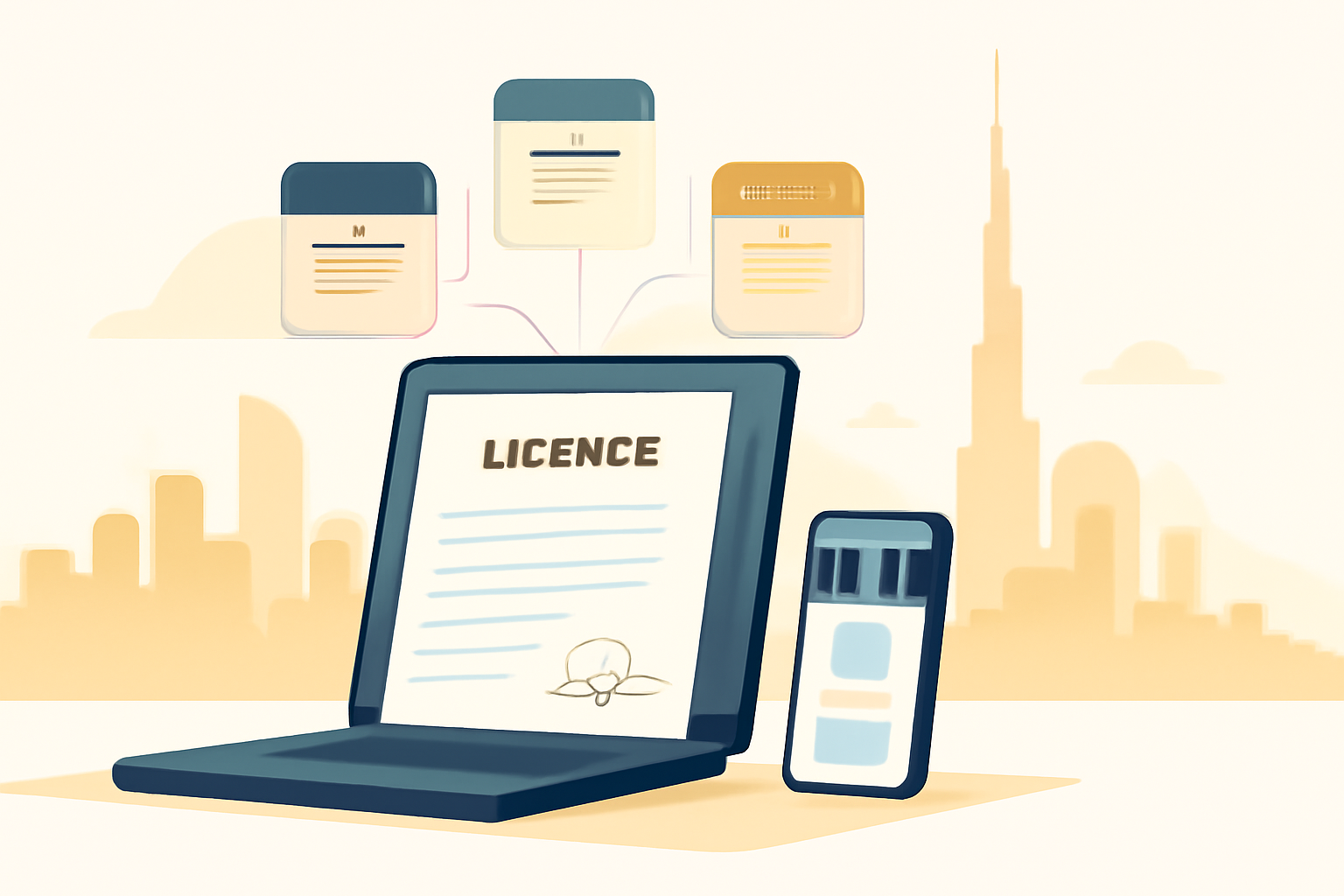
A Dubai trade license for online business is the legal permission to run one defined activity in the emirate. Because the specifics of any license are set by the authority that issues it, if you need to know exactly what you can do under a particular license, or what it requires, confirm the details directly with the relevant Dubai licensing authority before you apply or rely on it.
Key Takeaways

- “Online business” is not a licence category in Dubai. Licence categories are set by the relevant licensing authority, so check directly with that authority to confirm which category fits your planned activity.
- Licensing categories depend on the type of activity a business carries out, and service-based and product-based businesses are generally treated under different sets of rules. Because these classifications and their requirements vary, consult the relevant licensing or commercial authority in your jurisdiction to confirm what applies to you.
- The e-trader license is a low-cost mainland route built for social-media sellers of goods. It is commonly quoted at AED 1,070 with mandatory annual renewal, and it carries real limits: an expat applicant can hold the professional license only, and cannot trade, or manufacture and sell products.
- Jurisdiction — mainland or free zone — is a decision best made with guidance from the relevant UAE free zone authority or a licensed advisor, rather than based on advertised prices alone.
- Banking and payment-gateway requirements vary by provider, so confirm them directly with the relevant institutions as part of your licensing preparation.
- Fees, activity lists and eligibility rules change. Confirm the current position with Dubai’s Department of Economy and Tourism (DET) or your chosen free zone authority before you commit.
What a Dubai Trade License for Online Business Actually Covers
A trade license is the legal permission to conduct a defined business activity in Dubai. Because requirements differ from one business to another, the relevant licensing authority is the best source for details on what else may be needed before you begin operating.
Three documents get blurred together constantly by first-time founders:
- A trade license. Issued by Dubai’s Department of Economy and Tourism (DET) for mainland businesses, or by a free zone authority for companies registered inside that zone. It names your approved activities, and you may only operate within them.
- An e-trader license. A specific mainland permit introduced by the Department of Economic Development (DED) to regulate the sales of online commodities sold via social media websites. It was built for social-media sellers of goods, not for service firms.
- A free zone e-commerce package. A bundled offer pairing a free zone license with a desk, a set visa allocation and a fixed activity list. Convenient — but the activity list and the visa quota come from the package you buy, not from your own plan.
| Document | What it actually is | Who it suits | Main limitation |
|---|---|---|---|
| Trade license (mainland or free zone) | Legal permission to conduct named activities | Any business with clients, staff, contracts or investors | Needs the correct activity, a valid address and annual renewal |
| E-trader license | Mainland permit introduced by DED to regulate online commodity sales via social media | Solo social-media sellers of goods who reside in Dubai | Expat holders can apply for the professional license only — no trading, no manufacturing and selling products |
| Free zone e-commerce package | A free zone license bundled with a desk and a visa allocation | Digital-first service, software and content businesses; cross-border sellers | Activity list and visa quota are fixed; mainland access can be narrower |
Here is why the distinction matters more than any fee figure. “Online business” is not a licence category — no authority issues a licence to be online. What a licence actually permits depends on the specific activity it was issued for and on the rules of the authority that issued it. Because of that, a licence obtained for one activity is not automatically the right fit for another, and it is worth confirming the permitted scope directly with the issuing authority before you rely on it for a different line of work.
One caution before we go further. Licence types, fees and activity lists are revised from time to time. Treat this as a map of how the system works, and confirm your specific activity and current costs directly with DET or your free zone authority before you commit. Their published guidance — not a blog post, including this one — is the version that counts.
Which License Fits Your Online Model: Consulting, SaaS, Content or Product Ecommerce
The fastest way to choose is to name the thing you actually sell. Most digital founders land in one of four models, and each maps to a different activity family.
| Model | Typical activity family | Physical premises realistically required? | Corporate bank account & payment gateway | Visa outlook |
|---|---|---|---|---|
| Professional consulting / services | Professional or service activity — management consultancy, IT consultancy, marketing services | A flexi-desk is usually accepted | Straightforward when your contracts match your activity | Quota set by jurisdiction or package |
| SaaS and app businesses | IT / professional — software design, software publishing, IT services | A flexi-desk is usually accepted | Banks scrutinise the revenue model and jurisdiction; processors generally fine | Quota set by jurisdiction or package |
| Content and media — courses, coaching, publishing | Professional, media or training-related, depending on the exact activity | Varies; some activities attract third-party approval | Manageable; app stores and marketplaces verify your license | Quota set by jurisdiction or package |
| Product e-commerce / dropshipping | Commercial or trading family | Usually needs a storage, warehouse or fulfilment arrangement | Bank and gateway approval depend on activity and platform | Quota set by jurisdiction or package |
This is a general map, not a live activity list or a fee quote. Exact activity names, approvals and quotas must be confirmed with DET or your free zone authority.
How a business is classified can depend on whether it sells services or goods, and the rules that apply are not uniform across jurisdictions. Because the details vary, it is worth confirming the correct category and any permit requirements with the relevant local authority or a qualified adviser before proceeding.
The practical consequence: the model you pick first shapes ownership limits, visa eligibility and your future expansion options. Changing activity or jurisdiction later is possible, but it costs time and money that an hour of planning at the start would have saved. If you are still deciding how formal your structure needs to be, our guide on كيف تبدأ مشروعاً صغيراً في الإمارات: دليل المبتدئين covers the small-business fundamentals before you commit.
Do You Need an E-Trader License or a Full Trade License?
The e-trader license was introduced by the Department of Economic Development (DED) to regulate the sales of online commodities sold via social media websites (DED Café). It is deliberately narrow: it exists so that someone selling goods through Instagram or a similar platform can do so legally, cheaply, without building a full company structure.
The commonly cited eligibility rules are simple:
- The applicant must reside in Dubai.
- The applicant must meet the minimum age requirement of 21.
The fee is widely quoted at AED 1,070, and it is mandatory to renew the license annually. Since requirements and costs can change over time, confirm the current details directly with the issuing authority before you apply.
Now the limitation that catches people out. Although an Emirati or GCC national can apply for both licenses, an expat can apply for the professional license only. That limits the business to rendering professional services. Expatriates cannot trade, or manufacture and sell products, under this route. If your plans go beyond professional services, check the current rules and the correct licensing route with the relevant authority before you commit.
When should you consider moving to a full mainland or free zone trade license? Requirements and eligibility can vary depending on your activity and circumstances, so it is best to check the current rules with the relevant mainland or free zone authority before deciding. That authority can confirm what applies to your situation.
Mainland, Free Zone or Virtual: Choosing the Right Jurisdiction for an Online Business
Mainland (DET-issued). A mainland license places no restriction on working with UAE clients or government entities. Activity rules, premises requirements and visa quotas differ by licence type, so the same “mainland license” label can mean very different things depending on what you do. If you want to bid for government work or supply local enterprises, mainland is usually the straight path — our walkthrough of How to Get an Instant License in Dubai Mainland: Step-by-Step shows how quickly that route can move.
Free zone. Free zones are popular with SaaS, consulting and content businesses because packages combine pricing, a desk and a defined visa allocation. The trade-off is that free zone companies operate within the zone’s rules and may need additional steps to trade directly in the mainland market.
The real trade-offs come down to four questions. Can you sell to local and government clients the way you intend? Do you need import and export capability? How
Frequently Asked Questions About Dubai Trade License For Online Business
Do I need a trade licence to run an online business in Dubai?
Yes. A trade license is the legal permission to conduct a defined business activity in Dubai, issued by the Department of Economy and Tourism (DET) for mainland businesses or by a free zone authority for companies inside that zone. “Online business” is not itself a licence category — your license is issued for an underlying activity such as consulting, software, content or trading. You may only operate within the activities the license names.
How much does a Dubai trade licence for an online business cost?
Cost depends on the jurisdiction, activity and package you choose, and the article does not quote a single price for a full trade license. The e-trader license is commonly quoted at AED 1,070 with mandatory annual renewal. Treat that figure as a benchmark to verify with the issuing authority, since fees and rules change.
Can I get a Dubai trade licence without a physical office?
For professional and service models — consulting, SaaS and content — a flexi-desk is usually accepted, and free zone packages typically bundle a desk with the license. Product e-commerce and dropshipping models usually need a storage, warehouse or fulfilment arrangement instead. Exact premises requirements vary by activity and jurisdiction, so confirm them with DET or your free zone authority.
Can expats apply for an e-trader licence in Dubai, and what can they do with it?
Yes, expats can apply, provided they reside in Dubai and meet the minimum age requirement of 21. However, an expat can apply for the professional license only, which limits the business to rendering professional services. Expatriates cannot trade, or manufacture and sell products, under this route — so it is not suitable for holding stock, importing goods or scaling a physical product line.
Is a free zone or mainland licence better for a SaaS or consulting business in Dubai?
Free zones are popular with SaaS, consulting and content businesses because packages combine pricing, a desk and a defined visa allocation, but free zone companies operate within the zone’s rules and may need additional steps to trade directly in the mainland market. A mainland license places no restriction on working with UAE clients or government entities. The article advises following who you sell to and how many visas you need rather than the cheapest headline price.
Still have a question?
Every situation has its own details. Tell us what you are planning and we will come back to you with the specifics for your case.
Related articles
 Trade Licence
 Trade Licence
 Trade Licence
 Trade Licence
 Trade Licence
 Trade Licence
Latest guides
- ID Card Status UAE: Check Emirates ID Online 2024
- 2-Year Residence Visa Renewal UAE Cost: 2026 Fee Breakdown
- Set Up a Company in UAE: Your Step-by-Step Roadmap
- Housemaid Visa Abu Dhabi: Cost, Steps and Requirements
- Green Visa UAE: Requirements, Costs and How to Apply
- UAE Visit Visa Categories for Technology & AI Talent