
Getting a tourist visa for Dubai is actually pretty straightforward. For the most part, you just need a valid passport, a sponsor (like an airline or hotel), and some proof of your travel plans. The most common choices are the 30-day and 60-day visas, which cover just about everyone, from holidaymakers to business travelers. Nail these core elements, and you’re already on the path to a smooth application.
Understanding Dubai Visa Requirements At A Glance
Navigating the Dubai visa process can feel a bit overwhelming at first, but it’s much more manageable than it looks. Think of this guide as your roadmap. We’ll walk through everything, step-by-step, starting with the absolute basics to clear up any confusion and show you that the requirements are totally achievable.
First, we’ll break down the main types of tourist visas available. You'll get a clear picture of the popular 30-day and 60-day options and what makes them different. We'll also explain the difference between single and multiple-entry permits, which is a game-changer if you’re planning to use Dubai as a home base for exploring the region.
Key Visa Concepts Explained
Let’s start by unpacking the core pieces of the Dubai tourist visa puzzle. These are the foundational elements for pretty much every application, no matter where you're from or which visa you're aiming for.
-
Sponsorship: Here’s the big one. Unlike many other countries, you can't just apply for a Dubai tourist visa on your own. You absolutely need a sponsor. This is usually an airline (like Emirates), a hotel you’ve booked in Dubai, or a licensed travel agency. They're the ones who officially submit your application to the immigration authorities. For more on planning your trip, check out our guide to travel and tourism in Dubai.
-
Passport Validity: This is a strict, non-negotiable rule. Your passport must be valid for at least six months from the day you plan to enter the UAE. If it has less than six months left, your application will be rejected flat out, so double-check those dates!
To give you an idea of how well this system works, in the first quarter of the year alone, Dubai welcomed an incredible 5.31 million international visitors. That number, highlighted by Gulf News, isn't just a testament to the city's appeal—it proves the visa process is built to handle huge volumes efficiently.
For a quick reference, here’s a table that breaks down the most common requirements at a glance.
Quick Summary Of Key Dubai Visa Requirements
| Requirement | Details | Common Visa Types |
|---|---|---|
| Passport | Must be valid for at least 6 months from your entry date. | 30-Day, 60-Day, Multiple-Entry |
| Sponsor | An airline, hotel, or licensed travel agency in the UAE. | 30-Day, 60-Day, Multiple-Entry |
| Application | Submitted by your sponsor on your behalf. | 30-Day, 60-Day, Multiple-Entry |
| Photo | A recent passport-sized photo with a white background. | 30-Day, 60-Day, Multiple-Entry |
| Travel Itinerary | Confirmed flight bookings and hotel reservations. | 30-Day, 60-Day, Multiple-Entry |
This table should help you quickly identify what you need to prepare for the most popular visa options. Having these items in order is your first step toward a successful application.
Do You Need A Visa To Visit Dubai?
It's the first question every traveler asks: "Do I actually need a visa to visit Dubai?" The answer really comes down to one thing: your nationality. The UAE has friendly agreements with dozens of countries, which can make getting in incredibly simple. Figuring out where you stand is the very first step in planning your trip.
For a lot of passport holders, the whole process is as easy as showing up at the airport. This is all thanks to two straightforward options: visa-exempt travel and visa-on-arrival. If your home country is on either of these lists, you can relax—there’s nothing you need to apply for ahead of time.
Understanding Visa-Free Entry
Certain nationalities, especially those from Gulf Cooperation Council (GCC) countries, get to enjoy completely visa-exempt travel. It’s the simplest way in. Citizens from these nations can enter Dubai with just their passport or national ID, much like an EU citizen traveling within Europe.
For a much larger group of countries—think the UK, USA, Australia, Canada, and most of Europe—a visa-on-arrival is granted. This isn't something you apply for; it's literally just a stamp you get in your passport right after you land at Dubai International Airport.
This complimentary stamp is your ticket to a 30-day stay. If you decide you want to stick around a bit longer, you can usually extend it for another 30 days by paying a fee. The whole system is designed to make short tourist trips as hassle-free as possible.
When You Need To Apply In Advance
Now, if your country isn't on the visa-exempt or visa-on-arrival lists, you’ll need to sort out a tourist visa before you fly. This involves a sponsor-based process, which sounds a lot more intimidating than it actually is. A sponsor is simply an approved entity inside the UAE that handles the application for you.
So, who can act as your sponsor?
- Airlines: Major carriers like Emirates and Etihad often offer visa services as part of their flight booking process.
- Hotels: Many Dubai hotels can sponsor your visa application once you have a confirmed reservation with them.
- Travel Agencies: Any licensed travel or tour company in the UAE is authorized to manage tourist visa applications.
This system just ensures every visitor has a local point of contact, which adds a layer of accountability. Your sponsor is the one who submits all your paperwork to the immigration authorities, making everything much smoother on your end. The main dubai tourist visa requirements here are pretty straightforward: a passport with at least six months left on it, a clean travel record, and a confirmed itinerary through a recognized UAE entity. It's a structured approach that creates a clear path for every visitor, no matter where they're coming from.
Your Essential Document Checklist for the Application
Think of putting together your Dubai visa application like prepping for a big international trip. You wouldn't just throw things in a bag; you'd use a checklist. This is that checklist, designed to help you get every single document in order for a smooth, delay-free submission.
First things first, let's cover the absolute must-haves. These are the core items every single application needs, no matter which visa you're going for.
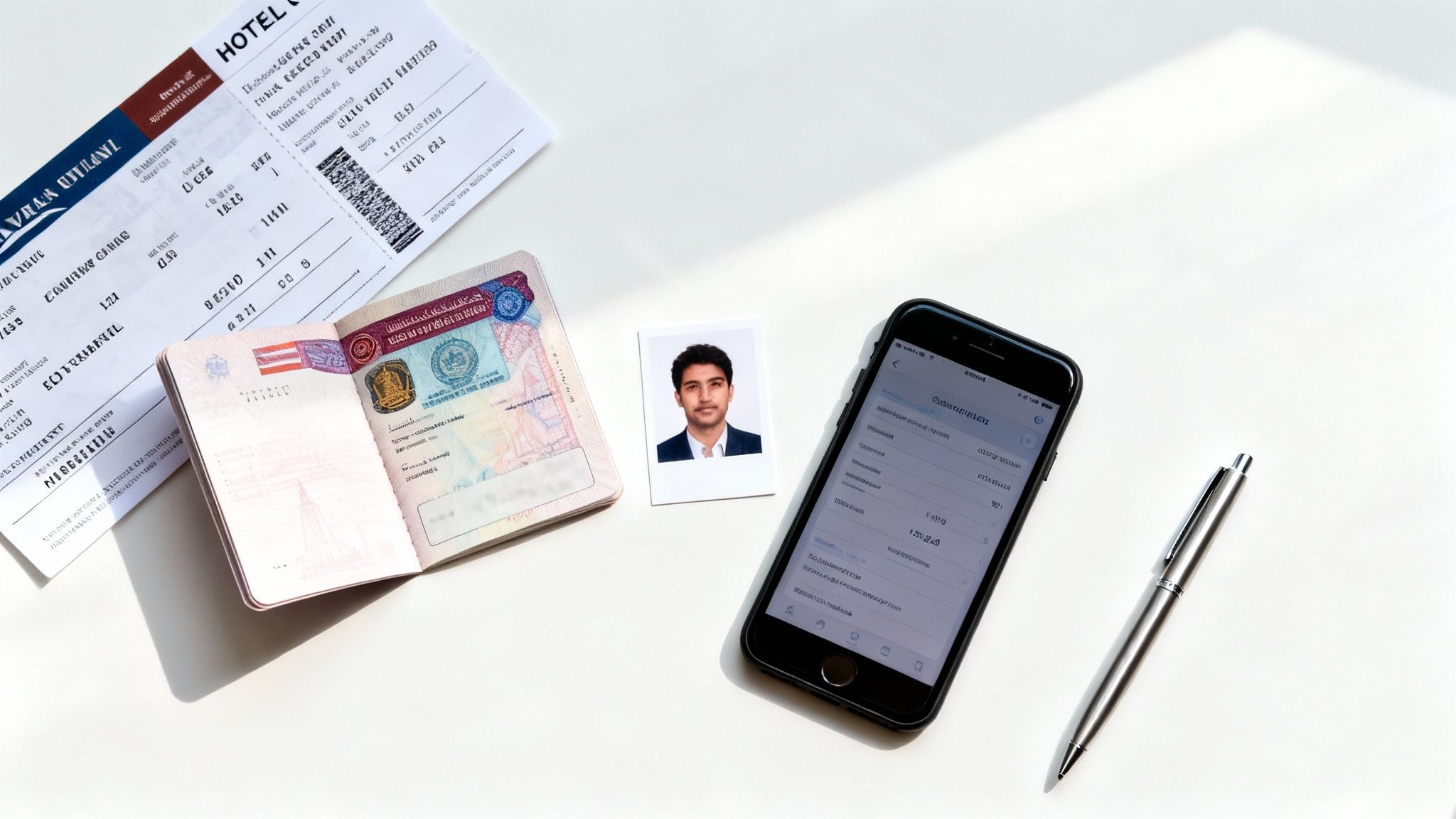
Core Application Documents
These three pieces are the foundation of your entire visa file. Immigration officials glance at these first to confirm who you are and if you meet the basic criteria.
- Color Passport Copy: You'll need a crisp, clear color scan of your passport's main information page. The most critical detail here is that your passport must be valid for at least six months from the day you plan to land in the UAE.
- Passport-Sized Photo: This needs to be a recent picture taken against a clean white background. Make sure it ticks all the boxes for standard passport photo rules—anything with colored backgrounds or odd shadows is an easy reason for rejection.
- Completed Application Form: Your sponsor—be it the airline, hotel, or a travel agency—will give you this form. Fill it out with total accuracy. Any little inconsistency can throw a wrench in the works.
Once you have these basics down, the next step is proving your trip is purely for tourism. That’s where your travel plans come into the picture.
Supporting Documents to Prove Your Intent
These documents show the authorities you've got a solid plan and the financial means to see it through. They're just as vital as your passport.
- Confirmed Flight Itinerary: You must provide a copy of your confirmed return flight ticket. This is their proof that you have a concrete plan to leave the UAE before your visa runs out.
- Proof of Accommodation: A confirmed hotel booking for your entire stay usually does the trick. If you're staying with family or friends, you'll likely need a copy of their Emirates ID and an official letter of invitation.
At the end of the day, a valid passport and confirmed accommodation are the two non-negotiables for any Dubai tourist visa application. Thankfully, the process has gotten much simpler. In fact, recent data shows that 45% of travelers are now choosing 30 or 60-day multiple-entry visas, a shift largely thanks to streamlined documentation for longer or more frequent stays.
If you're looking to get all your ducks in a row for the entire journey, it’s worth checking out a comprehensive travel planning checklist. It's a great resource to make sure nothing gets missed before you head to the airport.
How To Apply For Your Dubai Tourist Visa
Once you have all your documents in order, you’re ready for the main event: submitting your application. A common point of confusion for first-timers is that you don’t apply for a Dubai tourist visa directly with the immigration authorities. Instead, you need an official sponsor to handle it for you.
Think of these sponsors as different routes to the same destination—your approved e-visa. Choosing the right path comes down to what you value most: pure convenience, keeping costs down, or having personalized support every step of the way. The three most common sponsors are your airline, your hotel, or a dedicated travel agency.
Applying Through Your Airline
This is often the path of least resistance, especially if you’re flying with a UAE-based airline like Emirates or Etihad Airways. The entire process is baked right into your flight booking. It feels a lot like adding extra luggage or picking a seat—you just go into your online booking, and there’s an option to start your visa application and upload your documents.
What makes this route so convenient is that your flight details are already linked, creating a smooth, connected experience. After you submit everything and pay the fee, the airline’s visa team takes the wheel, submitting your application to the immigration authorities on your behalf.
Pro Tip: Going through your airline is a fantastic option if you’ve already booked your flights and are comfortable with a straightforward, self-service digital process. It’s fast, efficient, and keeps all your travel details neatly bundled together.
Using A Licensed Travel Agency Or Hotel
Another well-trodden path is to work with a licensed travel agency or have your hotel act as your sponsor. Agencies are brilliant if you want more hands-on support. This can be a lifesaver if your travel plans are a bit complicated or you just prefer having an expert to guide you through the dubai tourist visa requirements. They’ll double-check your documents, handle the forms, and manage all the back-and-forth with immigration.
If you’re still weighing your options, our detailed guide on the Dubai visit visa is a great resource to explore.
Similarly, many hotels in Dubai will sponsor a visa for guests who have a confirmed reservation. This is a great choice if you’ve already picked out where you’re staying. The hotel’s concierge or a dedicated visa desk will take care of the application for you.
For both agencies and hotels, the process generally looks like this:
- Initial Contact: You send over your travel details and the necessary documents.
- Document Review: They’ll check everything to make sure it’s up to official standards.
- Payment and Submission: Once you’ve paid the fees, they submit the application for you.
- Visa Delivery: As soon as it’s approved, the e-visa lands directly in your email inbox.
Ultimately, the "best" way to apply really depends on you. Airlines offer speed and integration, agencies provide expert guidance, and hotels deliver convenience tied directly to your stay.
Choosing The Right Dubai Visa Type And Cost
Picking the right Dubai visa is a bit like packing for a trip—you need to match your choice to your travel plans. Not all trips are the same, and Dubai’s visa system is designed with that flexibility in mind, offering different options for different kinds of visitors. Getting this right from the start means you’ll have the freedom you need without overpaying for it.
For most people planning a holiday, the standard 30-day and 60-day single-entry tourist visas are the go-to options. These are perfect for a straightforward vacation where you plan to enter and leave the UAE just once. They give you plenty of time to explore Dubai and the nearby emirates without feeling rushed.
This variety isn't accidental; it’s a core part of Dubai's strategy to welcome a huge number of visitors. With projections aiming for 22 million annual arrivals and visitor spending hitting AED 228.5 billion, the visa process has to be efficient. The dubai tourist visa requirements are designed to be clear, whether it's a simple 30-day visa for a short holiday or a 5-year multiple-entry visa for frequent, high-spending travelers. You can get more details about UAE's tourism growth on travelandtourworld.com.
Multiple Entry And Long Term Visas
Now, if you’re thinking of using Dubai as a home base to explore the region, a multiple-entry visa is a much smarter choice. Also available for 30 or 60 days, these visas let you leave and come back to the UAE as many times as you like within that period. It’s the ideal setup if your itinerary includes quick getaways to nearby spots like Oman or Bahrain.
This flowchart gives you a clear picture of the typical application paths, depending on whether you’re using an airline, a travel agency, or your hotel.
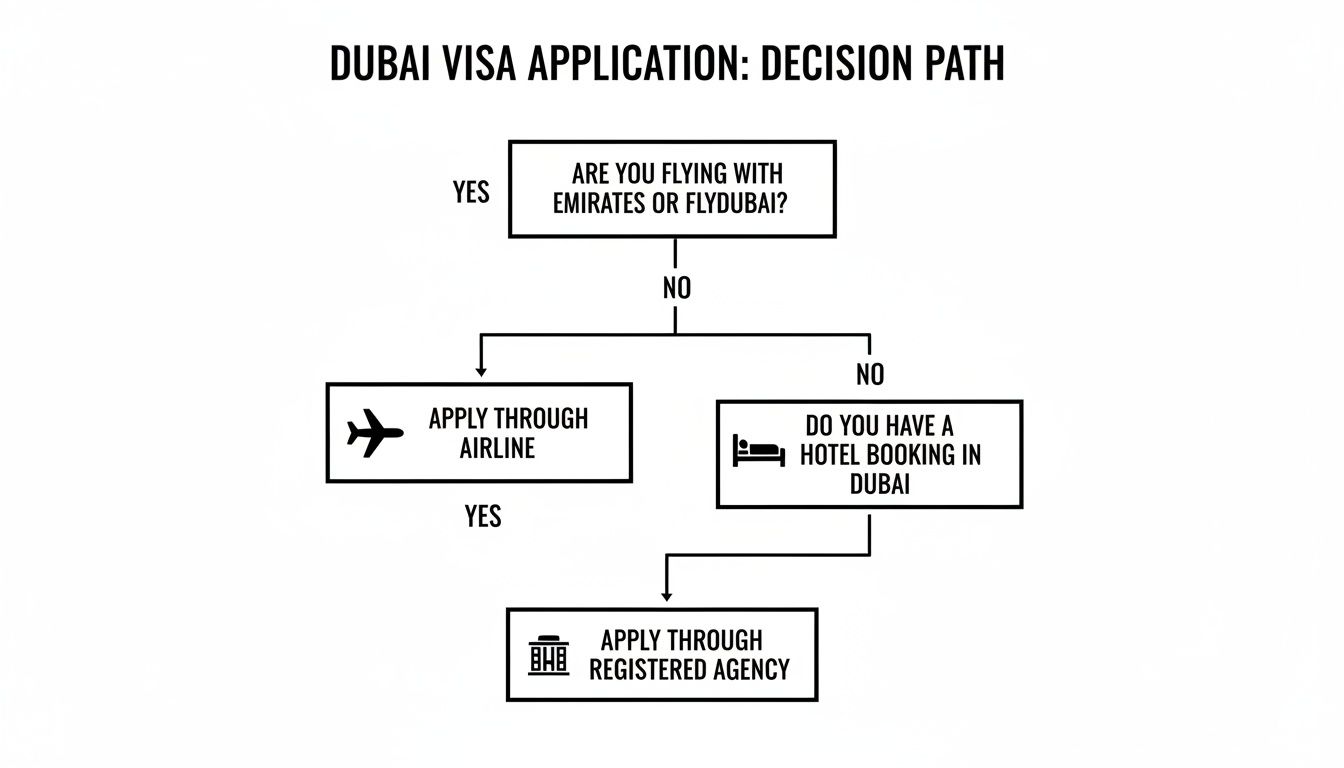
As the diagram shows, whoever your sponsor is—airline, hotel, or agency—they will be your main point of contact for submitting all the necessary documents.
For those who find themselves in Dubai often, whether for work or pleasure, the 5-year multiple-entry tourist visa is the best option by a mile. It lets you visit repeatedly over a five-year span, with each stay lasting up to 90 days. The eligibility requirements are a bit tougher, but for regular visitors, the convenience is unbeatable.
To help you see how these options stack up, here’s a quick comparison table breaking down the details of each visa.
Comparison Of Dubai Tourist Visa Options
| Visa Type | Duration of Stay | Entry Type | Estimated Fee Range (AED) | Best For |
|---|---|---|---|---|
| 30-Day Tourist Visa | Up to 30 days | Single Entry | 350 – 450 | Short holidays and single-trip vacations. |
| 60-Day Tourist Visa | Up to 60 days | Single Entry | 650 – 800 | Longer, more relaxed trips to explore multiple emirates. |
| 30-Day Multiple-Entry | Up to 30 days | Multiple Entry | 600 – 750 | Using Dubai as a base for short trips to nearby countries. |
| 60-Day Multiple-Entry | Up to 60 days | Multiple Entry | 1,000 – 1,500 | Extended regional travel with Dubai as a central hub. |
| 5-Year Multiple-Entry | Up to 90 days per visit | Multiple Entry | Varies Significantly | Frequent business travelers, property owners, and regular visitors. |
This table should make it easier to pinpoint the exact visa that fits your travel style and budget, ensuring you're all set for your trip to Dubai.
Common Application Mistakes And How To Avoid Them
Even with a process this clear, it's surprisingly easy to trip up. When you're applying for a Dubai tourist visa, tiny mistakes can lead to frustrating delays or, even worse, an outright rejection. The smartest way forward is to learn from the common slip-ups others have made, so your application sails through without a hitch.
Honestly, a huge number of rejections come down to simple document errors. A blurry scan of your passport's information page or a photo taken against a non-white background are two of the most frequent culprits. If officials can't clearly verify who you are, it's an immediate red flag.

Key Pitfalls And Pro Tips
To keep your application firmly on the right track, pay very close attention to these details. Each one is a classic reason for an application getting stuck or sent back.
- Passport Validity: This is a non-negotiable. Submitting a passport with less than six months of validity from your planned entry date is an automatic rejection. Check this before you even think about starting the form.
- Mismatched Information: Make sure the name on your application form is an exact match to what's in your passport. Even a single typo can throw a wrench in the works and cause major processing delays.
- Incorrect Visa Type: Planning a couple of short trips in and out of the UAE? Then don't apply for a single-entry visa. It’s a classic mistake that can completely disrupt your travel itinerary.
One of the biggest points of confusion is the difference between your visa's validity period and your allowed length of stay. Your visa might be valid for 60 days from the date it's issued, but that doesn't mean you can stay for 60 days. Your actual stay might be capped at 30 days from the moment you enter the country. Mixing these two up is the fastest way to accidentally overstay, which comes with some hefty penalties.
It’s absolutely vital to get the rules straight to avoid any trouble down the line. To get the full picture on the consequences, check out our detailed guide on the overstay fine in UAE.
By simply sidestepping these common errors, you can tackle the Dubai tourist visa requirements with confidence, knowing you've covered all your bases for a smooth, stress-free experience.
A Few More Questions You Might Have
Even with the clearest instructions, a few practical questions always pop up when you're in the middle of a visa application. It's completely normal. Let's tackle some of the most common ones we hear from travelers, so you can sort out those final details with confidence.
Think of this as the nitty-gritty stuff that comes to mind right when you think you have it all figured out.
Can I Extend My Dubai Tourist Visa?
Yes, you absolutely can. Most tourist visas can be extended twice, each time for an additional 30 days, without you ever having to leave the country. That gives you a potential 60 extra days to enjoy the UAE.
This is usually handled through official channels like the General Directorate of Residency and Foreigners Affairs (GDRFA) or an approved typing centre. Just keep in mind that you'll need to pay an extension fee for each renewal, so it's smart to factor that in if you think a longer stay is on the cards.
Is Travel Insurance Mandatory For A Dubai Visa?
This is a great question. While it's not always a strict requirement during the application itself, having valid travel and health insurance is highly recommended. For many nationalities, it's actually mandatory to have it when you arrive in Dubai.
Think of it as your essential safety net for any unexpected medical issues or travel hiccups. Some sponsors, like airlines, might bundle a basic insurance package with their visa service, but it's always a good idea to double-check the coverage details yourself.
Comprehensive insurance isn’t just about ticking a box; it’s about ensuring peace of mind. A medical emergency abroad can get expensive, fast. Proper coverage protects you from a huge financial headache during your trip.
How Long Does It Take To Get A Dubai Tourist Visa?
Processing times can shift a bit depending on who you apply through and how busy they are. But as a general rule, here’s what you can expect:
- Standard Processing: This typically takes anywhere from 2 to 5 working days.
- Express Service: If you're in a hurry, most sponsors offer an express option for an extra fee. This can get your e-visa approved in as little as 24 to 48 hours.
To keep things stress-free, our best advice is to apply at least one or two weeks before you plan to fly.
What Happens If My Visa Application Is Rejected?
It’s rare, but it can happen. If your application is rejected, the visa fees are usually non-refundable. More often than not, rejections are due to simple mistakes—things like a blurry passport scan, a typo on the form, or a history of overstaying a previous UAE visa.
Your first move should be to get in touch with your sponsor (the airline, hotel, or agency that handled the application). They can often provide some insight into why it was rejected and let you know if you can fix the issue and reapply.
Getting your visa sorted is the first big step toward an incredible Dubai adventure. For entrepreneurs and investors thinking about a more permanent move, Al Ain Business Center provides expert help with business setup and long-term visa solutions. Find out more at https://alainbcenter.com.