
Figuring out the exact Dubai mainland company formation cost can feel a bit like trying to hit a moving target. Generally, you're looking at a ballpark figure between AED 15,000 to AED 35,000. This gets your foot in the door, covering the essential government fees and initial paperwork. But—and this is a big but—that's just the starting line. The final number really depends on the path you choose for your business.
What Is the Real Cost to Start a Mainland Business in Dubai?
Trying to pin down the total cost of a Dubai mainland company is a bit like putting together a custom-built car. You have the base price, but the final cost is all in the options you select. It’s less about a single price tag and more about understanding the three core financial pillars that will make up your total budget.
Each of these pillars is a significant part of the overall Dubai mainland company formation cost. What you decide in one area has a direct knock-on effect on the others, so it’s crucial to see them as interconnected pieces of the same puzzle.
The Three Core Cost Pillars
To get a truly accurate financial picture, you need to break it down into these three key areas:
- Business Licence Fees: This is your non-negotiable government fee to operate legally. The cost here varies widely based on your business activity. A simple professional services licence, for instance, will cost less than a commercial trading licence that might need extra approvals from different authorities.
- Visa and Immigration Expenses: Don't forget the people! The number of investor or employee visas you need will add a substantial amount to your budget. Every single visa comes with its own string of costs—application fees, medical tests, Emirates ID processing—and they all add up quickly.
- Office Space and Ejari: A physical, registered address is a must-have for any mainland company in Dubai. Whether you opt for a budget-friendly flexi-desk or a private office, the annual rent is a major cost. This lease must be registered through the Ejari system, making it a key part of both your setup and ongoing expenses.
To give you a clearer idea, here's a quick look at how these costs can break down.
Estimated Breakdown of Dubai Mainland Setup Costs
This table provides a quick overview of the primary cost components and their estimated ranges, giving you an immediate sense of the financial commitment.
| Cost Component | Estimated Cost Range (AED) |
|---|---|
| Trade Licence & Name Approval | 10,000 – 15,000 |
| Local Sponsor/Service Agent | 5,000 – 15,000 (Annual) |
| Investor/Partner Visa | 3,500 – 5,000 (Per Person) |
| Establishment Card | 2,000 – 2,500 |
| Office Rent (Ejari) | 5,000 – 25,000+ (Annual) |
| Miscellaneous Fees | 1,000 – 3,000 |
Keep in mind, these are estimates. Your final costs will depend entirely on your specific business needs and choices.
A huge mistake people make is thinking the licence fee is the full story. It’s not. The licence is just the beginning. The real cost comes to light when you add in the mandatory office lease and the visas for yourself and your team, which can easily double that initial figure.
Getting a handle on these elements is your first step to building a realistic budget. It also helps to see how mainland stacks up against other options. If you're weighing your choices, our guide on Free Zone vs Mainland Dubai breaks down the financial differences in more detail. As a rule of thumb, experts often quote the AED 15,000 to AED 35,000 range for a Dubai Mainland company, but it's the variables like licence type and visa requirements that truly define the final investment.
Breaking Down Your Initial Government and Licensing Fees
Alright, let's get into the nitty-gritty of your Dubai mainland company formation cost. The first major hurdle is understanding the initial government and licensing fees. Think of these as the foundational costs—the non-negotiable payments you have to make to legally exist as a business in Dubai. You simply can't open your doors without settling these first.
These aren't just random numbers plucked out of thin air. Each fee pays for a specific administrative action by government bodies, mainly the Department of Economy and Tourism (DET), to get your company registered, approved, and officially on the books.
This whole first stage is really about getting your trade licence, which is made up of several smaller payments. Let's pull back the curtain on what they are and why they matter.
To give you a clearer view of where this money goes, the diagram below breaks down the three pillars of your total setup budget.
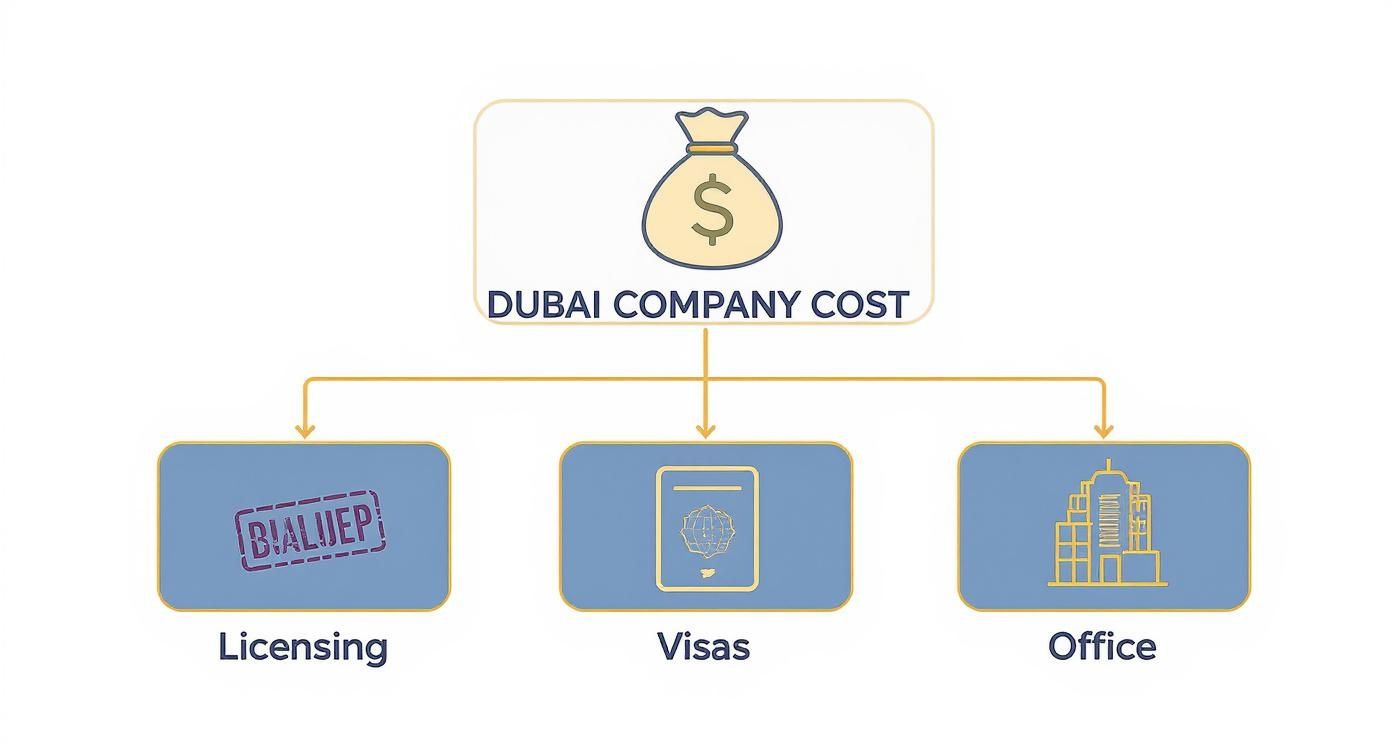
As you can see, the licence is the first big piece of the puzzle, right alongside the costs for your visa and office space.
Core Government Fees You Cannot Avoid
Before that shiny new trade licence is in your hands, you'll need to pay for a series of approvals and registrations. These are handled one after the other and make up most of what you'll see on an initial quote from any business setup consultant.
-
Trade Name Reservation: This is where it all begins. You need to reserve your company’s name to make sure it's unique and follows the UAE’s naming rules. The fee is usually around AED 620, but this can creep up if you're using foreign words or a name that isn't in Arabic.
-
Initial Approval Certificate: This is the DET’s first nod of approval. It’s their way of saying they have no objections to your business idea and the people behind it. This certificate gives you the green light to move on to the next steps, like getting your legal documents drafted. Expect this to cost about AED 250.
Think of these as crucial checkpoints. Once they're cleared, you're officially on the government's radar and ready to push forward.
The Main Event Your Trade Licence Fee
The biggest single government cost is the trade licence itself. But here’s the thing: there's no flat rate. The price tag depends entirely on what your business actually does. The DET groups licences into three main types, and each has its own cost structure.
- Commercial Licence: This is for any business that’s trading, buying, or selling goods. It's often one of the pricier licences because of the wide range of activities it allows.
- Professional Licence: Tailored for service-based businesses, consultants, artists, and other professionals. The base fee for this one is typically lower than a commercial licence.
- Industrial Licence: If you’re manufacturing, producing, or assembling anything, this is the one for you. These often come with extra approvals from other ministries, which can bump up the final cost.
The licence you choose is the single biggest driver of your government fees. A simple consulting business will have a much lower upfront cost than a sprawling general trading company. For a deeper dive into how trading activities impact your budget, check out our guide on the https://alainbcenter.com/dubai-trading-license-cost/.
Your business activity is the DNA of your company licence. It dictates not only the licence type but also whether you need approvals from other government bodies, each of which adds another layer of cost.
A perfect example is a medical clinic, which needs a sign-off from the Dubai Health Authority (DHA). Or a school, which needs clearance from the Knowledge and Human Development Authority (KHDA). These external approvals all come with their own separate fees.
Other Mandatory Government-Related Costs
Beyond the main licence fee, a few other charges will pop up on your final bill from the government. You'll see these itemised on any good setup quotation, and they're all required for you to be fully compliant.
- Memorandum of Association (MOA) Attestation: If you’re setting up an LLC, your MOA needs to be professionally drafted and legally attested. There are notary fees tied to this essential legal document.
- Market Fees: This is an ongoing fee, calculated as a small slice of your office's annual rent. You pay it to the DET when you get your licence and every time you renew it.
- Administrative and Service Charges: These are the smaller, miscellaneous fees for various government services, like using Tasheel or Amer centres to process your paperwork.
While these costs are specific to Dubai, it's always useful to see the bigger picture. For a wider view on the types of costs involved in setting up a company, this article on general company incorporation fees offers a great perspective.
By breaking down each of these government charges, you can look at any setup quote with confidence and build a solid budget for the foundational part of your Dubai mainland company formation cost.
Navigating the Mandatory Office Space Requirement
Setting up a company in mainland Dubai isn't just about paperwork; it's about putting down physical roots. A registered physical address is a legal cornerstone of your entire business, a non-negotiable requirement that plays a huge role in your initial and ongoing Dubai mainland company formation cost. Think of it as the foundation of your company's legitimacy, directly impacting your budget and visa eligibility.
Unlike many places where a simple virtual address will do, Dubai's mainland authorities insist on a tangible office. This isn't just a suggestion; it's enforced through Ejari, the official online registration platform for all tenancy contracts. Simply put, no registered Ejari means no trade licence. It’s a dead end.
So while you might see a starting formation cost around AED 25,000, that figure doesn't cover the annual lease for a physical office, which must be at least 20 square metres. It's a critical, recurring cost that you absolutely have to bake into your financial planning from day one.
Your Office Options From Budget-Friendly to Bespoke
The good news? "Mandatory office" doesn't automatically mean a huge, expensive corporate suite. The authorities get it. They've made room for a whole spectrum of solutions to fit different business sizes, stages, and budgets.
Choosing your office is a strategic move, balancing cost against location and your company's visa needs. Here are the main routes you can take:
-
Flexi-Desks and Co-Working Spaces: This is the smartest, most cost-effective way to get a valid Ejari. Renting a desk in a registered business centre ticks the legal box for a fraction of what a private office costs. It’s perfect for solo entrepreneurs, consultants, and lean startups needing a legitimate address without the heavy overhead.
-
Serviced Offices: Need a bit more privacy? A serviced office is the next step up. You get a private, furnished workspace inside a business centre, usually with shared amenities like a receptionist, meeting rooms, and utilities all bundled into one monthly fee. It projects a professional image while keeping things flexible.
-
Traditional Private Offices: For established businesses that need more space, control, and privacy, leasing your own dedicated office is the way to go. This gives you total autonomy over your environment but comes with higher annual rent and the responsibility of handling utilities and furnishings yourself.
How Location Dictates Your Rental Costs
It’s no surprise that your office lease cost is tied directly to its postcode. A prestigious address in a prime commercial hub will always carry a higher price tag than a similar-sized space in a less central area. Getting a handle on these geographical price differences is key to keeping your budget in check.
Choosing your office location is a critical financial decision. A small office in Business Bay might cost the same as a much larger one in Deira. You must align your location with your brand, budget, and operational needs, not just prestige.
Here's a quick look at how annual rental costs can differ across popular Dubai mainland business hubs:
| Business District | Best For |
|---|---|
| Business Bay | Consultants, tech firms, and corporate HQs seeking a central, prestigious address. |
| Deira | Trading companies, retail businesses, and startups looking for affordable, high-traffic commercial spaces. |
| Sheikh Zayed Road | Financial services, law firms, and international companies wanting high visibility and excellent connectivity. |
| Al Quoz | Industrial services, logistics companies, and businesses needing warehouse or workshop space. |
For entrepreneurs just getting their feet wet, options like flexi-desks are a brilliant way to satisfy the legal requirements without a massive financial outlay. In fact, many business centres now offer packages that feel like a virtual office but crucially come with that all-important legitimate Ejari. You can learn more about these agile setups in our guide to getting a virtual office in Dubai. This approach lets you secure your licence and visas while keeping your initial Dubai mainland company formation cost as low as possible.
Calculating Your Visa and Immigration Expenses
Once your business licence and office are sorted, the next big piece of your Dubai mainland company formation cost is bringing your people on board. Your team is your most valuable asset, of course, but each investor and employee visa comes with its own set of expenses. It's really important to budget for these on a per-person basis so you don't get caught out by surprise costs down the line.
Think of getting a visa as a multi-step project, not a one-off purchase. Each stage, from the initial application right through to the final stamp in the passport, has a government fee attached. Getting your head around this process is the key to accurately forecasting your costs as you start to grow your team.
The Anatomy of a Single Visa Cost
Whether it’s for an investor or an employee, every residence visa follows a pretty similar path with mandatory steps. And yes, each of these steps has a price tag that adds to the total bill for one person. Tally these up, and you'll have a solid per-visa cost estimate you can rely on.
Here are the main components you’ll be paying for with every single visa application:
- Establishment Card: Before you can sponsor anyone, your company needs an Establishment Card. Think of it as opening your company's file with the immigration authorities. It's a one-time fee, usually around AED 2,000, that gets you in the system.
- Entry Permit: This is the first green light, giving the person permission to enter the UAE for work or investment. The fees can differ slightly depending on whether they're inside or outside the country when you apply.
- Change of Status (if applicable): If your new hire is already in the UAE on a tourist visa, this fee lets you switch their status to a residence permit without them needing to fly out and back in.
- Medical Fitness Test: Every applicant has to go through a medical screening for certain communicable diseases. The cost varies based on how quickly you need it done—the standard service is the most budget-friendly.
- Emirates ID Application: This is for the mandatory identity card for all residents. The fee covers the application and the process of capturing their biometric data.
- Visa Stamping: The grand finale! This is the last step where the residence visa is physically stamped into the passport.
All in, a typical investor or employee visa will land somewhere between AED 3,500 and AED 5,000 per person once you've added up all these separate government charges.
Linking Your Office Space to Your Team Size
This is where your earlier decision on office space comes back into play and directly affects your hiring plans. The Dubai mainland authorities use your office size to figure out your visa quota—that’s the maximum number of employees you’re allowed to sponsor. It’s a practical rule to make sure companies actually have enough workspace for their staff.
As a general rule of thumb, the government allocates one visa for every 8 to 10 square metres of office space.
Your Ejari is more than just a lease agreement; it's a gatekeeper for your team's growth. A small office might meet the minimum legal requirement for your licence, but it will severely limit your ability to hire. Plan your space based on your projected headcount, not just your immediate needs.
This system creates a direct link between what you spend on rent and how big your team can get. For instance, a small flexi-desk setup might only get you one or two visas. But if you secure a 100-square-metre private office, you could potentially sponsor up to 12 employees, giving you much more room to expand.
Forecasting Your Total Visa Budget
To put together a realistic budget, you just need to multiply your estimated per-visa cost by the number of partners and employees you plan to bring on in your first year. It’s a simple bit of maths that turns a vague "people cost" into a concrete number you can plan around.
Let's walk through a quick example:
- Founder/Investor Visa: 1 x AED 4,500 = AED 4,500
- Initial Employee Visas: 3 x AED 4,000 = AED 12,000
- Establishment Card Fee: 1 x AED 2,000 = AED 2,000
In this scenario, your total initial immigration expense would be AED 18,500. By forecasting this, you ensure the human element of your Dubai mainland company formation cost is fully covered right from the very start.
Uncovering Hidden Fees and Strategic Investments
That first quote you get for your Dubai mainland company formation cost? It's a great starting point, but it's rarely the full story. Think of it like the sticker price on a new car; it gets you the basic model, but the features that make it road-ready and the long-term running costs are what really define your total investment. Far too many entrepreneurs get caught by surprise by these extras, which can throw a well-planned budget completely off course.
To build a financial plan that can actually weather the setup process, you have to look beyond the headline figures for your licence and visas. This means factoring in the services that make the process go smoothly and the essential costs that come after you get your licence. These aren't just optional add-ons; they're critical investments to make sure your business launches on solid, compliant ground.
The Essential Role of PRO Services
Trying to navigate Dubai's government departments on your own can be a real headache. You're dealing with multiple offices, specific documentation in Arabic, and strict submission rules. This is exactly where Public Relations Officer (PRO) services shift from being a simple cost to a priceless strategic investment.
Going it alone often leads to expensive mistakes, frustrating delays, and a whole lot of wasted energy. A good PRO team is your expert guide, handling all the government legwork so you don't have to.
Think of PRO services as your company's diplomatic corps. They speak the language of government departments, understand the unwritten rules, and keep your paperwork moving through the system—saving you from a logistical nightmare.
A professional PRO firm will take care of everything from immigration and labour filings to document clearing and attestations. Yes, it adds to your initial outlay, but the return is huge. You get back your time, avoid hefty fines, and gain the peace of mind that everything is being done correctly. This service is a non-negotiable part of a realistic Dubai mainland company formation cost.
Navigating Third-Party and External Approvals
Depending on what your business actually does, you might need a green light from authorities other than just the Department of Economy and Tourism (DET). Many specialised fields require approvals from their own governing bodies, and each one comes with its own fees and application hoops to jump through.
Forgetting to budget for these can bring your setup to a screeching halt. It's vital to figure out if you need any of these early in the game.
Here are a few common industries that require external approvals:
- Healthcare: Any business in the medical field, from a small clinic to a pharmaceutical trader, will need approval from the Dubai Health Authority (DHA).
- Education: If you're setting up a school, training institute, or even an educational consultancy, you'll need a nod from the Knowledge and Human Development Authority (KHDA).
- Engineering and Construction: These fields require approvals from Dubai Municipality and often the Society of Engineers.
- Food and Beverage: Restaurants, cafes, and food trading businesses must get permits from the Food Safety Department of Dubai Municipality.
Each of these approvals has its own price tag, which can run anywhere from a few hundred to several thousand dirhams. Building these costs into your budget from day one means no nasty financial surprises later on.
Critical Post-Setup Financial Planning
Getting your trade licence is a massive win, but you're not at the finish line just yet. To legally operate, open for business, and hire staff, you need to tick a few more boxes—and they all have costs attached. These post-licence expenses are a fundamental part of your total setup investment.
The two biggest post-setup steps are getting a corporate bank account and registering for Value Added Tax (VAT).
1. Corporate Bank Account Assistance
Opening a corporate bank account in the UAE isn't always straightforward. Banks have very strict due diligence and compliance checks. Many entrepreneurs find they need professional help to get it done. This service typically involves getting your documents in perfect order, helping you pick the right bank for your business, and coaching you through the compliance interviews.
2. VAT Registration and Compliance
If you expect your company's annual turnover to be more than AED 375,000, you are legally required to register for VAT with the Federal Tax Authority (FTA). While the registration itself is free, many businesses hire a professional to make sure it's done right. A small investment here can save you from big fines for non-compliance down the road.
By accounting for these so-called "hidden" fees and strategic investments, you elevate your budget from a simple estimate to a comprehensive financial strategy. This 360-degree view ensures your Dubai mainland company formation cost covers every angle, setting your business up for a smooth and successful launch.
How to Optimise Your Setup Budget Without Cutting Corners
Knowing all the individual costs is one thing, but making those costs work smarter for you is where the real magic happens. Optimising your Dubai mainland company formation cost isn’t about taking risky shortcuts. It's about making sharp, strategic decisions from day one that give you the most bang for your buck without messing with compliance or your long-term vision.
Think of it like packing for a big trip. You can't just leave your passport behind, but you can definitely choose multi-purpose gear and pack it efficiently to save space and weight. It's the exact same logic here—every choice you make creates a financial ripple effect down the line.
Choose Your Business Activities Wisely
One of the quickest ways to get your budget under control is by being smart about your business activities. Some activities, especially in fields like healthcare or education, demand pricey and time-consuming external approvals from bodies like the Dubai Health Authority (DHA).
By picking activities that fall squarely under the Department of Economy and Tourism (DET), you can completely sidestep these extra third-party fees. This one decision alone can save you thousands of dirhams and weeks of bureaucratic headaches, clearing your path to getting that licence much faster.
Embrace Smart Office Solutions
The mandatory office requirement can feel like a massive financial hurdle, but it doesn't have to break the bank. Instead of locking yourself into a lease for a big, traditional office right away, you can take a more agile approach that still ticks all the legal boxes for your Ejari.
- Flexi-Desks: These are your most budget-friendly friends. A flexi-desk in a registered business centre not only secures your Ejari but often makes you eligible for one or two visas. It’s the perfect setup for solo entrepreneurs or tiny startups.
- Serviced Offices: Need a bit more privacy but aren't ready for a long-term lease? A serviced office gives you a professional space with utilities and amenities all bundled in, which keeps your monthly overheads nice and predictable.
This strategy lets you meet the legal need for a physical address while keeping your initial and yearly rental costs at a bare minimum. You can always level up to a bigger space once your team and revenue start growing.
An expensive office doesn't guarantee success, but a smart office solution guarantees compliance without draining your startup capital. Focus on what you need to operate legally, not what looks impressive on day one.
Bundle Services with a Reputable Firm
Trying to DIY your company setup by hiring different people for your licence, visas, and legal paperwork can get complicated and expensive, fast. A much better move is to partner with a single, reputable business setup consultancy that offers everything in one package.
These all-in-one solutions usually cover:
- Trade licence processing
- Investor and employee visa applications
- Establishment card registration
- Help with opening a corporate bank account
Good firms have the relationships and streamlined processes to offer these bundled services at a much better price than if you paid for each piece separately. This doesn't just optimise your Dubai mainland company formation cost; it also saves you a huge amount of time and stress, ensuring your new business has a smooth, coordinated launch.
Your Questions Answered
When you're looking at the numbers for a Dubai business setup, a lot of questions can pop up. Let's tackle some of the most common ones to help you get a crystal-clear picture of the financials involved.
Can a Foreigner Really Own 100% of a Mainland Company?
Yes, they absolutely can. Following some game-changing legal updates, foreign investors can now hold 100% ownership of their mainland business for the vast majority of activities. This is a huge shift from the old rules, where a UAE national partner was required to hold a majority stake. Now, you get full control of your business and its profits, no local sponsor needed.
What’s the Most Budget-Friendly Mainland Licence to Get?
If you're looking for the most cost-effective entry point, the Professional Licence is usually your best bet. This licence is tailor-made for consultants, artisans, and other service-based professionals. Since you're not trading in physical goods, the associated government fees tend to be quite a bit lower than what you'd see for a Commercial or Industrial Licence.
How Much Should I Budget for the Annual Licence Renewal?
There isn't a single, fixed fee for renewing your licence each year. Instead, it’s a sum of a few different costs. The main components are the standard government service fees and something called a "market fee." This market fee is calculated as a small percentage (typically around 2.5%) of the annual rent for your office space. So, the more you pay for your office lease, the higher your renewal cost will be.
The single biggest factor influencing your yearly renewal fee is your office. A pricier Ejari (your registered tenancy contract) means a higher market fee, which directly bumps up your annual operating costs.
Does a Mainland Company Have to Pay Tax in Dubai?
Yes, but it's structured in a way that’s incredibly supportive of new and growing businesses. The UAE introduced a Corporate Tax of 9%, but here's the crucial part: it only kicks in for profits above AED 375,000 per year. If your annual profit falls below that threshold, your effective tax rate is 0%. This makes it one of the most attractive tax environments in the world for startups and SMEs.
Ready to stop guessing and get a clear, predictable budget for your business launch? The team at Al Ain Business Center is here to give you a detailed quote with no hidden surprises, custom-built for your specific needs. Let's make your Dubai mainland company formation smooth and affordable. Find out your exact setup costs by getting in touch with us at https://alainbcenter.com.