
The cost of a Dubai business license isn't a single, fixed number. It can be as low as AED 5,750 for a straightforward free zone package or climb past AED 50,000 for a more complex mainland company that needs physical office space. The final figure you'll pay comes down to your specific business type, where you choose to set it up, and how many visas you need.
This guide will break down every fee you'll encounter so you can build a budget that reflects reality, not just the advertised price.
Decoding Your Initial Investment

The first step in understanding the cost is realising the advertised price is just the starting point. Think of it like buying a car—there's the base price, but the leather seats, bigger engine, and sunroof all add to the final invoice. Setting up your business works the same way.
The initial fee you see is usually just for the core license itself. To get the full picture of your first-year expenses, you have to factor in several other critical components that build up your total budget.
The Core Cost Factors
Your journey begins with a few key decisions, and each one has a direct impact on your wallet. The most important choices you'll make are:
- Jurisdiction: Will you set up on the Mainland, giving you access to the entire UAE market, or in a specialised Free Zone, which offers perks like 100% ownership and tax advantages? This is the biggest single driver of your total cost.
- Business Activity: A professional services license for a consultant is almost always less expensive than a commercial trading license. The nature of your work directly influences the complexity and fees involved.
- Visa Requirements: How many residence visas will you and your team need? Every single visa adds costs for processing, medical tests, and the Emirates ID.
Despite these variables, setting up a business in Dubai has become incredibly competitive compared to other global hubs. For instance, base license fees at a free zone like the Dubai South Business Hub can start as low as AED 12,500.
When you add in one-time registration fees of around AED 9,000 for document processing, many basic setups can be launched for under AED 35,000 in the first year, not including visas. It’s this competitive pricing that continues to make Dubai such an attractive place to do business.
To give you a clearer idea, here's a quick look at what you can expect to pay for different types of setups in the first year.
Estimated First-Year Cost for a Dubai Business License at a Glance
This table summarises the typical cost ranges for different business setups, helping you quickly identify the bracket your venture might fall into.
| Setup Type | Estimated Initial Cost Range (AED) | Best For |
|---|---|---|
| Basic Free Zone (0-1 Visa) | AED 15,000 – AED 25,000 | Solopreneurs, freelancers, and small consultancies. |
| Standard Free Zone (2-3 Visas) | AED 25,000 – AED 40,000 | Small teams, startups, and service-based companies. |
| Mainland Professional License | AED 30,000 – AED 45,000 | Consultants, professional service providers, and local market access. |
| Mainland Commercial License | AED 40,000 – AED 60,000+ | Businesses involved in trading, import/export, and retail. |
Keep in mind these are estimates. Your final costs will depend on the specific free zone or mainland authority, your office requirements, and any additional government approvals your business activity might need.
Choosing Between a Mainland and Free Zone License
The single biggest decision you'll make, the one that steers the entire cost of your Dubai business license, is where you set up shop. Will you be on the Mainland, with direct access to the entire UAE market, or inside a specialised Free Zone? This isn't just about picking a location; it’s a strategic fork in the road that defines your costs, your market, and how you're allowed to operate.
Let’s break it down with an analogy.
A Mainland license is like opening a flagship store on a bustling city high street. You can sell to anyone and everyone walking by, trade directly with other local businesses, and even bid on big government contracts. But, as you'd expect, that prime real estate comes with a higher price tag and a bit more paperwork to get started.
On the other hand, a Free Zone license is more like running a slick, efficient e-commerce warehouse. Your operations are streamlined, your overheads are much lower, and you get great perks like 100% foreign ownership without needing a local partner. The catch? You're generally limited to selling within your zone or to international customers, not directly to the man on the street in the UAE.
The Mainland Advantage: Market Access at a Price
Setting up on the Mainland, usually as a Limited Liability Company (LLC), puts you right in the heart of the thriving UAE economy. It's the go-to choice for businesses in retail, local trading, construction, or any service that needs a physical presence across Dubai and the other Emirates.
The price of a Mainland license reflects this incredible access. The main costs you need to budget for are:
- Higher License Fees: The fees from the Department of Economy and Tourism (DET) are typically a step up from what you'd find in a free zone.
- Mandatory Office Space: You can't get around this one. A physical office with a registered tenancy contract (known as an Ejari) is a must. This adds rental costs plus a 2.5% market fee calculated from your annual rent.
- Local Service Agent (LSA): While most business activities now allow 100% foreign ownership, some professional licenses (like consultancies) still require a UAE national as a Local Service Agent. This is a fixed annual fee, usually falling between AED 5,000 and AED 15,000, that becomes a recurring operational cost.
When you add it all up, the total cost for a Mainland license is naturally higher, often starting from around AED 30,000 and climbing depending on your office and specific business activity.
The Free Zone Alternative: Cost-Efficiency and Simplicity
Dubai has over 40 free zones, each a mini-ecosystem tailored for specific industries—think tech hubs, media cities, and global commodity centres. It's an incredibly popular model for startups, international traders, and consultants because it’s both affordable and straightforward.
The real beauty of a Free Zone is its packaged, clear-cut pricing. You can get a full setup—license, registration, and visa eligibility—for a fraction of a Mainland company's cost. In fact, some of our entry-level packages start from just AED 5,750.
The financial benefits are hard to ignore. Free zones strip away many of the cost barriers you'd face on the mainland. For a much deeper dive, check out our complete guide comparing Free Zone vs Mainland Dubai.
Here’s where you really save with a free zone:
- No Physical Office Requirement (at first): Most free zones offer budget-friendly flexi-desk or co-working options. This ticks the box for having a physical address without the heavy financial burden of a full-time office lease.
- Bundled Packages: Costs are usually presented as all-in-one packages. They’ll cover your registration, license, and often your first visa eligibility for one fixed annual fee, making your budget predictable and easy to manage.
- 100% Foreign Ownership: This is standard across all free zones, meaning you completely avoid the need and the recurring cost of a Local Service Agent.
So, how do you choose? It all comes back to your business model. If your goal is to directly serve the local UAE market, the higher cost of a mainland license is a necessary investment. But if your business is focused on international clients, remote services, or you simply need a cost-effective launchpad in the region, the free zone is by far the smarter and more efficient path forward.
Decoding Every Fee and Charge in Your Business Setup
When you start looking into the real Dubai business license cost, it quickly becomes clear that the sticker price is just the beginning. Think of it like buying a car—the base model price is attractive, but you still need to account for registration, insurance, and other essentials to actually get it on the road. Your business setup is much the same, with several mandatory fees that all add up to your final investment.
This section is all about peeling back the layers. We'll break down every single charge, both the one-time payments and the recurring annual fees, so you can build a realistic budget and sidestep any nasty surprises down the line.
The first major decision you'll make, and the one that steers your entire cost structure, is choosing between a Mainland and a Free Zone setup.

As you can see, your journey starts here. Each path comes with its own distinct fee structure and unique set of benefits.
Your One-Time Setup Costs
These are the upfront, non-refundable government and administrative fees needed to get your company legally off the ground. You pay them once, and you’re set—unless, of course, you decide to make major changes to your business down the track.
- Initial Approval Fee: This is your first official step. You'll pay a small fee, usually around AED 150 – AED 500, for the authorities to give your proposed business idea the green light.
- Trade Name Reservation Fee: Every business needs a unique identity. This fee, typically AED 620 – AED 900, secures your chosen company name and makes sure it follows all UAE naming rules.
- Memorandum of Association (MoA) Attestation: If you're setting up an LLC or partnership, think of the MoA as your company's constitution. Getting this vital document notarised and legally attested can cost anywhere from AED 800 to AED 2,000.
- Establishment Card: This is essentially your company's immigration file. It’s a one-time registration that allows your business to start applying for visas, and it generally costs between AED 1,500 and AED 2,500.
Think of these as the gatekeeper fees. They have to be settled before your main license is even issued.
Annual and Recurring Costs
Once you're up and running, there are annual costs to keep your business compliant and in good standing. It's crucial to factor these into your long-term budget right from the start.
The biggest recurring cost you’ll face is the trade license fee itself. This is the core annual payment to the government that gives you the legal right to operate. It must be renewed every single year to avoid penalties.
But it doesn't stop there. Other major recurring expenses include:
- Office Space or Tenancy Contract (Ejari): Every business in Dubai needs a registered physical address. For mainland companies, this means leasing an office and registering the tenancy contract (Ejari). In a free zone, this is often a much more affordable flexi-desk or co-working space that comes as part of your package.
- Local Service Agent (LSA) Fee: If you have a professional license on the mainland, you're required to have a UAE National Service Agent. This involves a fixed annual fee, usually negotiated somewhere between AED 5,000 and AED 15,000.
- Chamber of Commerce Membership: For any business operating on the mainland, membership with the Dubai Chamber of Commerce is mandatory and includes an annual fee.
Getting your head around these differences is key, as the total trade license Dubai cost can swing wildly based on these factors.
Visa and Immigration Expenses
One of the huge draws of setting up a business in Dubai is the ability to get residency. But each visa comes with its own price tag. These costs are calculated per person and are vital for investors, partners, and any staff you plan to bring on board.
The visa process itself has a few stages, each with its own fee:
- Entry Permit Application: The first step to bring someone into the country for residency.
- Medical Fitness Test: A mandatory health check for all prospective residents.
- Emirates ID Application: The national identity card for everyone living in the UAE.
- Residency Visa Stamping: The final step, where the visa is physically placed in the passport.
When you pull it all together, the costs can vary dramatically. For example, a standard commercial license from the DED can run between AED 15,000 and AED 25,000 annually, while professional licenses are often more affordable at AED 10,000 to AED 15,000. Then you have to layer on the smaller, but mandatory, add-ons like commercial registration (AED 600), MoA attestation (AED 800-2,000), and various knowledge or innovation fees (AED 100-200).
And don't forget the people. Visa costs add another layer, with employee visas costing around AED 3,500 and investor visas hitting closer to AED 4,000. By understanding how each of these components—from the big-ticket license fee to the smaller administrative charges—fits together, you can build a budget that truly reflects the real cost of doing business here.
Real-World Cost Scenarios for Different Business Types
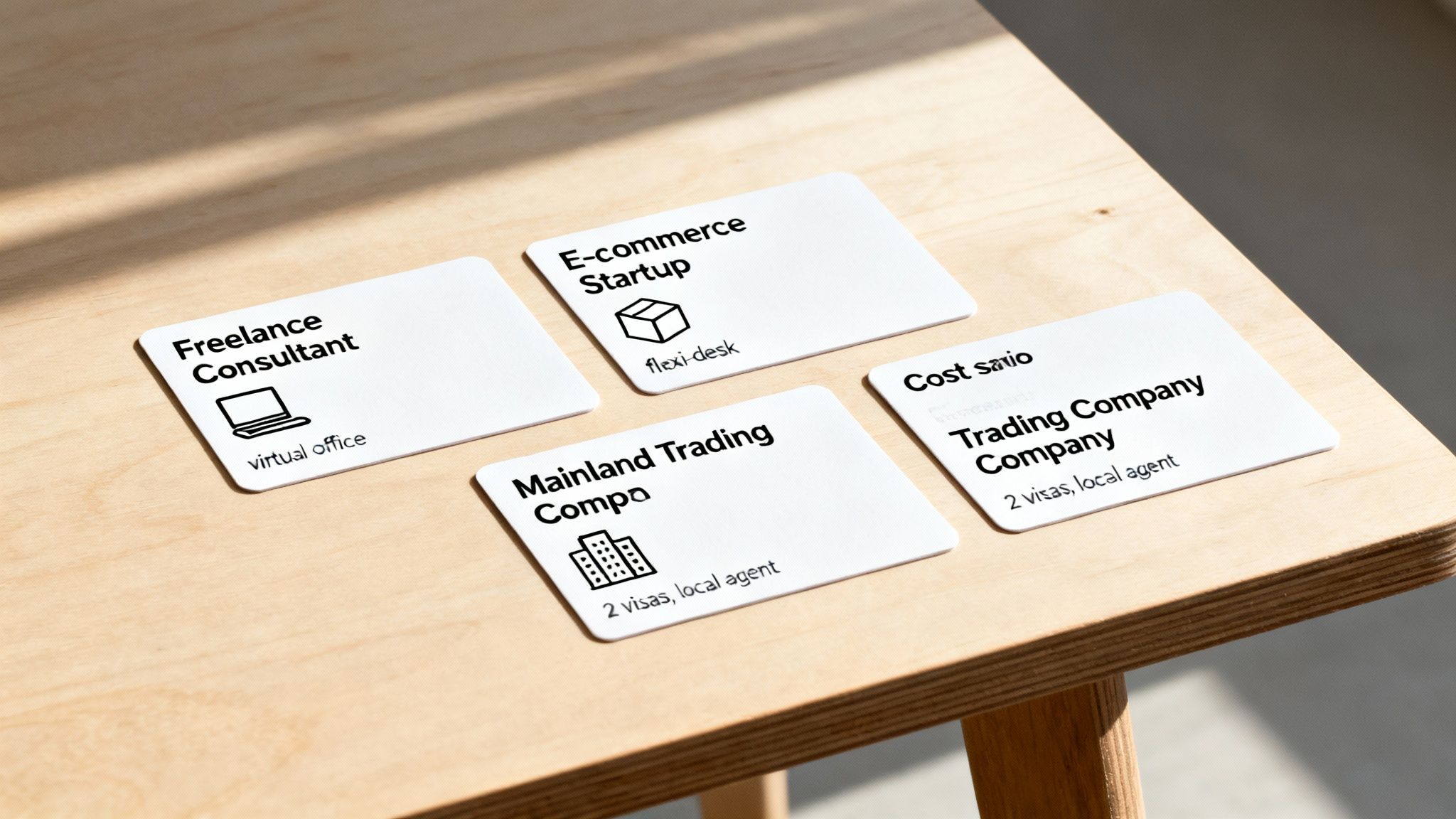
Theory and itemised lists are helpful, but nothing makes the Dubai business license cost clearer than seeing it in action. To really bring these numbers to life, let’s walk through three common, real-world scenarios. Each example mirrors a typical entrepreneurial path, giving you a tangible budget to compare against your own business plans.
We'll start with a lean setup for a solo professional, move on to a small e-commerce venture, and finish with a more traditional mainland trading company. You'll see exactly how the costs scale with complexity, office needs, and the number of visas required.
Scenario 1: The Freelance Consultant
Meet Alex, a digital marketing consultant who wants to operate as a solo professional. The main goal here is simple: get a residency visa and operate legally with the lowest possible overhead. For Alex, a free zone professional license with a virtual office or flexi-desk package is the clear winner.
This kind of setup is by far the most budget-friendly way to get your foot in the door. It’s perfect for freelancers, coaches, and any service-based entrepreneur who doesn’t need a physical office or the ability to trade directly within the local UAE market.
Here’s what a typical first-year cost breakdown looks like:
- Free Zone License Package (1 Visa): AED 17,500 (This usually bundles the trade name, registration, and establishment card fees).
- Investor Visa Processing: AED 4,000 (This covers the entry permit, medical test, Emirates ID, and the final visa stamping).
- Total Estimated First-Year Investment: ~AED 21,500
This lean approach gets Alex fully licensed and operational for a remarkably low initial investment. It’s a perfect example of how powerful and accessible free zone packages can be.
Scenario 2: The E-commerce Startup
Now, let's look at Sarah and her partner, who are launching a niche e-commerce brand. They need a commercial license to trade goods, an investor visa for Sarah, and a cost-effective solution for their small-scale operation. A free zone with an e-commerce license and a flexi-desk is the ideal fit here.
Their setup needs a bit more than Alex's, mainly because a commercial license is often priced slightly higher than a professional one. Still, they get to take advantage of the free zone’s affordability by avoiding a costly physical warehouse, at least in the beginning.
The UAE's business-friendly environment has led to explosive growth, with over 1.5 million active commercial licenses now registered. This boom is fuelled by accessible license costs, with Dubai's base fees for commercial licenses starting at around AED 12,500. This makes it an attractive market for startups and SMEs. Learn more about the growth of business registrations in the UAE.
Let’s map out their projected first-year budget:
- Free Zone Commercial License Package (1 Visa): AED 20,000
- Investor Visa Processing: AED 4,000
- E-channel Registration (often required): AED 5,000
- Total Estimated First-Year Investment: ~AED 29,000
This scenario shows how a small trading business can get off the ground efficiently, without the heavy financial burden that comes with a full-scale mainland setup.
Scenario 3: The Mainland Trading Company
Finally, let’s analyse a more complex setup for a Mainland LLC. This company, run by two partners, is focused on trading and distribution right here in the UAE. They need to import goods, hire two local staff members, and lease a small office to manage logistics. This is where the investment really starts to climb.
Going the mainland route is essential for any business wanting unrestricted access to the local market. But this access comes with mandatory costs like physical office rent and higher government fees, which significantly bump up the initial outlay.
Here’s a more detailed look at their first-year budget:
| Fee Component | Estimated Cost (AED) | Notes |
|---|---|---|
| Initial Approval & Name Reservation | AED 800 | Standard one-time government fees. |
| MoA Attestation | AED 1,500 | Required for an LLC partnership. |
| Commercial License Fee (DED) | AED 15,000 | The core annual fee for the license. |
| Small Office Rent (Annual) | AED 30,000 | Mandatory for a mainland license. |
| Market Fees (2.5% of rent) | AED 750 | Paid to the DED. |
| Establishment & Labour Cards | AED 2,500 | For immigration and labour files. |
| Investor Visas (x2 partners) | AED 8,000 | For both founding partners. |
| Employee Visas (x2 staff) | AED 7,000 | For the two hired employees. |
| Total Estimated First-Year Investment | ~AED 65,550 |
As you can see, the need for a physical office and multiple visas dramatically scales the total Dubai business license cost. These real-world examples highlight a crucial takeaway: your business model and market focus are the ultimate drivers of your final setup price.
How to Trim Your Business Setup Costs
Getting a handle on the full Dubai business license cost is your first win. The next is figuring out how to be smart about it. Launching your dream company in Dubai doesn't mean you have to empty your bank account before you even open your doors. A few strategic moves can seriously cut down your initial outlay, without cutting corners on your company's legal foundation.
The trick is to launch lean. Focus on what your business absolutely needs right now, and you can steer clear of unnecessary expenses. That leaves more of your capital for what really counts—fuelling your growth.
Choose Your Jurisdiction Wisely
Your single biggest cost-saving decision comes down to one thing: jurisdiction. While a mainland setup gets you direct access to the local market, free zones are practically built for cost-effective launches. Many offer multi-year license packages that let you pay for two or three years upfront at a nice discount, locking in your costs and saving you cash over the long haul.
Better yet, going the free zone route means you don't need a Local Service Agent. Just like that, you’ve wiped an annual fee of AED 5,000 to AED 15,000 right off your budget. That one choice gives you a massive financial head start from day one.
Rethink Your Office Space
For any new business, office rent is usually one of the heaviest financial lifts. But this is Dubai, and a traditional physical office often isn't a must-have, especially in a free zone. You can slash your overheads by going for a more flexible option.
- Flexi-Desk: This gets you a registered business address and access to a shared workspace. It ticks all the legal boxes for a fraction of what a private office would cost.
- Virtual Office: If you don't need a physical desk at all, a virtual office provides a prestigious business address and mail handling services for even less.
By sidestepping a long-term lease, you're not just saving on rent. You also avoid the 2.5% market fee that mainland companies have to pay on their annual tenancy contract.
Bundle Services and Plan Ahead
Here's another savvy move: bundle your setup services with a single, trusted provider. Experienced business setup consultants have established relationships with free zones and government departments, which means they can offer discounted packages that cover everything:
- License registration
- Establishment card processing
- Visa applications
Pulling these services together under one provider can unlock some serious savings compared to piecing them all together yourself. A good consultant is your single point of contact, making the whole process smoother and preventing costly mistakes or delays that can add up faster than you'd think.
Finally, get specific with your business activities. Listing too many, or picking activities that need extra external approvals, will drive up your government fees. Stick to the core activities you need to get started. The same logic applies to your visas—plan them out in advance. Last-minute or rushed applications always carry a premium. Mapping out your staffing needs from the get-go will shield your budget from those unexpected hits.
These aren't just tips for cutting costs; they're about making informed choices that position your business for long-term, sustainable success.
Why a Business Setup Consultant Is a Smart Investment
It’s easy to look at a consultant's fee as just another line item on your budget, but it’s honestly one of the smartest investments you can make when facing the Dubai business license cost.
Think of it like this: you could try assembling a complex piece of furniture by yourself with just a diagram. But hiring a skilled carpenter not only saves you a massive headache, it also guarantees you won't end up with a wobbly table and a pile of leftover screws. A good business setup consultant does the exact same thing for your company launch.
Their real value comes from turning a confusing, unpredictable process into a clear and predictable one. They know the ins and outs of every jurisdiction and license type, making sure you get the most cost-effective setup for your actual business needs. This alone can save you from overspending on a license you simply don’t require.
Navigating the Bureaucratic Maze
A great consultant does a lot more than just fill out paperwork. They have established relationships within government departments, which lets them cut through the red tape and speed up approvals. You can save weeks, sometimes even months, of frustrating delays. And every day you spend stuck in administrative limbo is a day you're not making money.
This is where their experience truly pays for itself. They help you sidestep common pitfalls like submitting incorrect documents or choosing the wrong business activity—mistakes that can get your application rejected and your fees forfeited. Their guidance is like an insurance policy for your initial investment.
A consultant’s real job is to give you peace of mind. They handle the entire administrative marathon, freeing you up to focus on what actually matters: finalising your business plan, talking to potential clients, and getting ready for a strong launch.
When you look at it that way, their fee is a small price to pay for a faster, error-free, and much less stressful setup. To get a better feel for how the right partner can change the game, you can learn more about what the best business setup consultants in Dubai bring to the table. Ultimately, investing in their expertise is a direct investment in your company's future.
Got Questions About License Costs? We’ve Got Answers.
As you get closer to launching your Dubai business, a few final questions about costs are bound to pop up. It's completely normal. Getting straight answers is key to building a realistic budget and moving forward without any surprises. Let's tackle the most common queries we hear from entrepreneurs just like you.
We want to clear up any lingering doubts you might have, from what to expect with annual renewals to how long the whole process really takes.
What Are the Annual Renewal Costs Really Like?
Your first-year setup fee is the big one, but the annual license renewal fee is your main recurring cost. A common mistake is assuming the renewal will be significantly cheaper. In reality, you should budget for the renewal to be almost identical to the first year's core license fee.
Think of it this way: the renewal cost is typically 80-100% of your initial license fee, minus any one-off charges like your Memorandum of Association attestation or establishment card. Planning for this ensures your business stays compliant and operational without any last-minute financial stress.
Can I Get a License Without Renting a Physical Office?
Yes, you absolutely can—and this is one of the best ways to keep your startup costs down, especially in a free zone. Free zones are built for flexibility and offer clever solutions like flexi-desks or virtual offices. These options give you a legitimate registered business address, satisfying all legal requirements without locking you into a costly traditional lease.
A flexi-desk package is a game-changer for startups, freelancers, and consultants. It provides a proper tenancy contract and address, effectively removing a huge expense from your initial Dubai business license cost.
Just keep in mind that for a mainland company, a physical office with a registered tenancy contract (Ejari) is nearly always a must-have.
How Long Does the Entire Setup Process Take?
The timeline really depends on where you set up (your jurisdiction) and what your business does. A free zone company formation is incredibly quick. If you have all your documents ready to go, the license itself can be issued in as little as 3 to 7 working days.
The full process, which includes getting your investor visa, takes a bit more time. From submitting your application to getting the final residency visa stamped in your passport, it's wise to plan for about 15 to 25 working days. A mainland setup can sometimes take a touch longer because of the extra steps for approvals and office registration.
Ready to get a precise, no-obligation quote for your business setup? The team at Al Ain Business Center provides transparent, all-inclusive packages tailored to your specific needs, ensuring there are no hidden costs. Start your business journey with a free consultation today!