
Setting up a company in Dubai Mainland is your ticket to the entire UAE market. It's a structured process, overseen by the Department of Economy and Tourism (DET), that takes you from choosing your business activity all the way to getting your trade licence in hand. This route gives you unrestricted trading access and makes you eligible for those valuable government contracts.
The Dubai Mainland Advantage: Why It Matters
Choosing between a mainland and a free zone setup is one of the first, and most critical, decisions you'll make. While free zones have their perks, a mainland company gives you the freedom to trade directly with the local market and operate anywhere in the UAE without geographical handcuffs. If your goal is to capture a significant piece of the local market, the mainland is almost always the right call.
The Department of Economy and Tourism (DET)—you might still hear it called the DED—is the authority that governs all mainland businesses. They're the ones you'll deal with for everything from reserving your trade name to the final licence issuance.
Key Things to Think About First
Before you jump into the paperwork, there are a few strategic points that will define your company's path. These early choices impact everything from your day-to-day operations to your long-term obligations.
- Go Anywhere, Do Business Anywhere: Unlike a free zone company, a mainland setup lets you conduct business across the UAE and internationally. A huge plus is the ability to bid on government tenders, which is a massive opportunity for many industries.
- Full Foreign Ownership: The game changed recently. For most business activities, foreign investors can now have 100% ownership of their mainland companies. That old rule about needing a local Emirati sponsor to hold a 51% share is a thing of the past for the majority of setups.
- A World of Business Activities: The DET offers a massive list of over 2,000 business activities. You can even combine several compatible activities under one licence, giving you plenty of flexibility.
- Built for Growth: Mainland companies can sponsor as many employee visas as they need. The only real limit is the size of your physical office space. This gives you a clear, scalable path to grow your team as your business expands.
I find it helpful to think of the whole process in three core stages: choosing your path, sorting the legalities, and finally, getting your licence.
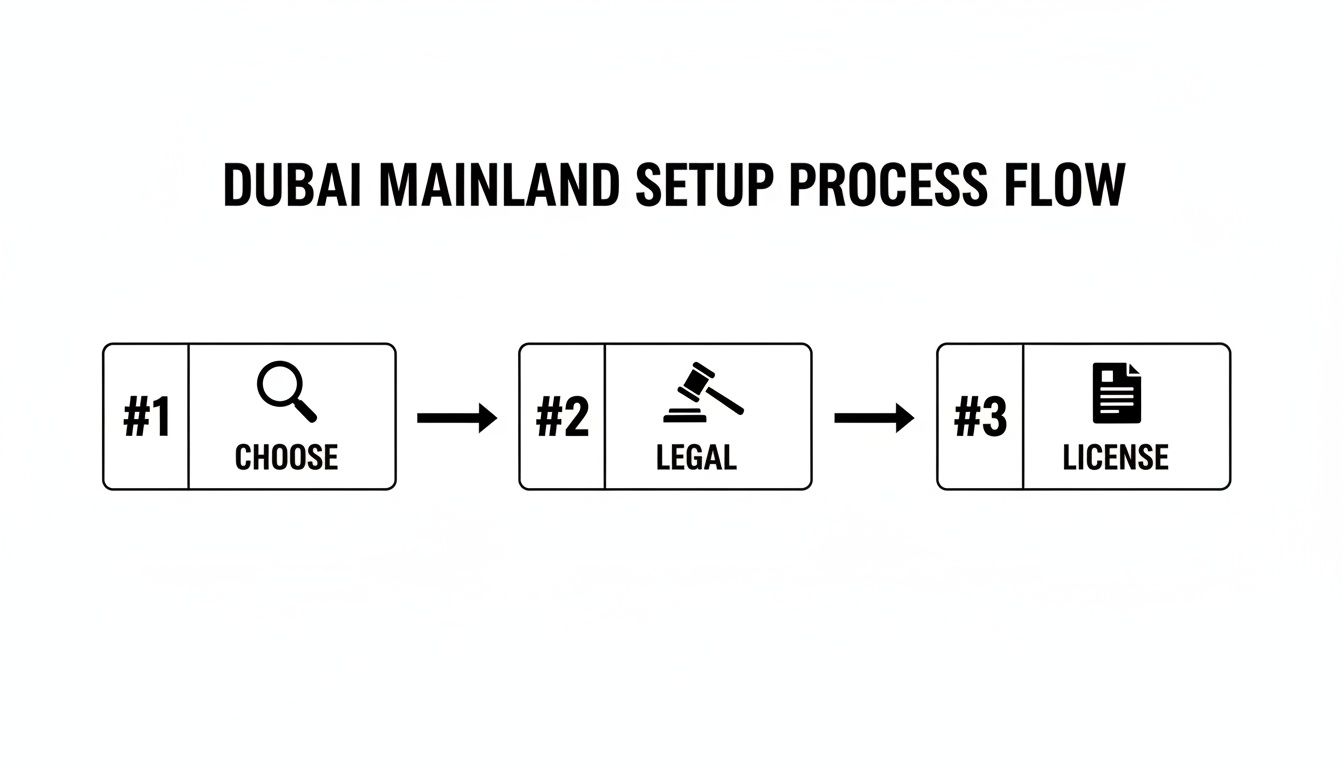
This flow shows how each step builds on the last. A little bit of smart planning upfront saves a lot of headaches later on.
A Quick Look at the Process
To give you a bird's-eye view, the entire journey breaks down into a few key phases. Knowing this from the start helps you get your documents ready and manage your expectations on timing.
The biggest change I've seen over the years is how much of this has moved online. From getting initial approvals to paying for the licence, many steps are now digital, which has seriously sped things up for most standard business types.
Here’s a quick summary table to show you how the pieces fit together.
Dubai Mainland Company Formation at a Glance
This table breaks down the main stages of setting up your company, showing you who you'll be dealing with and roughly how long each part should take.
| Phase | Key Action | Governing Body | Estimated Timeline |
|---|---|---|---|
| Planning & Approval | Select business activity & trade name | Department of Economy and Tourism (DET) | 1-2 Business Days |
| Legal & Documentation | Draft Memorandum of Association (MOA) | Notary Public / Approved Legal Firms | 1-3 Business Days |
| Office & Tenancy | Secure office space & obtain Ejari | Real Estate Regulatory Agency (RERA) | 1-5 Business Days |
| Final Licence Issuance | Submit final documents & pay licence fee | Department of Economy and Tourism (DET) | 1-2 Business Days |
This structured approach is designed to make sure all your legal and operational boxes are ticked off properly and in the right order.
Choosing Your Business Activity and Legal Structure
The foundation of your entire Dubai mainland company rests on two critical, interconnected decisions: what your business will do (your activity) and how it will be legally structured. Get this right from the start, and you're building on solid ground. Get it wrong, and you could be looking at costly changes down the line.
Your first move is to dive into the official list of over 2,000 business activities approved by the Department of Economy and Tourism (DET). Every single business, whether it's a small consultancy or a massive trading operation, has to pick its activities from this directory. This choice directly shapes the kind of trade licence you'll get.
Understanding the Main Licence Categories
The activity you select will place you into one of three main licence categories, and each one has its own purpose.
- Commercial Licence: This is your go-to for any business involved in buying and selling goods. Think general trading, retail shops, e-commerce stores, and import-export operations.
- Professional Licence: This licence is for businesses built on expertise and services. We're talking about IT consultants, marketing agencies, management advisors, and artisans—anyone whose value comes from their intellectual or artistic skills.
- Industrial Licence: If you're actually making something—manufacturing, processing, or assembling products—you'll need an Industrial Licence. This covers factories and production facilities.
This isn't just about ticking a box. The implications are very real. A professional services firm, for instance, often has completely different ownership rules and liability concerns than a commercial trading company.
Selecting the Right Legal Structure
Once you've pinpointed your business activity, the next piece of the puzzle is the legal structure. This defines your company's legal identity, its ownership, and how much liability the shareholders carry. For most international investors, a couple of options usually stand out.
A Limited Liability Company (LLC) is, by a long shot, the most common choice for anyone in trading or commercial activities. In an LLC, a shareholder's liability is capped at their investment in the company, which is crucial for protecting personal assets if the business runs into debt. It’s a solid, credible structure that banks and suppliers know and trust. Our detailed guide on setting up an LLC company in the UAE breaks this down even further.
On the other hand, if you're a professional offering services, a Sole Establishment (or a Civil Company if you have partners) is often the most direct path. This structure is linked directly to an individual professional, making it a perfect fit for consultants, designers, and other experts operating with a Professional Licence.
Expert Tip: Here’s a simple way to think about it: if your business sells things, you’re probably looking at a Commercial Licence and an LLC. If you sell your expertise, a Professional Licence with a Sole Establishment or Civil Company is likely your best bet.
The New Era of 100% Foreign Ownership
One of the most significant and welcome changes to Dubai's business scene has been the shift toward full foreign ownership. For years, most mainland companies needed a UAE national to hold a 51% share. That's no longer the case for the vast majority of businesses.
Thanks to reforms, particularly the Federal Commercial Companies Law No. 32 of 2021, the old 51% local partner rule has been scrapped for a huge number of activities. This is a true game-changer, allowing international investors to maintain 100% control and ownership of their mainland companies. You can find more details about these legal reforms on bakermckenzie.com.
What does this mean for you? It means you can have complete command over your company's strategy, profits, and assets without the need for a local Emirati partner in most commercial and professional fields. This simplifies the setup process immensely and gives foreign entrepreneurs the autonomy and confidence needed to thrive in Dubai’s dynamic market.
Navigating Documents and Government Approvals
Once you've locked in your business activity and legal structure, it's time to dive into the paperwork and official stamps. This is the stage where meticulous attention to detail can save you weeks of frustrating delays. Getting your documents right the first time is absolutely critical for a smooth journey through the government approval process.
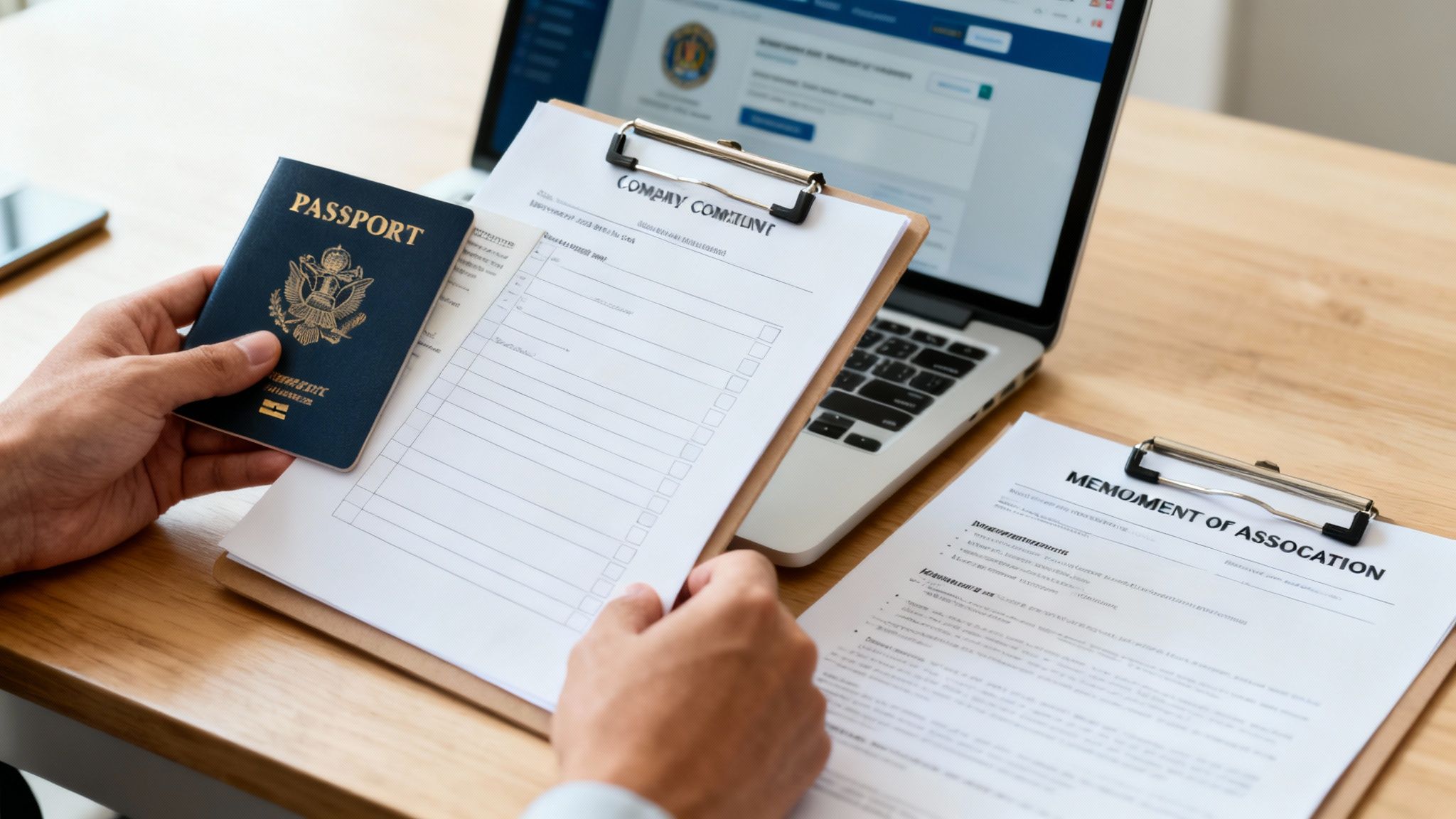
Think of this as building your company's official identity on paper. You're laying the foundation, document by document, before your business can truly exist in the real world.
Your Essential Document Checklist
Before you even think about approaching the Department of Economy and Tourism (DET), you need to get a core set of documents in order. Having these organised and ready to go will make a world of difference.
For every shareholder and manager involved in your new venture, you'll need to have these on hand:
- Clear Passport Copies: Make sure every passport has at least six months of validity left. A simple, clear scan is usually fine for the initial steps.
- Passport-Sized Photographs: These need to be recent photos against a plain white background, following the standard UAE requirements.
- Visa and Entry Stamp Details: If you're already in the UAE, you'll need a copy of your current visa page or your entry stamp to prove your legal status.
This initial paperwork is pretty standard across the board. As you move forward, understanding the benefits of e-signatures can really speed things up, especially if you have partners located overseas.
Securing Initial Approval and Your Trade Name
With your personal documents sorted, the first official move is applying for Initial Approval from the DET. This certificate is the government's nod of approval, confirming they have no objection to your proposed business and giving you the green light to proceed.
You'll do this at the same time as reserving your company's trade name. This isn't just about picking a name you like; it has to follow some pretty strict UAE regulations.
Trade Name Rules to Remember:
- It can't be identical to an existing company's name. A quick search can save you a headache here.
- It must not contain any offensive language or allude to any religion or political organisation.
- If you decide to use a person's name, it must be the full name of a partner, not just a surname.
Once the DET gives your trade name the okay, it's reserved for you, usually for about six months. This gives you ample time to get the rest of the setup finalised without the stress of someone else grabbing your name.
Drafting the Memorandum of Association
The Memorandum of Association (MOA) is the legal backbone of your business, particularly for a Limited Liability Company (LLC). This is a crucial document that maps out the entire operational framework of your company.
It lays out all the critical details, including:
- The company’s objectives and all planned activities.
- Full details of each shareholder and their ownership percentage.
- The company's total share capital.
- The specific responsibilities and powers assigned to the managers.
The MOA has to be drafted in both English and Arabic and then notarised by a public notary in Dubai. Because this is a legally binding contract between all partners, getting every detail perfect is non-negotiable. Many find the legal jargon overwhelming; engaging professional document clearing services is a smart move to ensure total accuracy and compliance.
The Importance of External Approvals
For a lot of business activities, getting approval from the DET isn't the final hurdle. Depending on what industry you're in, you might need additional approvals from other government ministries or regulatory bodies.
A classic mistake I see entrepreneurs make is underestimating how much time and effort external approvals take. Forgetting this step can bring your entire application to a screeching halt right at the finish line.
For instance, a few real-world examples include:
- A construction company will need permits from the Dubai Municipality.
- A healthcare clinic requires approval from the Dubai Health Authority (DHA).
- An educational institution has to get the go-ahead from the Knowledge and Human Development Authority (KHDA).
Without these specific external approvals, your final trade licence simply cannot be issued. It is vital to figure out which, if any, you need early on. Start applying for them in parallel with your DET application to sidestep any needless delays. This kind of proactive planning is what separates a smooth setup from a stressful one.
You've navigated the first few hurdles of approvals and legal paperwork, which is a huge step. Now, it's time to make things real by securing a physical address for your new company formation in Dubai mainland. This isn’t just a box-ticking exercise; the Department of Economy and Tourism (DET) won't issue your trade licence without a registered physical office.
This is often where entrepreneurs pause and think hard. Do you go all-in on a traditional office lease, or is there a more agile, modern way to meet this requirement? Your business model, budget, and future plans will really guide this decision.

Weighing Your Office Space Options
The classic route means finding a commercial property, getting locked into lease terms (usually for a year or more), and shelling out for a hefty deposit and agent fees. For an established business with a team and a clear need for its own dedicated space, this makes perfect sense.
But what if you're a startup, a solo founder, or an international company just dipping a toe into the Dubai market? That kind of long-term financial commitment can be a real burden. Thankfully, this is exactly why business centres and flexible workspaces have become so popular here. They offer a much more cost-effective and nimble alternative.
You could, for instance, get a flexi-desk or a small serviced office in a prime spot like Business Bay. This instantly gives you that prestigious business address and all the legal paperwork you need, but without the crippling overheads of a traditional lease. A major perk is that these centres handle everything from utilities to reception services, so you can just focus on building your business.
The Critical Role of the Ejari Certificate
Whichever path you take, your immediate goal is to get your hands on one vital document: the Ejari certificate. Ejari, which literally means 'my rent' in Arabic, is the official online system managed by the Real Estate Regulatory Agency (RERA) to register every tenancy contract in Dubai.
Here's a quick look at how it works:
- Sign the Tenancy Contract: You'll sign a formal lease agreement with the landlord or the business centre operator.
- Register Online: The signed contract is then uploaded to the Ejari portal along with other documents, like your passport copy, trade name reservation, and the landlord's details.
- Receive the Certificate: Once approved, you get your unique Ejari certificate. This is the non-negotiable proof of your physical address that the DET needs for your final licence application.
Securing your Ejari is the final piece of the physical setup puzzle. It’s the official link between your company and its registered address, a connection the DET takes very seriously. Without it, your application cannot proceed to the final stage.
This is another area where modern solutions really shine. If you don't need a full-time physical office, exploring a virtual office in Dubai can be a brilliant strategy. These services provide you with a completely legitimate business address and the all-important Ejari, satisfying all legal requirements while keeping your upfront costs remarkably low.
The Final Submission and Payment Voucher
Okay, so you've got your notarised Memorandum of Association (MOA) and your shiny new Ejari certificate. You now have everything you need for the final push. The next move is to submit this complete package of documents back to the DET.
An officer at the DET will do a final review to make sure every single document is present, accurate, and fully compliant. They'll check your initial approval, trade name certificate, MOA, and the Ejari. Assuming everything is in order, the department will issue the payment voucher.
Think of the voucher as the final invoice for your trade licence fees. It clearly lists all the government costs for your specific business activity and company structure. As soon as you pay it, the DET officially issues your trade licence. At that moment, your Dubai mainland company is legally born—ready to operate, open a corporate bank account, and start its journey in the UAE.
Life After Your License Is Issued
Getting that trade licence in your hands feels like a massive win, and it absolutely is. But think of it as the starting line, not the finish line. Now the real work begins. With the official paperwork sorted, your immediate priority is to get your company fully operational and, just as importantly, compliant. These next steps are what build a solid legal and financial foundation for your business to actually succeed.
The pace of business in Dubai is incredibly fast. A recent Dubai Chamber report highlighted that 35,500 new companies were registered in just the first half of 2025 alone. This explosion is largely thanks to digital processes that have slashed setup times. You can learn more about Dubai's accelerated business growth on persianhorizon.com. This speed means you need to be just as quick and organised in handling your post-licence formalities.
Getting Your Corporate Bank Account Active
First things first: open your corporate bank account. This isn't just a suggestion; it's a critical, non-negotiable step. Without a business account, you can't legally receive payments from clients, pay your suppliers, or manage your finances. Be prepared for a detailed process, as UAE banks have very strict Know Your Customer (KYC) and anti-money laundering regulations.
To avoid delays, get your document file ready before you even approach a bank. They will almost always ask for:
- Your Complete Company File: This means your shiny new trade licence, Memorandum of Association (MOA), Ejari certificate, and shareholder registry.
- Personal IDs for Everyone Involved: Have clear copies of passports, residence visas, and Emirates IDs for all shareholders and authorised signatories.
- A Solid Business Plan: The bank needs to understand what you do. A clear, concise plan showing your services, target customers, and financial projections for the first year is a must.
- Proof You're a Real Business: This could be anything from initial supplier contracts and draft agreements with potential clients to a professional company website.
Expert Tip: Don't just walk into the nearest bank branch. Do a bit of homework to see which banks have a reputation for being SME-friendly. A well-prepared, professional business plan is your single best tool for showing you're a serious venture and speeding up the approval.
Sorting Out Immigration and Visas
With your trade licence secured, you can now kick off the immigration process. The first step is registering your company with the right authorities. This involves getting your Labour Establishment Card from the Ministry of Human Resources & Emiratisation (MOHRE) and your Immigration Establishment Card from the General Directorate of Residency and Foreigners Affairs (GDRFA). You can't sponsor a single visa without these two cards.
Once your establishment cards are issued, you can apply for your own Investor Visa. This is what officially confirms your status as a business owner in the UAE, and it's typically valid for two years. The process itself involves submitting an application, going for a medical fitness test, and providing your biometrics for your Emirates ID.
After your own visa is stamped, you can start the process of sponsoring your employees. The number of visas you can apply for—your "visa quota"—is directly linked to the size of your physical office. This is why we stressed the importance of choosing the right office space earlier in the process!
Staying Compliant for the Long Haul
Running a business in Dubai comes with ongoing responsibilities you simply can't ignore. Getting these right from day one will save you a world of headaches, fines, and potential disruptions down the road.
Your biggest annual task will be renewing your trade licence. This means making sure your tenancy contract (Ejari) is up-to-date and submitting the renewal application to the Department of Economy and Tourism (DET) before it expires.
You also need to get familiar with your tax obligations. Depending on your turnover, you will likely need to register for Value Added Tax (VAT) with the Federal Tax Authority (FTA). On top of that, you must get to grips with the new Corporate Tax laws to figure out your company's liability. Meticulous accounting and bookkeeping are no longer just good practice; they are a fundamental compliance requirement. Don't take these duties lightly—the penalties for non-compliance can be severe.
Here's a quick checklist to keep you on track after you get your licence.
Post-License Compliance Checklist
This checklist covers the essential tasks you need to tackle immediately after receiving your Dubai mainland trade licence. Completing these steps ensures your business is not just legal, but fully operational and compliant from the get-go.
| Task | Key Requirement | Responsible Authority |
|---|---|---|
| Open Corporate Bank Account | Provide all company documents, shareholder IDs, and a business plan. | Chosen UAE Bank |
| Get Establishment Cards | Register with MOHRE for the Labour Card and GDRFA for the Immigration Card. | MOHRE & GDRFA |
| Apply for Investor Visa | Complete the application, medical test, and Emirates ID biometrics. | GDRFA / Amer Centre |
| Sponsor Employee Visas | Ensure office size meets quota requirements and follow the standard visa process. | GDRFA & MOHRE |
| Register for VAT | Register with the FTA if your annual turnover exceeds the AED 375,000 threshold. | Federal Tax Authority (FTA) |
| Assess Corporate Tax | Understand your obligations under the UAE Corporate Tax law. | Federal Tax Authority (FTA) |
| Set Up Bookkeeping System | Implement proper accounting software or hire an accountant. | Internal / Third-party |
| Annual Licence Renewal | Submit renewal application with a valid Ejari before the expiry date. | Department of Economy and Tourism (DET) |
Working through this list methodically will help you transition smoothly from simply having a licence to running a successful and fully compliant business in Dubai.
Answering Your Top Questions
Setting up a business on the Dubai mainland always kicks up a lot of questions. It's totally normal. You're probably wondering about local partners, trying to nail down the real costs, and figuring out what's what. Let's tackle the big ones we hear all the time to give you some clarity and confidence.
Do I Still Need a Local Sponsor in Dubai Mainland?
This is the number one question, and the answer is a game-changer for most foreign investors: No, you don't.
Thanks to some major legal updates, you can now have 100% foreign ownership for the vast majority of business activities on the mainland. The old rule that required a UAE national to hold 51% of your company shares is pretty much gone. This is huge—it means you have full control over your business, your profits, and your future.
That said, a handful of specific, strategic sectors still have their own rules. It’s always smart to double-check that your chosen business activity qualifies for 100% ownership before you go too far down the road.
What Is the Minimum Cost for a Mainland Licence?
Pinpointing a single, exact figure is tough because the final cost really depends on your specific setup. A few key things will move the needle:
- Your Business Activity: Different licences come with different government fees. A professional licence for a consultant will have a different price tag than a commercial trading licence.
- Office Space: This will be your biggest variable. A flexi-desk in a shared business centre is a world away, cost-wise, from a private office overlooking Sheikh Zayed Road.
- Visa Requirements: How many investor or employee visas do you need? Each one adds to the total.
So, while it varies, a realistic starting budget for a basic mainland setup—think a simple licence with a flexi-desk and one visa—usually lands somewhere between AED 20,000 to AED 35,000. This generally covers your trade licence, establishment cards, and other initial government fees.
A quick tip from experience: Don't just focus on the initial setup cost. Always remember to factor in your annual renewal fees. This includes renewing the licence itself and your ongoing office rent. It gives you a much more accurate picture of your long-term financial commitment.
Can I Run My Mainland Business from Home?
Generally speaking, no. One of the non-negotiable rules for a Dubai mainland licence is having a registered physical business address, which has to be verified with an Ejari certificate. The government needs to see a legitimate commercial space tied to your licence.
But that doesn't mean you have to sign an expensive lease for a traditional office you don't need. This is where modern solutions like flexi-desks or serviced offices come in. Signing up with a registered business centre gets you the official Ejari and a professional address you need to satisfy the legal requirement, all for a fraction of the cost. It’s a practical and popular workaround.
Mainland vs Free Zone: Which Is Better for My Business?
There’s no single "better" option here. The right choice depends entirely on who you plan to do business with.
- Go for Mainland if: Your main goal is to sell directly to customers inside the UAE, work with local businesses, or bid on valuable government contracts. A mainland licence gives you unrestricted freedom to operate anywhere in the country.
- Go for a Free Zone if: Your business is geared towards international trade, you need the specific infrastructure of an industry hub (like Dubai Media City or DIFC), or you're a solo entrepreneur looking for the most straightforward and cost-effective start.
The recent surge in mainland company setups shows just how confident investors are in the local economy. For instance, the Dubai Economy & Tourism’s Q1 2025 Business Survey revealed a Composite Business Confidence Index (BCI) of 114.9 points. The same report found that 31% of businesses had recently expanded their workforce, a clear sign that new mainland companies are driving job creation. You can get more insights by reading the full research about Dubai's business climate.
Ultimately, your decision should align with where you see your business growing in the years to come.
Ready to talk specifics for your mainland company? The team at Al Ain Business Center is here to give you straight answers and handle everything from start to finish. Let's get your business started on the right foot. https://alainbcenter.com