
Opting for a business setup in UAE mainland gives you a direct, all-access pass to one of the most vibrant economies on the planet. This isn't just a legal formality; it's a strategic decision that lets you trade freely across all seven emirates, throw your hat in the ring for lucrative government contracts, and set up a physical shop wherever you see fit. It’s about positioning your company for real, scalable growth.
Why a UAE Mainland Setup Is a Strategic Move

Choosing where to plant your business flag in the UAE is easily one of the most critical decisions you'll make. Free zones certainly have their perks, but a mainland company gives you a level of operational freedom and market access that’s tough to beat. Think of it like this: a free zone gives you a regional pass, while the mainland is your key to the entire UAE market.
With a mainland licence, you have the green light to work directly with local businesses and government bodies without any middlemen or restrictions. For businesses in sectors like retail, trading, and professional services that thrive on direct market interaction, this is a game-changer.
Unlocking Unrestricted Market Access
The biggest draw for a mainland setup is the freedom to do business anywhere in the UAE, without geographical handcuffs. You can open offices in the bustling heart of Dubai, set up retail stores in Abu Dhabi, or establish service centres in the quieter commercial districts of Sharjah. The choice is entirely yours.
On top of that, a mainland structure is often a non-negotiable requirement for bidding on high-value government tenders. If you're an international construction firm or an IT consultancy, this access can be your ticket to major projects that are simply off-limits to companies based in free zones.
The UAE has seen an incredible boom in business registrations, which have shot up by a staggering 235% in the last five years alone. Official figures from the Ministry of Economy show that the number of businesses jumped from around 400,000 in 2020 to over 1.3 million by mid-2024, largely thanks to groundbreaking reforms like allowing 100% foreign ownership.
UAE Mainland vs Free Zone At a Glance
Getting your head around the key differences between mainland and free zone setups is crucial. They each serve different purposes and cater to specific business models. This quick table breaks down the essentials.
| Feature | UAE Mainland | Free Zone |
|---|---|---|
| Business Scope | Unrestricted trade across the entire UAE | Operations generally limited to the free zone and overseas |
| Office Location | Can be located anywhere in the emirate | Must be within the specific free zone's boundaries |
| Government Contracts | Eligible to bid for government projects | Typically not eligible to bid directly |
| Ownership | Up to 100% foreign ownership for most activities | 100% foreign ownership is standard |
| Approvals | Department of Economic Development (DED) & others | Managed by the respective Free Zone Authority |
For a more detailed breakdown, you’ll want to check out our comprehensive guide on free zone vs mainland in Dubai.
Key Takeaway: A UAE mainland company is more than just a legal setup—it's a strategic asset for deep market penetration. It shows you're serious and committed to the region, which goes a long way in boosting your credibility with banks, partners, and major clients.
This enhanced standing often makes things like opening a corporate bank account or securing financing much smoother. Banks and government entities tend to see mainland companies as being more integrated into the local economy, which can be a massive advantage. When you combine the flexibility to choose any location with the power to serve the entire local market directly, the mainland becomes a powerful launchpad for long-term success.
Picking the Right Legal Structure for Your Company
Getting the legal framework right is the absolute bedrock of your business setup in UAE mainland. This one decision will ripple through everything you do, from your ownership rights and personal liability all the way to how freely you can operate across the Emirates. Nail this part, and you’re building your business on solid ground.
While you’ve got a few options, the Limited Liability Company (LLC) is almost always the go-to choice for international entrepreneurs, and for good reason. It offers a powerful mix of liability protection and operational freedom, making it a fantastic vehicle for just about any commercial or professional business you can think of.
Basically, it acts as a corporate shield, drawing a clear line between your personal assets and any business debts. That alone gives you incredible peace of mind when you're starting out.
The Power of the Limited Liability Company
An LLC is its own legal entity, completely separate from you, the owner (or shareholder). What this means in practice is that your liability is capped at whatever capital you've put into the company. If the business hits a rough patch financially, your personal wealth—your home, your car, your savings—is safe and sound.
This separation is a huge advantage, especially for foreign investors stepping into a new market. It creates a secure, predictable environment to do business. Imagine a European tech firm setting up an LLC in Dubai to work with local banks. They can operate with full confidence, knowing their parent company's assets back home are completely ring-fenced.
The LLC structure really does offer the best of both worlds. You get the limited liability of a big corporation combined with the flexibility of a partnership. It’s a robust and versatile framework that’s perfectly built for the fast-paced UAE market.
This flexibility is why you see LLCs across every industry imaginable, from general trading and e-commerce to consulting and manufacturing.
Navigating 100 Percent Foreign Ownership
One of the biggest game-changers in the UAE business world has been the law allowing 100% foreign ownership for mainland companies. Not long ago, most mainland LLCs needed a UAE national to hold a 51% majority stake. That requirement has been scrapped for a massive list of business activities, giving international investors total control.
This means you can own your business outright. You make all the decisions, and you keep all the profits—no local partner required. It has completely changed the game for a business setup in UAE mainland, bringing the ownership benefits once found only in free zones right to the heart of the local economy.
So, what kind of activities qualify? The list is long and covers most commercial and industrial sectors. To be sure your business idea is on the list, you'll need to check the official activities provided by the Department of Economy and Tourism (DET) in the emirate you plan to set up in.
Defining Your Business Activities with DET
Your journey with the Department of Economy and Tourism (DET)—what used to be the DED—really kicks off when you define your business activities. This isn't just a formality; it's a critical step that dictates your licence type, your eligibility for certain legal structures, and whether you'll need a thumbs-up from other government bodies.
For instance, a marketing consultancy needs a professional licence. A business importing and selling electronics will get a commercial licence. Every activity has a unique code, and your final trade licence will list every single operation you're approved for.
Here’s a bit of practical advice I’ve picked up over the years that can save you from common delays:
- Be Specific and Think Ahead: List every single service or product you intend to offer right now and in the near future. Adding activities later costs time and money.
- Keep It Grouped: Try to stick to activities that fall under the same licence type (like all commercial or all professional). It just makes the whole process simpler.
- Check for Extra Approvals: Some fields—think healthcare, education, or financial services—need pre-approval from specific ministries. You have to factor that extra step into your timeline from day one.
These recent reforms allowing 100% foreign ownership on the mainland have flung the doors wide open for investors. With a DET licence, you can now operate anywhere in the UAE, work directly with local clients, bid on government contracts, and open branches without a local sponsor. This shift covers most trading, industrial, and service activities, empowering entrepreneurs like never before. You can find more insights on scaling your business in Dubai on e.zone.
By taking the time to carefully choose your legal structure and business activities right at the start, you're paving the way for a smooth setup and putting your new venture in the best possible position for success.
Your Practical Path to a UAE Trade License
Once you've locked in your legal structure and business activities, it's time to move from planning to execution. This is where the paperwork really begins, turning your vision into a legally recognised company. Securing your trade license is a step-by-step journey, and each stage is designed to make sure your business setup in UAE mainland is fully compliant before you open your doors.
Let's make this real. Imagine you're setting up a management consultancy in Dubai. Your main goal is to get through the licensing process without hitting the common roadblocks that cause frustrating delays.
Reserving Your Trade Name
First up, your company needs a name. This isn't just about creativity; the UAE has strict rules you need to follow. Your name has to be unique, professional, and can't include any offensive language or nods to religious or political groups.
For our consultancy example, a name like "Innovate Solutions FZCO" would be immediately rejected. Why? Because "FZCO" is only for free zone companies. A much better, compliant option would be "Innovate Management Consultancy LLC." You'll submit a few choices to the Department of Economy and Tourism (DET), and they'll approve one that's available and ticks all the boxes.
Insider Tip: Before you get too attached to a name, check its availability on the DET's online portal. Having three solid, compliant options ready to go will make this first step much faster.
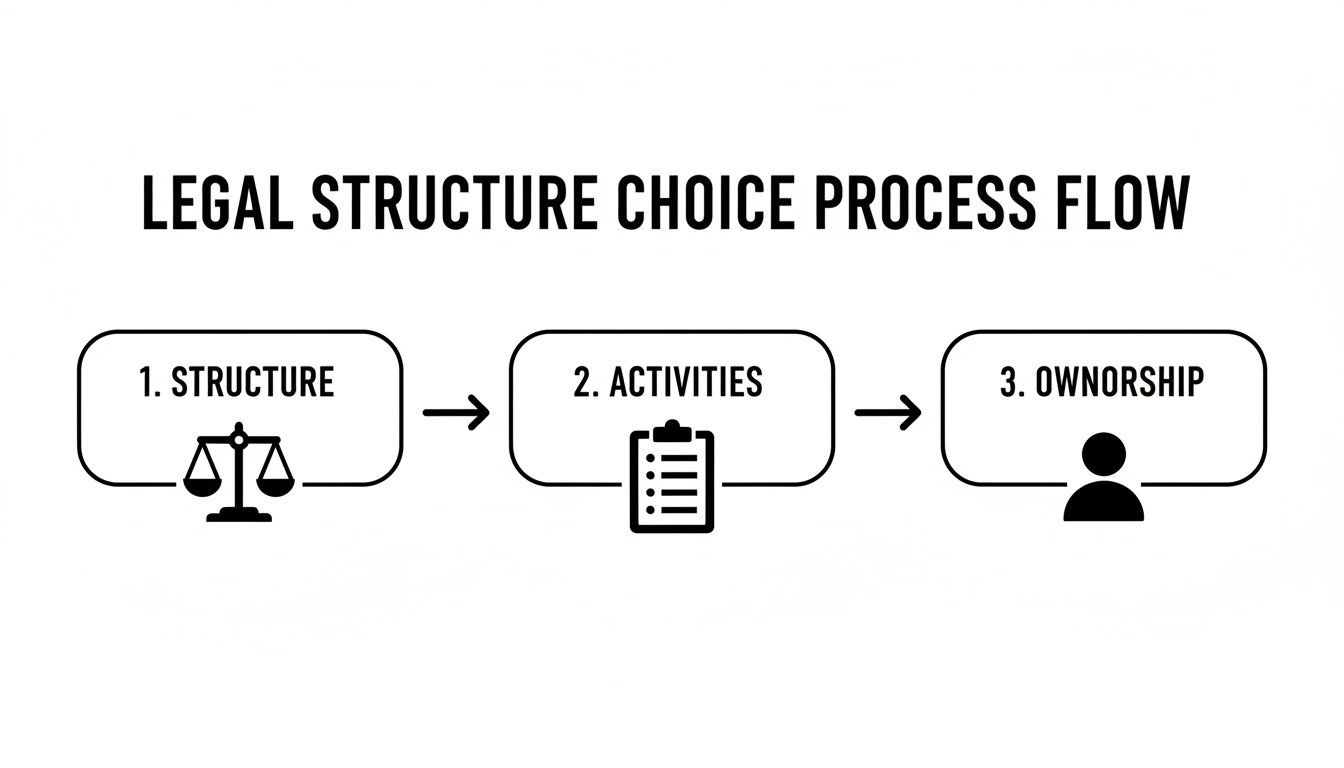
This flow shows how your initial decisions on structure and activities set the stage for the licensing process. Getting this sequence right is the secret to a smooth setup.
Securing the Initial Approval
With your trade name officially reserved, the next big milestone is getting Initial Approval. Think of it as a preliminary green light from the government—a "no objection" certificate that gives you the go-ahead to continue with your company formation.
To get this, you’ll submit passport copies for all shareholders along with the application form. For some specialised fields like healthcare or finance, you might need extra approvals from other ministries at this point. Our management consultancy, however, usually just needs the standard DET approval. This step simply confirms the UAE government is okay with you setting up shop.
Drafting Your Memorandum of Association
The Memorandum of Association (MoA) is your company's constitution. It's a critical legal document that spells out the nuts and bolts of your business, and it must be meticulously drafted and attested by a notary public.
The MoA for our consultancy would need to include:
- The full names and details of every shareholder.
- The exact business activities the company is licensed for.
- The total share capital and each partner's ownership percentage.
- Details on the management structure and how profits or losses will be shared.
A well-written MoA is your best defence against future disagreements between partners. It establishes clear rules from day one, covering everything from decision-making power to what happens if someone wants to exit the business. It’s always smart to have a professional handle this to ensure it's airtight and fully compliant with UAE Commercial Companies Law.
Finding an Office and Getting Your Ejari
Every mainland company in the UAE needs a physical address—it's non-negotiable. But this doesn't mean you need a huge, expensive office from the get-go. Many startups and consultancies start lean with a virtual office or a desk in a co-working space, which are both cost-effective and fully compliant.
Once you have a tenancy contract, you have to register it on the Ejari system. Managed by the Real Estate Regulatory Agency (RERA), Ejari is Dubai's official online platform for tenancy agreements. Your Ejari certificate is a must-have document for your final trade license application, as it legally validates your company's physical address. For a closer look at the licensing process, our guide on how to get a trade license in Dubai has more great info.
The Final Submission and Payment
You're almost there. With your trade name approval, initial approval certificate, attested MoA, and Ejari in hand, you're ready for the final submission to the DET.
Once the authorities review and approve your complete application, they'll issue a payment voucher for the license fees. As soon as you pay, your official trade license is issued. Congratulations! Your UAE mainland company is now officially registered and legally ready to operate. This license is your key to everything that comes next—opening a corporate bank account, sponsoring employee visas, and diving into the local market.
A Realistic Look at Your Financial Commitments
When you start thinking about a business setup in UAE mainland, the first question that almost always comes up is, "How much is this going to cost me?" It’s tempting to look for a simple, one-size-fits-all number, but the reality is more nuanced. The true cost is a mix of one-time setup fees and the recurring expenses that keep your business running.
Let's break down what you’ll actually be paying for. Think of it less like a single bill and more as a series of investments you're making to build a solid foundation for your company.
One-Time Setup and Licensing Fees
Getting your company off the ground involves several upfront government fees. These are non-negotiable costs required to officially register your business as a legal entity.
These one-time payments are mostly for your trade licence and include things like:
- Trade Name Reservation: A small but crucial fee to lock in your business name.
- Initial Approval Certificate: This is the government giving your business idea the green light to proceed.
- Memorandum of Association (MoA) Attestation: This covers the cost of notarising your company's core legal document.
- Trade Licence Issuance Fee: The main government charge for your licence. The exact amount depends on your business activities.
For a really close look at these initial costs, our detailed guide on Dubai mainland company formation cost breaks everything down even further.
To give you a clearer picture, here's a rough idea of what to expect for a standard LLC in Dubai.
Estimated Cost Breakdown for a Dubai Mainland LLC
This table lays out the typical one-time and annual costs you’ll encounter when setting up and maintaining a mainland company. Keep in mind that these are estimates and can vary based on your specific business activities and requirements.
| Cost Item | Estimated One-Time Fee (AED) | Estimated Annual Fee (AED) |
|---|---|---|
| Trade Licence Issuance | 12,000 – 15,000 | 12,000 – 15,000 |
| Chamber of Commerce | 2,200 | 2,200 |
| Government Service Fees | 1,500 | – |
| Trade Name Reservation | 620 | – |
| Initial Approval | 150 | – |
| MoA Attestation | 900 | – |
| Establishment Card | 500 | 500 |
| Office Rent (Ejari) | – | 15,000+ |
| Local Service Agent/Sponsor | – | 7,000 – 15,000 |
| Total (Approx.) | 17,870 – 20,870 | 36,700 – 47,700 |
These figures should help you budget more effectively, but it's always a good idea to get a personalised quote to avoid any surprises.
Ongoing Operational and Renewal Costs
Once you're up and running, the financial focus shifts to the annual costs that keep your business compliant and operational.
Your biggest recurring expense will be the annual trade licence renewal. This is paid to the Department of Economy and Tourism (DET) and is essential for keeping your business in good standing. You'll also have the yearly rent for your office space, which is needed to keep your Ejari (tenancy contract) valid.
Other annual costs you'll need to plan for include:
- Establishment Card Renewal: A must-have for sponsoring visas for yourself and your team.
- Visa Renewal Fees: Every residence visa tied to your company has an expiry date and will need renewing.
- PRO Service Fees: Most businesses hire a professional firm to handle all the government paperwork and renewals, which usually involves an annual retainer fee.
Key Insight: Don't just focus on the startup cost. Budgeting for your annual renewals from day one is just as critical. It prevents cash flow headaches down the road and ensures you stay compliant without any last-minute stress.
Understanding Your Tax Obligations
The UAE's tax system is one of its biggest draws, but you absolutely need to know your obligations to stay on the right side of the law. The good news is, it's pretty straightforward.
First off, there’s no personal income tax here. That’s a massive plus for you as the owner and for any staff you hire.
The two main taxes you'll encounter are:
- Value Added Tax (VAT): A standard 5% VAT is applied to most goods and services. You only need to register for VAT if your annual turnover from taxable supplies and imports hits AED 375,000.
- Corporate Tax: The UAE now has a federal Corporate Tax set at 9%. But here's the key part: it only kicks in for annual net profits above AED 375,000. Any profit below that threshold is taxed at 0%.
The economic backdrop for all this is incredibly strong. In 2024, the UAE attracted a staggering AED 167.6 billion in foreign direct investment—a 48% jump that solidifies its role as the gateway to the MENA region. With Dubai's GDP projected to grow by 5.1% in 2025, this pro-business tax framework is sitting on very solid ground. You can get more practical details on the UAE's market dynamics in this practical guide.
Securing Visas and Building Your Team

You’ve got the trade licence in hand – congratulations! This is a huge milestone, but now the real work begins. It’s time to transform your company from a legal document into a living, breathing operation. That means getting residency visas for yourself as the investor and for any team members you plan to hire.
This part of your business setup in UAE mainland isn't a race; it's a methodical process with very clear steps. It all kicks off with your company's Establishment Card. This small but critical card is issued by the immigration authorities and officially registers your new company with them.
Think of the Establishment Card as your company's passport. Without it, you can't sponsor a single visa.
The Visa Application Milestones
Once your Establishment Card is issued and active, you can start the visa process. It's a logical sequence designed to verify a person's identity and health before they're granted residency here in the UAE.
It starts with an entry permit, which you might hear called a "pink visa" or "white visa." This document allows you or your employee to legally enter the UAE for the purpose of employment. It's valid for 60 days, which gives you a two-month window to complete the rest of the steps.
After arriving in the country with this permit, a few mandatory steps follow for everyone:
- Medical Fitness Test: This is a standard procedure involving a blood test and a chest X-ray. It’s a public health measure to screen for certain communicable diseases.
- Emirates ID Biometrics: The next stop is a designated government centre where the applicant provides their fingerprints and has a photo taken for their official Emirates ID card.
Once the medical test is passed and biometrics are in the system, all the documents are bundled for the final stage: visa stamping. A residency visa sticker is physically placed inside the applicant's passport, which officially confirms their legal status as a UAE resident. The physical Emirates ID card typically arrives a few days later.
The Invaluable Role of PRO Services
Honestly, trying to navigate the different government portals and typing centres for each of these steps is a massive headache. It's time-consuming, confusing, and if you make a mistake, it can lead to frustrating delays. This is exactly where professional PRO (Public Relations Officer) services become a game-changer.
A good PRO handles all the paperwork, submissions, and follow-ups on your behalf. They know the system inside and out, ensuring everything is filed correctly the first time.
For any new business owner, juggling visa applications while trying to actually launch your business is a recipe for disaster. A reliable PRO service isn't a luxury; it's a strategic investment in a smooth, stress-free setup.
Understanding Emiratisation and Compliance
As you look to the future and plan your company's growth, you need to have the UAE's Emiratisation policy on your radar. This is a national initiative designed to boost the participation of Emirati nationals in the private sector.
Currently, the policy requires private sector companies with 50 or more employees to meet specific hiring quotas for UAE nationals. While this won't impact your startup on day one, it's a critical factor in your long-term hiring strategy. Staying compliant is non-negotiable as you scale.
Your Pathway to the Golden Visa
One of the most powerful advantages of a mainland company is its potential to be a direct route to the prestigious UAE Golden Visa. This is a long-term residency visa, usually valid for 10 years, granted to investors, entrepreneurs, and people with exceptional talents who meet certain criteria.
As the owner of a mainland company, you may become eligible based on the size of your capital investment, proving your commitment to the UAE economy. This offers incredible stability for you and your family, removing the need for frequent visa renewals and solidifying your long-term presence in the region.
Answering Your Top UAE Mainland Setup Questions
When you’re looking to set up a business in the UAE mainland, a lot of questions pop up. It’s only natural. Having helped countless entrepreneurs make this move, we’ve heard pretty much all of them. Here are the straight-up answers to the questions we get asked the most, designed to give you some real clarity.
Do I Still Need a Local Service Agent for a Professional Licence?
Yes, and this is a really important point to get right. The landmark 100% foreign ownership law was a game-changer for commercial LLCs, but it doesn’t apply to every single business type.
If you're in a service-based industry—think consultancy, IT services, or a medical clinic—you’ll be applying for a professional licence. For these, you still need a UAE national to act as your Local Service Agent (LSA).
But don’t let that worry you. This isn't the old sponsorship model. An LSA holds zero shares in your company and has absolutely no say in management or day-to-day operations. Their role is purely administrative. For an agreed annual fee, they act as your liaison with government departments, making sure your paperwork is always compliant. A good LSA is worth their weight in gold for keeping things running smoothly.
Can I Use a Virtual Office for My Mainland Company?
Absolutely. In fact, it's a smart and increasingly popular move for new businesses. A virtual office is a completely legal and cost-effective way to meet the mandatory physical address requirement for your trade licence.
This means you get your official Ejari (the registered tenancy contract) without being locked into the heavy costs of a physical office right from day one.
With a virtual office, you get a premium business address, mail handling, and on-demand access to meeting rooms. It’s the perfect lean startup solution for consultants, new ventures, and international firms testing the waters in the UAE market.
This approach frees up your initial capital, letting you invest in growth instead of rent.
What Should I Expect When Opening a Corporate Bank Account?
Opening a corporate bank account is one of the final, crucial steps. It’s good to know upfront that UAE banks perform very thorough due diligence and compliance checks. It’s a strict process, but it’s what keeps the country's financial system so robust.
You'll need to have your full set of company documents ready to go, including:
- Your official Trade Licence
- The notarised Memorandum of Association (MoA)
- Your company's Establishment Card
- Passport and visa copies for every shareholder
Banks will almost always ask for a solid business plan and will want to meet the key shareholders in person. The whole thing can take a few weeks, so our best advice is to get started on this as early as possible with all your documents perfectly in order. Being proactive here makes all the difference.
How Long Does the Entire Mainland Setup Process Take?
The timeline can vary, but a realistic window for a complete mainland company setup is anywhere from two to eight weeks. This covers everything from the initial trade name approval and drafting your MoA right through to getting that final trade licence in your hands.
What makes the timeline shift? A few things. If your business activity requires special approvals from external ministries—like healthcare or education—that can add some time. The speed at which you secure your office space and get your Ejari also plays a part. Working with an experienced setup consultant helps you see these steps coming, sidestep common delays, and just get through it all much more efficiently.
Ready to launch your business in the UAE with confidence and clarity? The team at Al Ain Business Center has over a decade of experience in making the setup process seamless. Let us handle the complexities so you can focus on your success.