
So, you're thinking about starting a business in Dubai. It's a fantastic move, but the first question on everyone's mind is always the same: what's it going to cost me?
Getting a straight answer can be tricky. A bare-bones, zero-visa Free Zone package might start as low as AED 9,000, while a full-blown Mainland company with an office and a couple of visas could easily top AED 50,000. The final number really boils down to your specific choices—jurisdiction, business activity, office space, and how many visas you'll need.
Understanding Your Initial Business Setup Cost in Dubai
Before you can even think about profits, you have to get a handle on the upfront investment. Nailing down your budget from day one is the key to making smart decisions that won’t come back to bite you later.
I like to think of it like building a custom car. Your business licence is the chassis—the absolute foundation. The office space is your engine, powering your operations. And the employee visas? Those are the wheels that get you moving. Each part is essential, and the specific choices you make for each will shape the final price tag and performance of your new venture. The business setup cost in Dubai isn't a single line item; it's a sum of these crucial parts.
The Core Cost Components
Before we get into the nitty-gritty, let’s zoom out. Every dirham you spend at the start will almost certainly fall into one of these three buckets, whether you're setting up on the Mainland or in a Free Zone.
- Licensing and Registration Fees: This is your entry ticket. It covers the cost of your trade licence, reserving your company name, and getting those initial nods of approval from the government.
- Office and Infrastructure Costs: Every business here needs a registered address. This could be anything from an affordable flexi-desk in a Free Zone to your own physical office space on the Mainland.
- Visa and Establishment Card Fees: These are the costs to legally bring people on board, starting with yourself as the investor and extending to any staff you hire.
Your choice between a Mainland or Free Zone setup is the single biggest decision affecting your budget. A Mainland company gives you the freedom to trade anywhere in the UAE, but it often means higher costs for office space and compliance. Free Zones, on the other hand, offer neatly bundled, cost-effective packages that are perfect for specific industries.
While you're budgeting for your physical setup, don't forget about your digital presence—it's just as vital for most businesses today. Building a proper online store, for instance, has its own set of costs. For a good breakdown on that, check out this guide on the true cost of an ecommerce website, as it can be a significant upfront expense.
Initial Cost Snapshot Mainland vs Free Zone
To give you a clearer picture, let's look at a high-level comparison. This isn't an exact quote, but it's a solid ballpark estimate for what a typical small business might expect to pay in its first year.
| Cost Component | Estimated Mainland Cost (AED) | Estimated Free Zone Cost (AED) |
|---|---|---|
| Trade Licence & Registration | 15,000 – 25,000 | 10,000 – 20,000 |
| Office Space (Annual Rent) | 25,000+ (Physical Office) | 5,000 – 15,000 (Flexi-Desk) |
| Investor/Partner Visas (x1) | 4,000 – 7,000 | 3,500 – 6,000 |
| Establishment Card | 2,000 – 2,500 | 1,500 – 2,000 |
| PRO Services & Approvals | 3,000 – 5,000 | Included or lower |
| Approximate Total (First Year) | 49,000 – 64,500+ | 20,000 – 43,000+ |
As you can see, the numbers can vary wildly. The Mainland route requires a bigger initial investment, largely due to the mandatory physical office space. Free Zones offer more flexibility and lower entry costs, which is why they're so popular with startups and solo entrepreneurs. Your business model will ultimately decide which path makes the most financial sense.
Calculating Mainland Company Formation Costs
Thinking about setting up on the Dubai Mainland? It’s a smart play if you want unrestricted access to the entire UAE market. But here's the thing you need to get your head around first: the costs work very differently than they do in a free zone.
Unlike a neat, bundled free zone package, a mainland setup is more of an à la carte experience. You’ll be dealing with several individual expenses that you need to budget for one by one.
The biggest ticket item right off the bat is your trade license fee. This isn't a single, fixed price. The cost is tied directly to your business activities. For example, a professional license for a consultancy firm will have a completely different price tag than a commercial license needed for trading goods. Think of it as paying for different levels of market access; the more you want to do, the more comprehensive (and expensive) your license will be.
Breaking Down Government and Legal Fees
Before you even get your hands on that shiny new license, you’ll need to navigate a series of mandatory government charges. These are non-negotiable steps in the company formation process, and each has its own fee.
- Initial Approval: This is your first green light from the Department of Economy and Tourism (DET), basically confirming they’re okay with your business idea.
- Trade Name Reservation: You need to register your company name to make sure it’s unique and not already taken. Yes, there's a fee for that.
- Memorandum of Association (MOA) Attestation: This is your company's foundational legal document. Getting it drafted, notarised, and legally attested all comes with separate costs.
These administrative fees might seem small compared to the main license cost, but they are essential hurdles to clear. To really get into the nitty-gritty of how these individual charges stack up, our comprehensive guide on Dubai mainland company formation cost lays it all out.
The Mandatory Office Space Requirement
Here’s probably the biggest factor that sets mainland setup costs apart: the need for a physical office space. You absolutely must have a registered physical address with an Ejari (the official tenancy contract) to finalise your license. This adds a significant rental cost to your initial budget, whether you go for a traditional office or a more modern co-working space.
When you pull it all together, the investment for a mainland company starts to look quite different. Experts often say that while the initial LLC license might be quoted between AED 15,000 and AED 20,000, that's just the start. Once you add office rent, all the government charges, and visa fees, your total first-year cost can easily climb to AED 35,000 to AED 67,000 or even more.
A quick note on ownership: While 100% foreign ownership is now standard for most mainland activities, some professional licenses might still require a Local Service Agent (LSA). This means paying an annual fee to a UAE national who acts as your official representative for government paperwork but holds no shares or liability in your company.
Budgeting for a Free Zone Company Setup
Dubai's free zones are practically built to be cost-effective launchpads for global entrepreneurs. They offer a much more direct, and often more affordable, route to market by simplifying the whole setup game. Think of it less like building a custom car from scratch and more like picking an all-inclusive holiday package—everything you need is bundled right in.
The core services—your licence, registration, and a basic workspace—are usually wrapped up into a single price. This makes financial planning so much more straightforward for new investors because it gets rid of many of the variable costs you'd see with a mainland setup. The biggest win here is predictability in your initial business setup cost in Dubai.
This bundled approach is a huge draw for startups and SMEs. The packages are designed to grow with you, allowing you to start with just the essentials and then add more services or visas as your company finds its feet and expands.
Key Free Zone Cost Components
Even though the packages simplify budgeting, it's still smart to know what you’re paying for. Costs can swing quite a bit between different free zones like DMCC, IFZA, or Shams, as each one targets specific industries with its own unique pricing.
Generally, your main expenses will boil down to these:
- Licence Package: This is the big one. It covers your trade licence for a certain number of business activities and often includes a set number of visas and access to shared facilities.
- Office Space: Most entry-level packages will require you to have at least a flexi-desk or a spot in a shared office. This ticks the mandatory box for a physical address without the hefty price tag of a private office lease.
- Establishment Card: This is a crucial document that lets your company start applying for employee and investor visas. It's a one-time fee you pay right at the beginning of your journey.
One of the most significant financial advantages of a free zone is the 100% foreign ownership and tax exemptions. This structure not only gives you full control but also significantly lowers long-term operational costs, making your initial investment more efficient.
Comparing Costs Across Popular Free Zones
The free zone landscape is competitive, which is fantastic news for entrepreneurs. Different authorities roll out attractive pricing to pull in specific types of businesses. For instance, the International Free Zone Authority (IFZA) offers licences that start from AED 12,900, while Sharjah’s Shams Free Zone has packages starting considerably lower at just AED 5,750. Flexi-desk options, a very popular choice for new businesses, typically run between AED 4,000 and AED 7,000 annually.
Choosing the right zone is all about balancing cost with the value you get. A pricier zone like DMCC might offer premium networking opportunities and infrastructure that completely justifies the higher price tag for certain businesses. For those laser-focused on finding the most budget-friendly options, our guide on the cheapest free zone in UAE is packed with valuable insights.
Factoring in Visa and Establishment Card Fees
Getting residency for yourself and your team isn't just another box to tick; it’s a core part of your business setup cost in Dubai. These aren't minor administrative fees you can overlook—they're a significant and non-negotiable part of your initial budget.
Before you can even think about sponsoring your first employee, your company needs an Establishment Card. The best way to think of this is as your company's official passport. It’s the foundational document that registers your business with the immigration authorities and gives you the green light to apply for visas. This is a one-time fee, usually somewhere between AED 1,500 and AED 2,500, that essentially unlocks your ability to build a team in the UAE.
With your Establishment Card active, you can start the visa process for yourself (as the investor) and any employees you plan to hire. It's a journey with multiple steps, and each stage has its own government fee.
The Visa Application Cost Roadmap
The total price for a single residency visa isn't one big payment. Instead, it's a series of smaller fees that add up. Whether you're setting up in a free zone or on the mainland, the path for each person generally looks like this:
-
Entry Permit (Employment Visa): This is the first piece of the puzzle. It’s the document that lets an individual enter the UAE for work. The cost can change depending on whether they are already inside or outside the country when you apply.
-
Medical Fitness Test: Every applicant has to go through a mandatory medical screening for certain communicable diseases. You'll find standard, urgent, and VIP options, all with different price tags.
-
Emirates ID Application: This is the mandatory residency ID card for absolutely everyone living in the UAE. The fee covers the application and the printing of the card itself, which will be valid for the same duration as the visa.
-
Visa Stamping: The final step. This is where the residency visa is physically stamped into the applicant's passport, making them an official UAE resident.
When you add it all up, the cumulative cost for a single investor or employee visa typically lands between AED 3,500 and AED 7,000. This range covers all the government fees from start to finish, giving you a solid number to budget for each person you bring on board.
Sponsoring Your Family
Of course, your business journey in Dubai often means relocating your family, too. The great news is that once your own residency visa is sorted, you can sponsor your spouse, children, and even your parents.
The process is quite similar to getting an employee visa, involving an entry permit, a medical test for anyone over 18, and an Emirates ID application. It’s absolutely crucial to factor these extra costs into your financial planning. Doing so ensures a smooth and stress-free move for both your professional and personal life in Dubai.
Planning for Hidden and Ongoing Expenses
It's a common mistake, but a smart budget for your business setup cost in Dubai has to look far beyond those initial, one-time payments. To build a company that lasts, you need to plan for all the recurring and sometimes overlooked costs that keep your business legal and running long after you’ve framed that new trade licence.
Thinking your spending stops after the initial setup is like assuming a car only costs the sticker price—forgetting all about fuel, insurance, and maintenance. These ongoing expenses are the fuel for your business, and if you don't budget for them, you could grind to a halt unexpectedly.
One of the first hurdles you'll face right after getting your licence is opening a corporate bank account. This can be surprisingly tricky. Banks in the UAE often require you to deposit and maintain a substantial minimum balance, and some have account opening or maintenance fees. It's an absolutely critical step, but one you need to be financially ready for.
Annual Renewals and Amendments
The most predictable ongoing cost you'll have is your annual renewal. Your trade licence, office lease (even a flexi-desk), and your Establishment Card all have expiry dates and need to be renewed every single year. A good rule of thumb is to set aside roughly the same amount you paid for your initial licence and office fees for these yearly renewals.
Of course, businesses change and grow. You might need to add a new activity, change your company name, or bring on a new partner. Each of these changes requires an official amendment to your trade licence, and each one comes with its own government fee. It’s always wise to have a small contingency fund set aside just for this.
Budgeting for professional assistance, what we call PRO services, is a strategic move, not just another cost. These are the experts who handle all your government paperwork—from visa renewals to licence amendments—making sure everything is filed correctly and on time. It saves you an incredible amount of time and helps you avoid expensive fines for missed deadlines or incorrect paperwork.
Mandatory Financial Obligations
Beyond the admin renewals, there are a few key financial duties you absolutely must plan for to operate legally in the UAE. These aren't optional; they're essential costs that protect both your business and your people.
- VAT Registration: If you expect your company's annual turnover to be more than AED 375,000, you are legally required to register for Value Added Tax (VAT) and file regular returns.
- Employee Health Insurance: In Dubai, providing medical insurance is mandatory for all your employees. This recurring premium is a vital part of your operational budget. To get a handle on this, it's worth researching the best expat medical insurance for your life abroad to find plans that fit your needs.
- UAE Corporate Tax: Since June 2023, businesses earning a net profit over AED 375,000 are subject to a 9% Corporate Tax. This means you'll need proper accounting and financial reporting, adding another important layer to your long-term financial planning.
Mainland vs. Free Zone: Making the Smart Choice for Your Budget
So, you're at a crossroads: Dubai mainland or a free zone? This is one of the biggest decisions you'll make, and it really boils down to your specific business model, who you plan to sell to, and what your finances look like. Getting this right from the start means asking the right questions before you put any money down, making sure your choice fuels your long-term growth.
Let's break it down. Think about your customers first. If your goal is to trade directly with businesses and consumers across the UAE or open a physical shop on a busy street, then a mainland setup is non-negotiable. But if your sights are set on international clients or you're running a service-based business from your laptop, a free zone offers a much leaner, more cost-effective way to get started. Don't forget your operational needs, either. The mandatory physical office for a mainland licence can be a hefty expense, while many free zones offer affordable flexi-desk options that keep those initial costs way down.
Key Questions to Guide Your Decision
To figure out the best path forward, take a minute to think through these fundamental questions. This quick checklist will help you see which jurisdiction truly offers the best value and room to grow for your specific venture.
- Who are my main customers? (Are they in the local UAE market or international?)
- Do I need a physical shop or an office the public can walk into? (It's a simple Yes/No)
- What’s my realistic budget for the first year of operations?
- How many employee visas do I need right away?
It's easy to focus on just the licence fee, but that's only part of the story. This decision tree shows some of the other costs that often catch people by surprise, like banking requirements and those pesky renewal fees.
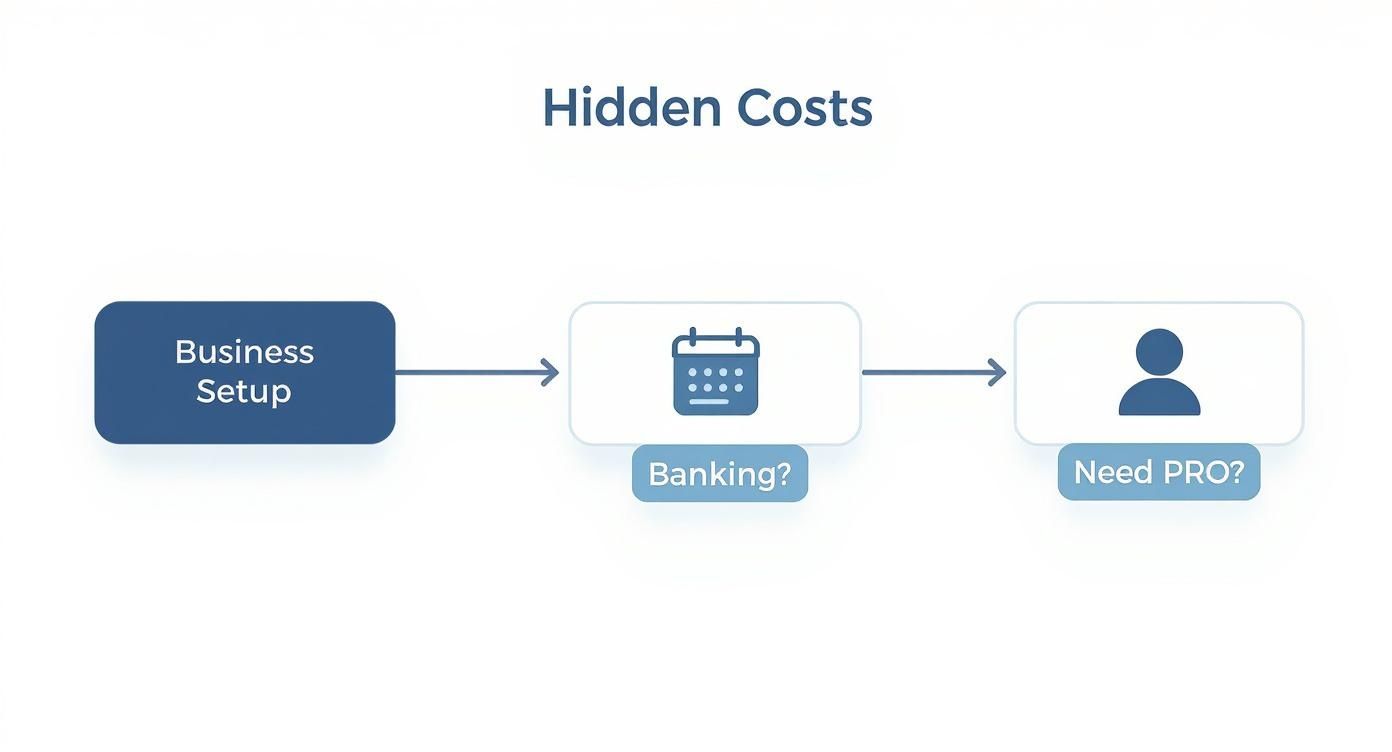
As the chart makes clear, decisions you make after getting your licence—like which bank you choose or who handles your PRO services—are all part of your total business setup cost in Dubai. For an even deeper dive into these differences, our detailed guide on free zone vs mainland Dubai is a must-read.
To help you visualise the trade-offs, we've put together a simple comparison table.
Mainland vs Free Zone Decision Matrix
| Factor | Dubai Mainland | Dubai Free Zone |
|---|---|---|
| Market Access | Unrestricted access to the entire UAE local market. | Restricted to trading within the free zone and internationally. Requires a distributor for local sales. |
| Ownership | 100% foreign ownership for most activities. | 100% foreign ownership is standard. |
| Office Space | Mandatory physical office space required. | Flexible options, including virtual offices and flexi-desks. |
| Visa Quota | Generally more flexible and depends on office size. | Quota is often tied to the package chosen; can be limited. |
| Government Approvals | Requires approvals from DED and other relevant authorities. | All processes are handled by the specific free zone authority. |
| Initial Cost | Generally higher due to office rent and registration fees. | Often lower initial setup costs. |
This matrix should give you a clearer picture of where your priorities lie. There's no single "best" answer, only what's best for your business.
Here's the bottom line: the "cheapest" option isn't always the best one. You need to look at the true value each jurisdiction brings to the table. A slightly higher upfront cost for a mainland licence might pay for itself tenfold with direct access to the local market. On the other hand, a lean free zone package could be the perfect, low-risk launchpad for a global digital business. Your choice should empower your growth, not hold it back.
Got Questions? We've Got Answers
As you map out your business journey in Dubai, a few common questions always seem to pop up. Let's tackle them head-on so you can move forward with confidence.
What's the Absolute Cheapest Way to Get Started in Dubai?
If you're looking for the most budget-friendly way to get your foot in the door, a zero-visa or freelance package from a free zone like IFZA or Shams is your best bet. These can start from as low as AED 5,750, but it’s crucial to know what you’re getting—and what you’re not.
These packages are perfect for solo entrepreneurs or consultants who don't need a UAE residency visa right away. The catch? They come with limitations on the types of business activities you can conduct and, most importantly, don't include a visa. So, if your plan is to live and work in the UAE full-time from day one, you'll need to look at other options.
Do I Still Need a Local Sponsor? And What Will It Cost Me?
Good news! For most commercial and industrial businesses on the mainland, the old rule of needing an Emirati sponsor with a 51% share is gone. Thanks to the 100% foreign ownership laws, you can now hold full control over your company.
However, if you're setting up a professional services business, like a consultancy, you might still need a Local Service Agent (LSA). An LSA doesn't own any part of your company; they simply act as your official liaison with government departments. This service comes with a fixed annual fee, which typically falls somewhere between AED 5,000 and AED 15,000.
Here's a golden rule for budgeting that we always share with our clients: expect your annual renewal costs to be roughly the same as your initial setup fees for the licence and office. Planning for this from the start saves a lot of headaches and financial surprises down the line, keeping your business compliant and running smoothly.
Planning your Dubai launch is much easier when you have an expert in your corner to demystify the costs and regulations. The team at Al Ain Business Center offers clear, straightforward advice on everything from licence fees to long-term compliance, making sure your venture starts on solid financial ground. Find the perfect setup package for your business by visiting us at https://alainbcenter.com.