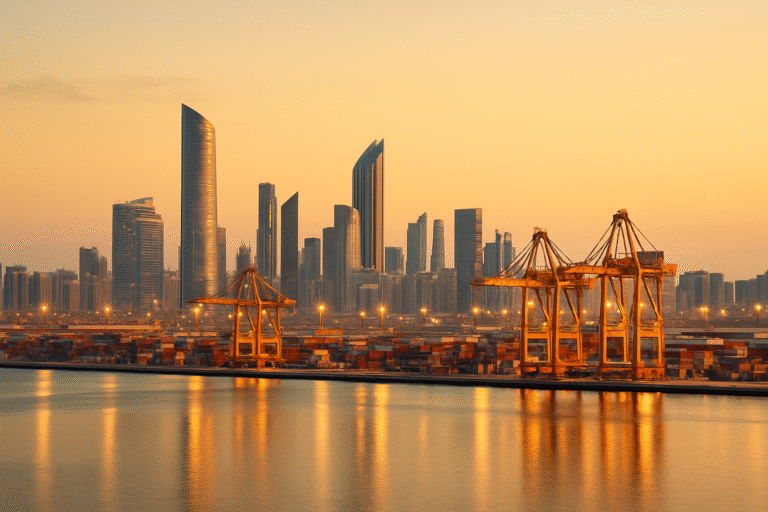

Setting up inside Dubai’s largest free zone usually comes down to one question: does your business actually depend on port access, warehousing and re-export capability? Companies in Jebel Ali Free Zone — better known as JAFZA — are overwhelmingly trading, logistics, e-commerce fulfilment and light manufacturing operations, and the zone’s licence categories, customs treatment and facility options are built around that reality. This guide covers what founders genuinely need before committing: whether JAFZA fits your model, which entity and licence to choose, how ownership works in practice, what to budget for in AED, how long setup takes, and exactly which documents we handle on your behalf.
Key Takeaways

- JAFZA is Dubai’s largest free zone by scale, home to more than 11,000 businesses from over 100 countries and sustaining around 130,000 jobs (Jafza official site, captured 27 September 2026).
- Businesses registered there generated $190 billion in trade value in 2024, which tells you how heavily the zone leans toward goods movement rather than pure services (Jafza official site, captured 27 September 2026).
- You can register a Free Zone Establishment (FZE), a Free Zone Company (FZCO) or a branch of an existing company, all with 100% foreign ownership of the licence-holding entity.
- JAFZA is strongest for trading, re-export, freight forwarding, warehousing, e-commerce fulfilment and light manufacturing — and a poor fit for digital-only services or mainland-retail-dependent models.
- Costs are driven by four variables: licence activity, facility type, visa allocation and the registrations that sit behind them. We quote these itemised rather than as a headline figure, because JAFZA’s pricing changes with activity and space.
- Licence issuance and visa stamping run on separate timelines. Plan them as two projects, not one.
- Verify all fees, visa rules and timelines with JAFZA or a licensed adviser at the time of setup — these change.
Why JAFZA Still Sets the Benchmark Among Dubai Free Zones
Scale matters when you are choosing where to base a trading or logistics business. JAFZA hosts over 11,000 companies from more than 100 countries and supports roughly 130,000 jobs (Jafza official site, captured 27 September 2026). Those numbers are not marketing decoration — they reflect a zone with mature customs processes, established freight networks and a deep pool of suppliers, customs brokers and 3PL operators already operating on site.
The trade figures reinforce the same point. Businesses registered in Jafza generated $190 billion in trade value in 2024 (Jafza official site, captured 27 September 2026). A zone does not reach that volume without functioning infrastructure behind it.
That infrastructure is geographic as much as administrative. JAFZA sits directly adjacent to Jebel Ali Port, one of the busiest container terminals in the region, and close to Al Maktoum International Airport for air freight. On the road side, Emirates Road and Sheikh Zayed Road give you direct land distribution routes into the rest of the UAE and onward across the Gulf. For a business that moves physical goods, that adjacency reduces handling time and cost in ways a purely administrative free zone cannot replicate.
Legacy is the quieter advantage. JAFZA has spent decades building customs procedures, gate-pass systems, re-export documentation and logistics integration. Newer free zones are still assembling that capability. If your model depends on moving containers, clearing customs efficiently or consolidating shipments, you are buying into infrastructure that already works.
Where JAFZA is not the answer: it is not designed for every business model. It excels for trading, logistics, e-commerce fulfilment and light manufacturing. It is usually the wrong choice for a two-person consultancy with no goods, and for businesses whose revenue depends on selling directly into the UAE domestic market.
When comparing JAFZA against other Dubai free zones, evaluate four things: licence fit, physical space requirements, client visa allocation and total first-year cost — including the recurring costs that follow.
What Kind of Company Can You Register in Jebel Ali Free Zone?
JAFZA offers three routes, and the right one depends on how many shareholders you have and whether a parent company already exists.
| Structure | Shareholders | Best suited to | What to watch |
|---|---|---|---|
| Free Zone Establishment (FZE) | One | Solo founders, single-owner trading and logistics businesses | Adding an investor later usually means restructuring or transferring shares |
| Free Zone Company (FZCO) | Two or more | Partnerships, joint ventures, founder teams planning future investment | Shareholding percentages and share Capital allocation need to be agreed up front |
| Branch | None — extension of a parent | Existing UAE or foreign companies expanding into JAFZA | The parent company’s documents and attestation requirements drive the timeline |
If you are setting up alone but expect investors within a year or two, an FZCO from the start is usually simpler than converting an FZE later. If your parent company already trades and you simply need a JAFZA presence, a branch keeps the corporate identity consistent.
Eligible activities span general trading, import and export, re-export, logistics and freight forwarding, warehousing, e-commerce, packaging, assembly and light manufacturing, plus consultancy and services in selected categories. Some activities are approval-based and require additional permits or sign-off from an external authority before the licence can be issued.
How does JAFZA compare with other popular options? DMCC suits commodities trading and structured commodity businesses. Dubai Silicon Oasis fits technology and software companies. IFZA appeals to cost-sensitive service businesses that want a fast, lighter setup. JAFZA wins where goods physically move.
JAFZA is the wrong fit for pure freelancer service work, for models entirely dependent on mainland retail, and for businesses that need unrestricted onshore sales without a distributor or a second licence. If you are an individual working remotely rather than building a company, our guide to Remote Work Visa Dubai Requirements: Documents & Process is the more relevant path. And if you are still weighing a smaller first venture, كيف تبدأ مشروعاً صغيراً في الإمارات: دليل المبتدئين walks through the fundamentals.
Licence Types for Companies in Jebel Ali Free Zone: Which One Fits Your Model?
Licence wording is not a formality. It determines what customs will let you clear, what your bank sees when it reviews your file, and what your customers can contract you for.
| Licence | Who it suits | Typically triggers |
|---|---|---|
| Trading | Import, export, distribution and re-export of defined goods | Customs registration, JAFZA gate pass |
| General trading | Businesses with a broad or evolving product range | Same as trading, with wider activity scope |
| Logistics and freight forwarding | 3PL operators, customs brokers, supply chain providers | Customs code, facility space, vehicle and handling permits |
| Industrial / manufacturing | Production, assembly, packaging and processing | Industrial approvals, larger premises, environmental or safety permits |
| Service and consultancy | Professional and advisory work in permitted categories | Scope restrictions — check the approved activity list |
| E-commerce | Fulfilment-led models using JAFZA warehousing | Storage space, customs handling, returns processes |
A general trading licence gives you broader product scope, but that breadth can work against you. A narrow definition may be too restrictive if your product range shifts. The practical test is this: match the licence wording to what your bank and your clients will see, not just to what JAFZA approves. A licence that reads cleanly to a compliance officer and a customer contract is worth more than one that technically covers everything.
If your model is fulfilment-led, our breakdown of E Commerce License Dubai Cost in 2026: Fees & Guide covers how e-commerce licensing costs sit alongside warehousing and immigration.
100% Foreign Ownership and What It Actually Means for Operations
Full foreign ownership is a core feature of the free zone regime. You do not need a UAE national sponsor to hold the licence itself, and profits remain with the owner. That said, 100% ownership of a free zone company is not the same as unfettered access to the whole UAE market, and understanding the difference early saves expensive corrections later.
Customs status works differently inside the zone. Goods move in and out under a distinct customs treatment, which is precisely what makes re-export and consolidation efficient. It also means your compliance obligations around documentation and declarations are specific to free zone rules.
What free zone status does not give you is direct mainland trading. If your customers are UAE-based businesses or consumers, you generally need a distributor, an agent, or a mainland licence route to serve them. Many founders run a free zone logistics entity alongside a mainland presence; if that dual structure interests you, How to Get an Instant License in Dubai Mainland: Step-by-Step explains the mainland side. Offshore structures are a different conversation again — How to Set Up an Offshore Company in the UAE for Trading covers when an offshore entity makes sense instead of, or alongside, a free zone one.
Banking deserves an honest reality check. UAE banks assess free zone companies on the strength of the activity description, physical presence and documentation quality. A vague licence activity, no visible office or warehouse, and thin supporting paperwork are the three most common reasons an application stalls. Your account opening is a compliance exercise, not a formality.
Visa allocation is linked to your facility. Larger offices and warehouses typically support a larger residence visa quota; a flexi-desk supports very few. If you plan to hire, size your space against your headcount forecast rather than your current team — upgrading later costs more. Employment and immigration processes for sponsored staff run through the relevant federal authority, and our guide to mohre covers employer registration, fees and penalties.
On corporate tax and economic substance, free zone entities face rules that depend on their activities and whether they meet qualifying criteria. These rules are updated regularly. Confirm your position with a qualified tax adviser before you structure anything.
Office, Warehouse and Flexi-Desk Options Inside JAFZA
Facility choice drives three things at once: your licence category, your visa eligibility and your annual cost. There are four main options.
- Flexi-desk and shared workspace. The leanest entry point, suitable for early-stage trading companies that need a registered address and a small visa allocation. Good for testing the model, limited for client-facing operations.
- Executive offices and serviced suites. For businesses that host clients, run a sales team, or simply need a credible address with room to grow.
- Pre-built warehouses. For storage and light manufacturing. Jafza lists leasing rates starting as low as AED 400 per square metre (Jafza official site, captured 27 September 2026). Final rates depend on size, location within the zone and availability at the time you enquire.
- Land plots for build-to-suit facilities. For larger industrial and logistics operators that need custom layouts, higher throughput or specialised handling.
The decision rule we give clients is simple: pick the smallest facility that supports your visa needs and your customs activity, then scale up as volumes grow. Over-specifying space at setup locks capital into rent you do not yet need; under-specifying it forces a costly mid-year upgrade and can hold up visa applications.
How Much Does It Cost to Set Up a Company in JAFZA?
We do not publish a single headline number for JAFZA setup, because quoting one would be misleading. Pricing varies with activity, facility type and the number of visas you need. What we can do is show you exactly what you are paying for, so nothing appears on the invoice as a surprise.
| Cost component | What it covers | Recurring? |
|---|---|---|
| Licence fee | The activity-specific licence itself | Yes, annually |
| Registration fee | Company registration with the authority | Usually one-time at setup |
| Facility cost | Flexi-desk, office or warehouse lease | Yes, annually or per lease term |
| Visa allocation | The right to sponsor a set number of residence visas | Yes |
| Establishment card | The company’s immigration file, needed before visa processing | Yes, renewed annually |
| E-channel and customs registrations | Digital immigration access and customs code where the activity requires it | Renewal dependent |
| Visa costs per person | Entry permit, medical testing, Emirates ID, stamping | Yes, per renewal cycle |
Line items founders frequently miss: document attestation and translation, medical testing, Emirates ID fees, insurance deposits, and dependent visa costs for family members. None of these are large individually, but together they shift the first-year total meaningfully.
Warehouse-based businesses have a natural cost floor set by square metreage. The AED 400 per square metre starting rate published by Jafza gives you a reference point for planning (Jafza official site, captured 27 September 2026) — but treat it as a starting rate, not a quotation, since size, location and availability all affect what you will actually pay.
One budgeting habit worth adopting: compare total three-year cost across free zones, not the first-year promotional figure. Renewal fees, visa renewals, immigration card renewals and facility escalations are where the real difference between zones shows up.
How Long Does JAFZA Company Registration Take?
Timelines are best expressed in working days, and they depend on how quickly documents come together. A standard trading or service licence with a flexi-desk moves through the fewest stages. Add a warehouse, an industrial licence or an approval-based activity, and you are adding external sign-offs to the sequence.
The stages that determine overall duration:
- Name reservation and activity selection
- Application preparation and submission
- Document attestation and translation, where corporate shareholders are involved
- Initial approval from JAFZA
- Licence issuance
- Establishment card and e-channel registration
- Customs code, where the activity requires it
- Visa processing: entry permit, medical testing, Emirates ID, residence stamping
Four factors cause most delays: an unclear or poorly chosen activity, incomplete attested documents, gaps in shareholder KYC information, and facility availability. Each one is preventable, and each one is cheaper to prevent than to fix.
Some stages can run in parallel. Document attestation can often proceed while the application is under review, and facility selection can happen alongside licence processing. Sequencing that work well is the single biggest lever on total duration.
Set expectations realistically on one point: licence issuance and visa stamping are separate timelines. A founder who assumes the licence is the finish line will be surprised when visa processing adds its own stage. Plan them as two projects.
Documents and Steps We Handle on Your Behalf
Most of the friction in free zone setup is administrative, not strategic. Here is what we take off your desk:
- Shareholder documents. Passport copies, photographs, and attested or legalised corporate documents where a company is a shareholder. Managing director documents are also collected.
- Name reservation and activity selection. Aligned to JAFZA’s approved activity list, so the wording supports your banking and client contracts from day one.
- Application preparation and submission. Including follow-up through initial approval.
- Attestation, notarisation and translation coordination. Handled through the relevant embassies and UAE authorities — the step most founders underestimate.
- Facility selection and lease documentation. Flexi-desk, office or warehouse, matched to your visa and customs requirements.
- Establishment card, e-channel registration and customs code. Where the activity requires customs access.
- Visa processing. Entry permit, medical testing, Emirates ID and residence visa stamping for shareholders and employees.
- Bank account introduction support. Including coordination of the compliance documents banks ask for.
If you are applying from outside the UAE, the process is entirely workable — our Arabic guide هل يمكنني فتح شركة في دبي من الخارج؟ نعم، إليك الطريقة explains how remote setup works in practice.
JAFZA vs Other Dubai Free Zones: A Decision Framework
| Your priority | JAFZA | Other free zones | Mainland |
|---|---|---|---|
| Port proximity and re-export volume | Strongest fit | Varies | Indirect |
| Warehousing and logistics integration | Strongest fit | Limited or absent | Possible, higher cost |
| Low-cost licence for consulting or services | Not the cheapest | Usually better value | Higher cost |
| Unrestricted UAE domestic sales | Not available directly | Not available directly | Strongest fit |
| Visa quota for a growing team | Scales with facility size | Scales with facility size | Scales with premises |
Choose JAFZA when your model depends on port proximity, re-export volume, warehousing or logistics integration. Choose a smaller or cheaper free zone when you need a low-cost licence for consulting or services with no physical goods movement. Consider the mainland route when your revenue depends on direct sales into the UAE domestic market. Consider a dual-licence or branch structure when you need free zone logistics and mainland market access together.
A simple scoring approach works well: rate each candidate zone from one to five on cost, location, visa capacity and activity fit, then pick the highest total. It forces the trade-offs into the open. If you are still mapping the whole process, كيفية بدء عمل تجاري في دبي خطوة بخطوة is a useful companion read.
Common Mistakes to Avoid When Setting Up in JAFZA
- Choosing the activity too narrowly or too broadly. Both directions can block a bank account or a key client contract. Activity wording is a strategic decision.
- Underestimating visa quota. Upgrading facilities later costs more than sizing correctly at the start.
- Assuming free zone status allows unlimited mainland trading. It does not, unless you hold a mainland licence or work through a distributor.
- Skipping document attestation early. This is the most common cause of lost weeks.
- Treating an advertised starting rate as the final cost. Registration, immigration and renewal fees sit on top.
- Leaving compliance and bookkeeping until renewal season. Penalties and blocked renewals follow, and both are avoidable.
Is JAFZA Right for Your Business? A Straight Answer
You are likely a strong fit if your business moves physical goods, relies on re-export, or needs warehousing and logistics infrastructure. You are also a fit if you want the credibility that comes with a base used by over 11,000 businesses from 100+ countries (Jafza official site, captured 27 September 2026).
You are probably not a fit if your work is purely digital services with no goods movement and no need for port access. Nor if your primary customer base is UAE mainland retail or government, which usually calls for a mainland licence.
The practical next step is straightforward. Confirm your activity list, size your visa requirement honestly against your hiring plans, and request an itemised quotation before paying anything. That sequence prevents almost every expensive mistake in this article.
We handle that for you. Book a free consultation with Al Ain Business Center and we will map your activity, entity type and facility to your actual business model, then give you a transparent breakdown in AED — no obligation, no pressure.
A note on accuracy: fees, timelines and visa rules for JAFZA and UAE free zones change periodically. Verify current figures with JAFZA or a licensed adviser at the time of setup. The figures cited above are attributed to Jafza’s official site as captured on 27 September 2026 and should be reconfirmed before you commit.
Frequently Asked Questions About Companies In Jebel Ali Free Zone
How much does it cost to set up a company in Jebel Ali Free Zone?
JAFZA setup costs are driven by four variables: licence activity, facility type, visa allocation and the registrations behind them, so there is no single headline figure. Pricing is quoted itemised rather than as a bundled number because JAFZA’s fees change with activity and space. Warehouse leasing rates inside Jafza are listed from as low as AED 400 per square metre, depending on size, location within the zone and availability.
Can a foreign national own 100% of a JAFZA company?
Yes. FZE, FZCO and branch structures all allow 100% foreign ownership of the licence-holding entity. You do not need a UAE national sponsor to hold the licence, and profits remain with the owner. Note that this applies to the free zone entity itself and does not extend to direct mainland trading rights.
What is the difference between an FZE and an FZCO in JAFZA?
An FZE (Free Zone Establishment) has a single shareholder and suits solo founders and single-owner trading or logistics businesses, though adding an investor later usually means restructuring or transferring shares. An FZCO (Free Zone Company) has two or more shareholders and suits partnerships, joint ventures and founder teams planning future investment. With an FZCO, shareholding percentages and capital allocation need to be agreed up front.
Can a JAFZA company trade directly in the UAE mainland?
No. Free zone status does not give you direct mainland trading rights. If your customers are UAE-based businesses or consumers, you generally need a distributor, an agent, or a mainland licence route to serve them. Many founders run a free zone logistics entity alongside a mainland presence.
How many visas can I get with a JAFZA licence?
Visa allocation is linked to your facility rather than to a fixed number attached to the licence. Larger offices and warehouses typically support a larger residence visa quota, while a flexi-desk supports very few. If you plan to hire, size your space against your headcount forecast, because upgrading later costs more.
Is JAFZA better than DMCC or IFZA for a trading business?
For goods-based trading, JAFZA is usually the stronger fit: it offers mature customs processes, port and airport adjacency, warehousing and re-export capability. DMCC suits commodities trading and structured commodity businesses, while IFZA appeals to cost-sensitive service businesses that want a fast, lighter setup. JAFZA wins where goods physically move, but it is a poor fit for digital-only services or mainland-retail-dependent models.
Still have a question?
Every situation has its own details. Tell us what you are planning and we will come back to you with the specifics for your case.