
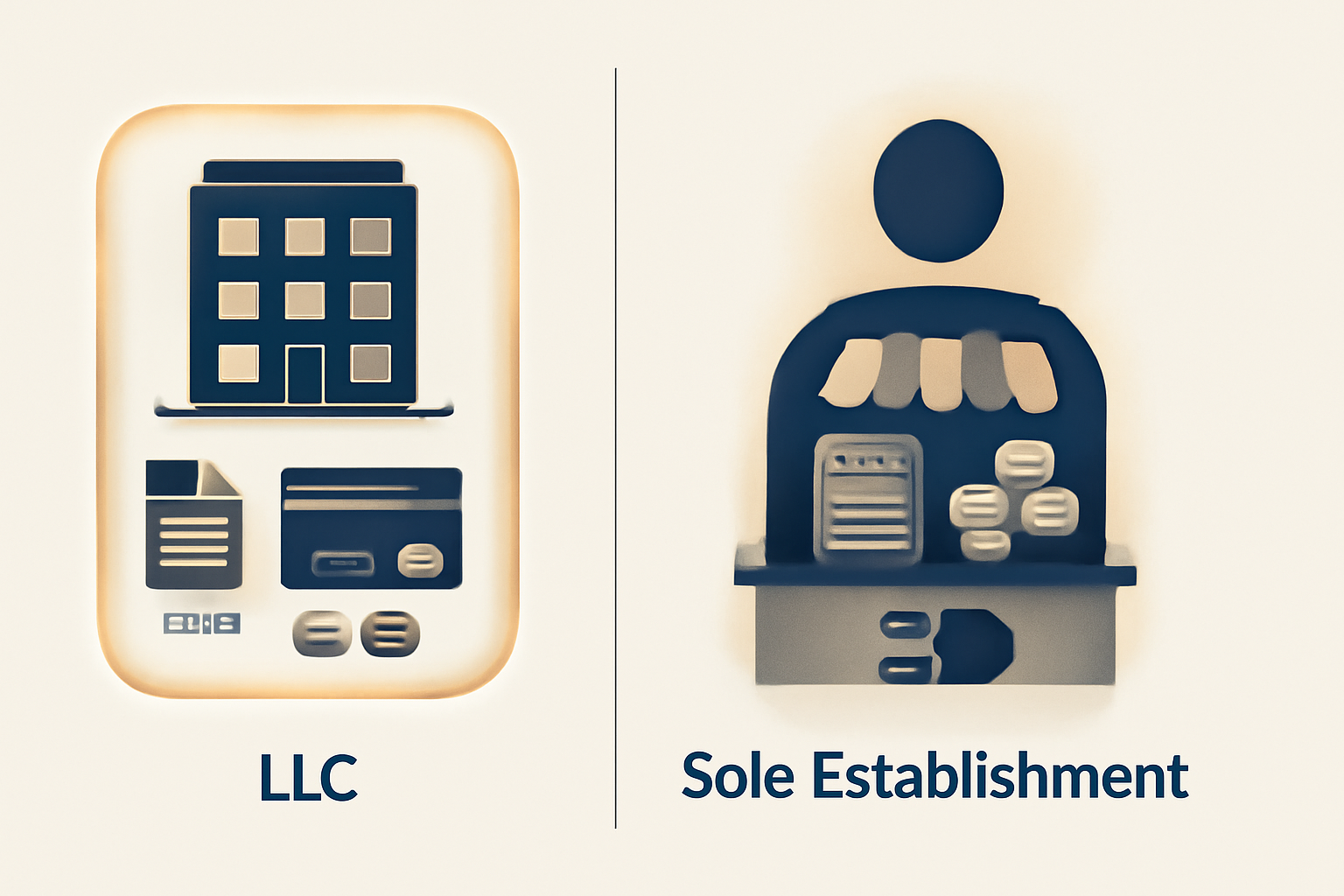
The core difference between an LLC and a sole establishment in the UAE — answering what is the difference between LLC and sole establishment in UAE — starts with legal identity. An LLC is a separate legal entity, so your personal assets stay apart from business debts. A sole establishment has no such separation: you and the business are legally the same person.
That is the answer most comparisons stop at. It is also the point where the practical questions begin — the ones that usually settle the matter. Will your biggest client sign a contract with an unincorporated business? Will the bank ask you to sign a personal guarantee anyway? Can you add a partner in year two without starting over?
This guide answers all three, then applies the same reasoning to common business types, so you choose a structure you can grow into rather than one you have to unwind.
Key Takeaways
- An LLC is a separate legal entity. It holds the licence, signs in its own name and can be sued in its own name. Shareholders are liable only up to the amount they have invested.
- A sole establishment is not separate from its owner. One person owns and operates it, keeps full control, and carries responsibility for its profits and liabilities.
- Liability is the first filter, not the only one. Vendor onboarding, tender documents and banking requirements often settle the choice before personal risk is even discussed.
- Either structure can involve a personal guarantee. Choosing an LLC does not stop a bank, landlord or supplier from asking you to sign personally on a specific facility or lease.
- Adding a partner means changing the legal form. Moving from a sole establishment to an LLC is generally possible, but treat it as a rebuild with fresh documents and approvals.
- Rules differ by emirate, free zone and activity. Ownership conditions, permitted activities, office requirements and conversion procedures all vary. Confirm the current position with the authority that licenses you.
What Is the Difference Between an LLC and a Sole Establishment in the UAE?
Separate legal identity, without the legalese
A separate legal entity is a business the law treats as its own person. It holds the trade licence, signs the lease, opens the bank account, employs staff, owns the equipment, and answers for its debts in its own name. When a claim lands on an LLC, the shareholders’ exposure stops at what they put in.
A sole establishment runs the other way. It is a business owned and operated by one person without forming a separate legal entity — which means the individual and the business are legally the same. There is no line between owner and business, so the owner is personally liable for all its debts and obligations (Meydan Free Zone).
This is why the sole establishment has long been a natural route for consultants, freelancers and other professionals offering specialised services under their own name. It is simple, it is theirs, and for many service businesses it works.
Side by side: LLC vs sole establishment
| Point of comparison | LLC | Sole establishment |
|---|---|---|
| Legal status | Separate legal entity | Not separate — owner and business are legally the same |
| Personal liability | Shareholders liable only up to the amount invested | Owner personally liable for all debts and obligations |
| Number of owners | One or more shareholders, subject to the licensing authority’s rules | One owner only |
| Day-to-day control | Held by the owner or an appointed manager, within the company’s constitutional documents | Held entirely by the owner |
| Adding a partner or investor | Generally possible through a share transfer or new share issue, subject to approvals | Normally requires a change of legal form or a new entity |
| Typical fit | Businesses planning to scale, hire, bid for larger contracts or raise investment | One-person professional practices trading under the owner’s own name |
| Setup complexity | Heavier — typically involves constitutional documents (a memorandum and articles of association) and additional approvals | Lighter — a single owner licensing an activity |
| Ongoing obligations | Corporate records, filings and governance requirements set by the authority | Simpler, tied mainly to the licence and the owner |
One terminology note that saves confusion later: authorities do not all use the same label. Some free zones issue licences under their own naming convention — an FZ-LLC, for instance — while the underlying principle, limited liability, is the same. Read your licence for what it actually says about ownership and liability, not for the acronym.
Two caveats before you build a decision on that table
Limited liability is not a force field. If you personally guarantee a loan or a lease, or if a specific law places a duty directly on an owner or manager, the separation does not shield you from that particular obligation. The principle holds broadly, but the detail depends on the contract in front of you — not on the label printed on your licence.
The table describes legal form, not paperwork. What you actually submit, and what it costs, depends on the authority licensing you and the activity you are licensed for. Treat the “typical fit” row as the start of a conversation with your advisor, not a verdict.
[Image placeholder 1 — suggested subject: side-by-side diagram showing an LLC as a separate legal entity with its own licence, bank account and liability boundary, next to a sole establishment where owner and business are the same legal person.]
Will Your Biggest Client Sign a Contract With a Sole Establishment?
This question quietly sinks more sole establishment plans than liability ever does.
A sole establishment is a properly licensed business, not an informal arrangement. But some counterparties look at the legal form standing behind the invoice rather than at how good your work is. Government entities, large corporates and any organisation with a formal procurement function typically run vendor onboarding that asks for your trade licence, your legal structure, your commercial registration details and sometimes your ownership information.
Tender documents and framework agreements are usually drafted with corporate entities in mind: an authorised signatory, a company stamp, a bank account in the company’s name. A sole establishment can sometimes satisfy those requests and sometimes cannot — it depends on the buyer’s internal policy, not on a rule that applies everywhere.
So do not guess. Before you choose a structure, ask your two or three biggest target clients one direct question: what do you need from a supplier before you can issue a purchase order? Most will tell you plainly, and their answer is worth more than any comparison article — including this one.
If your clients are private individuals and small businesses buying your time and expertise, a sole establishment is often perfectly workable. If your revenue depends on organisations with a procurement team, the corporate form of an LLC tends to make those conversations considerably shorter.
The one-email test
Write to your largest prospect before you file anything. Ask whether they can onboard a sole establishment as a vendor, and whether anything in their procurement policy requires a limited liability company. The reply usually arrives within days and removes months of doubt. It costs you nothing but a short email — and it is far cheaper than discovering the answer after you have paid for a licence, a visa and a year of renewals.
Will the Bank Ask You to Sign a Personal Guarantee Anyway?
Here is where the tidy “LLC protects you, sole establishment exposes you” story starts to bend.
A personal guarantee is a promise that you personally will repay a debt if the business does not. Banks commonly look to the people standing behind a small or newly formed company when deciding whether to lend, and a personal guarantee is one of the tools they use. The practical result: a founder who chose an LLC specifically for liability protection can still be asked to sign personally for a facility, a credit line or a commercial lease.
That does not make the LLC pointless. It means the protection applies to the company’s trading debts and legal claims — not automatically to every contract you sign in your own name. Company risk and personal contractual risk are different things, and it helps to keep them apart from day one.
Before you file anything, do three things:
- Talk to at least two banks about what they would need to open a corporate account for your activity, and whether a personal guarantee, deposit or other security would form part of that conversation.
- Read every lease and supplier contract as though the company were you — because for that particular contract, it might be.
- Ask what changes over time. Some banks ease their security expectations once a company has a trading history. Knowing the path in advance tells you whether the guarantee is permanent or a phase.
Account-opening requirements differ between banks, and between free zones and the mainland. Confirm current requirements directly with the bank you intend to use rather than relying on someone else’s experience from two years ago.
Can You Add a Partner Without Starting Over?
Founders ask this in month one. Far more wish they had asked it in month twelve.
Converting a sole establishment into an LLC is generally possible, but think of it as a rebuild rather than the flick of a switch. You are changing the legal form of the business. The exact procedure is set by the licensing authority, so verify it before you rely on it — but here is what the change typically touches:
- The licence itself, which must be amended or reissued in the new legal form.
- Constitutional documents, since an LLC is governed by a memorandum and articles of association that record shareholding and management.
- Existing contracts, which may need to be novated — meaning the new entity formally takes over the rights and obligations of the old one — so your clients are contracting with the right party.
- The bank mandate and account, which are tied to the legal entity that opened them.
- Registrations such as VAT and corporate tax, which sit with the entity and need updating if you are registered.
- Third-party records, including suppliers, marketplaces, insurers and anyone holding your registration details on file.
Expect this to take real calendar time, and expect some of it to happen while you are also running the business.
The alternative is not cheaper
Shutting the sole establishment and starting a new LLC carries its own friction: a new licence, a new bank account, new contract signatures, and a break in trading history that some clients and lenders will ask about.
Sequence matters. If you already know a co-founder is joining, or that you intend to raise investment, forming the LLC first is usually the shorter path. If you are testing a market alone with a low-risk service, starting lean and converting later can still make sense — provided you go in knowing the rebuild is part of the plan rather than a surprise.
[Image placeholder 2 — suggested subject: timeline graphic showing a sole establishment converting into an LLC, with labelled steps for licence amendment, constitutional documents, contract updates and bank mandate changes.]
A Decision Framework Mapped to Real Business Types
Generic advice is easy. Matching a structure to what you actually do is harder — so here is the same logic applied to common profiles. Treat these as starting positions rather than rulings, and confirm the detail with the authority licensing you.
| Your situation | Usually fits | Why | Watch out for |
|---|---|---|---|
| Freelance consultant or designer billing individuals and small businesses | Sole establishment | Low overhead, full control, one owner, limited third-party onboarding requirements | Corporate clients with procurement processes may ask for a corporate entity |
| Small agency chasing corporate retainers | LLC | Easier to pass vendor onboarding and sign framework agreements | Banking security and personal guarantees can still apply to you |
| E-commerce business selling to consumers in the UAE | LLC | Growth, hiring and marketplace onboarding are generally simpler | Marketplace and payment-provider requirements vary |
| Supplier to government or large contractors | LLC | Tender documents are typically written for corporate entities | Verify each client’s vendor requirements before you set up |
| Two or more founders from day one | LLC | Shareholding can reflect your agreed split from the start | A sole establishment cannot hold two owners |
| Business built around intellectual property or valuable assets | LLC | Assets and contracts sit with the company, not with you personally | Assignment of pre-existing intellectual property needs to be handled properly |
| Trading conducted entirely outside the UAE | Consider an offshore structure | A different instrument with a different purpose — often used to hold assets or trade internationally | Offshore entities generally cannot trade inside the local UAE market |
Mainland, Free Zone or Offshore: Two Decisions, Not One
Two separate choices get tangled together here, and untangling them makes everything simpler.
The first decision is legal form: LLC or sole establishment. The second is jurisdiction: where that business is licensed. A mainland jurisdiction means a licence issued through the emirate’s economic department, which lets you trade across the UAE and contract directly with government entities. A free zone licence is issued by a specific zone and governs how you may operate inside it and beyond it. Not every authority licenses both legal forms for every activity, so the two decisions interact — but they are still two decisions.
An offshore company is a different instrument altogether. It generally cannot trade inside the local market and is more often used for international trading, invoicing and asset holding. If that is closer to your plan, our guide to how to set up an offshore company in the UAE for trading walks through how it works and when it is the right tool.
The practical point: a sole establishment and an LLC can each exist on the mainland or in a free zone, subject to that authority’s rules and to your activity being permitted there. Answer “which legal form” first, then “which jurisdiction”, and the paperwork stops feeling arbitrary.
Beyond Liability: What Else Your Structure Decides
Liability gets the headlines. These four items show up in almost every formation conversation we have.
Who owns the assets. In an LLC, equipment, intellectual property and contracts generally sit with the company. In a sole establishment, they are yours personally — straightforward until you want to sell the business or bring in an investor.
Who signs the contracts. A company signs in its own name through an authorised signatory. That makes it easier to change who runs the business without re-papering every agreement your clients hold.
Sponsorship and visas. To sponsor residence visas for yourself or your staff, you need your trade licence plus an establishment card — the immigration document that registers your company with the immigration authority so it can hold a visa quota. It is a separate step from licensing, and it needs to be in place before you can hire properly. Your quota depends on your licence, your office arrangement and your jurisdiction.
What happens when ownership changes. Bringing in a partner, transferring shares or exiting is a governance exercise in an LLC, handled through the company’s constitutional documents. In a sole establishment, the business is tied to one person, which makes succession and transition questions harder to answer cleanly.
Common Mistakes That Force a Restructure in Year Two
Most forced restructures trace back to one of these.
Choosing on cost alone. The cheaper licence today can be the expensive one when it blocks the client you were planning to win.
Assuming the liability shield covers every signature. If you guarantee a lease personally, the shield does not apply to that lease. Structure does not replace reading the contract.
Not asking clients first. One email to your biggest prospect answers the “will they sign with me?” question better than any article can.
Postponing the partner conversation. If another founder is even a possibility, raise it before you file, not after.
Treating requirements as universal. Ownership conditions, permitted activities, office requirements and conversion procedures differ by emirate, free zone and activity. What worked for a friend in a different zone may not apply to you.
Forgetting the establishment card. Licensing the company and registering it for immigration are separate steps. Skipping the second one delays every hire you make.
What to Verify Before You File
Work through this checklist and get the answers in writing where you can:
- Your activity. Confirm the exact activity you will be licensed for, and whether a sole establishment is permitted to carry it out in your chosen jurisdiction.
- Ownership rules. Check the nationality and ownership conditions that apply to your activity and jurisdiction. These have changed in recent years and vary widely, so use the licensing authority’s own published guidance rather than second-hand summaries.
- Vendor requirements. Ask your target clients what they need before they will issue a purchase order.
- Banking. Speak to the bank you plan to use about account opening for your activity, and about guarantee or security expectations.
- Growth plan. Decide now whether a partner or investor may join within the next two years.
- Conversion path. Ask the authority what changing legal form later would involve, so the answer is known before you need it.
- Costs and timelines. Request the current fee schedule and processing times directly from the licensing authority. These change, and the authority’s own published information is the reliable source.
How We Help You Choose Once and Move On
Choosing a structure is not a research exercise — it is a decision that should still look sensible in year three. If you are still weighing what is the difference between LLC and sole establishment in UAE, the answer depends on your plan, not our paperwork.
At Al Ain Business Center, we start with your plan, not our paperwork: what you sell, who buys it, whether you will hire, and whether anyone else will own a share. From there we recommend a legal form and a jurisdiction, explain the trade-offs in plain English, and set out our fees in AED upfront before any work begins — so nothing lands as a surprise on an invoice later. Where your activity allows 100% foreign ownership, we confirm that for your specific case rather than assuming it applies to you.
Then we handle the process: licensing, documentation, approvals, the establishment card, and PRO services — the government liaison work that keeps renewals and filings on schedule. You get one point of contact and a clear view of what happens next.
If you would rather test an idea lean before committing to a corporate structure, we will tell you that too. Good advice sometimes means recommending a smaller setup than you walked in asking for, and we would rather you grow into a structure than out of one. When a client asks
Frequently Asked Questions About What Is The Difference Between Llc And Sole Establishment In Uae
Can a foreign national own 100% of an LLC in the UAE?
The article does not set out ownership percentages for foreign nationals, because ownership conditions differ by emirate, free zone and activity. It advises confirming the current position with the authority that licenses you before you file.
Can a sole establishment have more than one owner?
No. A sole establishment has one owner only and is owned and operated by a single person without forming a separate legal entity. Adding a partner generally requires changing the legal form or forming a new entity.
Can I convert my sole establishment into an LLC later?
Conversion is generally possible, but treat it as a rebuild rather than a simple switch. It typically involves amending or reissuing the licence, creating constitutional documents, updating contracts, the bank mandate, and registrations such as VAT and corporate tax. The exact procedure is set by your licensing authority.
Which is cheaper to set up in Dubai — an LLC or a sole establishment?
The article does not give figures but describes setup complexity: an LLC is heavier, typically involving constitutional documents and additional approvals, while a sole establishment is lighter, with a single owner licensing an activity. Actual cost depends on the authority licensing you and your activity.
Is a sole establishment liable for UAE corporate tax?
The article does not address corporate tax liability directly. It notes that registrations such as corporate tax sit with the entity and need updating if a sole establishment converts into an LLC. Verify your position with the relevant authority or a tax advisor.
Which structure is better for freelancers and consultants in the UAE?
A sole establishment has long been a natural route for consultants, freelancers and professionals offering specialised services under their own name, and it is often workable when clients are private individuals and small businesses. If your revenue depends on organisations with a procurement function, an LLC tends to make vendor onboarding easier.
Can a sole establishment sponsor visas for employees and family?
The article does not cover visa sponsorship for employees or family members. Visa rules vary by emirate, free zone and activity, so confirm current requirements with the authority that licenses you.
Still have a question?
Every situation has its own details. Tell us what you are planning and we will come back to you with the specifics for your case.
Related articles
 Business Setup
 Business Setup
 Business Setup
 Business Setup
 Business Setup
 Business Setup
Latest guides
- 2-Year Residence Visa Renewal UAE Cost: 2026 Fee Breakdown
- Housemaid Visa Abu Dhabi: Cost, Steps and Requirements
- Green Visa UAE: Requirements, Costs and How to Apply
- UAE Visit Visa Categories for Technology & AI Talent
- Business Visa in UAE 2026: Types, Costs and How to Apply
- Visa-Free Countries for UAE Residents With Pakistani Passports