
Think of a Dubai virtual office as your company’s professional storefront in the UAE, without the eye-watering price tag of a physical office. It gives your business a prestigious physical address and all the essential office services you need, but without the commitment of a long-term lease. It's the smart way to establish a solid presence here, allowing you to register your company and get your trade license while you run your business from literally anywhere on the globe.
Your Business Presence in the UAE Without the Physical Office
Picture this: your business has a prime address in a well-known Dubai tower. You have a dedicated local phone number and a team handling your mail, but you haven't paid a single dirham in rent or utilities for an actual office. That's the magic of a Dubai virtual office. It provides all the front-facing infrastructure of a traditional office, while you and your team stay flexible and work remotely.
But this isn't just about looking good on paper. It's a fully legal and recognised solution for company formation in Dubai. For countless entrepreneurs, freelancers, and international companies looking to test the waters, a virtual office is the key that unlocks the UAE market. It’s a budget-friendly way to meet the legal requirement for a registered address—something you absolutely need to get a trade license from authorities like the Department of Economy and Tourism (DET).
Core Components of a Virtual Office Package
While different providers offer various bells and whistles, most Dubai virtual office packages, like the ones we offer at Al Ain Business Center, are built around a few core essentials. These services work together to give your business a polished and professional identity right from the start.
- A Prestigious Business Address: Your company gets a real, physical address in a recognised commercial district. You can proudly display this on your website, business cards, and all your official paperwork.
- Mail Handling and Forwarding: No need to worry about missing important documents. All mail and packages sent to your address are received, sorted, and can be forwarded to you, wherever you are in the world.
- A Dedicated Phone Number: You'll get a local Dubai phone number, often with professional call answering and forwarding. This ensures you never miss a client call and maintain a local presence.
- On-Demand Meeting Room Access: Need to meet a client face-to-face? Many packages include access to fully equipped meeting rooms and boardrooms, so you can host professional meetings whenever the need arises.
A critical piece of the puzzle, especially for mainland business setups, is the Ejari certificate. This is a government-issued document that legally registers your tenancy contract—even for a virtual space—and is mandatory for getting and renewing your trade license.
Who Benefits Most From This Model?
The sheer flexibility of a Dubai virtual office makes it a perfect fit for a whole range of businesses. Think about a UK-based e-commerce brand wanting to tap into the UAE market. They can use a virtual office to set up a local returns address and a customer service line, which instantly boosts their credibility with local customers.
Or consider a solo consultant who needs a professional address to look legitimate but doesn't want the financial drain of renting an office. A virtual office provides an agile, scalable foundation to build and grow a business in one of the most competitive hubs in the world.
Choosing Between Mainland and Free Zone Virtual Offices
Picking the right spot for your Dubai virtual office is more than just getting a fancy address; it’s one of the first big strategic calls you'll make. This decision shapes how you can operate, who you can sell to, and how your business can grow. In Dubai, it all comes down to two main paths: setting up on the Mainland or in a Free Zone.
Think of it this way: a Mainland virtual office is your all-access pass to the entire UAE market. It lets you trade, sell, and work with anyone, anywhere in the country. A Free Zone virtual office, however, is more like a specialised VIP ticket for global trade, often coming with unique perks like 100% foreign ownership.
Understanding the Mainland Option
If your business plan involves selling directly to customers in Dubai, Abu Dhabi, or anywhere else in the UAE, a Mainland setup is your go-to. This is the path for businesses that want to bid on government contracts, open a physical shop, or invoice local clients without any restrictions.
But this freedom comes with its own set of rules. For years, setting up a Mainland company meant you needed a local Emirati partner who would hold 51% of the shares. While recent reforms have opened things up for many industries, some key sectors still have these ownership rules. Crucially, your trade license is tied directly to a registered tenancy contract, known as an Ejari.
For a Mainland business, a valid Ejari is non-negotiable. It's the official registration of your tenancy contract with the Dubai Land Department and a mandatory requirement for your trade license application and renewal. Al Ain Business Center ensures all our virtual office packages are fully compliant and provide the necessary documentation.
Exploring the Free Zone Advantage
Free Zones are special economic areas, each with its own independent governing authority and regulations, all designed to pull in foreign investment. The UAE has over 45 of these zones, and many are tailored to specific industries—think tech hubs, media cities, and commodity centres.
Choosing a virtual office in a Free Zone has some serious benefits, with the headline act being 100% foreign ownership. No local sponsor needed. This makes it the perfect setup for entrepreneurs focused on international trade, consulting, or providing services to clients outside the UAE. On top of that, you often get tax exemptions and much simpler import-export rules.
The boom in Dubai's virtual office scene is directly linked to the explosive growth in new companies setting up shop, especially in free zones. Just look at the Dubai International Financial Centre (DIFC), which registered 1,081 new active companies in the first half of 2025 alone—that’s a 32% jump from the same period in 2024. This shows just how many businesses are using flexible office solutions to meet regulations while keeping their physical overheads low.
Side-By-Side Comparison
So, how do you decide? The best way is to see them lined up against each other. Each option has clear strengths depending on what your business actually does and where you want it to go.
To help you get a clear picture, we’ve put together a quick comparison table. For an even more detailed breakdown, our comprehensive guide on Free Zone vs Mainland Dubai offers a deeper analysis.
Mainland vs. Free Zone Virtual Office Comparison
| Feature | Mainland Virtual Office | Free Zone Virtual Office |
|---|---|---|
| Market Access | Unrestricted access to the entire UAE local market. | Primarily for trade within the free zone and internationally. |
| Business Scope | Can conduct business and open branches anywhere in the UAE. | Operations are generally restricted to the specific free zone. |
| Ownership | May require a local sponsor for certain strategic activities. | Allows for 100% foreign ownership, providing full control. |
| Visa Eligibility | Generally offers a higher potential for employee and investor visas. | Visa eligibility can be more limited and is tied to the zone's rules. |
| Approvals | Requires approvals from the Department of Economy and Tourism (DET). | Governed by the authority of the specific free zone where it is located. |
| Best For | Businesses targeting the local UAE customer base and government tenders. | International trading companies, consultants, and global service providers. |
Ultimately, the right choice hinges on your business model. If you’re here to conquer the local market, Mainland is likely your best bet. If your sights are set on the global stage, a Free Zone offers incredible flexibility and control.
The Strategic Benefits of a Virtual Office
Opting for a Dubai virtual office is much more than a simple cost-saving tactic; it's a strategic play to build a professional, resilient business right from the start. It gives you the power to project a strong corporate image with a prestigious address in a prime business district, immediately elevating your credibility with clients, partners, and even banks.
Think about a European tech startup trying to crack the Middle Eastern market. Renting a physical office in Downtown Dubai would cost a small fortune, locking them into a long-term lease before they've even landed their first client. A virtual office, on the other hand, lets them establish a credible presence instantly, test the waters, and build key relationships—all with maximum agility and minimal financial exposure.
Slashing Overheads for Smarter Growth
The most immediate win is the massive cut in overheads. A traditional office lease comes with a laundry list of recurring expenses that can bleed a startup or SME dry. A virtual office practically wipes these off the books.
- No Commercial Rent: Steer clear of the steep costs of leasing prime office space in Dubai.
- Zero Utility Bills: Forget about paying for electricity, water, and high-speed internet.
- Reduced Staffing Costs: You won't need a full-time receptionist or administrative staff.
This newfound financial freedom means you can funnel capital where it actually counts—into marketing, product development, or expanding your team. You get all the benefits of professional infrastructure without the financial weight, creating a lean and efficient way to operate.
This visual guide can help you figure out if your business goals lean more towards the local UAE market or global trade, which in turn guides your office choice.
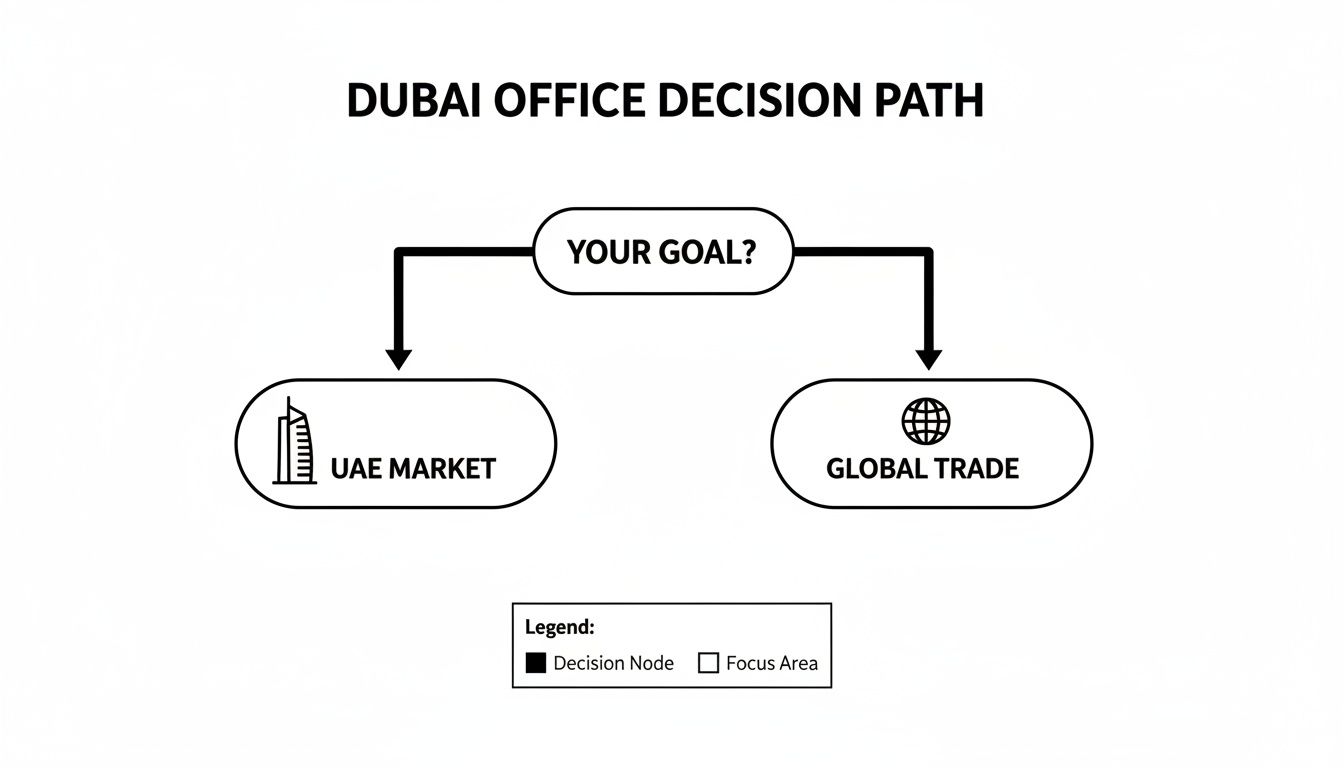
As the decision path shows, businesses aiming for local UAE customers typically require a Mainland setup. In contrast, those with an eye on international operations are often a better fit for a Free Zone.
Unlocking Unmatched Operational Flexibility
A virtual office frees your business from being tied to a single physical spot, offering incredible flexibility for modern work. Your team can be spread across the globe, collaborating digitally, while your business maintains a professional, centralised hub in Dubai. It's the perfect model for digital nomads, international consultants, and companies that have fully embraced remote work.
It also makes scaling up a breeze. As your business grows, you're not held back by the four walls of an office. You can expand your team and operations without the logistical headache of finding a new, bigger space, making growth feel much smoother and more sustainable.
This flexibility is a huge reason for the market's growth. Between 2024 and 2032, Dubai is expected to lead the UAE's flexible office space market. This trend is driven by the city's unique business landscape, where SMEs make up about 95% of all companies and contribute around 40% to the GDP. For these businesses, sky-high commercial rents make a virtual office an essential tool for securing a trade-licence-compliant address without the crippling expense. You can read more about the rise of flexible office spaces in the UAE.
A virtual office isn't just a mailing address; it's a launchpad. It provides the essential legal and professional framework—including a verifiable address for your trade license—that allows a new business to operate legitimately in the UAE from day one.
With a solution from Al Ain Business Center, you get far more than an address. You gain a strategic partner committed to providing a fully compliant foundation, complete with the necessary Ejari documentation, so you can focus on what you do best: building your business.
So, What Are the Catches? Understanding the Limitations and How to Navigate Them
While a Dubai virtual office offers incredible flexibility and a way to slash overheads, it's not a magic wand for every corporate need. Thinking of it that way can lead you straight into some frustrating roadblocks later on. It’s far better to know the boundaries from the get-go so you can build a sustainable, compliant business from day one.
The two biggest hurdles you might face are tied to residence visas and opening a corporate bank account. A basic virtual office package is a brilliant tool for getting your company registered, but it doesn't automatically grant you all the same perks as a physical office. Let’s break down what that really means and how you can navigate these challenges.
The Reality of Residence Visas
One of the most common myths is that any virtual office will automatically qualify you for a UAE residence visa. That's simply not true. Your eligibility for an investor or employee visa is often directly linked to the physical footprint of your business. Government authorities want to see a real, tangible commitment to the local economy, and a simple virtual address doesn't always cut it.
This is especially true in the free zones. Many of them tie their visa quotas directly to the amount of physical office space a company leases. A basic virtual office or a flexi-desk package might get you your trade licence, but it could come with zero visa allocation.
So, what are your options?
- Upgrade Your Package: This is often the simplest fix. Many providers, including us at Al Ain Business Center, offer different tiers. Moving up to a dedicated desk or a small private office within our centre usually ticks the box for visa eligibility.
- Choose the Right Jurisdiction: Not all free zones are created equal. Some are more flexible than others when it comes to visa allocations for virtual setups. A little research upfront into which zones align with your visa needs is a critical first step.
- Get Expert Advice: Before you sign anything, have a chat with a business setup consultant. We can point you towards the right package and jurisdiction, making sure there are no nasty surprises waiting for you down the line.
Taking a proactive approach here will save you from the painful scenario of having a registered company but no legal way to live in the UAE to run it.
Navigating Corporate Bank Account Approvals
Opening a corporate bank account in the UAE with just a virtual office can be another tricky area. UAE banks are under strict "Know Your Customer" (KYC) and Anti-Money Laundering (AML) regulations. They need to be absolutely sure that your business is a legitimate, functioning entity, and the lack of a physical office can sometimes raise a red flag.
The bank’s main concern boils down to one word: substance. They’re looking for solid proof that your company has a genuine presence and isn't just a "mailbox company." A virtual address on its own might lead to extra questions, more paperwork, or even a flat-out rejection from some banks.
Banks in the UAE are increasingly focused on the "substance" of a business. This means they are looking for proof of real economic activity, a clear business plan, and a verifiable operational base—elements that a basic virtual office address might not sufficiently demonstrate on its own.
To get your account opened, you need to build a stronger case. This means coming prepared with a detailed business plan, proof of your professional background, and any documents demonstrating your ties to the UAE. Having an official Ejari for a mainland setup or a proper tenancy contract from a reputable free zone provider can make a world of difference.
At Al Ain Business Center, we provide fully compliant documentation to support you through this crucial step. By preparing thoroughly and partnering with a provider who gets what the banks are looking for, you can get through this process without a hitch.
Your Step-By-Step Setup Guide

Getting your Dubai virtual office up and running shouldn't feel like navigating a maze. When you break it down into a few clear stages, the whole process becomes straightforward and manageable. Think of it less as a confusing journey and more like a simple checklist.
The entire setup really boils down to four key milestones. It starts with you, figuring out what your business actually needs. From there, you'll choose a provider and package that fits the bill. Then comes the paperwork, and finally, you get that all-important tenancy contract—the document that unlocks your trade license.
Following these steps isn't just about ticking boxes; it's about building your business on a solid, compliant foundation right from the get-go.
Step 1: Define Your Business Needs
Before you even glance at a provider's website, take a moment for some honest self-assessment. This is the most important step because it stops you from paying for features you'll never use or, worse, picking a package that doesn't meet your core requirements.
To get a clear picture, ask yourself a few direct questions:
- What is my core business activity? A freelance consultant has wildly different needs from an e-commerce brand.
- Will I need to meet clients face-to-face? If the answer is yes, then having access to professional meeting rooms is non-negotiable.
- Is a residency visa part of my plan? This is a huge one. Not all virtual office setups support visa applications, so it’s a critical filter.
- What’s my budget? Having a realistic number in mind makes it much easier to narrow the field.
Answering these gives you a solid blueprint. With that clarity, you can evaluate different providers and packages with confidence, knowing exactly what you're looking for.
Step 2: Select Your Provider And Package
With your blueprint in hand, you can start comparing Dubai virtual office providers effectively. Look past the flashy headline price and dig into what’s actually included. A great provider like Al Ain Business Center will be transparent, with all-inclusive packages that spell out exactly what you get for your money.
This is also where you'll make the big decision between a Mainland or Free Zone location, which directly impacts who you can do business with. Once you've found a provider that feels like a genuine partner, select the service package that aligns with the needs you defined in Step 1. Make sure it covers the essentials like mail handling, a local phone number, and—most importantly—the official documentation needed for your business license. To get a better handle on the costs involved, check out our detailed guide on the Dubai business license cost.
Step 3: Complete The Necessary Paperwork
After you've locked in your package, it's time to handle the documentation. A professional provider will make this part feel effortless. Generally, you’ll only need to submit a few key documents to move forward.
- Passport Copy: A clear, valid copy for the business owner.
- Trade Name Reservation: Proof that your chosen company name has been approved and reserved.
- Initial Approval Certificate: This is the official nod from the relevant authority (like the DET for Mainland) confirming your business activity is permitted.
Your provider should be there to guide you, ensuring every form is filled out correctly and sent to the right people. It’s this attention to detail that prevents frustrating delays and keeps your setup moving forward smoothly.
Step 4: Receive Your Official Tenancy Contract
This is the finish line—the most rewarding step of all. Once your documents are processed and payment is sorted, you’ll be issued your official tenancy contract. If you're setting up on the Mainland, this will be your government-attested Ejari certificate.
This document isn't just a piece of paper; it's the legal cornerstone of your company's presence in Dubai, proving you have a registered physical address.
With your contract in hand, you’re ready to tackle the final stages of your trade license application, open your corporate bank account, and officially start doing business. It’s the moment your company’s professional footprint in the UAE becomes a reality.
How to Choose the Right Virtual Office Provider
Picking a provider for your Dubai virtual office is a foundational business decision, not just another item to tick off your list. The right partner gives you a legitimate, compliant address that fuels your growth. The wrong one? It can lead to legal nightmares and operational dead ends. You've got to look past the flashy price tags to find a provider that's truly in your corner.
Your choice has a direct impact on your ability to get a trade license, open a bank account, and operate without any hiccups. It’s about making sure the address on your business card is more than just a mailbox—it needs to be a real, verifiable commercial spot that ticks all the UAE's regulatory boxes.
Verifying Address Legitimacy
First things first: you absolutely must confirm the physical address is a genuine, commercial location. Some of the rock-bottom priced providers might offer you an address in a residential building or an unapproved zone, which is a surefire way to get your trade license application rejected on the spot.
A legitimate provider will always be upfront about their location. You need to do your own homework:
- Google the Address: A quick search can tell you if it's a known business centre or a questionable spot.
- Ask for Proof: Don't be shy. Request photos of the building, the reception desk, and any meeting rooms they have.
- Check for Professional Signage: A reputable centre will have clear branding and look the part.
A provider’s willingness to be transparent about their physical location is a massive indicator of their credibility. If they get cagey about sharing details or photos, take that as a major red flag.
The Ejari Non-Negotiable
For any business setting up on the Mainland, being able to issue a valid Ejari is completely non-negotiable. An Ejari is the official registration of your tenancy contract with the Dubai Land Department (RERA), and you'll need it for your trade license application and every renewal. It's mandatory.
The catch is, not all virtual office providers are actually authorised or set up to issue one. Before you sign anything, ask them a straight-up question: "Can you provide a government-attested Ejari certificate for this virtual office package?" If you get anything less than a confident "yes," you should walk away. This single piece of paper is the key to your company's legal footing on the Mainland.
Evaluating Support Services and Expertise
A virtual office should be more than just an address; it’s your support system. The quality of the team behind the provider can make a world of difference in your day-to-day operations and your entire setup experience.
Get a feel for their capabilities by looking at these points:
- Responsiveness: How quickly and professionally do they get back to your initial questions? This is often a little preview of the service you'll get once you're a client.
- Scope of Services: Do they just offer the basics? Look for valuable extras like a professional call answering service, mail forwarding with prompt notifications, and easy access to meeting rooms.
- Knowledge and Guidance: Can they answer your real-world questions about business setup, visa rules, and banking needs? An experienced provider gets the whole picture. For instance, our team can explain exactly how a virtual office fits into the wider world of PRO services in the UAE, making sure your journey is smooth from A to Z.
Ultimately, choosing a provider like Al Ain Business Center isn't just about renting an address. It's about partnering with a team that's invested in your long-term success, giving you the compliance, support, and professional image your business deserves to thrive in Dubai.
Frequently Asked Questions
When you're looking at setting up a business in a new country, a lot of questions pop up. It's completely normal. We get asked about the nuts and bolts of a Dubai virtual office all the time, so we've put together some straight-to-the-point answers to help clear things up and get you moving forward with confidence.
Can I Get a Residence Visa with a Virtual Office?
This is probably the most important question we get, and the answer needs a bit of explanation. A standard, basic virtual office package on its own will not get you a UAE residence visa. That’s the simple truth.
Visa eligibility is almost always linked to having some form of physical presence. Free zones, for example, often tie the number of visas a company can have to the amount of actual office space it leases. So, a simple virtual address gets your business a trade license, but it typically comes with a zero visa allocation.
But that doesn't mean you're out of options. You can:
- Upgrade your package: Many providers, including us here at Al Ain Business Center, have different tiers. Simply moving up to a dedicated desk or a small private office is often all it takes to meet the requirements for a visa.
- Opt for a visa-inclusive package: Some business setup bundles are specifically created to package a compliant office solution with one or more residence visas right from the start.
The key takeaway? You absolutely must clarify visa eligibility with your provider before you sign anything.
Is Opening a Bank Account Difficult?
It can be a bit of a hurdle, but it’s definitely not impossible. UAE banks are under strict regulations and have a duty to verify the "substance" of your business—they want to see proof that you're a real, operating company, not just a mailbox. A virtual address by itself can sometimes raise a red flag and lead to more questions.
To make it a smooth process, you need to be prepared. A solid business plan, your professional credentials, and—most importantly—a legitimate tenancy contract are your best tools. For a mainland company, a valid Ejari certificate is the gold standard that banks are looking for. Working with a credible provider who ensures your paperwork is 100% compliant makes a world of difference here.
What is an Ejari and Is It Always Required?
Ejari literally means "my rent" in Arabic, and it's the official government system for registering all tenancy contracts in Dubai. If you're setting up a mainland business, an Ejari is non-negotiable. It's a legal requirement to get your trade license and to renew it each year.
Things work a bit differently in the free zones. Each free zone has its own authority and might have its own internal leasing and registration system. However, for any business that plans to operate directly within the wider UAE market, the Ejari is the official document that proves your business address is legitimate.
What Is the Typical Cost for a Dubai Virtual Office?
The price can swing quite a bit depending on the provider, how prestigious the address is, and what's included in the package. A bare-bones package with just a business address and mail handling might start as low as AED 3,000 to AED 5,000 a year.
If you’re looking for more, like a dedicated phone number, call answering services, and access to meeting rooms, you're likely looking at a range of AED 8,000 to AED 15,000 annually, or sometimes more. It’s always best to ask for a clear breakdown of what’s included to make sure there are no hidden fees and that the package truly fits what your business needs.
At Al Ain Business Center, we offer transparent, all-in-one virtual office solutions built for real growth and full compliance. Contact us today to find the perfect setup for your business journey in Dubai.