
Starting a business in Dubai can feel like navigating a maze, but it doesn't have to be a solo mission. Think of professional company formation services in Dubai as your expert guide, handling every critical detail—from licences to visas—so you can pour your energy into your business vision.
Launching Your Business in Dubai's Thriving Market
Trying to set up a company in Dubai on your own is a bit like trying to build a high-performance car from scratch. You could spend ages sourcing every single part and trying to decipher complex manuals, or you could bring in a specialist team that knows exactly which components work together to make the engine roar from day one. That's what company formation services do; they're your master mechanics for building a successful business in the UAE.
These experts take the guesswork and administrative headaches off your plate, turning what could be an overwhelming process into a clear, manageable plan. Instead of losing weeks trying to figure out government portals and legal paperwork, you get a partner who handles it all.

Why Expert Guidance is Essential
Dubai's business scene isn't just growing; it's exploding with opportunity. This rapid expansion creates incredible potential, but it also adds layers of complexity. One of the first major decisions you'll face is choosing the right jurisdiction for your business. The two main paths are:
- Dubai Mainland: This setup is your ticket to trading directly within the entire UAE market without any restrictions. It's the perfect choice for businesses aiming to work with local consumers, other Emirati companies, or government bodies.
- Dubai Free Zone: These are special economic areas that offer compelling perks like 100% foreign ownership and major tax exemptions. Free zones are tailor-made for international trade and specific industries like technology, media, or logistics.
Choosing between the Mainland and a Free Zone is a foundational decision that will shape your company's future. An expert consultant brings the strategic insight needed to match your business model with the right legal framework, helping you sidestep costly mistakes from the very beginning.
Dubai's pro-business policies have turned it into a magnet for global entrepreneurs. The sheer volume of new companies highlights just how crucial an efficient, expert-led setup process is to get in on the action quickly.
Capitalising on a Booming Market
The demand for straightforward business setup support has skyrocketed. Between 2023 and 2025, Dubai saw more than 350,000 new business registrations, a powerful testament to its dynamic economic climate. In the first half of 2025 alone, over 35,000 new companies joined the Dubai Chamber of Commerce, showing the incredible pace of growth.
You can learn more about the trends shaping Dubai's entrepreneurial future on. This flood of new ventures means that getting started quickly and correctly is more important than ever. With the right support, you can navigate this bustling market and set your business up for success.
Choosing Your Business Habitat: Mainland vs. Free Zone
One of the very first, and most critical, decisions you'll make when starting a business in Dubai is choosing its "habitat." This choice dictates where your company can legally operate, who it can do business with, and the rules it has to play by. Think of it like deciding whether to build your new shop in the middle of a bustling city centre or in a specialised, self-contained community.
The two main paths are a Dubai Mainland setup or a Dubai Free Zone setup. Each one offers a completely different set of advantages, and the right one for you depends entirely on your business model. This decision isn't just a piece of paper; it directly shapes your company's operational freedom, ownership structure, and long-term potential.
A simple analogy helps clear things up. Picture the Mainland as an open savanna. Your business can roam freely, hunt for opportunities anywhere in the UAE, and trade directly with local customers, other businesses, and even government bodies. There are no geographical fences holding back your commercial activities within the country.
A Free Zone, on the other hand, is more like a specialised ecosystem—think of a high-tech greenhouse or a coral reef. It’s a designated area with its own unique rules, perfectly designed to support specific types of life, or in this case, specific industries. These zones are built for international trade, offering huge perks like 100% foreign ownership and major tax exemptions.
The Dubai Mainland Advantage
Opting for a Mainland company gives you the keys to the entire UAE market. This is the go-to choice if your primary customers are right here, within the country. You can set up your office anywhere in Dubai, whether it's a high-rise on Sheikh Zayed Road or a warehouse in Al Quoz, and you can invoice any client across the seven emirates directly.
What's more, Mainland companies are the only ones eligible to bid for lucrative government contracts. This makes it the default choice for businesses in construction, supply, and other sectors that work hand-in-hand with public entities. For entrepreneurs looking to build a powerful local brand and scale within the domestic market, the Mainland offers a level of flexibility that's tough to beat.
The Power of Dubai Free Zones
Free Zones are a different world. They operate under their own regulations, separate from the Mainland's legal framework. Dubai has over 40 of them, and each is often tailored to a specific industry—like media, tech, healthcare, or commodities. The benefits that pull in global entrepreneurs are seriously compelling:
- Complete Foreign Ownership: You keep 100% ownership of your company. No local partner needed.
- Tax Exemptions: Most free zones offer zero corporate and personal income taxes.
- Profit Repatriation: You can send 100% of your profits and capital back home without any restrictions.
- Customs Privileges: If you're in the import/export game, you'll benefit from much simpler customs procedures.
This structure is a perfect fit for businesses focused on international trade, consulting firms with a global client base, or e-commerce companies serving customers outside the UAE.
The growth of these zones has completely reshaped Dubai's economy. Just look at the Dubai Multi Commodities Centre (DMCC)—it registered over 1,100 new companies in the first half of 2025 alone, bringing its community to nearly 26,000 firms. As a strategic growth engine, DMCC is thought to contribute about 15% of Dubai’s annual foreign direct investment. You can read more about DMCC's impressive growth on.
Choosing between Mainland and Free Zone isn't just a legal formality; it's a strategic decision that defines your company's operational DNA. Aligning your business goals with the right jurisdiction from day one is the cornerstone of a successful launch in Dubai.
Dubai Mainland vs Free Zone At a Glance
Making the right call means understanding the real-world differences. While both paths get you a valid trade licence, they create very different operational frameworks that will impact everything from where you can have your office to how many visas you can get.
For a deeper dive, our comprehensive guide on Free Zone vs Mainland Dubai breaks it all down to help you make an informed decision.
But for now, here’s a quick overview to see the core features side-by-side.
| Feature | Dubai Mainland | Dubai Free Zone |
|---|---|---|
| Market Access | Unrestricted trade across the entire UAE and internationally. | Primarily for international trade; local trade often requires a distributor. |
| Ownership | 100% foreign ownership is now available for most business activities. | 100% foreign ownership is a standard feature for all companies. |
| Office Location | Can be located anywhere in Dubai, in any commercial district. | Must be located within the specific free zone's geographical boundaries. |
| Govt. Contracts | Fully eligible to bid on and work with UAE government projects. | Generally not eligible to work directly with government bodies. |
| Visa Eligibility | Typically unlimited, based on the size of your physical office space. | Limited number of visas allocated based on the package chosen. |
Ultimately, this is where professional company formation services in Dubai come in. An expert can analyse your business plan and recommend the habitat where your venture won't just survive, but truly thrive.
Securing Your Dubai Trade License
Think of your trade license as your company's official passport. It’s not just a formality; it's the legal document that spells out precisely what your business is allowed to do and where it can operate. Getting this right from the very beginning is absolutely critical. Choosing the wrong license can lead to serious headaches, from hefty fines and operational roadblocks to, in the worst-case scenario, having your business activities shut down.
Picking the correct license is the foundation of your entire company structure. It's like finalising the blueprint before you start building a house—everything else depends on it. The Dubai authorities have a massive list of specific business activities, and your license must perfectly align with the services you plan to offer. This is exactly where professional company formation services in Dubai prove their worth, helping you navigate the official lists to ensure you're compliant from day one.
The Three Core License Types Explained
In Dubai, business licenses generally fall into three main categories, each tailored for a different type of business. Getting a handle on these distinctions is your first real step toward making the right call for your venture.
-
Commercial License: This is your go-to for any business that involves trading, buying, or selling goods. It covers a huge range of activities, from general trading and e-commerce to real estate and logistics. If your business model is built around physical products, you'll almost certainly need a Commercial License.
-
Professional License: This license is built for service-based businesses and skilled professionals. Think consultancies, artisans, medical clinics, law firms, and educational providers. It's all about your intellectual skill or artistic talent, not about trading tangible goods.
-
Industrial License: As you might guess, this one is for any business involved in manufacturing, processing, or other industrial activities. This includes factories, production plants, and assembly units that turn raw materials into finished products.
This simple flowchart can help you visualise that initial big decision: where should you set up shop?
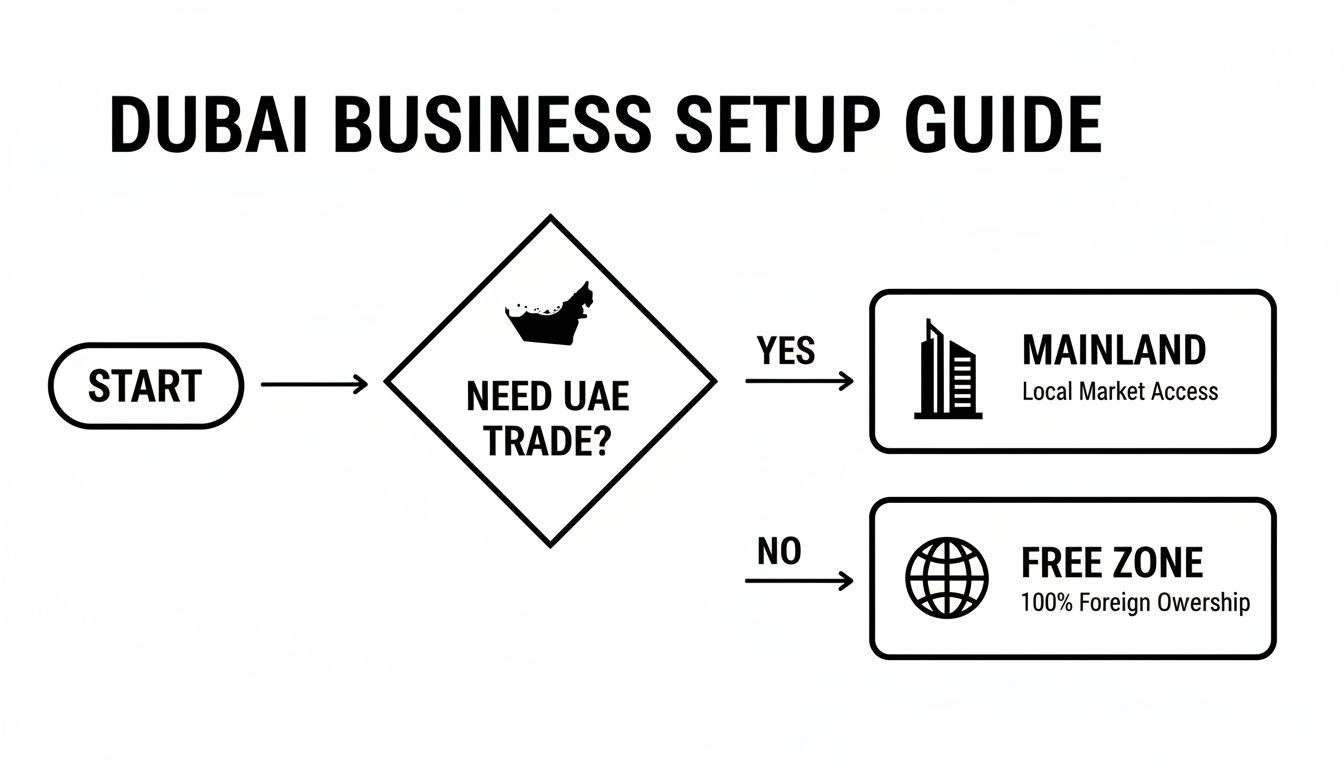
As you can see, the choice between Mainland and a Free Zone really comes down to your primary market—are you targeting customers inside the UAE or looking further afield?
Navigating Business Activities and Special Approvals
Once you've zeroed in on the right license category, the next challenge is to define the exact business activities your company will perform. The Department of Economic Development (DED) has a list with over 2,000 approved activities, and it's your job to select the ones that perfectly describe what you do.
For example, opening a restaurant isn't as simple as getting a general commercial license. You'll need specific activity codes for food service, plus approvals from the Dubai Municipality. Likewise, a medical clinic needs special permits from the Dubai Health Authority (DHA). If you miss these external approvals, your whole setup process can grind to a halt.
An expert can help you bundle related activities under a single license, saving you time and money. For a deeper dive into this, check out our guide on how to get a trade license in Dubai.
Choosing the right activities isn't just a box-ticking exercise. It defines your company’s legal scope, impacts your visa eligibility, and determines whether you need additional government approvals, making expert guidance a critical asset.
Small and medium enterprises (SMEs) are the lifeblood of the UAE's economy. By mid-2022, there were around 557,000 SMEs in the country, a number expected to hit 1 million by 2030. These businesses are a huge deal, contributing about 63.5% of the nation's non-oil GDP. This just goes to show how much the economy relies on businesses that get their licensing and setup right. Getting your license sorted properly is your ticket to tapping into this incredible market.
Navigating the Step-by-Step Formation Process
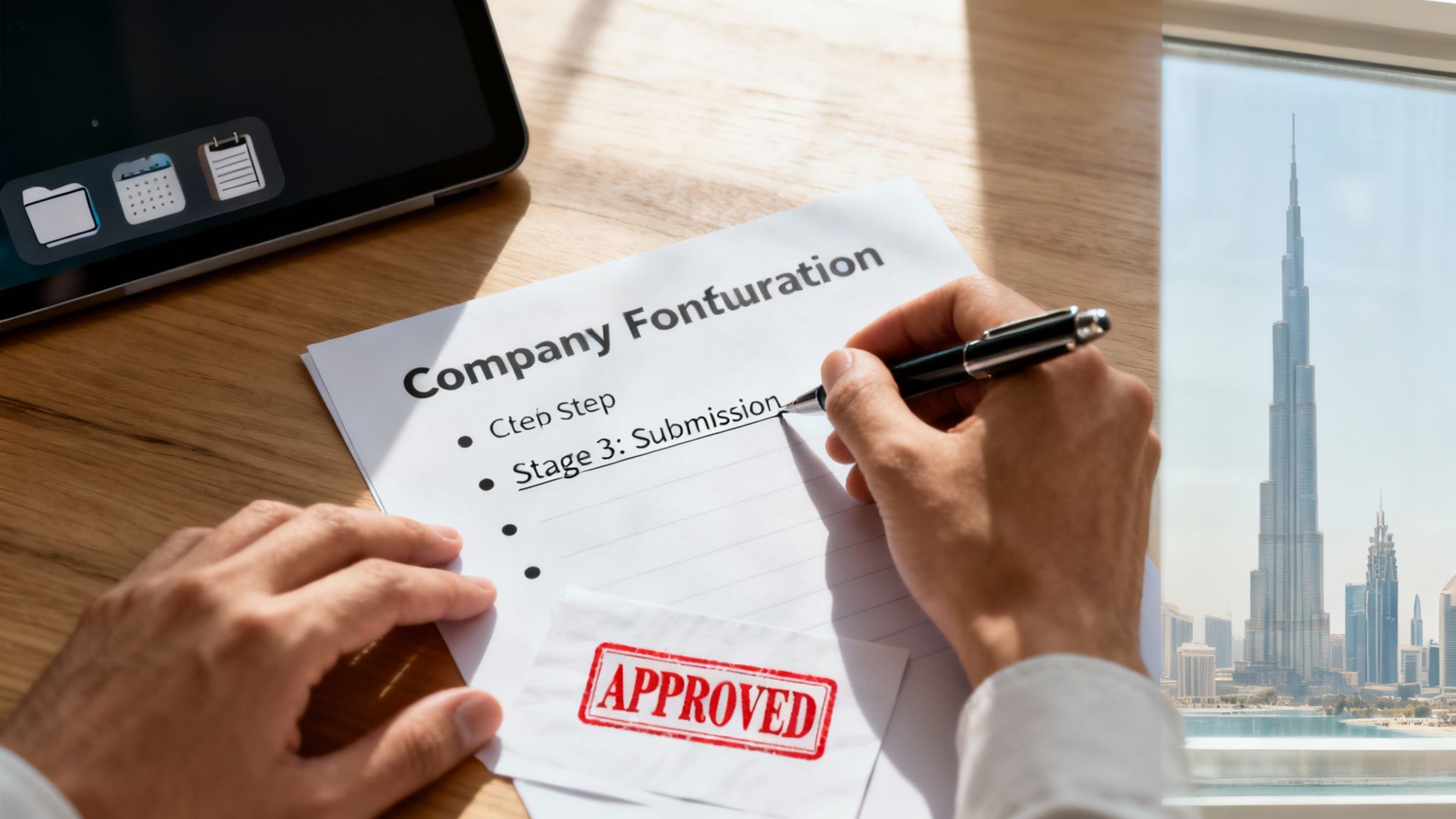
Setting up a company in Dubai isn't a single action, but a sequence of carefully planned steps. Think of it like a recipe: you can't just throw all the ingredients in a bowl at once. Each step, from choosing a name to opening a bank account, has to be completed in the right order for the final result to be a success.
A professional company formation service is your expert guide through this recipe. They know the exact sequence, the precise measurements of paperwork, and how long each stage needs to "bake" with the government authorities. This roadmap will walk you through the entire journey, turning what can seem like a complex procedure into a clear, manageable process.
Initial Approvals and Legal Foundations
The very first move is to give your business an identity by picking and registering a unique trade name. This is more than just a branding exercise; the name has to follow the UAE’s strict naming rules and get the nod from the Department of Economic Development (DED) or the relevant free zone authority. Your formation agent will handle the name check and reservation, steering you clear of common mistakes that can cause frustrating delays right at the start.
With your trade name approved, the next milestone is getting Initial Approval. This is a critical document from the authorities stating they have no objection to your business idea. It's the official green light that allows you to move forward with the more detailed parts of the setup.
Once you have this clearance, it’s time to draft the legal backbone of your company. This usually involves:
- Memorandum of Association (MOA): Essential for Limited Liability Companies (LLCs), this document details the ownership structure, share capital, and the rules of how the company will operate.
- Local Service Agent (LSA) Agreement: For certain professional licences on the mainland, this appoints a UAE national as an agent. Crucially, they have no ownership stake or control over your business operations.
These documents need to be drafted with absolute precision and, in many cases, notarised before a public official. A formation specialist ensures every clause is legally sound, protecting your interests from day one.
Securing Your Physical Space and Final Approvals
With the legal paperwork sorted, you now need a physical address. Every company in Dubai, whether on the mainland or in a free zone, is required to have a registered office. This is made official with a tenancy contract, which is called an Ejari on the mainland.
Don't panic—this doesn't automatically mean you need a huge, expensive office. Many new entrepreneurs satisfy this legal requirement by starting with a flexi-desk or a virtual office package, which is a far more budget-friendly option. Your consultant can show you the most cost-effective ways to meet this rule for your specific licence type.
After your legal documents are notarised and your office lease is signed, you're on the home stretch. Everything is bundled together—your initial approval, trade name certificate, MOA, and tenancy contract—and submitted for the final review. Once the government fees are paid and the authorities give their final approval, your official trade licence is issued. This is the moment your company officially exists in the eyes of the law.
The company formation process is a sequence of interdependent steps. A mistake in an early stage, like an improperly drafted MOA, can bring the entire process to a halt later on, highlighting the importance of getting every detail right from the start.
Post-Setup Essentials: Bringing Your Company to Life
Getting your trade licence is a huge achievement, but the work isn't quite finished. To become fully operational, you need to complete a few more essential steps. This is often where entrepreneurs who go it alone get tripped up, as it involves dealing with a whole new set of government departments.
Your first task is usually to apply for the company's Establishment Card, which registers your business with the immigration authorities. You cannot process any visas without this card. From there, the next steps are:
- Opening a Corporate Bank Account: This can be a surprisingly tough hurdle in the UAE. Good formation agents have strong relationships with banks, which helps to smooth out the application and get your account opened faster.
- Processing Visas: This is the process for your own investor or partner visa, which grants you UAE residency. It includes a medical fitness test, giving biometrics, and applying for your Emirates ID.
- Hiring Staff: With your company fully active, you can now start the process of sponsoring visas for your employees.
A full-service firm will manage this entire sequence for you, from submitting your visa paperwork to telling you exactly where to go for your medical test. This hands-on support is what turns a stack of legal documents into a living, breathing business that’s ready for banking, hiring, and growth.
Getting to Grips with Costs and Paperwork
Let's talk about two of the most important—and often most stressful—parts of setting up your business: the money and the mountain of paperwork. No one likes financial surprises, and getting the budget right from day one is the key to a stress-free launch. We'll break down what you'll pay upfront versus what you'll need to cover annually.
On the flip side, you've got the documents. The list changes depending on who's behind the company—are you an individual entrepreneur, or is another company the owner? Nailing this from the get-go saves you from frustrating delays and extra costs. This is exactly where professional company formation services in Dubai become worth their weight in gold, making sure every page is properly prepared, attested, and filed on time.
Decoding Your Financial Commitment
The total cost to get your business up and running isn't just a single invoice. It’s a mix of initial government charges and the ongoing costs of keeping the lights on.
- One-Time Setup Fees: These are the initial hurdles to clear to get your company legally on the books. Think of things like reserving your trade name, getting your initial approval, the fee for issuing the licence itself, and costs for notarising legal documents like your Memorandum of Association (MOA).
- Recurring Annual Costs: These are the expenses you need to factor into your budget every single year to stay compliant and operational. The big ones here are renewing your trade licence, paying your office rent (your Ejari), and renewing your Establishment Card.
Here's a simple way to think about it: setting up your business is like buying a car. The one-time fee is the sticker price. The recurring costs are your annual registration, insurance, and maintenance—all essential to keep it legally on the road. You absolutely have to budget for both.
Your Essential Document Checklist
The documentation process can be a bit painstaking, and the requirements shift slightly depending on whether the owners are individuals or a foreign company. Having everything ready to go beforehand will seriously speed things up.
For individual shareholders, the list is pretty straightforward:
- Passport Copies: A clear, valid copy for every single shareholder and manager.
- Visa and Entry Stamp: A copy of the UAE residence visa, or for non-residents, the tourist visa entry stamp from when you arrived.
- Passport-Sized Photos: A few recent photos with a white background for your visa and Emirates ID processing.
Now, if a corporate entity is the shareholder, the paperwork gets a bit heavier and requires official attestation.
- Parent Company's Trade Licence: A valid copy of its registration certificate.
- Memorandum of Association (MOA): The parent company’s MOA needs to be properly attested.
- Certificate of Incumbency: This is a document that lists the current directors and officers of the parent company.
- Board Resolution: An official, signed resolution from the parent company's board giving the green light to open a new company here in Dubai.
Just a heads-up: all corporate documents coming from outside the UAE must be notarised in their home country, then attested by the UAE Embassy there, and finally attested again by the Ministry of Foreign Affairs here in the UAE.
Estimated Cost Breakdown for Dubai Company Formation
To give you a clearer idea of the numbers involved, we've put together a sample table. This shows the typical cost ranges for both a Free Zone and a Mainland setup. Keep in mind, these are just estimates—the final figures can change based on your specific business activity, the type of office you choose, and how many visas you need.
| Cost Component | Typical Free Zone Cost (AED) | Typical Mainland LLC Cost (AED) |
|---|---|---|
| Initial Registration & Licence | 12,000 – 25,000 | 20,000 – 35,000 |
| Establishment Card Fee | 1,500 – 2,500 | 2,000 – 3,000 |
| Investor/Partner Visa (per person) | 3,500 – 6,000 | 4,000 – 7,000 |
| Annual Office Rent (Flexi-Desk) | 5,000 – 15,000 | 10,000 – 20,000 |
| Annual Licence Renewal Fee | 10,000 – 20,000 | 15,000 – 30,000 |
As you can see, the initial investment and ongoing costs differ quite a bit. A careful review of these figures against your business plan is a critical step in deciding which jurisdiction is the right launchpad for your venture.
Essential Support Services After Your Company Is Formed
Getting your trade licence is a huge milestone, but it’s really just the starting line. The best company formation services in Dubai don't just disappear after the paperwork is filed; they stick around and become your long-term operational partner. Think of them as the support crew that keeps your new business running smoothly long after the launch party.
This ongoing support is what separates the pros from the rest. It’s what keeps you, the entrepreneur, from getting swamped with administrative headaches. Instead of trying to figure out government portals and ever-changing rules, you can pour all your energy into what you do best: growing your business.

Navigating Visas and Government Liaison
One of the first things you'll need after forming your company is help with immigration and labour files. This is where Public Relations Officer (PRO) services come in. A PRO is essentially your company's dedicated government specialist, an expert who handles every interaction with official departments on your behalf.
Their role is massive and absolutely critical to your operations:
- Visa Processing: They manage the entire visa journey—from your own investor visa to sponsoring your staff and their families. This includes the medical tests and Emirates ID applications.
- Document Management: PROs are your safeguard against missed deadlines. They handle the renewals for your trade licence, establishment card, and other official permits.
- Labour and Immigration Filings: They’re the ones who process employment contracts, work permits, and visa cancellations with the Ministry of Human Resources and Emiratisation (MOHRE).
Trying to tackle these tasks alone is a recipe for expensive delays, fines, and a lot of frustration. To get a better sense of how much they cover, you can explore a full breakdown of professional PRO services in the UAE.
Critical Financial and Administrative Support
Beyond the government red tape, a truly comprehensive formation partner will help you build a solid business foundation with a few other key services.
A classic hurdle for new businesses is opening a corporate bank account. UAE banks have incredibly strict due diligence requirements, and it’s not uncommon for applications to get rejected. A formation agent with solid banking relationships can make introductions and help you prepare a flawless application, massively boosting your chances of getting approved quickly.
Honestly, securing a corporate bank account can often be tougher than getting the trade licence itself. An experienced consultant’s network and guidance can be the difference between a successful application and months of dead ends.
On top of that, here are a few other services that are absolute game-changers:
- VAT Registration and Filing: If your business crosses the revenue threshold, registering with the Federal Tax Authority (FTA) and filing quarterly returns is non-negotiable.
- Bookkeeping and Accounting: Keeping your financials in order isn't just for compliance; it's essential for making smart business decisions.
- Document Attestation: Need to use your corporate documents outside the UAE? They’ll need to be legally attested—a complicated process that a service provider can handle seamlessly for you.
Your Questions Answered
Starting a business in Dubai is an exciting prospect, but it's natural to have a few questions swirling around. Let's tackle some of the most common ones we hear from entrepreneurs just like you, so you can move forward with total confidence.
Can Setting Up a Company Get Me a UAE Residence Visa?
Absolutely. This is actually one of the main reasons many entrepreneurs choose Dubai. Setting up a company here, whether it’s on the mainland or in a free zone, is your direct ticket to applying for a UAE residence visa.
This doesn't just cover you; it extends to your family and even your employees. The number of visas you can apply for usually links back to the size of your office space and the nature of your business. The best company formation services in Dubai will manage this whole process for you, from the initial application to your medical test and finally getting that Emirates ID in your hand.
Do I Really Need a Physical Office to Register My Business?
Yes, you need a registered physical address, but that doesn't mean you have to sign an expensive lease for a big office right away. You’ve got options that are much smarter for a new business.
Many free zones and some mainland licences are perfectly happy with a flexi-desk or a virtual office package. For startups and solo entrepreneurs, this is a game-changer. It keeps your startup costs low while ticking all the legal boxes. Of course, if you're running a larger operation or your business activity demands it, you'll need a dedicated office space.
Think of your office choice as your first strategic move. A virtual office keeps your overheads at rock bottom, freeing up your capital to pour back into what really matters: growing the business.
How Long Does It Take to Form a Company?
The timeline really depends on where you set up, what your business does, and how quickly you get your documents in order.
A straightforward free zone company can be up and running in as little as a few days to two weeks. A mainland company might take a bit longer, typically between two and four weeks, especially if it needs special approvals from government ministries. Working with an experienced setup specialist can seriously speed things up, as they ensure every piece of paper is correct and submitted right the first time.
Ready to launch your Dubai business without the headache? The experts at Al Ain Business Center are here to handle everything—from getting your licence and visas to making sure your operations are good to go. Start your journey today with a free consultation.
Related articles
 Business Setup
 Business Setup
 Business Setup
 Business Setup
 Business Setup
 Business Setup
Latest guides
- 2-Year Residence Visa Renewal UAE Cost: 2026 Fee Breakdown
- Housemaid Visa Abu Dhabi: Cost, Steps and Requirements
- Green Visa UAE: Requirements, Costs and How to Apply
- UAE Visit Visa Categories for Technology & AI Talent
- Business Visa in UAE 2026: Types, Costs and How to Apply
- Visa-Free Countries for UAE Residents With Pakistani Passports