
So, you're ready to set up your company in Dubai. It's a fantastic move, but let's be honest, the initial steps can feel a bit overwhelming if you don't know where to start. Think of this guide as your roadmap, laying out the entire journey from your initial idea to holding that official trade licence.
We'll break down the key stages involved, helping you get a clear picture of the path ahead before we dive into the nitty-gritty details. Getting this sequence right from the beginning is crucial. It’s not just about ticking boxes; it’s about making smart, informed decisions that will set your business up for long-term success.
Your Dubai Company Registration Roadmap
Your first big decision point is choosing the right jurisdiction. This is probably the most fundamental choice you'll make, and it boils down to two main options:
- Dubai Mainland: This is your go-to if you plan on trading directly within the UAE market. Think physical shops, local client services, or bidding for those lucrative government contracts. A mainland licence gives you the ultimate freedom to operate anywhere in the Emirates.
- Dubai Free Zone: Perfect for businesses with an international focus. If you're exporting goods, providing services to clients outside the UAE, or simply want a global trading base, free zones are designed for you. They come with perks like 100% foreign ownership and tax incentives, but they do have limitations on trading directly within the local UAE market.
This single choice will shape everything that follows—your licence type, who can own the company, and even your office requirements.
Dubai's pull as a global business hub is stronger than ever. The government's pro-business mindset and streamlined processes are attracting entrepreneurs from every corner of the world, creating a truly dynamic economic landscape.
A Thriving Business Environment
The numbers speak for themselves. The city’s reputation isn’t just hype; it's backed by incredible growth.
For instance, the Dubai Chamber of Commerce recently announced that over 35,000 new companies joined in just the first half of the year. That's a staggering figure, pushing their total active membership to well over 210,000. It's a clear signal of the massive confidence global entrepreneurs have in Dubai's future. You can read more about Dubai's impressive business growth on The Startup Scene.
To give you a clearer picture of the journey, here’s a quick overview of the main stages you'll navigate.
Dubai Company Registration Key Stages at a Glance
This table breaks down the fundamental phases of the Dubai business setup process, providing a high-level look at what each step involves.
| Phase | Key Action | Primary Consideration |
|---|---|---|
| 1. Business Activity & Legal Form | Define your services or products and choose a legal structure (e.g., LLC, Sole Establishment). | Your chosen activity dictates the type of licence you need (Commercial, Professional, Industrial). |
| 2. Jurisdiction Selection | Decide between setting up on the Mainland or in a Free Zone. | This impacts market access, ownership structure, and office requirements. |
| 3. Trade Name Reservation | Choose and register a unique name for your company with the relevant authorities. | The name must comply with UAE naming conventions and not be already in use. |
| 4. Initial Approval | Submit your initial application and supporting documents to the relevant authority (DED or Free Zone). | This confirms the government has no objection to you starting the business. |
| 5. MoA & Office Space | Draft and notarise your Memorandum of Association (MoA) and secure a registered office address. | A physical or virtual office lease (Ejari) is mandatory for most setups. |
| 6. Final Submission & Licence | Submit all documents, pay the final fees, and receive your official trade licence. | This licence legally permits you to start operating your business in Dubai. |
This roadmap will guide you through each of these phases, ensuring you're fully prepared to launch and thrive in this bustling commercial hub.
Choosing Your Business Jurisdiction: Mainland vs Free Zone
When you’re looking at how to register a company in Dubai, your very first big decision is where to set up shop. This isn’t just about an address; it's about choosing between a Mainland or a Free Zone jurisdiction. This choice will fundamentally shape how your company operates, who can own it, and what markets you can access. Think of it as the strategic foundation for your entire UAE venture.
A lot of newcomers see this as a simple trade-off between freedom and ownership, but it's far more nuanced than that. Each path offers a unique set of advantages designed for specific business models. Your long-term vision—whether it's direct local trade, international expansion, or providing specialised services—is what will ultimately point you in the right direction.
The Dubai Mainland Advantage
Opting for a Dubai Mainland company gives you the ultimate freedom: the ability to operate and trade anywhere across the UAE. A Mainland licence, issued by the Department of Economy and Tourism (DET), means no geographical handcuffs. You can set up your office, open a retail store, or serve clients directly in all seven emirates.
This unrestricted market access is the number one reason entrepreneurs go this route.
- Direct Local Trading: You can sell your products and services directly to anyone in the local UAE market without needing a middleman or agent.
- Government Contracts: Mainland companies are eligible to bid on lucrative government tenders and projects—a massive market segment in the UAE.
- Geographical Flexibility: You're free to establish your office or commercial space in any approved location in Dubai, from a high-rise in a bustling business district to a spot in a quiet suburban community.
Picture this: a marketing agency wants to land clients in both Dubai and Abu Dhabi, or a retail brand has plans to open stores in multiple malls. For them, a Mainland setup is non-negotiable. The same goes for a construction firm that wants to work on government infrastructure projects. For a deeper dive into this option, we’ve put together a comprehensive guide on company formation in Dubai Mainland.
This flowchart breaks it down nicely, helping you see whether a Mainland (office building) or Free Zone (globe) setup is a better fit for your business.
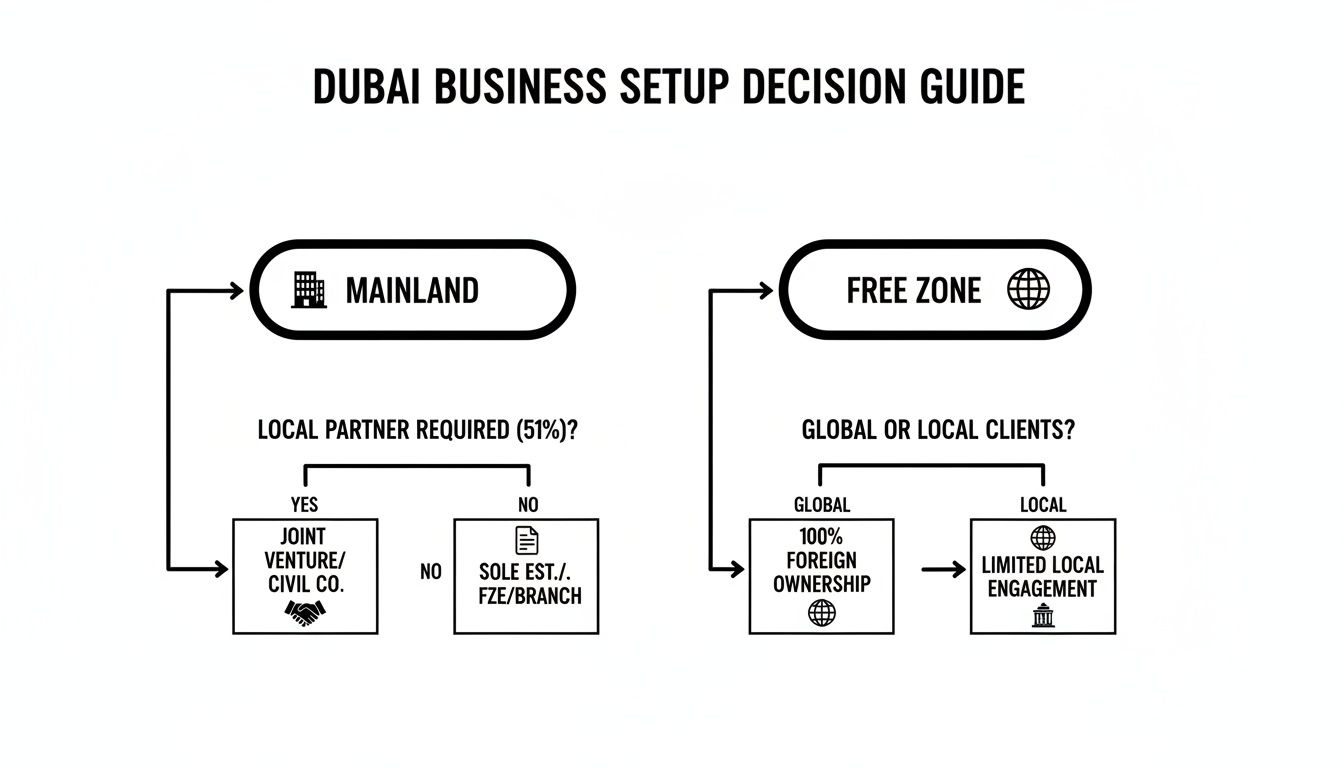
The key takeaway? Your target market is the deciding factor. If you're aiming for the local UAE population or government work, the Mainland should be at the top of your list.
The Power of Dubai Free Zones
Dubai's free zones are designated economic areas packed with incentives to attract foreign investment. With over 40 free zones in Dubai alone, many are industry-specific, creating powerful business ecosystems for sectors like technology, media, commodities, and healthcare.
The biggest draws for a free zone company are the financial and structural benefits.
For international entrepreneurs, the ability to retain 100% ownership while benefiting from zero corporate and personal taxes is a game-changer. Free zones provide a secure, regulated, and business-friendly environment that is purpose-built for global commerce.
This structure is perfect for businesses that don't need a direct physical presence within the domestic UAE market. Think of an e-commerce store shipping products globally, a software development firm with clients all over the world, or a consultancy advising businesses outside the UAE.
Making The Right Strategic Choice
Ultimately, this decision boils down to your core business activity and your target audience. A Mainland setup offers unmatched access to the local UAE market, whereas a Free Zone gives you an efficient, cost-effective hub for international operations.
Let’s look at a real-world scenario. An Australian tech startup wants to establish a regional HQ to serve clients in the Middle East and Europe. Their goal isn't to sell software within the UAE, but to use Dubai as a strategic base. For them, a tech-focused free zone like Dubai Internet City is the perfect fit. It offers 100% foreign ownership, zero corporate tax, and an environment buzzing with other tech giants.
Now, consider a British restaurant chain planning to open a new location in Downtown Dubai. Their needs are completely different. To run a physical restaurant and serve local customers, they must have a Mainland licence. This allows them to lease a commercial property, hire staff to work on-site, and trade directly with the public.
To make this even clearer, here's a side-by-side comparison.
Mainland vs Free Zone: A Head-to-Head Comparison
Choosing between the Mainland and a Free Zone is one of the most critical decisions you'll make. This table lays out the key differences to help you see which structure aligns better with your business goals.
| Feature | Mainland Company | Free Zone Company |
|---|---|---|
| Market Access | Unrestricted trade across the UAE | Limited to the specific free zone and international markets |
| Ownership | 100% foreign ownership for most activities | 100% foreign ownership as standard |
| Office Requirement | Mandatory physical office space with Ejari | Flexible options, including virtual offices and flexi-desks |
| Government Tenders | Eligible to bid | Generally not eligible |
| Visa Eligibility | Dependent on office size | Typically allocated a set number of visas |
| Corporate Tax | 9% on taxable profits over AED 375,000 | 0% corporate tax (Qualifying Free Zone Person status may apply) |
Getting this choice right from the start will save you a huge amount of time and money down the line. It ensures your business is built on a foundation that perfectly matches your operational needs and your ambitions for growth in the UAE.
Figuring Out Your Dubai Trade Licence and Business Activities
Once you've locked in your jurisdiction, the next big piece of the puzzle is your trade licence. You can think of this as your company's official permission slip—it spells out exactly what your business is legally allowed to do in Dubai. Getting this right isn’t just ticking a box; it’s about building a compliant foundation from the get-go.
The whole process boils down to two things: picking the right licence category and then getting super-specific about your business activities. This is one of those moments where the details really, really matter. A small mistake here could mean facing fines or hitting a wall with your operations down the line.
The Three Core Licence Categories
In Dubai, every business falls under one of three main licence types. Each one is built for a different kind of operation.
- Commercial Licence: This is your go-to for any business that buys and sells goods. It’s a broad category covering everything from general trading and e-commerce stores to real estate agencies and retail shops. If trading is part of your model, you'll be looking at this one.
- Professional Licence: Designed for businesses built on expertise and services. Think consultancies, marketing firms, tech startups, designers, and other skilled professionals. One of the huge perks here is that it can allow for 100% foreign ownership for many activities, even on the Mainland.
- Industrial Licence: Just like it sounds, this licence is for any business involved in manufacturing, production, or assembly. Whether you're processing food or putting together complex machinery, this is the licence you'll need.
It’s simple: the licence you choose has to match what you actually do. You can’t run a consulting business on a commercial licence or start trading goods with a professional one.
How to Navigate The Official List of Business Activities
This is the part that can feel a bit daunting for new entrepreneurs. Both the Department of Economy and Tourism (DET) for Mainland setups and the individual free zone authorities have massive lists of approved business activities—we’re talking thousands of options. Your job is to sift through them and pinpoint the exact ones that describe your business.
For instance, if you're launching a digital marketing agency, you wouldn't just select "Marketing." You’d need to dig deeper and choose specific activities from the official list, like "Social Media Marketing Services" or "Search Engine Optimisation Services." Precision is your best friend here.
Key Takeaway: Don't be vague. Spend time going through the official activity list and pick the codes that perfectly capture what you do. Choosing the wrong activity is one of the most common—and totally avoidable—mistakes people make when setting up their company.
You can often bundle several related activities under one licence, but keep in mind that each activity you add might nudge the final cost up. Some activities also come with extra hurdles, like needing a green light from external bodies such as the Health Authority or the Telecommunications and Digital Government Regulatory Authority (TDRA).
The momentum in certain sectors is undeniable. In just one recent nine-month period, building contracting projects soared, with 2,722 new licences issued. The digital world is booming, too, with e-commerce sites accounting for 2,678 licences and social media platforms not far behind at 2,335. You can find more details on these booming UAE business sectors on Dubai Business Capital.
Why Your Choice Matters for The Future
Picking your business activities isn’t just about getting your licence approved today; it's about setting your company up for future growth. If you have plans to expand your services down the road, it’s often smarter (and cheaper) to include those potential activities from the very beginning.
Sure, you can add an activity later, but it involves a formal amendment process that will cost you both time and money.
For entrepreneurs coming from abroad, you might also need professional business license translation services if you have existing foreign licences or permits that need to be submitted as supporting documents. Making a smart, informed decision now, guided by your long-term vision, will ensure your licence is a launchpad for growth, not a box that limits you.
A Practical Walkthrough of The Registration Process
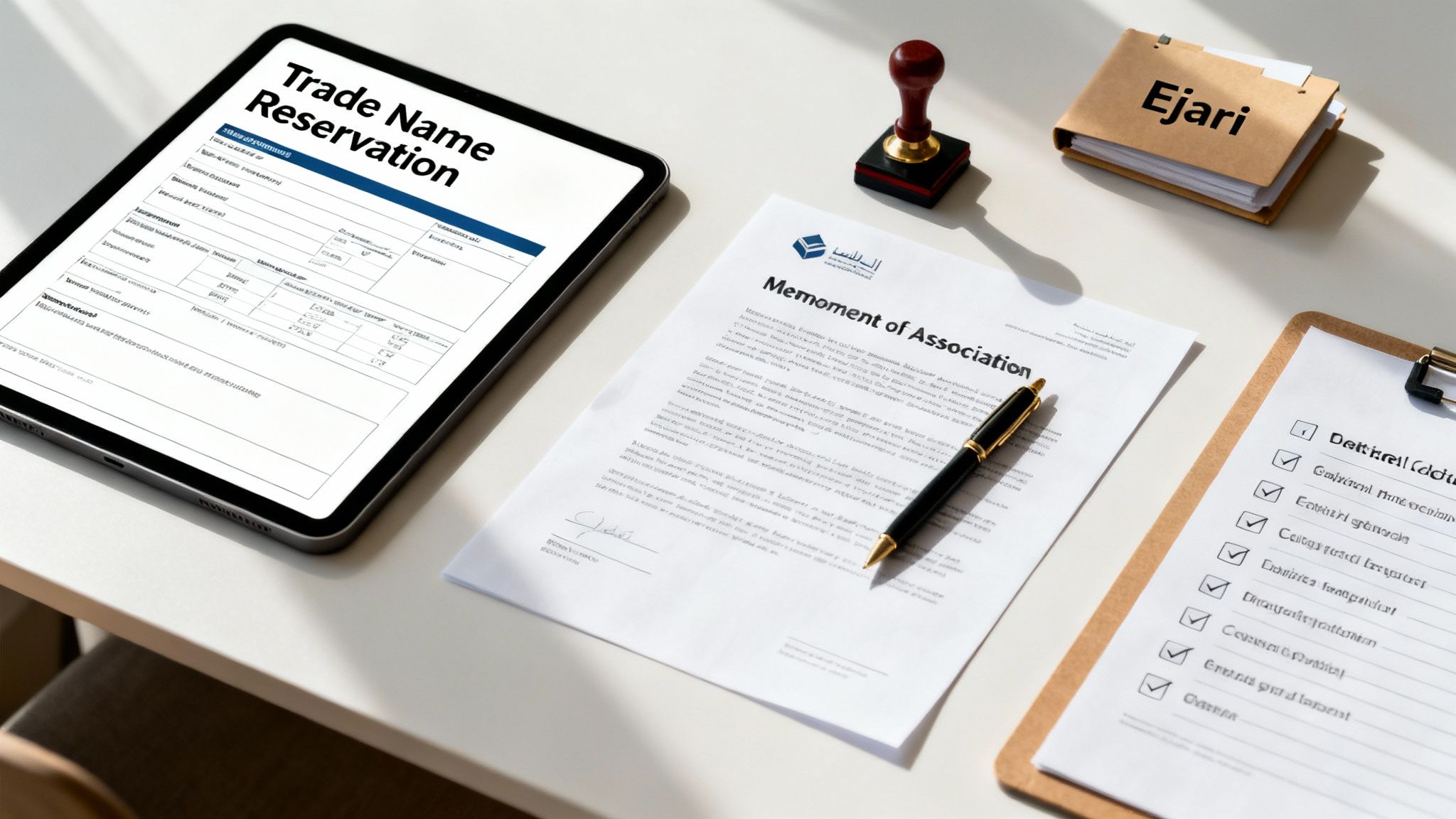
Once you've nailed down your jurisdiction and business activities, it's time to get into the nitty-gritty of the registration itself. This part of the journey is less about big-picture strategy and more about checking the right boxes in the right order. We'll walk through the core stages, giving you a clear roadmap of what's coming, from picking a name to finally holding your trade licence.
The system is built for efficiency, but a little inside knowledge on the sequence and paperwork makes a world of difference. It’s all about being prepared and understanding why each step matters.
Securing Your Trade Name and Initial Approval
Your first real move is to reserve your company's trade name. This is more than just picking something catchy; it has to align with UAE naming conventions. It's the first official checkpoint on the path of how to register a company in Dubai.
A few ground rules are non-negotiable:
- No Offensive Language: The name can't contain anything that might be considered offensive or against public morals.
- No Religious or Governmental References: Steer clear of names linked to religious figures or official governing bodies.
- Be Unique: Most importantly, the name can't already be taken by another registered company in the UAE.
My advice? Always have three name options ready to go. It saves a ton of time if your first choice is already claimed. Once your name is approved, you’ll apply for what’s known as initial approval. This is basically the government authority—whether that's the DET for mainland or your specific free zone—giving your business concept a preliminary nod. It confirms they've got no objections, clearing you to move on to the more detailed legal steps.
Drafting Your Memorandum of Association
With the initial green light, your focus shifts to the Memorandum of Association (MOA). For a Limited Liability Company (LLC), this is the bedrock legal document. It spells out everything from the company's structure and ownership shares to its business goals and the specific duties of each partner.
Don't rush this. The MOA is the rulebook for how your company operates internally, so getting it right is crucial. It details profit distribution, outlines the process for bringing on a new partner, and sets the terms for a partner's exit. I always recommend working with a legal advisor or a setup consultant here to make sure every clause is buttoned up and truly protects your interests.
A well-drafted MOA is more than a formality; it's a critical agreement that prevents future disputes between shareholders. It provides a clear framework for how the business will be run, ensuring all partners are aligned from day one.
After it's drafted, all shareholders need to sign the MOA, and it must be officially notarised. This can often be done at a public notary or through the authority's own digital platforms. It's vital to be familiar with the legal requirements for electronic signatures to ensure all your documents are fully compliant with regulations.
Finding and Registering Your Office Space
Every single company in Dubai must have a registered physical address. This isn't optional; it's how your business's presence in the emirate is officially verified. The kind of space you need, however, depends entirely on your jurisdiction.
For a mainland company, you'll need to lease a physical office. That tenancy contract then has to be registered through the Ejari system, a government portal that authenticates lease agreements. Your Ejari certificate is a must-have document for your final licence application.
Free zones, on the other hand, offer way more flexibility. Based on your business activities and how many visas you need, you could choose:
- A full physical office inside the free zone.
- A shared "flexi-desk" or smart desk setup.
- A virtual office, which gives you a registered address without the overheads of a physical workspace.
This flexibility is a huge reason many international entrepreneurs opt for free zones. For a deeper dive into these options, our guide on company formation in Dubai free zones has all the details. No matter which route you take, that signed lease agreement is the key that unlocks the final stage of your application.
The Final Application and Payment
You've done the legwork and gathered all the pieces: trade name approval, initial approval, a notarised MOA, and a registered lease agreement. Now it’s time to package it all up. The final step involves submitting this complete file, along with passport copies for all shareholders and managers, to the relevant authority.
They'll review everything for accuracy and compliance. Once it's all verified, you'll get a payment voucher for the trade licence fees. As soon as that payment is processed, the authority issues your official trade licence. This is it—the document that gives you legal permission to start operating in Dubai. You'll also typically receive your company's Establishment Card, which is essential for processing residency visas for you and any staff you hire.
Managing Costs, Visas, and Post-Licence Essentials
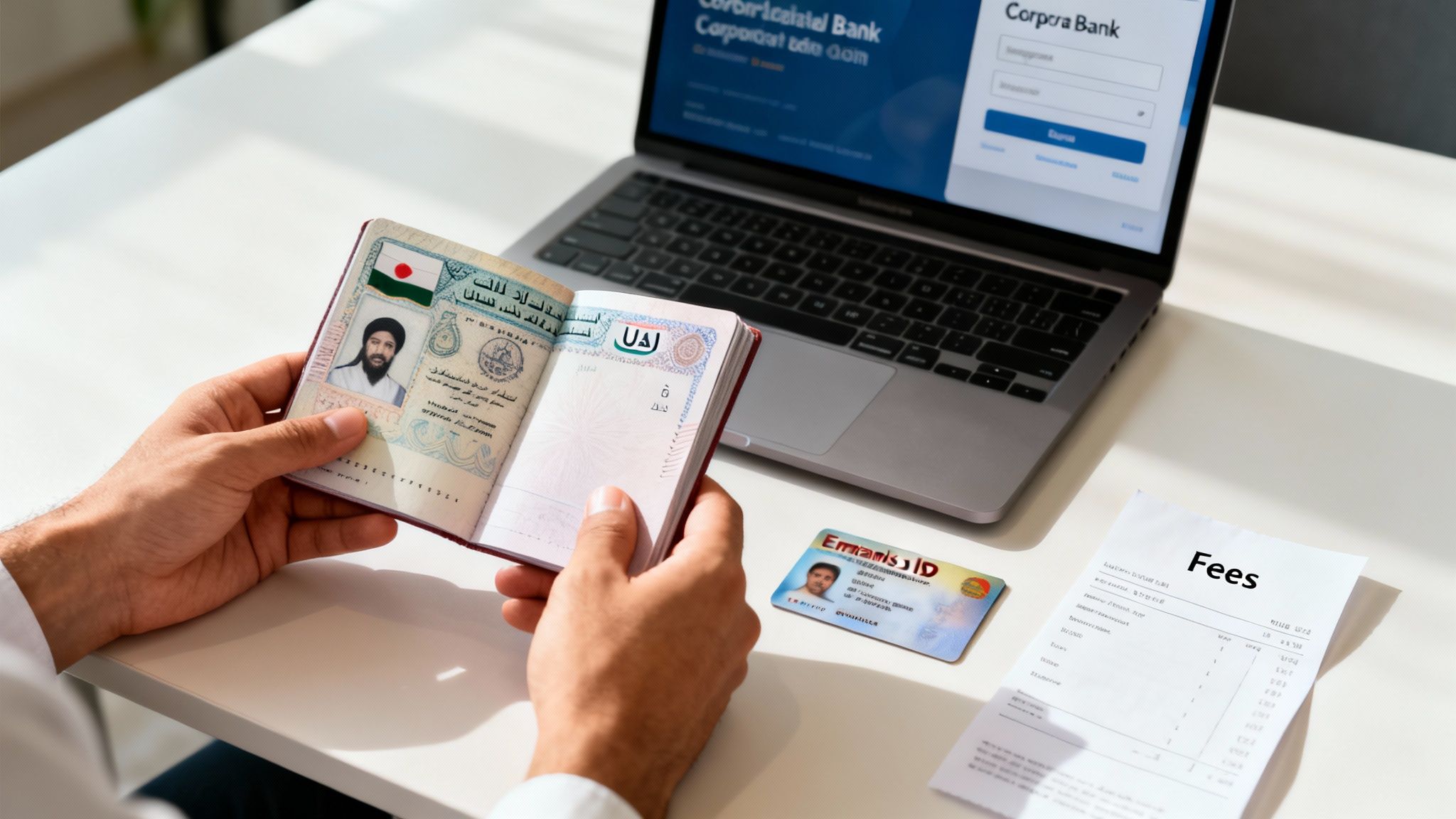
Getting that new trade licence in your hands is a fantastic milestone, but it's really the starting line, not the finish. Your focus now needs to pivot to the practical steps that turn your legal entity into a living, breathing business. This means getting a handle on a new set of costs, securing residency for yourself and your team, and ticking off some essential compliance boxes.
This is where sharp budgeting becomes non-negotiable. The initial licence fee is just one piece of the puzzle; you need a crystal-clear picture of all the associated costs to prevent any unwelcome surprises down the road. We're talking about everything from visa processing and medical tests to getting your bank account sorted and registering for tax.
Understanding The Full Cost of Your Dubai Company
When you’re budgeting for how to register a company in Dubai, it's all too easy to fixate on the trade licence fee alone. But a realistic financial plan has to include several other mandatory, one-time expenses that come right after.
A transparent cost breakdown from a good consultant should always include:
- Establishment Card Fee: This is your key to start applying for employee and investor visas.
- E-channel Registration: A necessary system for managing all your visa applications online.
- Visa Application and Stamping Fees: These are per-person costs for entry permits and the final residence visa stamp in the passport.
- Medical Fitness Test and Emirates ID: Every visa applicant has to go through these mandatory steps.
- Annual Licence Renewal Fees: A significant recurring cost you absolutely need to factor into your yearly budget.
These expenses add up quickly, so it's always smart to ask for a detailed, all-inclusive quotation upfront. This way, you have a complete picture of the total investment needed to get your company fully operational and compliant from day one. No guesswork involved.
Securing Your Residency Visa
With your trade licence and establishment card issued, you can kick off the residency visa process. As the owner, you're eligible to apply for an investor or partner visa, which solidifies your legal residency and allows you to live and work in the UAE long-term.
The process itself is quite methodical. It begins with an entry permit, which is then followed by a mandatory medical fitness test to screen for any communicable diseases. Once you get the all-clear, you'll complete your biometrics for the Emirates ID card—your official government identification. The final step is getting the visa stamped into your passport. For a deeper dive, our guide explains exactly how to get a residence visa in Dubai and what to expect.
Your investor visa is the key that unlocks your ability to sponsor others. Once your own residency is finalised, you can then sponsor visas for your employees and family members, such as your spouse and children.
Navigating Post-Licence Compliance
Once your licence and visa are sorted, there are two final but critical administrative hurdles: opening your corporate bank account and registering for Corporate Tax.
A corporate bank account is essential for managing your business finances, and UAE banks are known for their strict compliance checks. Be ready for a thorough due diligence process. You'll need to present your new trade licence, Memorandum of Association (MOA), and copies of the passports and visas for all shareholders.
On top of that, under the UAE's tax regime, nearly all businesses must register with the Federal Tax Authority (FTA). You are required to register for Corporate Tax even if your annual profits fall below the AED 375,000 threshold. Getting this done proactively ensures you stay compliant from the get-go and avoids any potential headaches or penalties later on. Nailing these final steps sets a rock-solid foundation for your company's future success.
Your Dubai Company Registration Questions, Answered
Even with the best roadmap, questions are bound to pop up. It’s only natural. We get calls every day from entrepreneurs hitting a specific snag or just wanting to clear up a point of confusion. Think of this as a quick chat where we tackle the most common queries we hear.
Getting these details sorted early on can save you a world of headaches and unexpected costs down the line. From timelines to visas, here’s what you need to know for a smooth setup.
How Long Does This Actually Take?
This is usually the first question on everyone's mind. The honest answer? It depends. A Dubai Free Zone company can be set up remarkably fast – sometimes in as little as 5-10 working days. For entrepreneurs who need to get up and running yesterday, this speed is a massive plus.
Setting up on the Mainland typically takes a bit longer, usually around 2-4 weeks. The extra time is mostly down to securing a physical office and getting the tenancy contract (Ejari) registered, which adds a few steps to the dance.
Expert Tip: The single biggest thing that slows people down is incorrect paperwork. A tiny error on a form or a blurry passport copy can bring the whole process to a halt. Double-check everything before you hit submit.
Can I Get This Done From My Home Country?
For the most part, yes. You can kick off and complete the bulk of your company registration remotely, especially with a Free Zone. Modern processes mean a lot of it can be handled digitally.
By giving a business setup consultant a notarised Power of Attorney, you can let them handle the legwork in Dubai while you focus on your business back home. But there’s one big exception.
- Opening the Bank Account: This is the one part you can't skip. Almost every bank in the UAE will require the shareholders or signatories to be physically present for the final step. It’s a mandatory, in-person meeting for their compliance checks.
So, while you can handle the legal formation from afar, plan on making at least one trip to Dubai to get your company’s finances in order.
What’s the Minimum Investment I Need to Show?
This is a great feature of the Dubai system. Unlike many other jurisdictions, there is no legally mandated minimum share capital for most business activities. For a Mainland LLC, the law simply says your capital should be "sufficient" to meet your business goals.
This gives you incredible flexibility. You don’t have to lock up huge amounts of cash just to get started. That said, your business plan still needs to be realistic about your actual startup costs—things like your trade licence, office rent, and first few months of operational expenses. Just be aware that some highly specialised activities or specific free zones might have their own capital rules.
Which Business Sectors Are Really Taking Off?
It always pays to know where the momentum is. We’re seeing explosive growth in a few key areas right now.
The real estate, renting, and business services sector has been an absolute powerhouse, with 23,204 new companies registered recently. Logistics is also on a tear, with the transport, storage, and communication sector welcoming 5,901 new businesses. Construction isn’t slowing down either, showing a 33% jump in new company registrations. You can dig into more of the numbers over at the Dubai Media Office's recent report.
Do I Still Need a Local Sponsor?
Let’s clear this one up for good. The idea that you need an Emirati partner holding 51% of your company is one of the most persistent myths out there. Thanks to major legal reforms, 100% foreign ownership is now the standard for the vast majority of business activities on the Dubai Mainland.
If you’re setting up with a professional services licence on the Mainland, you will need a Local Service Agent (LSA). But an LSA is not a shareholder. They have zero ownership in your business and are simply paid an annual fee to act as your official liaison with government departments. And in the Free Zones? 100% foreign ownership has always been the rule.
Navigating the setup process is your first big step towards building a successful business in the UAE. At Al Ain Business Center, we provide the expert guidance to make your company formation journey as seamless and straightforward as possible. Contact us today for a free consultation, and let's get your business vision off the ground.
Related articles
 Business Setup
 Business Setup
 Business Setup
 Business Setup
 Business Setup
 Business Setup
Latest guides
- 2-Year Residence Visa Renewal UAE Cost: 2026 Fee Breakdown
- Housemaid Visa Abu Dhabi: Cost, Steps and Requirements
- Green Visa UAE: Requirements, Costs and How to Apply
- UAE Visit Visa Categories for Technology & AI Talent
- Business Visa in UAE 2026: Types, Costs and How to Apply
- Visa-Free Countries for UAE Residents With Pakistani Passports