
Setting up a company in a Dubai free zone is an attractive option for many entrepreneurs, and for good reason. It offers a clear route to 100% foreign ownership, tax exemptions, and the ability to send all your profits home. These specially designated economic areas were created to pull in international investment, providing a secure and well-regulated playground for both startups and established businesses.
Understanding Dubai Free Zones Before You Begin
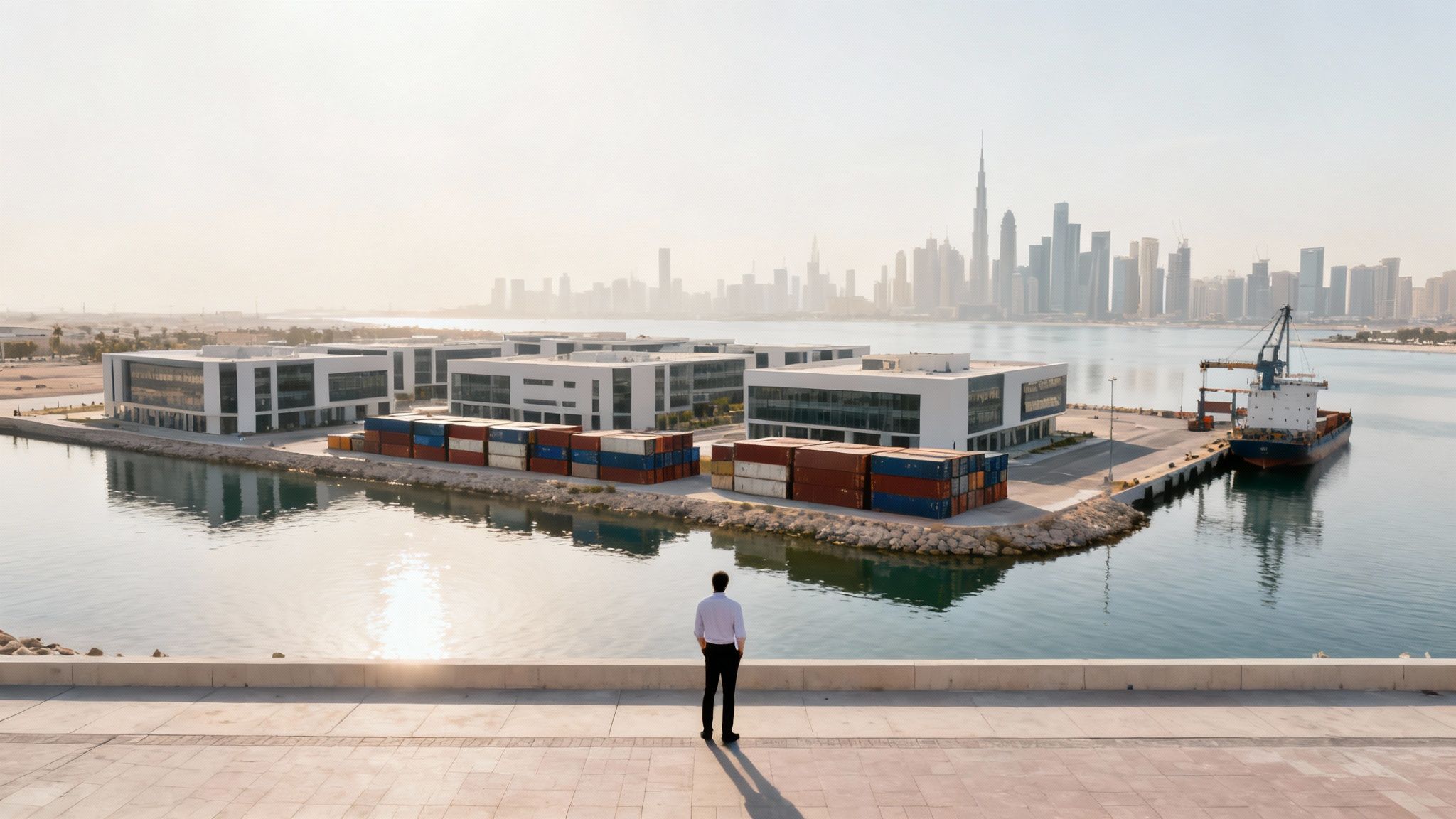
Before you get lost in the paperwork, it's worth taking a moment to understand what a Dubai free zone actually is. Think of it as a special economic bubble with its own rules, all designed to make business easier. With over 45+ free zones in the UAE, each one often focuses on specific industries, which creates these incredible ecosystems where networking and innovation just happen naturally.
The biggest draw for international investors? The freedom. Unlike setting up on the mainland, a free zone company doesn't need a local Emirati partner. This gives you total control over your business, which is perfect if you’re focused on international trade, consulting, or services that aren't aimed at the local UAE market.
Core Advantages of a Free Zone Company
The benefits go way beyond just ownership. People consistently choose this route because of a few powerful perks that directly boost their bottom line and make operations smoother.
- Tax Efficiency: Most free zones offer a 0% corporate tax rate for a certain period, and there's no personal income tax. That’s a massive win for profitability.
- Full Profit Repatriation: You're free to transfer 100% of your capital and profits back to your home country. No strings attached.
- Simplified Import and Export: Companies in free zones are exempt from customs duties on goods coming in and going out, a huge advantage for any trading business.
- Modern Infrastructure: You get access to world-class facilities, from flexible hot desks to huge warehouses and executive suites, suiting businesses of every shape and size.
You only have to look at the numbers to see how successful these zones are. For example, DMCC (Dubai Multi Commodities Centre) reported registering over 1,100 new companies in the first half of 2025 alone, pushing its total members towards 26,000 firms. That kind of growth tells you something about the opportunities available.
Distinguishing Between Business Structures
Choosing the right legal structure is one of the most important decisions you'll make. A common sticking point for newcomers is understanding the difference between free zone, mainland, and offshore companies. Each serves a very different purpose.
To simplify things, here's a quick side-by-side comparison.
Free Zone vs Mainland vs Offshore At a Glance
| Feature | Free Zone Company | Mainland Company | Offshore Company |
|---|---|---|---|
| Ownership | 100% foreign ownership | Local sponsor often required (some exceptions) | 100% foreign ownership |
| Business Scope | Can trade internationally and within its free zone | Can trade directly within the UAE mainland | Cannot trade within the UAE |
| Office Space | Must have a physical presence in the free zone | Must have a physical office on the mainland | Virtual office is sufficient |
| Visas | Eligible to apply for employee visas | Eligible to apply for employee visas | Not eligible for visas |
| Tax | 0% corporate and personal tax | 9% corporate tax on profits above AED 375,000 | 0% corporate and personal tax |
| Primary Use | International trade, regional hub | Local market access, retail | Asset holding, investments |
This table gives you the basics, but the choice really comes down to your business model.
A free zone company is your gateway to international markets from a UAE base. A mainland company targets the local UAE market directly. An offshore company, on the other hand, is a non-resident entity used primarily for international asset holding and investment.
Let's say a tech startup from Europe wants a regional hub to serve clients across the Middle East and Asia—a free zone is the perfect fit. But if a retail brand wants to open a shop in The Dubai Mall, it must register as a mainland company. Getting to grips with the unique characteristics of free zone companies in Dubai is the first real step toward making a smart decision that supports your long-term goals.
How to Choose the Right Dubai Free Zone
Picking the right free zone from over 30 options in Dubai is easily the most critical decision you'll make when setting up your company. This choice goes far beyond just securing a location; it defines your operational costs, the legal rules you play by, and your ultimate potential for growth. I've seen too many entrepreneurs fall into the trap of grabbing the cheapest package, only to find out later the zone doesn’t even permit their specific business activity or lacks the logistical setup they need.
You have to approach this strategically. Think of it like choosing a neighbourhood to live in. You wouldn't just look at the price tag; you’d check out the local schools, amenities, and the overall feel of the community. A free zone is an ecosystem, and your job is to find the one where your business can truly flourish.
Align Your Business Activity with a Specialised Zone
Your first filter should always be your business activity. Dubai’s free zones were brilliantly designed as industry-specific hubs to create synergy and drive innovation. It makes absolutely no sense to set up your tech startup in a logistics-focused zone—you'd miss out on invaluable networking opportunities and specialised infrastructure right at your doorstep.
For example, a commodity trading company would naturally find its home in the Dubai Multi Commodities Centre (DMCC). It's more than a location; it’s the global epicentre for that industry, offering perfectly tailored licenses, trading platforms, and an entire network of relevant businesses. On the flip side, a media production house would be much better suited to Dubai Media City (DMC) or Sharjah Media City (Shams), surrounded by studios, creative freelancers, and potential clients.
Pro Tip: Don't just glance at the main activity list. Always dig deeper into the sub-categories. Some free zones have incredibly specific and nuanced activity lists. Finding that perfect match can save you a world of compliance headaches later on.
Here’s a real-world scenario I often see: a UK-based e-commerce business needs a regional fulfilment centre. A quick search might point them to a general-purpose zone. However, a zone like Dubai CommerCity or the Jebel Ali Free Zone (JAFZA), with its direct port access and advanced logistics, is a far more strategic move. This choice alone could save them a fortune in shipping and distribution costs down the line.
Evaluate Location and Infrastructure Practically
The physical location of your free zone is important, but not just for the address on your letterhead. For trading and logistics firms, proximity to airports like Al Maktoum International or seaports like Jebel Ali can be a make-or-break factor. For a service-based consultancy, being closer to the city centre for client meetings might be the top priority.
Think through the day-to-day realities of your operation:
- Logistics: If you're handling goods, how close is the zone to major ports and airports?
- Client Access: Do you need to project a certain image by being in a prestigious location like DIFC to meet high-profile clients?
- Employee Commute: Can your team easily get to the zone via public transport? A remote location can make it tough to attract and keep good people.
Beyond the map, you need to scrutinise the facilities. Your needs will evolve. You might start with a simple flexi-desk, but what happens when you need to hire five people? Make sure the free zone has a clear growth path, offering everything from co-working spaces and private offices to warehouses.
Analyse the True Cost Beyond the Initial Fee
It’s tempting to be swayed by a low upfront registration fee, but that’s rarely the whole story. The true cost of company formation in Dubai free zones is a mix of one-time setup fees and recurring annual expenses. A package that looks cheap at first might hide steep renewal fees or expensive visa processing costs.
To get a proper financial overview, you must compare itemised quotes. Transparency is key. A detailed cost breakdown is essential, and you can get a better idea of what to expect by reading our complete guide on the Dubai free zone license cost. This will help you budget accurately for your first year and beyond, without any nasty surprises.
The appeal of these zones is undeniable. Recent industry reports show free zones are a huge driver of new business, making up over 40% of new company formations in recent years. This trend points to a major shift towards technology and knowledge-based businesses. This data just reinforces that while the opportunity is massive, making an informed financial decision is more important than ever.
To help you get started, here is a quick look at some of the top free zones categorised by their industry focus. This should help you narrow down your search considerably.
Top Dubai Free Zones by Industry Focus
| Industry | Recommended Free Zones | Key Advantages |
|---|---|---|
| Technology & IT | Dubai Silicon Oasis (DSO), Dubai Internet City (DIC) | Tech-focused ecosystem, networking events, access to talent. |
| Commodities & Trading | Dubai Multi Commodities Centre (DMCC) | World-class trading infrastructure, industry-specific licenses. |
| Media & Creative | Dubai Media City (DMC), Dubai Studio City | Hub for media companies, production facilities, creative community. |
| Logistics & E-commerce | Jebel Ali Free Zone (JAFZA), Dubai CommerCity | Proximity to ports and airports, advanced warehousing solutions. |
| Consulting & Services | IFZA, Meydan Free Zone | Cost-effective packages, flexible office solutions, quick setup. |
| Healthcare & Science | Dubai Healthcare City (DHCC) | Specialised medical facilities, regulatory support for health sector. |
This table is a great starting point. By carefully weighing these factors—activity alignment, location, and the true cost—you’re no longer just picking a free zone. You are strategically selecting a business partner that will champion your long-term success.
Navigating the Company Registration Process
Once you’ve locked in the perfect free zone, it’s time to bring your business vision to life. This is where the plan on paper becomes a real, legally recognised company. While the idea of navigating government processes might seem intimidating, most Dubai free zones have a surprisingly straightforward registration journey. We’ll walk through it together, from securing your company name to finally getting that business license in your hands.
The whole system is designed to be methodical, making sure you tick all the legal and regulatory boxes right from the start. If you understand the flow and get your ducks in a row beforehand, you can sidestep the common mistakes that trip up so many new entrepreneurs.
Securing Your Trade Name and Business Activities
The first real step is picking and reserving your company’s trade name. This is more than just a branding decision; it’s a non-negotiable legal requirement. Your name has to be unique and follow the UAE’s naming rules—anything offensive, blasphemous, or referencing religious figures is a definite no-go. Keep in mind that adding words like "Global" or "International" might come with a higher fee or require extra justification.
At the same time, you'll be finalising your list of business activities from a pre-approved list provided by the free zone. This is a critical choice. You are only legally allowed to do the business listed on your licence.
- Be Specific: Don't just put "Consultancy." Vague descriptions are a common reason for rejection. Choose activities that perfectly describe what you do.
- Think Ahead: Planning to offer more services down the line? It’s often easier (and cheaper) to add them to your licence now rather than amending it later.
- Check for Restrictions: Some activities, like anything related to finance or healthcare, might need extra approvals from other government bodies. It’s smart to get clarity on this early on.
For example, a marketing consultant should opt for specific activities like "Marketing Management" and "Social Media Marketing Services." This leaves no room for doubt and ensures you're fully compliant.
Preparing and Submitting Essential Documentation
With your name and activities sorted, it's time to gather the paperwork. This is easily the most document-intensive part of setting up a company in a Dubai free zone, and where a sharp eye for detail pays off. Seriously, missing or incorrectly filled-out documents are the number one reason applications get delayed.
The exact checklist can differ slightly from one free zone to another, but the core documents are pretty much standard across the board.
Insider Tip: Document attestation can be a real headache. Any official documents from outside the UAE (like your university degree or an existing company’s certificate of incorporation) must be attested. This involves getting them stamped by the UAE Embassy in your home country and then again by the Ministry of Foreign Affairs (MOFA) here in the UAE. This process can take weeks, so get it started as early as you possibly can.
Your application package will typically need to include:
- Application Form: The official registration form from the free zone.
- Passport Copies: Clear, colour copies for every shareholder and the appointed manager.
- Visa and Entry Stamp: If you're already in the UAE, a copy of your current visa page and entry stamp.
- Business Plan: Many free zones, especially specialised ones like DMCC or DSO, will ask for a basic business plan outlining your goals, target market, and financial forecasts.
- No Objection Certificate (NOC): If a shareholder is on a UAE residence visa sponsored by their current employer, you’ll likely need an NOC from that sponsor.
Once you have everything together, you'll submit the full package to the free zone authority for their initial review.
This diagram breaks down the thinking process that gets you to this point—weighing your industry against location and cost factors.
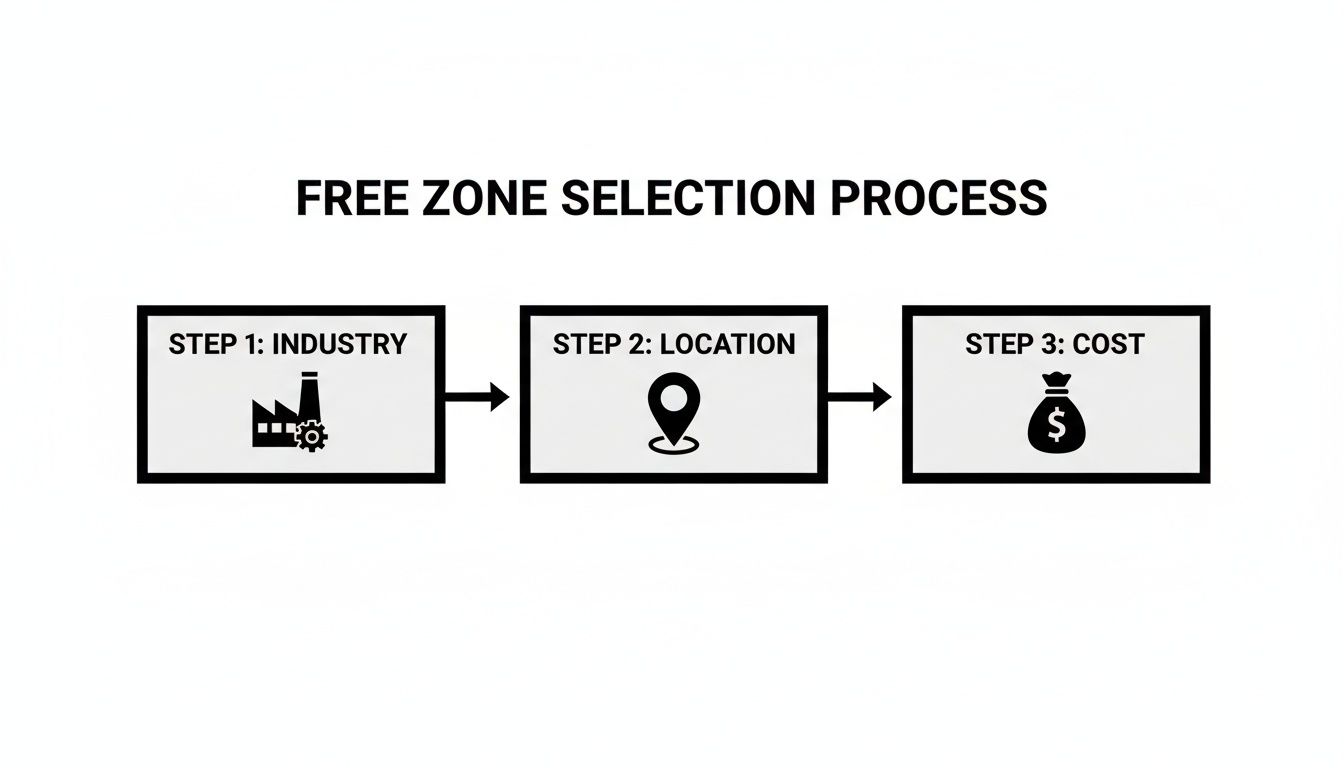
It’s a great visual reminder of how those early decisions directly shape the kind of documents and licence you’ll need to apply for.
Finalising Legalities and License Issuance
After your initial application gets the green light, you’ll be called in to sign the legal documents. This is a big moment—it’s when your company officially comes into existence. You will typically sign a Memorandum of Association (MOA) and Articles of Association (AOA), which detail the company's structure, who owns what, and how it will be run.
This is also when you’ll settle the government fees. The payment covers your licence registration, office lease (even if it's just a flexi-desk), and other setup costs. Always ask for a fully itemised invoice so you know exactly what you’re paying for.
The very last step is the issuance of your business licence. This document is your official green light to start operating. It will clearly show your company’s name, legal form (like FZE or FZCO), registered address, and, most importantly, all your approved business activities.
The whole registration process can take anywhere from a few working days to a couple of weeks, depending on the free zone's efficiency and how complex your application is. Once you have that trade licence, your company is a legal entity in the UAE, ready for the next steps like processing visas and opening a corporate bank account.
Handling Post-License Formalities

Getting your trade licence is a huge milestone. It’s the moment your company officially exists, and it's definitely a time to celebrate. But the journey from being a licensed entity to a fully operational business isn't quite over. A few more crucial steps are needed to build your company’s foundation.
This next phase is all about getting the right credentials for you and your team, and perhaps most critically, setting up your financial infrastructure. These are the areas where I see many new entrepreneurs hit unexpected delays. By understanding what’s involved with immigration and banking before you get there, you can navigate this stage much more smoothly and get your business running faster.
The Immigration and Visa Process
Your new trade licence is the key that unlocks the ability to sponsor visas—first for yourself as the investor, and then for any employees you bring on board. The first thing you'll need is an Establishment Card. Think of it as your company’s unique immigration file, linking your business directly to the General Directorate of Residency and Foreigners Affairs (GDRFA).
Once that card is issued, you can kick off the actual visa applications. It's a fairly standard sequence of events:
- Apply for an Entry Permit: This is the initial approval that allows you to start the residency process from within the UAE.
- Medical Fitness Test: Every applicant for a UAE residence visa goes through a routine medical screening, which includes a blood test and a chest X-ray.
- Emirates ID Biometrics: You’ll need to visit an official service centre to provide fingerprints and have your photo taken for your Emirates ID card.
- Visa Stamping: Once you pass the medical test and complete biometrics, your passport is submitted to have the final residence visa stamped inside.
From start to finish, this process usually takes between two to four weeks. It’s a well-defined path, but one where paying close attention to detail is essential to avoid delays. Keep your documents organised!
A common mistake I see is underestimating how long visa processing takes. Always build a buffer of at least one month into your timeline before you expect to have your team fully on the ground and operational.
Opening Your Corporate Bank Account
This is, without a doubt, the most challenging part of the post-licence journey for any new company formation in Dubai free zones. Opening a corporate bank account in the UAE has become a very stringent process, largely due to strict international anti-money laundering (AML) and know-your-customer (KYC) regulations. Banks here are incredibly diligent, and you have to be completely prepared.
Having your trade licence and other company documents is just the starting point. The banks will want to see a comprehensive file that proves your business is legitimate, credible, and has a clear reason for being here.
Preparing for Bank Due Diligence
To boost your chances of a successful and quick account opening, you need to think like a banker. What will they want to see? Simply walking in with your new licence isn't going to cut it. Your application becomes much stronger when you come prepared with a solid file.
Here's what you should have ready:
- A Detailed Business Plan: This should clearly explain your business model, target audience, financial projections, and the background of the shareholders.
- Shareholder Profiles: Have professional CVs for all shareholders ready, along with a six-month personal bank statement to show a healthy financial history.
- Proof of Business Activity: If you have an existing business elsewhere, bring its website details, corporate bank statements, or audited financials. For a brand-new startup, any contracts, invoices, or letters of intent from potential clients can make a huge difference.
Your goal is to paint a crystal-clear picture for the bank. They need to understand who you are, what your business does, and why you need an account in the UAE.
I worked with a UK-based IT consultant who got her licence quickly but was rejected by two banks because her application file was too thin. For her third try, she included her professional CV, letters of intent from three potential clients in the region, and bank statements from her UK company. Her account was approved in under two weeks.
The key takeaway is that banks are looking for substance. The more evidence you provide to prove your business is legitimate and has real potential, the smoother the process will be. While the banking hurdle can seem daunting, proper preparation makes all the difference. Remember, the journey doesn't end with the licence; it's also about building the operational foundation for your company's future success, which includes keeping your credentials current. To learn more, check out our guide on the essentials of a timely trade license renewal.
Keeping the Wheels Turning: Operating and Growing Your Free Zone Company
So, you’ve done it. The company is officially formed, the licence is framed on your wall (or at least saved as a PDF), and your new corporate bank account is active. Take a moment to celebrate—that’s a huge milestone. But as any seasoned entrepreneur will tell you, this is where the real work begins. Now, the focus shifts to running the business, staying compliant, and planning for growth.
Think of your business licence and lease agreement like essential annual subscriptions. Letting them lapse isn’t an option. You absolutely must renew them on time every year to keep your company in good legal standing. If you miss these deadlines, you’re looking at hefty fines, a suspension of your company’s visa services, or even having your bank account frozen. It’s a simple task, so get it on your calendar with reminders set months in advance.
Staying on the Right Side of the Law
Beyond just renewing your licence, you need to keep up with the UAE's evolving regulations. This isn't just bureaucratic box-ticking; it's fundamental to your company's health.
A big one is maintaining your Ultimate Beneficial Ownership (UBO) register. The authorities need to know who truly owns and controls the company, and they are incredibly strict about it. You must keep this information accurate and updated, as failing to do so can lead to serious penalties.
Then there’s the Economic Substance Regulations (ESR). If your business activities fall under its scope—things like banking, insurance, or holding company activities—you have to prove you have a real operational presence here in the UAE.
We always tell our clients: keeping meticulous records isn't just about avoiding trouble. It’s about building a credible, sustainable business. A clean compliance history is gold when you're dealing with banks, potential investors, or government bodies. It tells them your company is solid, well-managed, and trustworthy.
Planning Your Next Move: How to Scale
Once you've settled into a good operational rhythm, you can start looking ahead. The beauty of the free zone framework is its flexibility. You're not stuck with the setup you started with; it's designed to grow with you.
Here are a few common ways we see businesses scale up:
- Adding More Business Activities: Got a great idea for a new service or product line? You can apply to amend your business licence. This is the proper, legal way to broaden your revenue streams and pivot as the market demands.
- Upgrading Your Space: That flexi-desk that was perfect for day one might start feeling cramped. Moving to a dedicated private office, or from a small warehouse to a larger one, is a very standard process that supports team growth and bigger operational needs.
- Boosting Your Visa Quota: As you bring on more talent, you’ll need more visas. You can apply to increase your company’s visa allocation, which is often linked to the size of your office space.
Reaching a New Market: Tapping into the Mainland
For a long time, the biggest drawback of a free zone company was the inability to trade directly with the Dubai mainland market. You typically had to go through a local distributor, which added complexity and cost. But things have changed, and it's a game-changer for many.
A landmark decision, Executive Council Resolution No. (11) of 2025, has opened up legal pathways for certain free zone companies to conduct specific activities on the mainland without needing a whole separate mainland company. This has torn down a massive barrier, unlocking a huge domestic market, especially for service-based businesses.
This shift makes a strategic company formation in a Dubai free zone an even more powerful choice, giving entrepreneurs a launchpad for both local and international success.
Got Questions About Your Dubai Free Zone Setup?
Even the most straightforward plan for setting up in a Dubai free zone comes with its fair share of questions. It's only natural. These aren't just hypotheticals; they're the real-world queries we hear from entrepreneurs every single day.
Getting these points cleared up from the get-go can save you a world of time, money, and headaches down the line.
Can My Free Zone Company Do Business Across the UAE?
This is probably the most common question we get, and for a good reason. The short answer is: it's complicated, but getting easier.
Traditionally, a free zone company was ring-fenced to operate within its specific zone or trade internationally. To do business on the UAE mainland, you needed to go through a local distributor or agent. This was designed to protect mainland businesses and keep the markets separate.
However, things are definitely changing. New regulations are opening doors for free zone companies, especially service-based businesses, to get special permits allowing them to work on the mainland. The key takeaway? It's not a blanket 'yes' or 'no'. The answer depends entirely on your specific business activity and the free zone you choose. Always check the latest rules for your exact setup.
What Is the Real Total Cost of a Dubai Free Zone Company?
Let's be honest: the advertised price is almost never the final price. You’ll see packages marketed for AED 15,000–25,000 for a basic setup with one visa, but this figure often conveniently leaves out some mandatory extras.
Things like your visa medical test, Emirates ID application, establishment card fees, and the costs just to get a bank account open can quickly add up.
For a simple, one-person company in its first year, a realistic, all-in budget is much closer to AED 30,000–50,000. My best advice? Always demand a fully itemised quote. Make sure it breaks down every single one-time setup fee and recurring annual cost so there are absolutely no financial surprises later.
How Long Does the Entire Company Formation Process Take?
Getting your trade license can be surprisingly quick – sometimes it’s done in just a couple of days, other times it might take up to two weeks. But that’s just one piece of the puzzle.
The full process, from submitting your first application to having the residence visa stamped in your passport and a corporate bank account that's actually ready to use, is a longer journey.
A realistic timeline for the complete, end-to-end setup is anywhere from 4 to 8 weeks. Be warned: opening the corporate bank account is often the biggest bottleneck. It's smart to kickstart that process the very moment you have your new company licence in hand, so you can run it in parallel with your visa application.
Navigating these nuances is so much easier when you have an experienced guide. The team at Al Ain Business Center offers clear, straightforward advice to manage every part of your business setup, helping you sidestep common mistakes and get up and running faster. Start your journey with confidence at https://alainbcenter.com.
Related articles
 Free Zones
 Free Zones
 Free Zones
 Free Zones
 Free Zones
 Free Zones
Latest guides
- ID Card Status UAE: Check Emirates ID Online 2024
- 2-Year Residence Visa Renewal UAE Cost: 2026 Fee Breakdown
- Set Up a Company in UAE: Your Step-by-Step Roadmap
- Housemaid Visa Abu Dhabi: Cost, Steps and Requirements
- Green Visa UAE: Requirements, Costs and How to Apply
- UAE Visit Visa Categories for Technology & AI Talent