
For a long time, the UAE was famous for its virtually tax-free status, but the recent roll-out of VAT and Corporate Tax signals a major change in direction. This isn’t just about adding new regulations; it’s a strategic move to build a more robust and sustainable economy for the future. This guide is here to cut through the complexity and make this new system easy to understand for businesses and expats alike.
Getting to Grips with the New UAE Tax Landscape
The UAE’s move towards a more formal tax system is a deliberate step away from relying so heavily on oil and gas revenue. You can think of it like a growing city deciding to build a modern, solid infrastructure—these new taxes are the financial foundations supporting the nation’s long-term stability and growth.
This pivot also brings the UAE more in line with global standards for transparency and economic management, reinforcing its reputation as a world-class place to do business. It’s a significant development, especially when you look at the wider region. Historically, the Middle East has had some of the lowest tax-to-GDP ratios globally. As economies here diversify, financial policies are naturally evolving with them. For a deeper dive, it’s interesting to see the historical taxation trends in the MENA region and how the UAE’s new approach fits into this bigger picture.
The Three Pillars of UAE Tax
To confidently navigate this new environment, you need to understand the three main types of tax you’ll come across. Each one has a different job to do and will affect your business in its own way.
- Corporate Tax: This is a direct tax levied on the net profits of companies and other business entities. For most businesses operating in the UAE, this is the biggest change to get used to.
- Value Added Tax (VAT): An indirect tax that applies to most goods and services. Businesses essentially act as collectors for the government, adding it to their sales.
- Excise Tax: Another type of indirect tax, but this one is specifically targeted at goods considered harmful to health or the environment, like tobacco and sugary drinks.
At its heart, this new tax framework is designed to create a steady and reliable income stream for the government. This money goes directly into funding public services and major infrastructure projects, ensuring the UAE continues to prosper and develop for generations to come.
Why This Matters for Your Business
Getting your head around this new tax system isn’t just a box-ticking exercise for compliance—it’s a core part of your business strategy. Whether you’re a brand-new startup, a growing SME, or an international firm, your tax obligations will shape some of your most important decisions.
We’re talking about everything from choosing your company’s legal structure and operational setup to how you price your products and manage your accounts. A solid grasp of the basics is the first step to not only meeting your legal duties but also making smart financial choices for your business in the UAE. This guide will walk you through each element, giving you the clarity you need to feel prepared and in control.
Decoding the UAE Corporate Tax Framework
The arrival of Corporate Tax is easily the biggest shake-up for businesses in the UAE in recent memory. For the first time, companies are looking at a direct tax on their net profits, which marks a huge shift in how the country’s finances are structured. But this wasn’t a sudden move; the new system was built to line up with global tax standards while making sure the UAE stays a top destination for international business.
At its heart, the new system brings in a headline rate of 9% on taxable income. The real game-changer, though, especially for small businesses and startups, is the incredibly generous zero-tax threshold.
The Power of the Zero-Tax Threshold
To give startups and growing SMEs a real fighting chance, the law was designed with a brilliant feature: any taxable income up to AED 375,000 is taxed at 0%. Think of it as a tax-free allowance for your profits. It’s only the money you make above that amount that gets hit with the 9% rate.
This tiered system is a clever way to ensure the tax load falls on larger, more profitable companies. It gives smaller outfits the breathing room they need to pour money back into the business, hire more people, and really get a foothold in the market without being choked by tax bills.
This image gives you a bird’s-eye view of how Corporate Tax slots into the UAE’s overall tax system, right alongside VAT and Excise Tax.
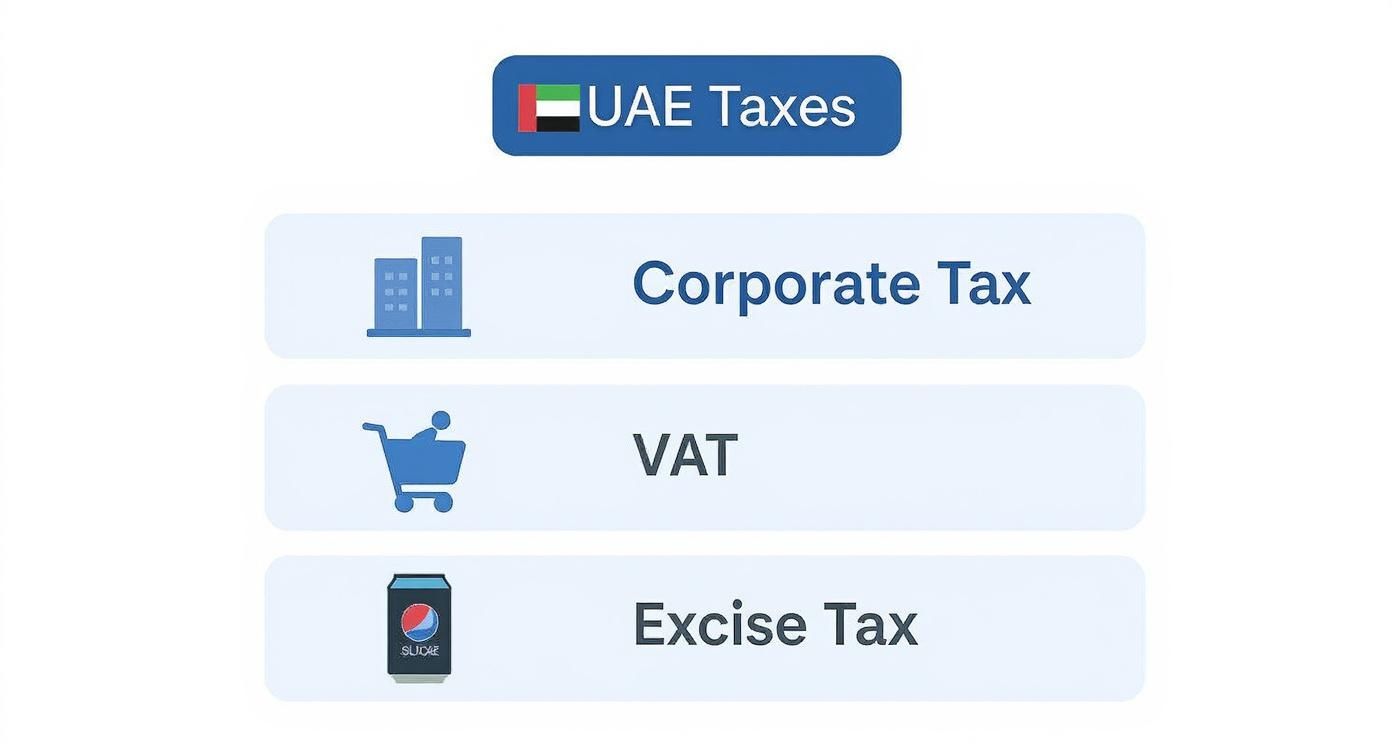
As you can see, while VAT and Excise are taxes on consumption, Corporate Tax is all about business profits. This makes it a whole different ball game that every company needs to get a handle on.
Navigating the Rules for Free Zone Companies
Where things get a bit more complex is with companies set up in one of the UAE’s many Free Zones. For years, these zones have been the crown jewel of the UAE’s appeal to foreign investors, packed with special perks. The new tax law keeps that advantage alive, but it now comes with a few strings attached.
A Qualifying Free Zone Person (QFZP) can still enjoy a sweet 0% Corporate Tax rate, but only on what’s called ‘Qualifying Income’. This isn’t an automatic pass; you have to tick several important boxes to get it.
To help you see the key differences at a glance, here’s a quick comparison:
UAE Corporate Tax At A Glance
| Attribute | Mainland & Non-Qualifying Free Zone | Qualifying Free Zone |
|---|---|---|
| Standard Rate | 9% on taxable income over AED 375,000 | 9% on Non-Qualifying Income |
| Zero-Tax Rate | 0% on taxable income up to AED 375,000 | 0% on all Qualifying Income |
| Key Condition | General compliance with tax laws | Must meet ‘QFZP’ and ‘Qualifying Income’ criteria |
Essentially, the table shows that while everyone gets a break on the first slice of profit, Free Zone companies can extend that 0% rate much further, provided they play by the new rules.
One of the biggest rules is the ‘substance’ requirement. Free Zone companies now have to prove they are legitimate operations, not just ‘paper’ companies set up to dodge taxes. This means having enough employees, physical assets, and operational spending right there in the Free Zone.
Fail to meet these substance rules, or earn income from activities that don’t qualify, and you’ll find yourself paying the standard 9% rate. This makes the classic debate of mainland vs. free zone more important than ever. If you’re weighing your options, getting familiar with the structure of an LLC company in the UAE mainland is a great starting point for comparison.
Understanding Qualifying Activities
So, what exactly is this ‘Qualifying Income’ that gets the 0% rate? The government has laid out a specific list of business activities that fit the bill. Generally, these are activities that support the UAE’s bigger economic goals.
Some of the key qualifying activities include:
- Manufacturing or processing of goods.
- Holding shares and other securities.
- Owning and operating ships.
- Reinsurance services.
- Fund and wealth management services.
- Providing headquarter services to related companies.
- Treasury and financing services for related companies.
- Financing and leasing of aircraft.
- Logistics and distribution services.
If your Free Zone company makes money from dealing with mainland businesses or from certain regulated sectors like banking, that income will likely fall outside the ‘qualifying’ bucket and be taxed at 9%. It’s a crucial distinction for any Free Zone business with diverse income streams.
Key Exemptions from Corporate Tax
While the tax net is wide, it doesn’t catch everyone. Certain types of organisations are completely exempt from Corporate Tax, usually because they’re government-run or already taxed under a different system.
Here are the main groups that don’t have to worry about CT:
- Government Entities: The federal and Emirate governments and their departments.
- Government-Controlled Entities: Companies fully owned and run by the government can also be exempt.
- Natural Resource Extraction: Businesses in the oil and gas sector. These are typically taxed at the Emirate level, so federal CT doesn’t apply.
- Qualifying Public Benefit Entities: Think registered charities and non-profits that serve the public good.
Figuring out if you fall into one of these exempt categories is the very first step in mapping out your company’s tax obligations. It helps you know exactly where you stand in this new financial landscape.
Mastering VAT and Excise Tax in the UAE
Beyond the new Corporate Tax on profits, you need to get to grips with the UAE’s indirect taxes. These are the taxes woven into the daily fabric of buying and selling goods and services. The two big players here are Value Added Tax (VAT) and Excise Tax, and knowing how they work is absolutely essential for any business operating in the country.

This strong focus on indirect tax is a major feature of the regional economy. Across the MENA region, the scales are tipped heavily towards taxes on goods and services, which made up roughly 50% of total tax revenues in a 2020 analysis. To put that in perspective, taxes on company profits contributed less than 15%. If you’re curious about the bigger picture, you can discover more insights on MENA tax composition trends.
How Value Added Tax Works
VAT is a consumption tax applied at a standard rate of 5% to most goods and services. The best way to think of it is like a tax relay race. A manufacturer adds 5% VAT when selling to a wholesaler. The wholesaler pays that VAT but then adds their own 5% when they sell to a retailer, claiming back the tax they just paid.
This chain reaction continues down the line. Each business in the supply chain effectively acts as a tax collector for the government, passing the cost along until it reaches the final customer. It’s the end consumer who ultimately bears the full 5% cost, as they can’t claim it back.
The Critical Difference: Zero-Rated vs. Exempt
This is where things get a bit more nuanced, but it’s a distinction you absolutely must understand. Not everything falls under the standard 5% rate, and the difference between “zero-rated” and “exempt” supplies has a massive impact on your cash flow and ability to recover tax paid on your own business expenses.
- Zero-Rated Supplies: These are still taxable goods and services, but the rate applied is 0%. Think of certain healthcare and educational services, or the international transport of people and goods. Because they are technically taxable, a business selling zero-rated items can still recover all the VAT it paid on its costs.
- Exempt Supplies: These are completely outside the scope of VAT. This category includes things like certain financial services or the sale of bare land. If your business only deals in exempt supplies, you cannot register for VAT. The crucial consequence? You cannot recover the VAT you pay on your own business purchases.
Understanding this distinction is absolutely key to managing your finances. Being able to recover input tax (the VAT you pay) reduces your overall tax bill. But if your sales are exempt, that input tax becomes a sunk cost, eating directly into your profit margin.
Targeting Specific Goods with Excise Tax
While VAT is a broad-brush tax, Excise Tax is much more like a spotlight, aimed at very specific products. It’s often called a ‘sin tax’ because its main purpose is to discourage the consumption of goods considered harmful to public health or the environment by making them significantly more expensive.
This tax is slapped on at the point of import or production right here in the UAE. That cost is then passed all the way down to the consumer, resulting in a higher price on the shelf. If you deal in these goods, you have a major compliance responsibility.
Products Subject to Excise Tax
If your business imports, produces, or even just stockpiles any of the items below, you are required to register for and pay Excise Tax. The rates aren’t small—they’re designed to have a real impact.
Here’s a clear breakdown of the taxable goods and their rates:
| Product Category | Excise Tax Rate | Examples |
|---|---|---|
| Tobacco & Tobacco Products | 100% | Cigarettes, shisha tobacco |
| Electronic Smoking Devices | 100% | E-cigarettes, vapes (devices & liquids) |
| Carbonated Drinks | 50% | Soft drinks with added sugar |
| Sweetened Drinks | 50% | Any ready-to-drink beverage with added sugar |
| Energy Drinks | 100% | Drinks with stimulant substances like caffeine |
Getting these indirect taxes right is non-negotiable for doing business in the UAE. From issuing correct VAT invoices to accurately declaring excisable goods, staying compliant is the only way to protect your business from hefty penalties and keep your financial house in perfect order.
Your Step-By-Step Guide to Tax Compliance
Moving from theory to action is what truly matters when managing your business’s tax obligations. Think of this section as your roadmap to staying on the right side of the Federal Tax Authority (FTA) and sidestepping those painful, unnecessary penalties. It’s about replacing compliance anxiety with a clear, straightforward plan.
The first, most fundamental question every business owner asks is, “When do I actually need to register?” The FTA has drawn clear lines in the sand with thresholds for both VAT and Corporate Tax. Crossing them makes registration a legal must-do, not a choice.
Knowing Your Registration Thresholds
Getting the timing right on your registration is your first line of defence against non-compliance penalties. It all boils down to your business revenue.
For VAT Registration:
- Mandatory Registration: If your taxable supplies and imports have topped AED 375,000 over the past 12 months, you absolutely must register. The same applies if you forecast hitting that number in the next 30 days.
- Voluntary Registration: If your taxable supplies and imports (or even just your expenses) are over AED 187,500, you can choose to register. This is a smart move for many businesses, as it allows you to claim back the VAT you pay on your own expenses.
For Corporate Tax Registration:
- This one is simple: every business with a commercial licence in the UAE has to register for Corporate Tax. It doesn’t matter if you’re on the mainland or in a free zone, what your profit forecast is, or even if you qualify for the 0% tax rate. Registration is a universal requirement for all legal business entities.
Remember, the responsibility for watching these numbers is squarely on you, the business owner. Keeping a close, proactive eye on your revenue is the only way to guarantee you register on time and keep your standing with the tax authorities solid.
The Registration Process on EmaraTax
Once you’ve confirmed you need to register, your next port of call is EmaraTax. This is the FTA’s official online portal, and it’s where everything tax-related happens—from registration and filing returns to paying what you owe.
To kick things off, you’ll need to create an account and pull together some key documents. While the exact list can shift slightly, you should get these ready:
- A valid copy of your Trade Licence
- Passport and Emirates ID copies for the owner(s) and any partners
- The company’s Memorandum of Association (MOA)
- Full contact details and your physical office address
- Your business bank account details
Having this paperwork organised beforehand will make the online registration process go much more smoothly. Let’s be honest, gathering and submitting official documents can be a bit of a headache. Getting expert help ensures everything is filed correctly the first time. For anyone needing a hand, professional documents clearing services are invaluable for taking care of the administrative heavy lifting.
Ongoing Compliance: Your Filing Duties
Getting registered is just the first step. Staying compliant is an ongoing commitment that revolves around regular filing and keeping meticulous records.
VAT Returns: If you’re registered for VAT, you’ll typically need to file a VAT return quarterly. You have 28 days after the end of each tax period to submit your return and settle any tax due with the FTA.
Corporate Tax Returns: Your Corporate Tax return is an annual task. The deadline for both filing and payment is within nine months from the end of your company’s financial year. For example, if your financial year closes on 31 December, your return and payment are due by 30 September the following year.
Proper record-keeping is the absolute backbone of tax compliance. The FTA mandates that all businesses must keep their financial records—invoices, receipts, accounting books, you name it—for at least five years. This documentation isn’t just for you; it’s what you’ll need to verify your filings if the FTA ever decides to conduct an audit.
How Tax Residency Impacts Expats and Owners
For any expat or international business owner in the UAE, getting your head around corporate tax is only half the battle. Your personal tax residency is the other, equally critical, piece of the puzzle. Even with the UAE’s famous 0% personal income tax, where the world sees your financial “home base” can have massive consequences for your global income.
Think of it this way: your tax residency is the country that gets the first right to tax you. If you’re living and working in Dubai, but your home country still considers you one of its tax residents, they might want a piece of your worldwide income—including everything you earn here. This is exactly why establishing official tax residency in the UAE is such a powerful financial strategy.
Defining a UAE Tax Resident
Becoming a tax resident in the UAE isn’t just about holding a visa. It’s about demonstrating that the centre of your life—both personal and financial—is genuinely here. The Federal Tax Authority has laid out clear rules for this.
Generally, you’re considered a tax resident if you tick one of these boxes:
- The 183-Day Rule: You’ve been physically present in the UAE for 183 days or more in any 12-month period.
- Permanent Home & Financial Centre: You have a permanent place to live in the UAE, and it’s also where your main business and financial interests are located.
Meeting these criteria is your ticket to applying for a Tax Residency Certificate (TRC). This is the official document that proves your status to foreign tax authorities and banks. It’s the key that unlocks some serious tax advantages.
The real power of a Tax Residency Certificate is its ability to activate Double Taxation Avoidance Agreements (DTAAs). The UAE has signed these treaties with over 130 countries specifically to stop people and businesses from being taxed twice on the same income.
How a TRC Protects Your Income
Let’s make this real. Imagine you’re a British entrepreneur who has set up a successful business in Dubai. Your company pays the 9% UAE corporate tax on its profits. Without a UAE TRC, tax authorities back in the UK might still see that profit as your personal income and decide to tax it again at the UK’s much higher rates.
Now, if you have a valid UAE Tax Residency Certificate, the story changes completely. You can present this certificate to HMRC, and under the DTAA between the UAE and the UK, the income already taxed in the UAE is protected from being taxed again. That one document shields your earnings from being slashed by double taxation.
This is why, even in a country with no income tax, securing your tax residency is a non-negotiable step for any financially savvy expat. It’s a protective shield for your hard-earned money. For anyone just starting to build their financial presence here, learning the ropes for a non-resident bank account in Dubai is an excellent place to begin.
Getting Your Tax Compliance Right with Our Help
Figuring out the UAE’s tax regulations is the first big step. But actually putting it all into practice, day in and day out? That’s a whole different ball game. Whether you’re dealing with Corporate Tax or VAT, the process demands incredible precision and an eye for detail. This is where having professional support shifts from being just helpful to absolutely essential.
At Al Ain Business Centre, we’re not just a service provider; we’re your partner in this. We step in to turn what can feel like a complex web of obligations into a clear, straightforward process.
Our support kicks in right from the very beginning. We make sure your business is registered correctly with the Federal Tax Authority (FTA) from day one, so you can sidestep any early mistakes or frustrating delays. We take the guesswork out of the equation and manage the entire application, ensuring every single detail is spot on.
Your Path to Peace of Mind
Getting registered is just the start. Our services are really about building a solid foundation for your business to stay compliant and operate smoothly in the long run. We focus on putting the right systems in place so you can get back to what you do best—growing your business.
Here’s how we support you:
- Professional Bookkeeping: We handle your financial records with care, keeping everything meticulous and up-to-date. Think of this as the bedrock of your tax compliance; it ensures every return you file is a perfect reflection of your business activity.
- Expert Filing Assistance: Our team doesn’t just fill out forms. We prepare and submit your tax returns with an expert eye, making sure every deadline is hit and every calculation is double-checked. This proactive approach drastically reduces the risk of errors that could trigger an audit or penalties.
- Dedicated PRO Services: Consider us your liaison with the government. Our Public Relations Officers (PROs) manage all those essential communications and administrative tasks for you, handling paperwork and procedures efficiently so you don’t have to.
When you work with us, you’re not just outsourcing tasks; you’re investing in genuine peace of mind. We lay out a clear, expertly guided path to achieving and maintaining full tax compliance.
Ultimately, our goal is to lift the administrative weight of tax management off your shoulders. With our team handling the tricky parts—from registration and bookkeeping to government liaison—you get the freedom and confidence you need to steer your business toward its biggest goals without distraction.
Frequently Asked Questions About UAE Tax
Getting to grips with a new tax system always throws up a few specific questions. Let’s tackle some of the most common queries we hear from business owners and expats to clear up any confusion.
Is There Personal Income Tax In The UAE For Employees?
In short, no. The UAE doesn’t have a personal income tax on salaries. The money you earn from your job is yours to keep, free from local tax deductions.
That being said, you can’t just ignore tax altogether. If you’re an expatriate, your home country might still have rules about your worldwide income. This is where officially establishing tax residency in the UAE becomes a really important step to manage your international tax situation properly.
What Happens If My Business Misses A Tax Filing Deadline?
Missing a deadline for filing or payment means you’ll be hearing from the Federal Tax Authority (FTA), and it usually involves administrative penalties. These aren’t just suggestions; they are strictly enforced and can become a significant financial headache if ignored.
For both VAT and Corporate Tax, the FTA can issue fines for a number of slip-ups, including:
- Registering for tax too late.
- Failing to submit a tax return on time.
- Not paying the tax you owe by the deadline.
The best defence is a good offence. Keep a close eye on your deadlines and make sure your financial records are impeccable. Honestly, working with a professional advisor is one of the surest ways to stay on top of things and keep your business in good standing with the authorities.
Does My Free Zone Company Have To Register For Corporate Tax?
Yes, absolutely. Every single company, including all entities based in a Free Zone, is legally required to register for Corporate Tax. There are no exceptions here—it’s a mandatory step for everyone, no matter how much profit you expect to make.
Even if you’re certain your company will have zero taxable income or will qualify for the 0% Corporate Tax rate on its ‘Qualifying Income,’ you still have to go through the registration process. The FTA needs a complete picture of every business operating in the UAE, and this universal registration is how they achieve it.
Skipping this step can lead to hefty penalties for non-compliance, so make sure your Free Zone company gets registered on the official EmaraTax portal to meet its legal duties.
Navigating the complexities of tax registration, bookkeeping, and ongoing compliance can be demanding. Al Ain Business Center offers expert guidance to ensure your business meets every requirement, allowing you to focus on growth with complete peace of mind. Learn how our dedicated services can support your business.