
Trying to nail down the exact trade license cost in Dubai can feel a bit like hitting a moving target. If you're budgeting, a safe range to start with is anywhere from AED 15,000 to over AED 50,000 for your first year.
That isn't one single bill, of course. It’s a mix of different fees that all depend on the choices you make: your specific business activity, whether you set up on the Mainland or in a Free Zone, and how many employee visas you'll need right out of the gate.
Your Guide to Dubai Trade License Costs
Getting a handle on the financial side of your Dubai trade license is the very first real step toward launching your business here. It's less like buying an off-the-shelf product and more like building a custom package. Every decision you make—from your trade name to your office space—tweaks the final number.
What you're really investing in is much more than a piece of paper. This license is your official green light to operate, your entry ticket into one of the world's most dynamic economies, and the key to opening your corporate bank account and hiring your team.
Breaking Down the Primary Expenses
So, where does the money actually go? To get a clearer picture, let's unpack the main components that make up the total cost. These are the unavoidable fees you’ll run into, no matter what kind of business you're starting:
- Initial Approval & Trade Name Reservation: These are your first official hurdles. You're essentially asking the authorities if your business idea is viable and if your chosen name is available and appropriate.
- License Issuance Fee: This is the main fee you pay to the governing body, whether that's the Department of Economy and Tourism (DET) for a mainland company or a specific Free Zone authority.
- Government Service Fees: Think of these as the smaller administrative costs for processing your application, often called Tasheel fees or other service charges.
- Office or Tenancy Contract: You must have a registered address in Dubai. Whether it's a physical office or a flexible co-working space, this lease agreement (Ejari) is a mandatory and significant part of your budget.
These costs haven't stood still. Just a decade ago, a standard commercial license on the mainland might have set you back around AED 10,000. Today, you're looking at a range of AED 15,000 to AED 25,000, which reflects just how much Dubai's economy and regulations have matured. This upward trend really drives home the need for careful, up-to-date budgeting.
A classic mistake we see entrepreneurs make is focusing only on the license fee itself. They forget about the other essential costs like the Establishment Card, visa processing for themselves and their staff, and any special permits needed for their industry. These can easily add thousands of dirhams to the initial setup cost.
Now, let's dive into each of these costs in more detail. We’ll use some real-world examples to help you build a budget that's realistic and leaves no room for surprises.
Choosing Your Jurisdiction: Mainland vs Free Zone
When you decide to set up a business in Dubai, one of the first big questions you'll face is where to set it up. This isn't just about a physical address; it's a fundamental choice that dramatically shapes your total trade license cost in Dubai, your ownership structure, and what your business can actually do. You're choosing between a Mainland setup and a Free Zone.
Think of it like this: a Mainland license, which comes from the Department of Economy and Tourism (DET), is like opening a shop right on the high street. You have the ultimate freedom to trade with anyone, anywhere across the entire UAE—from a client in Abu Dhabi to a supplier in Ras Al Khaimah. There are no middlemen or restrictions. That direct market access is its biggest superpower.
A Free Zone license, on the other hand, is like setting up in an exclusive, high-tech business park. Each zone is its own little kingdom, governed by its own authority (think of major players like DMCC or JAFZA). They offer incredible perks, most famously 100% foreign ownership and exemptions from corporate tax and customs duties. But, they're built for international trade. If you want to do business on the UAE mainland, you'll usually need to go through a local distributor.
To make this clearer, here’s a visual that breaks down the decision-making process for both paths.
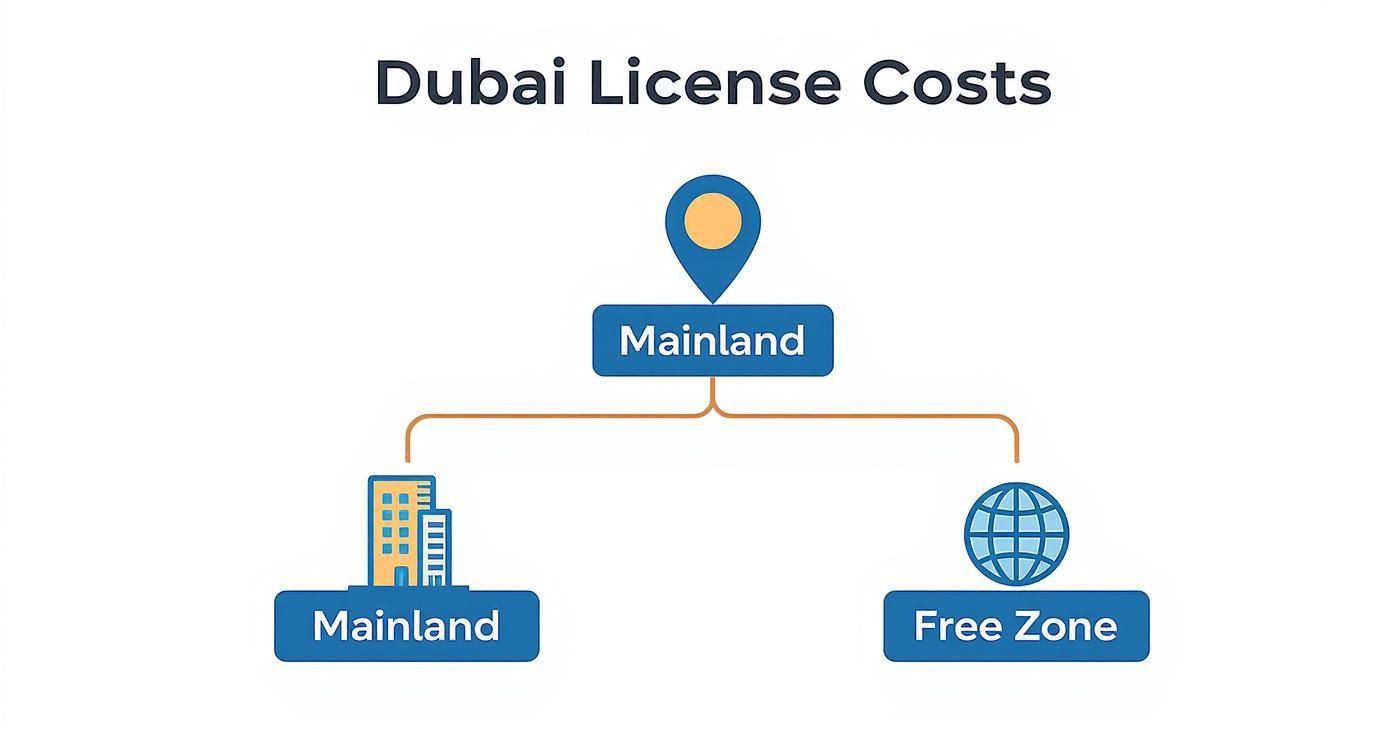
As you can see, this isn't a minor detail—it's the first domino that falls, influencing every other step and cost in your business setup journey.
Comparing the Cost Structures
The money side of things is where Mainland and Free Zone setups really start to look different, and it's about more than just the price tag on the license itself.
Getting a Mainland license often feels like paying for things à la carte. You'll have separate fees for initial approval, another for reserving your trade name, plus market fees which can be tied to your office rent, and a few other government charges.
Free Zones tend to bundle everything up. They often present you with a package deal that includes your registration, license, and sometimes even a basic "flexi-desk" for one all-in price. This sounds simpler, but you have to read the fine print. Things like visa costs, establishment card fees, and any approvals needed from outside the zone are almost always extra.
Here's the key takeaway: Neither option is always "cheaper." A Mainland license might work out better for a consultant who doesn't need a big office, while a Free Zone package could be a steal for a trading company focused on import-export. It all comes down to what your business does.
To give you a clearer picture, let's put the typical costs side-by-side.
Cost Comparison: Mainland License vs. Free Zone License
This table breaks down the common one-time and recurring costs you'll encounter when setting up on the Dubai Mainland versus in a typical Free Zone.
| Cost Factor | Dubai Mainland (DET) | Typical Free Zone | Key Considerations |
|---|---|---|---|
| Initial Approval Fee | AED 250 – AED 750 | Often included in package | A standard first step for Mainland setups. |
| Trade Name Reservation | AED 620+ | Usually included in package | The fee depends on the name's nature (e.g., foreign names cost more). |
| License Issuance Fee | AED 8,000 – AED 15,000+ | AED 10,000 – AED 25,000+ | This is the core fee, highly dependent on business activity and legal structure. Free Zone fees are often part of a larger package. |
| Office/Lease Cost | Physical Office Required (starts from AED 20,000/year) | Flexi-Desk options (starts from AED 5,000/year) | Mainland requires a registered Ejari. Free Zones offer more flexibility, including co-working and virtual offices. |
| Establishment Card | AED 500 – AED 2,000 | AED 500 – AED 2,000 | A mandatory card for sponsoring employees. |
| Investor/Partner Visa | Approx. AED 3,500 – AED 5,000 per visa | Approx. AED 3,500 – AED 5,000 per visa | Costs include application, medical test, and Emirates ID. |
| Market Fees (Dubai Municipality) | 2.5% of office annual rent | Not Applicable | A specific recurring cost for Mainland businesses with a physical office. |
| Local Service Agent/Sponsor | AED 5,000 – AED 15,000+ annually (if applicable) | Not Applicable | No longer mandatory for many activities, but still required for some professional licenses. |
While these figures provide a solid baseline, remember they can shift based on your specific business activity, the number of visas you need, and the particular Free Zone you choose. The Mainland offers direct market access at a potentially itemised cost, whereas Free Zones provide packaged simplicity geared towards international operations.
Ownership and Operational Freedom
For years, the killer feature of Free Zones was 100% foreign ownership. This was a huge deal when Mainland companies legally required a local Emirati sponsor to hold 51% of the shares.
But the rules have changed, and it's a game-changer.
Recent legal reforms now allow for full foreign ownership for most business activities on the Mainland, too. This has suddenly made the Mainland incredibly appealing to foreign investors who previously felt locked into the Free Zone model. For anyone setting up a Limited Liability Company (LLC), this is the best of both worlds: total freedom to trade across the UAE and full control of your company.
If you're leaning this way, our detailed guide on setting up an LLC company in the UAE is a must-read.
Let's quickly recap the core differences to help you decide:
- Market Access: Mainland gives you a free pass to the entire UAE market. Free Zones are great for global trade but often need a local agent to sell goods within the UAE.
- Office Requirements: Mainland businesses almost always need a physical office with a registered tenancy contract (Ejari). Many Free Zones are far more flexible, offering co-working desks or even virtual office packages.
- Government Approvals: A Mainland license might need sign-offs from multiple bodies like the Dubai Municipality or Civil Defence, depending on what you do. In a Free Zone, the zone authority usually handles everything, which can be much simpler.
- Business Scope: Mainland companies can bid on government contracts and open branches anywhere in the UAE. Free Zone companies are typically restricted to operating within their zone's boundaries.
At the end of the day, the right choice boils down to your business model. Are you a consultant who needs to meet clients all over Dubai? The Mainland is probably your best bet. Are you running an e-commerce business that ships goods worldwide? A Free Zone could be the perfect fit. Weighing these factors carefully will ensure you build your business on the right foundation.
How Your Business Activity Shapes Your License Fees
The single biggest factor that will steer the final cost of your trade license in Dubai is the nature of your business itself. Not all licenses are cut from the same cloth; the fees are directly linked to the specific activities you plan on carrying out. Think of it like this: the cost and paperwork to register a small delivery scooter are worlds apart from what’s needed for a heavy-duty cargo truck.
In Dubai, business activities are neatly sorted into three main categories. Figuring out which bucket your business falls into is the very first step in getting a realistic grip on your budget. Each category has its own rulebook, a different likelihood of needing external approvals, and, you guessed it, a different price tag.
The Three Core License Categories
Your business will be licensed under one of these primary types, each built for a specific purpose. The path you choose here will have a ripple effect across your entire financial plan.
- Commercial License: This is your go-to for any business centred around buying and selling goods. We’re talking general trading, e-commerce shops, real estate agencies, and retail outlets. These activities almost always need a physical footprint, like an office or warehouse.
- Professional License: This license is designed for individuals or companies that offer specialised, skill-based services. Think consultants, marketing agencies, auditors, lawyers, and IT service providers.
- Industrial License: Just as the name implies, this one is for businesses that manufacture, process, or assemble products. It covers everything from factories and production plants to workshops.
The differences between them aren't just on paper—they have real financial implications. A marketing agency with a Professional license, for example, might get away with a flexi-desk to start, keeping those initial overheads incredibly low. On the flip side, a general trading company under a Commercial license will need a warehouse from day one, adding a substantial rental cost right into the mix.
Why a Professional License Can Seem Cheaper at First
On the surface, a Professional license often looks like the most wallet-friendly option. This is mostly because the government fees can be lower, and the operational rules are often more relaxed. After all, businesses in this category are selling expertise, not physical items, which completely changes the regulatory game.
One of the biggest money-savers is the office requirement. Many professional services don't need a sprawling physical office on day one. In many cases, especially within free zones, a co-working space or even a virtual office package is enough to satisfy the legal need for a registered address. This flexibility alone can save a new business tens of thousands of dirhams in annual rent.
But there’s a crucial catch to be aware of for mainland Professional licenses. While most now offer 100% foreign ownership, some specific activities might still require you to appoint a Local Service Agent (LSA). An LSA is an Emirati national or a fully UAE-owned company who acts as your official liaison for government paperwork but holds zero shares or ownership in your business. This service comes with an annual fee that you absolutely must factor into your recurring costs.
A key takeaway here: "cheaper" doesn't always mean simpler. The initial license fee for your professional service might be lower, but forgetting to budget for a mandatory LSA fee can throw a nasty, unexpected wrench in your financial plans down the road.
Commercial and Industrial Licenses: The Cost of Handling Goods and Production
It's no surprise that Commercial and Industrial licenses typically come with a higher price tag. The reasons are entirely practical. Any business involved in trade or manufacturing naturally has more logistical hurdles and public interaction, which means more regulatory oversight is needed.
A Commercial license, especially one for general trading, is one of the most versatile but also one of the pricier options. The freedom to trade in a wide array of goods means more compliance checks are necessary. What's more, these businesses almost always need a physical warehouse or office space with a valid Ejari (the official tenancy contract), which is a major recurring expense.
The Industrial license is usually the most expensive and complex of them all. This is simply because manufacturing activities have a direct impact on public health, safety, and the environment, and the authorities take that very seriously.
Here’s a quick look at why the costs stack up:
- External Approvals: An Industrial license isn't a one-stop shop. It often requires green lights from several external bodies. Depending on your product, you could need approvals from the Dubai Municipality, the Civil Defence for fire safety, and even the Ministry of Health and Prevention. Each of these approvals has its own application fee and inspection process.
- Infrastructure Demands: Setting up a factory or production line requires serious capital investment in land, construction, and machinery. All of this must meet strict government standards before you can even think about switching the lights on.
- Compliance and Reporting: These businesses face a much tougher set of ongoing rules, from waste management protocols to worker safety regulations, all of which add to the daily operational costs.
At the end of the day, the kind of work you do provides the blueprint for your license cost. A consultant selling knowledge will have a completely different financial journey than a factory producing goods. Understanding this distinction from the very beginning is fundamental to a successful launch in Dubai.
Budgeting for Visa and Establishment Card Fees
Getting your trade license is a huge milestone, but don't pop the champagne just yet. It's not the final step to getting your business up and running. To actually live in the UAE, run your company, and hire a team, you need to account for immigration costs. These are the fees that often catch people by surprise, turning a well-planned budget for the trade license cost in Dubai on its head.
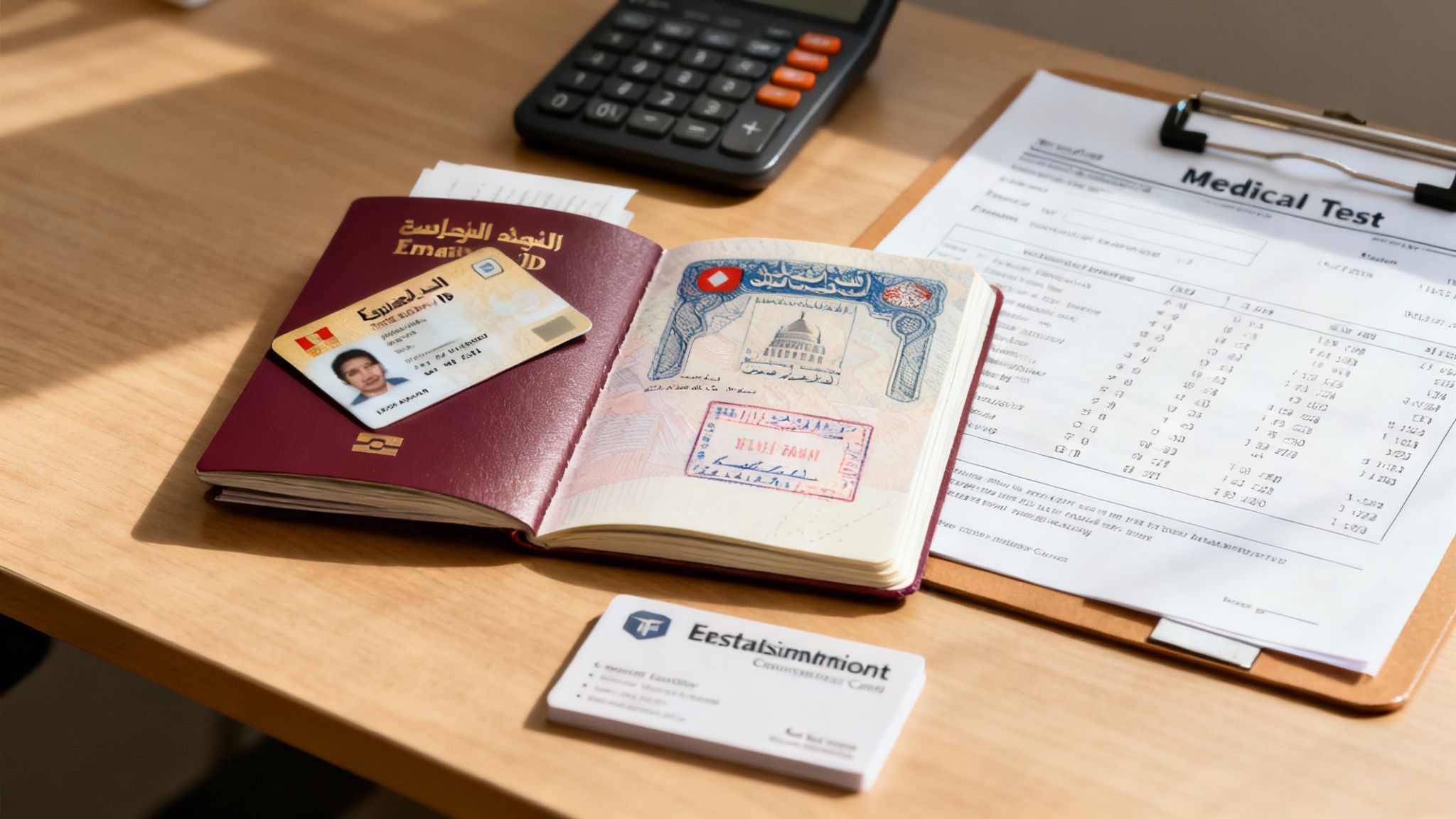
Think of it this way: your trade license is like the car's registration, but the visas and Establishment Card are the keys. Without them, you can't legally "drive" your business. These aren't optional extras; they're absolutely essential for operating legitimately in the UAE.
Understanding the Establishment Card
Before you can sponsor anyone for a visa—even yourself—your company needs an Establishment Card. It's a small plastic card, but it's incredibly important. It basically acts as your company's official immigration file with the General Directorate of Residency and Foreigners Affairs (GDRFA). This little card is what connects your trade license to the entire immigration system.
The process is pretty straightforward. As soon as your license is issued, you apply for the card. The cost usually lands somewhere between AED 500 and AED 2,000, depending on where you're set up (Mainland or Free Zone) and how you apply. Without it, you’re at a complete standstill on all visa applications.
The Investor Visa Process and Costs
As the business owner, your first move is securing your own residency. This is done with an investor or partner visa, which is directly linked to your new company. It's not a single payment but a series of steps, and each one has a fee. Knowing this from the start is key to keeping your budget on track.
A common mistake we see is people thinking the visa cost is one lump sum. In reality, it's a chain of smaller payments for different services—from the entry permit to getting the final stamp in your passport. Breaking it down like this helps avoid nasty surprises later on.
Let's walk through the typical steps and what you can expect to pay:
- Entry Permit Application: This is your green light to enter the UAE for residency purposes. This usually costs around AED 500.
- Status Change: If you're already in the UAE on a tourist visa, you'll need to "change your status" to resident. This fee is typically between AED 600 and AED 800.
- Medical Fitness Test: Everyone needs a mandatory health check, which includes a blood test and chest X-ray. The standard service is about AED 320, though you can pay more for faster VIP options.
- Emirates ID Application: You'll need to apply for your official government ID card. For a two-year visa, this costs around AED 370.
- Visa Stamping: The final piece of the puzzle is getting the residency visa sticker placed inside your passport. The fees for this last stage are generally around AED 900.
All in, you should plan to budget somewhere between AED 3,500 to AED 5,000 for each investor visa. This is a realistic range that covers all the necessary government fees and administrative bits and pieces from start to finish.
Budgeting for Employee Visas
Once your own visa is sorted, you can start bringing on your team. The process for sponsoring employees is very similar to the investor visa, with just a few minor differences. You'll go through the same steps: entry permit, medical test, Emirates ID, and visa stamping.
The total cost per employee visa also falls in the AED 3,500 to AED 5,500 range. The important thing to remember here is the extra costs involved with hiring, like mandatory health insurance and sometimes even bank guarantees. These can add a fair bit to your overall employee sponsorship budget.
Forecasting these immigration fees is every bit as critical as calculating your license and office rent. By building these numbers into your initial budget, you get a complete, honest financial picture. It’s the best way to ensure your journey to launching a fully operational business in Dubai is smooth and free of financial stress.
Factoring in Your Office Space and Rental Costs
When setting up a business in Dubai, your office address isn't just a mailing location—it's a non-negotiable legal requirement. This choice will be one of the biggest factors influencing your final trade license cost in Dubai, particularly if you're setting up on the Mainland. The decision you make here is directly tied to your legal structure and the government fees you'll pay.
Your options stretch from a traditional office with a formal lease all the way to modern, flexible solutions. Understanding the financial and legal weight of each is crucial for building a realistic budget, especially for startups wanting to keep their initial overheads lean.
Mainland Office Requirements: The Ejari Rule
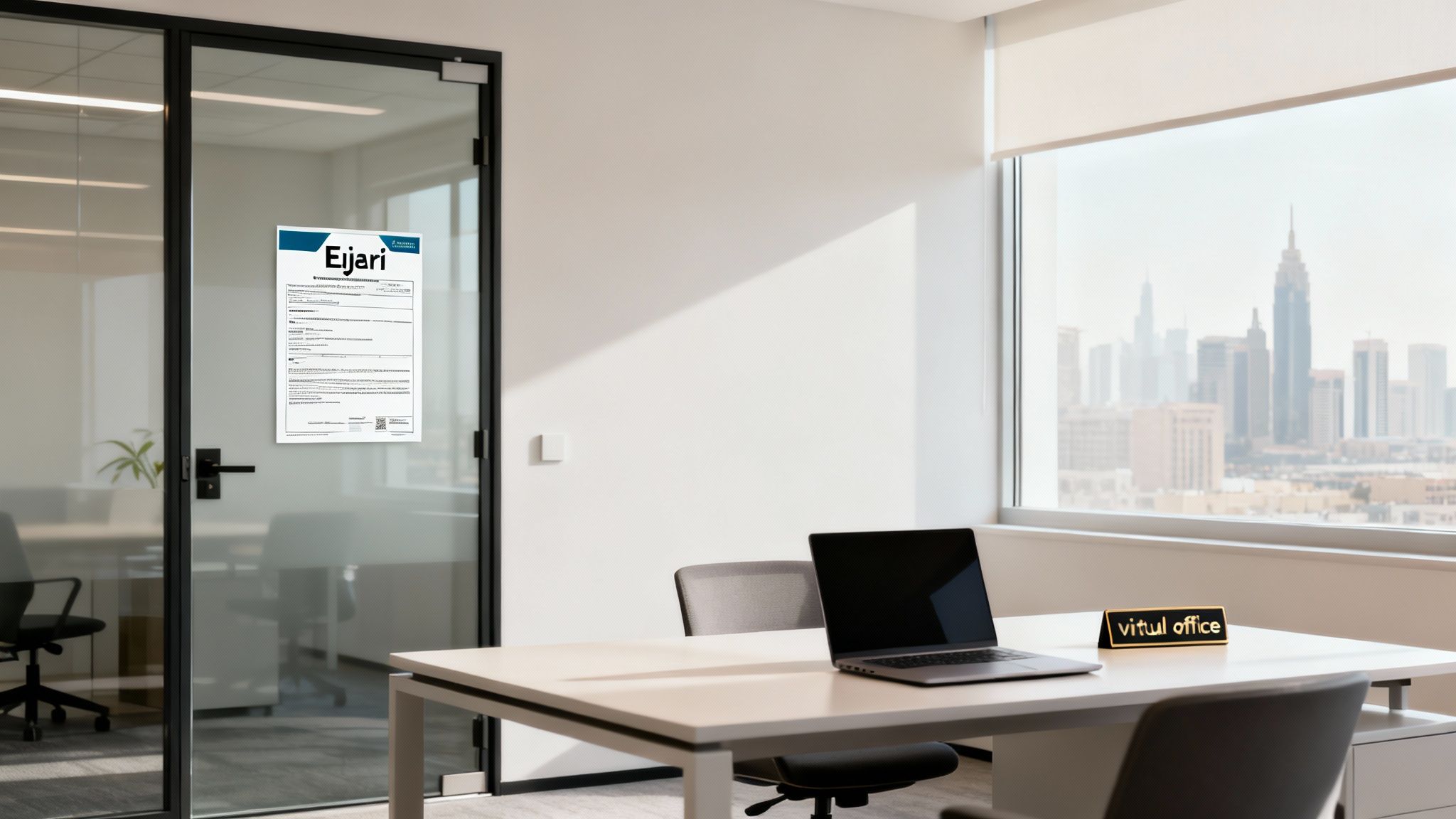
For anyone establishing a business on the Dubai Mainland, the rules are black and white. You absolutely must have a physical office space, secured by a tenancy contract that’s registered with the Real Estate Regulatory Agency (RERA). This official, registered contract is known as an Ejari.
Think of the Ejari as more than just a lease agreement. It’s the official proof of your physical address that the Department of Economy and Tourism (DET) needs to see before they even consider issuing your license. Without a valid Ejari, your application is dead in the water.
Here’s a critical detail many entrepreneurs miss: for Mainland businesses, certain government fees are directly calculated from your annual office rent. A perfect example is the Market Fees collected by the Dubai Municipality, which are typically 2.5% of your annual rental value. This means a pricier office directly inflates your recurring license costs.
Free Zone Flexibility: Flexi-Desks and Virtual Offices
This is where Free Zones really shine, offering a major cost advantage for new businesses. They get that not every company needs a four-walled office from day one. To cater to this reality, most Free Zones provide flexible workspace solutions that tick the legal box for a registered address without the hefty price tag of a physical lease.
- Flexi-Desks: A very popular route. You get access to a shared co-working space, giving you a legitimate business address and a place to work when you need it, without the commitment of a private office.
- Serviced Offices: These are your plug-and-play private offices within a business centre. You get more privacy than a flexi-desk and access to shared amenities like receptionists and meeting rooms.
- Virtual Offices: Often the most budget-friendly option available. A virtual office gives you a premium business address and mail handling services, but no physical workspace. It's the perfect solution for service-based consultants or international entrepreneurs who don't need a physical footprint in Dubai.
These packages bundle the address and essential services into one predictable annual fee, making them a much more affordable alternative to a traditional lease. If you're leaning this way, it’s worth understanding the benefits of a virtual office in Dubai to see how you can keep initial costs down while still projecting a professional image.
Making the Right Choice for Your Business
So, which path do you take? The right workspace comes down to your business model, your budget, and where you see your company heading. A general trading company, for instance, will almost certainly need a physical warehouse and office right from the start, making a Mainland setup with an Ejari a necessity.
On the flip side, a solo marketing consultant or a tech startup can get off the ground with a lean flexi-desk package in a Free Zone. This smart approach lets you pour your capital into growing the business instead of tying it up in a long-term lease. Weighing these options carefully ensures your workspace supports your business both financially and operationally from day one.
Optimizing Your Budget for a Dubai Trade License
Figuring out the total trade license cost in Dubai isn't just about paying the fees listed on a form. It’s about making smart, strategic choices from the very beginning that can save you a significant amount of money. With a solid plan, you can cut down your initial setup costs, freeing up capital to grow your business instead of just covering administrative overheads.
One of the most powerful ways to keep your budget in check is to be deliberate about the business activities you choose. Some activities, especially in regulated fields like healthcare, F&B, or education, need a stamp of approval from various external government ministries. Each of these approvals comes with its own price tag, and they can quickly add thousands of dirhams to your final invoice.
By selecting activities that don't need these extra sign-offs, you can often sidestep a whole layer of complexity and cost. Think about it: launching a straightforward management consultancy is a much more direct and affordable path than setting up a restaurant with all its associated health and safety approvals.
Thinking Long-Term with Multi-Year Licenses
Here’s another pro tip: look beyond the first year. Many jurisdictions, especially the free zones, offer multi-year license packages. These deals can give you a hefty discount compared to paying the standard annual renewal fees.
Sure, paying for a two or three-year license upfront feels like a bigger spend initially, but it locks in your rate and shields you from any potential fee hikes down the line.
This approach gives you two clear wins:
- Direct Cost Savings: You’ll often see a discount of 10-15% or more compared to renewing your license every single year.
- Budget Predictability: It makes your financial planning much simpler by fixing a major operational cost for the next few years.
The Strategic Value of a Business Setup Consultant
It might sound strange to suggest adding a consultant’s fee to your budget when you’re trying to save money, but this is a classic case of spending a little to save a lot. An experienced business setup consultant is more than just a paper-pusher; they're your guide through a system that can be complex and, at times, confusing.
Their real value lies in helping you avoid the common, and often expensive, mistakes. A single error on an application—like choosing the wrong legal structure or an incorrect business activity code—can get your submission rejected. That means you have to reapply and pay the government fees all over again. These delays don't just cost you money; they cost you precious time you could be using to build your business.
A professional consultant cuts through the noise. They provide a clear, all-inclusive quotation right from the start, bundling all the government fees, service charges, and their own advisory fee into one transparent figure. This completely removes the risk of surprise costs popping up halfway through the setup process.
That kind of clarity is invaluable. Instead of trying to decipher confusing fee structures and guess your total outlay, you get a precise financial roadmap. For a quick initial estimate, you can even use a handy Dubai trade license cost calculator to start building a preliminary budget.
Ultimately, partnering with a firm like Al Ain Business Center isn't an expense—it's a powerful cost-saving tool. Our guidance ensures you pick the most cost-effective jurisdiction and license for what you want to achieve, helping you launch your Dubai business smoothly, on time, and most importantly, right on budget.
Common Questions About Dubai Trade License Costs
Once you get a handle on the main costs of setting up in Dubai, a few practical questions almost always pop up. Entrepreneurs want to know where they can be flexible and how they can save a bit of cash. Let's tackle some of the most common queries with clear, straightforward answers.
Can I Get a Trade License in Dubai Without Renting an Office?
Yes, you absolutely can, but it’s a classic "it depends" situation, hinging entirely on your business activity and where you set up shop.
Many free zones are designed with flexibility in mind. They offer flexi-desk or virtual office packages that tick the legal box for a registered address without locking you into a costly physical lease.
On the mainland, it's a bit different. Some professional licenses might let you get started without a dedicated office, but you will always need a registered business address. For most commercial and industrial activities, however, a physical office or workshop secured with a valid Ejari is a firm requirement.
What Is the Cheapest Trade License Available in Dubai?
The "cheapest" license is the one that fits your specific needs without unnecessary extras. Generally speaking, freelance permits or licenses in free zones a bit further from the city centre are the most budget-friendly ways to get started. Some of these packages can be found for as low as AED 6,000.
But a word of caution: always read the fine print. These rock-bottom prices often come with serious limitations, like not being eligible to apply for any visas. Before you commit, make sure you know exactly what’s included in the package.
How Long Does It Take to Get a Trade License in Dubai?
The timeline can really vary. A straightforward mainland license, say for a consulting business with no special requirements, can sometimes be processed and in your hands in just a few days.
In most free zones, you’re typically looking at a timeframe of one to four weeks from the day you submit your application to the day you receive the license. If your business activity needs a sign-off from other government bodies—think healthcare, education, or transport authorities—the process can stretch out for several weeks, or in some cases, even a couple of months.
Planning your business setup can feel like navigating a maze, but it doesn't have to be that way. Al Ain Business Center offers clear, all-inclusive packages designed to get your business licensed and running without the headache of hidden fees or surprises. Start your journey with a free consultation today.
Related articles
 Trade Licence
 Trade Licence
 Trade Licence
 Trade Licence
 Trade Licence
Latest guides
- ID Card Status UAE: Check Emirates ID Online 2024
- 2-Year Residence Visa Renewal UAE Cost: 2026 Fee Breakdown
- Set Up a Company in UAE: Your Step-by-Step Roadmap
- Housemaid Visa Abu Dhabi: Cost, Steps and Requirements
- Green Visa UAE: Requirements, Costs and How to Apply
- UAE Visit Visa Categories for Technology & AI Talent