
If you're an expatriate working in the UAE, you know that building a life here often means bringing your family along for the journey. The UAE spouse visa is the key that unlocks this possibility, allowing you to sponsor your husband or wife to live with you in the Emirates. Think of it as the official bridge that unites your family, turning a solo work assignment into a shared life experience.
This process is a fundamental part of what makes the UAE so welcoming to its massive expat community, ensuring that family always comes first.
What Is The UAE Spouse Visa
At its core, the spouse visa is a specific type of residence permit designed for the husband or wife of a legally employed resident. It essentially ties your spouse's legal status to yours, granting them the right to live in the UAE for the same duration as your visa—typically for one to three years at a time, with the option to renew.
This is a world away from a temporary tourist visa. A spouse visa gives your partner a solid foundation to truly settle in. With it, they can:
- Live legally in the UAE for an extended period.
- Open their own bank account.
- Get a UAE driver's licence.
- Even explore job opportunities, provided they secure a work permit from the Ministry of Human Resources and Emiratisation (MOHRE).
Getting this visa right is the first crucial step. It’s an essential piece of the larger puzzle of how to get a residence visa in Dubai and solidifies your family’s place in the country.
The Core Purpose of Sponsoring Your Spouse
Ultimately, the UAE's spouse visa system is about strengthening the social fabric. With such a large expatriate population, the government understands that allowing residents to bring their families creates a more stable, community-focused environment and encourages people to put down roots.
For many professionals, the ability to sponsor a spouse is a deal-breaker. It's what transforms a job offer into a genuine opportunity to build a home, ensuring your personal and professional lives can grow side-by-side in a new country.
This entire framework is built on a simple principle: the sponsor is financially responsible for their spouse. That’s exactly why you’ll see strict requirements around minimum salary and proof of accommodation, which we'll dive into shortly.
As the UAE’s expatriate population has boomed, so has the demand for family sponsorship. We've seen this reflected in recent visa trends. In 2023, Dubai issued over 158,000 Golden Visas, a massive jump from just 47,150 in 2021. A huge number of these long-term visas are designed to facilitate family residency, proving just how central family unity is to the UAE's vision for the future.
Meeting The Eligibility Requirements
Before you even think about gathering documents or booking appointments, let's talk about the first and most critical step: confirming you’re eligible. Think of this as the foundation of your application. If it’s not solid, the whole process can get shaky.
The UAE government has set out very clear criteria for both the sponsor (that’s the UAE resident) and the applicant (the spouse coming over). These rules aren’t just red tape; they’re in place to make sure the sponsoring resident has the financial stability to support their family comfortably. Getting this right from the very beginning will save you a world of time, money, and stress.
Let's break down exactly what you and your spouse need to have in place to qualify for a spouse visa in the UAE.
Sponsor Eligibility: The Financial Foundation
As the sponsor, your main job is to show that you are financially capable. The government needs to know you can support your spouse without any issues once they join you in the UAE. The biggest piece of this puzzle is your monthly salary.
The income requirements have been refined over the years to be very specific. According to the Federal Authority for Identity, Citizenship, Customs and Port Security (ICP), a sponsor must earn a minimum salary of AED 4,000 per month. This isn't an arbitrary number; it reflects what's considered a stable income to support a family here. It’s always a good idea to discover the latest requirements for sponsoring family members to stay up-to-date.
Besides your salary, you also need to prove you have suitable accommodation. This is usually done with a valid, attested tenancy contract—what’s known as an Ejari in Dubai. This document officially registers your rental agreement and serves as concrete proof of your address and living situation.
Applicant Eligibility: The Legal Connection
For the person being sponsored, the entire process hinges on the legality and authenticity of your marriage. The cornerstone of the application is your legally recognised marriage certificate. This is much more than just a piece of paper; it’s the official proof of your union and must be properly authenticated to be accepted by the UAE authorities.
This authentication process, called attestation, is a bit of a journey. Your marriage certificate will need to be stamped and verified by several bodies, typically including:
- The Ministry of Foreign Affairs (or an equivalent body) in the country where you were married.
- The UAE Embassy or Consulate in that same country.
- The Ministry of Foreign Affairs (MOFA) right here in the UAE once the document arrives.
If your marriage certificate is in a language other than Arabic or English, you'll also need a legal translation from a certified translator. Getting these steps wrong is one of the most common reasons applications get delayed or even rejected.
It's crucial to view these eligibility checks not as hurdles, but as a structured pathway. By meeting each requirement systematically, you are building a strong, compliant application that immigration officials can approve with confidence.
Sponsor Eligibility Checklist for UAE Spouse Visa
To simplify things, we've put together a quick-reference table outlining the core requirements for the sponsor. Use this checklist to see if you meet the essential criteria before you dive into the application process.
| Requirement | Mainland & Most Free Zones | Key Details & Notes |
|---|---|---|
| Minimum Salary | AED 4,000 per month | Your salary must be clearly documented in your official labour contract. Some professions may have different thresholds. |
| Valid Accommodation | Required | An attested tenancy contract (like an Ejari) in the sponsor's name is the standard proof you'll need. |
| Residency Status | Valid UAE Residence Visa | The sponsor must hold a valid residence visa and Emirates ID. This is non-negotiable. |
| Profession | Varies by Emirate/Zone | While most professional roles are accepted, specific rules can sometimes apply, especially for female sponsors. |
By carefully reviewing these conditions, you can confidently figure out your eligibility and get ready to start a successful spouse visa application.
Your Complete Document Checklist
Let's be honest, gathering all the right paperwork is usually the most tedious part of any visa application. Think of it like a puzzle – if one piece is missing or doesn't fit perfectly, the whole picture is incomplete. A simple mistake, like a missing stamp or a passport that’s about to expire, can cause frustrating delays or even get your application rejected.
To help you sidestep these common pitfalls, we’ve broken down the required documents into two clear lists: one for the sponsor and one for the spouse being sponsored. Getting this stage right is your best defence against headaches later on. Pay close attention to the details for each document, because when it comes to immigration, precision is everything.
Essential Documents from the Sponsor
As the person sponsoring your spouse, your paperwork needs to prove three things: you’re a legal resident, you’re financially stable enough to support them, and you have a proper place to live in the UAE. Immigration officials want to see that you have a solid foundation here.
Here’s exactly what you’ll need to have ready:
- Passport and Residence Visa Copies: You'll need clear, colour copies of your passport’s main page and your current UAE residence visa. Crucially, your passport must have at least six months of validity left.
- Original Emirates ID: Your physical, valid Emirates ID card is required.
- Attested Labour Contract: This is your official employment contract from the Ministry of Human Resources and Emiratisation (MOHRE) or your free zone authority. It clearly states your profession and salary, which must meet the minimum requirement (usually AED 4,000 per month).
- Recent Salary Slips: To show your income is current, you'll need salary slips from the last three months.
- Attested Tenancy Contract (Ejari): Your registered Ejari proves you have suitable accommodation. If you own your home, you'll need the title deed instead. The contract must be in your name.
- Recent Utility Bill: A recent bill from DEWA, SEWA, or another provider acts as an extra proof of your address.
- Passport-Sized Photographs: Get a few recent, high-quality photos with a plain white background that match the official government standards.
Crucial Documents from the Sponsored Spouse
For your spouse, the focus is on verifying their identity and confirming your legal relationship. This is where the attestation process becomes incredibly important, as it’s how the UAE officially recognises documents from other countries.
Here’s what you need to prepare for the applicant:
- Original Passport and Copies: Your spouse will need their original passport, plus clear colour copies. Just like the sponsor's, it must be valid for at least six months.
- Passport-Sized Photographs: You’ll need several recent photos with a white background that meet the specific UAE visa photo guidelines.
- Attested Marriage Certificate: This is the big one. Your marriage certificate has to go through a specific chain of authentication: first attested by the Ministry of Foreign Affairs in the country of marriage, then by the UAE Embassy there, and finally stamped by the Ministry of Foreign Affairs (MOFA) here in the UAE.
- Legal Translation of Marriage Certificate: If your certificate isn’t in Arabic or English, you must get it legally translated into Arabic by a certified translator. This translation also needs to be attested.
The attestation journey for your marriage certificate is non-negotiable. It's a multi-step verification process that confirms the document's authenticity across international borders. We always advise clients to start this process as early as possible, because it can easily take several weeks to complete.
By carefully putting together and double-checking every document on this list, you’re building a strong, compliant application. A little extra effort now not only boosts your chances of a quick approval but also takes a huge amount of stress out of the process. Trust us, getting the details right at this stage is an investment that pays off.
The Step-by-Step Application Process
Navigating the application for a spouse visa in the UAE can feel like a complex journey, but it’s best understood as a sequence of clear, manageable stages. Breaking it down into a logical roadmap removes the guesswork and helps you move forward with confidence. Whether your spouse is currently inside or outside the country, the core steps remain pretty much the same, with each one building on the last.
This whole process involves a few key touchpoints, from online government portals to in-person appointments at centres like Amer in Dubai or through the Federal Authority for Identity, Citizenship, Customs & Port Security (ICP) in other emirates. Let's walk through the entire path, from getting that first entry permit to the final visa stamp in the passport.
Stage 1: Kicking Off the Application and Getting the Entry Permit
The very first move is to get an entry permit for your spouse. Think of this permit as a temporary visa that allows them to enter the UAE specifically to complete their residency paperwork. If your spouse is already here on a tourist visa, this step simply becomes a "change status" application instead.
- Open a Sponsorship File: As the sponsor, you'll need to open a file with the relevant immigration authority, like the General Directorate of Residency and Foreigners Affairs (GDRFA) in Dubai.
- Submit the Application: The entry permit application is usually done online through the ICP Smart Services platform or with the help of an accredited typing centre. This is where you'll upload scanned copies of all the documents we discussed earlier.
- Pay the Fees: You'll settle the initial application and issuance fees at this point.
Once approved, you’ll get an electronic entry permit, which is typically valid for 60 days. If your spouse is applying from abroad, they must enter the UAE within this window. For those already in the UAE, this approval means you can move on to the next stage without them having to leave the country.
This infographic gives you a good visual of the document flow from both you (the sponsor) and your spouse, showing how important proper attestation is.
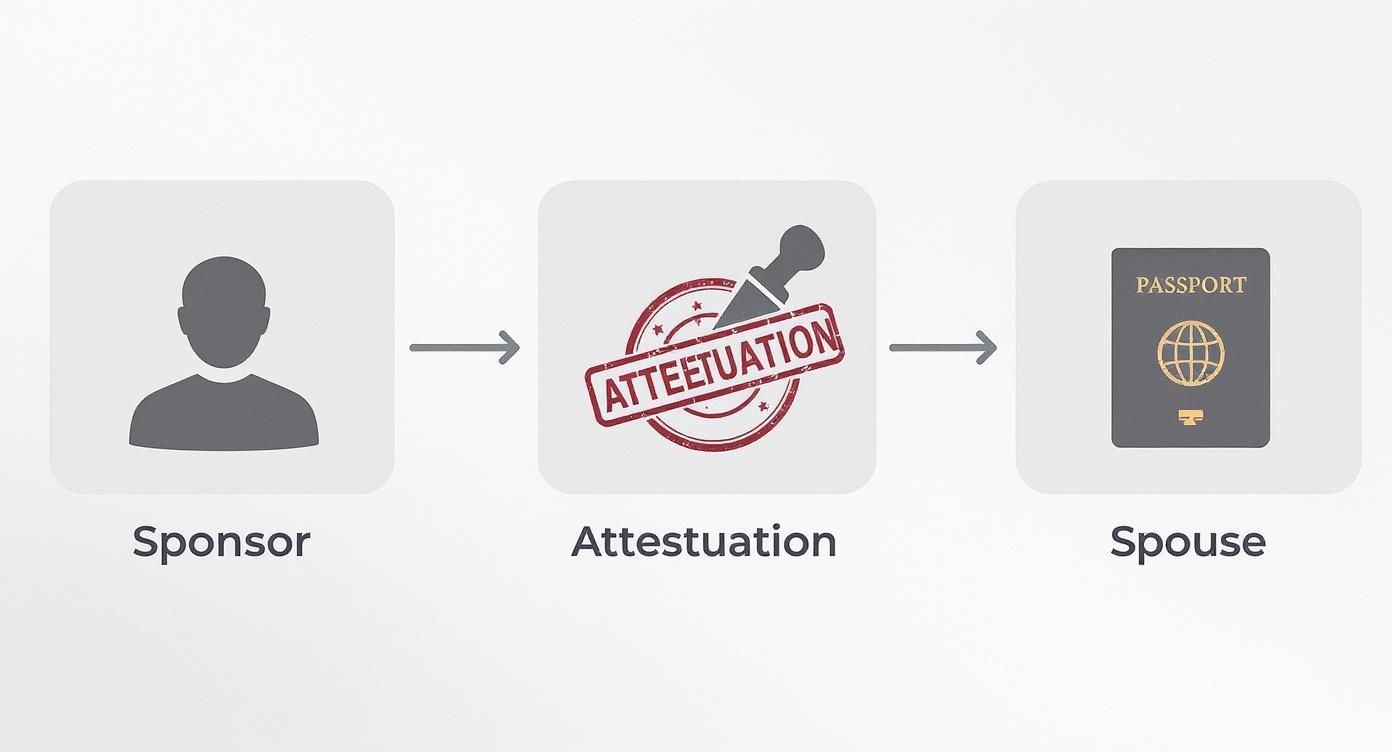
As you can see, a successful application is all about synchronising the right attested documents from both sides to create a complete, compliant file for the authorities.
Stage 2: The Medical Fitness Test and Emirates ID
After your spouse enters the country on the new permit (or after the status change is approved), the clock starts ticking. You generally have 60 days to complete the rest of the steps, starting with the mandatory medical fitness test.
This test is standard procedure for all new residence visa applicants over 18. It’s done at government-approved medical centres and screens for specific communicable diseases. The process is straightforward:
- Head to a designated medical fitness typing centre to apply for the test.
- Go to the medical centre for a quick blood test and a chest X-ray.
- The results are usually sent out electronically within 24-48 hours.
At the same time, you should get the ball rolling on the Emirates ID application. This involves a trip to a typing centre to fill out the form. After that, your spouse will get an appointment for their biometrics (fingerprinting and photo) at an ICP Customer Happiness Centre.
Pro Tip: Try to schedule the medical test and Emirates ID biometrics appointment as soon as that entry permit is issued. Any delays here can create a real time crunch later on.
Stage 3: Visa Stamping and Final Approval
Once your spouse has a clean bill of health from the medical test and has done their biometrics, you're on the home stretch. The final step is submitting all the documents for the visa stamping.
This is where everything comes together:
- The original passport of your spouse.
- The original entry permit.
- The passed medical fitness report.
- The Emirates ID application receipt.
- All of your documents as the sponsor (passport copy, labour contract, etc.).
- Proof of valid health insurance for your spouse.
These documents are submitted to the immigration authorities, often through the same channel you used for the entry permit. You'll find that many of these submissions now happen online, and understanding how these systems work is key. For more on this, our guide can help you unlock the secrets to swift e-channel UAE visa processing.
After submission and final approval, your spouse's passport will be stamped with their residence visa. It's typically valid for one to two years, matching the duration of your visa as the sponsor. The physical Emirates ID card will be delivered by courier a few days later, officially marking the end of a successful UAE spouse visa process.
Managing Your Spouse's Visa: Renewal and Cancellation
Getting that final visa stamp feels like the end of the journey, but it’s really just the beginning of managing your spouse’s residency. A spouse visa in the UAE isn't a "set it and forget it" document; it needs to be renewed on time to stay valid. And if your circumstances change, you need to know exactly how to cancel it correctly.
Think of the visa like a subscription that needs renewing. If you let it expire, you could face daily fines and legal headaches, turning a simple task into a major problem. Staying on top of it is the key to keeping your family’s legal status secure and stress-free.
The Spouse Visa Renewal Process
The good news is that renewing a spouse visa is usually more straightforward than the first application, since you've already proven the relationship. You'll want to kick off the process within 30 days of the current visa's expiry.
The requirements will look familiar because you're essentially re-confirming your eligibility. Here’s a quick rundown of what’s involved:
- Medical Fitness Test (Again!): Your spouse will need to head back to a government-approved health centre for another medical exam to confirm they're still in good health.
- Updated Paperwork: You'll need to submit your renewed labour contract, an up-to-date tenancy agreement (Ejari), and copies of both your and your spouse’s Emirates IDs.
- Health Insurance: Proof of valid health insurance for your spouse is non-negotiable for renewal.
- Application Submission: You can get this done through an authorised typing centre or online via platforms like the ICP Smart Services portal.
Keeping all your documents in order is half the battle. For a more detailed guide, you can dive into the complete UAE visa renewal process on our blog.
How to Handle Visa Cancellation Correctly
Life happens. Whether you're planning to leave the UAE for good or going through the difficult process of a divorce, the visa sponsored by you must be officially cancelled. Just letting it expire while your spouse is out of the country is the wrong way to go about it and can cause serious problems down the line.
As the sponsor, you are responsible for starting the cancellation. It involves submitting a cancellation request with your spouse’s original passport and Emirates ID to the immigration authorities. After it's processed, your spouse typically gets a 30-day grace period to either leave the UAE or find a new visa under a different sponsor.
A word of caution: if a sponsored visa isn't cancelled properly, the person could be blacklisted in the immigration system. This could prevent them from ever re-entering the UAE, even as a tourist.
Special Support for Widowed or Divorced Women
The UAE government has put thoughtful policies in place to support women who suddenly lose their sponsoring husband. Recent updates offer a vital safety net for widows and divorced women.
They can now apply for their own one-year residence visa without needing a new sponsor right away. This gives them precious time to get their affairs in order and search for a job if they want to remain in the country. This humanitarian approach has helped many women secure their residency independently after a major life event.
Frequently Asked Questions
Even with a clear roadmap, the journey to securing a spouse visa in the UAE can throw up a few curveballs or specific questions. This section cuts straight to the chase, answering some of the most common queries we get from clients, helping you clear up any lingering doubts.
We’ll tackle some of the big ones, from the rules for women sponsoring their husbands to what to do if your application gets rejected and how long you should expect the whole thing to take.
Can a Woman Sponsor Her Husband in the UAE?
Absolutely, yes. A woman can sponsor her husband in the UAE, but the requirements are a bit stricter than when a man sponsors his wife. The authorities mainly want to see that the female sponsor has the financial stability to support her family on her own.
It used to be that this was reserved for women in specific professions like teaching, medicine, or engineering. Thankfully, things have become more flexible. Now, the biggest factor is usually the sponsor's monthly salary.
To be eligible, a woman sponsoring her husband often needs to meet a higher minimum salary, typically around AED 10,000 per month. She might also need to provide a no-objection certificate (NOC) from her employer. Of course, all the standard documents, like an attested marriage certificate and a tenancy contract in her name, are still required.
What Happens If a Spouse Visa Application Is Rejected?
Getting a rejection notice is frustrating, but it doesn't always mean it's the end of the line. Your first step should be to find out exactly why the application was turned down. While immigration authorities don't always spell out the reason, most rejections come down to a few common issues:
- Paperwork Problems: A missing signature, a certificate that isn’t properly attested, or an expired passport can all cause an immediate rejection.
- Salary Shortfall: The sponsor’s income didn't meet the minimum requirement.
- Security Flags: The applicant may not have passed a routine background security check.
- Past Visa Issues: If the sponsored spouse has a history of overstaying or a previous ban in the UAE.
Once you know what the problem is, you can often fix it and simply reapply. For example, if a document was missing the right attestation, get it properly stamped and submit a fresh application. For more complicated issues, it's a good idea to get some professional advice to help you navigate an appeal or reapplication.
Figuring out the "why" behind a rejection is everything. It's the difference between a quick fix and resubmission versus needing a more careful strategy to get your application for a spouse visa in the UAE back on track.
How Long Does the Entire Spouse Visa Process Take?
The total time it takes to get a spouse visa can vary quite a bit. It depends on factors like whether you're applying from inside or outside the UAE and how quickly you can get your documents attested. On average, you can expect the whole process—from applying for the entry permit to getting the final visa stamped in the passport—to take anywhere from three to six weeks.
Here’s a rough breakdown of the timeline:
- Entry Permit Issuance: This is usually pretty quick, taking about 3-5 working days.
- Change of Status (if inside the UAE): This can often be done in just 1-2 working days.
- Medical Test & Emirates ID Biometrics: Medical results are typically ready in 24-48 hours, and you can book your biometrics appointment soon after.
- Visa Stamping: Once all your documents are in, this final step takes another 5-7 working days.
Keep in mind that the biggest delays often happen right at the start, during the document collection phase. Getting your marriage certificate attested, in particular, can take several weeks depending on the procedures in your home country.
Navigating the ins and outs of a spouse visa application demands real attention to detail and a solid understanding of each step. At Al Ain Business Center, our experienced PRO services team takes the entire process off your hands—from document attestation and typing to final submission. We're here to make sure everything goes smoothly so you can focus on starting your new life together in the UAE. Get started with Al Ain Business Center today!
Article created using Outrank
Related articles
 Visas
Visas Visas
Visas Visas
Visas Visas
Visas Visas
VisasLatest guides
- ID Card Status UAE: Check Emirates ID Online 2024
- Set Up a Company in UAE: Your Step-by-Step Roadmap
- Medical Leave in UAE Labour Law: Your Rights Explained
- Abu Dhabi Labour Court Claims: Steps, Fees and Timelines
- Abu Dhabi PRO Services: What They Do and Why You Need Them
- Mission Visa UAE: How to Get One and Who Qualifies in 2026