
Setting up an LLC company in UAE is by far the most common path entrepreneurs take, and for good reason. It offers a solid mix of asset protection and operational freedom, creating a legal wall between your personal finances and your business—a critical first move for anyone serious about succeeding in the Emirates.
So, What Exactly Is a UAE LLC and Why Is It So Popular?
Before you get lost in the paperwork, it’s worth understanding what a Limited Liability Company (LLC) really is and why it continues to be the go-to choice for business setup in the UAE. Forget the textbook definitions for a moment. At its core, an LLC is a business structure that makes your company its own legal person, completely separate from you.
What does that mean in the real world? If the business runs into debt or faces legal trouble, your personal assets—your home, your savings, your car—are kept safe. This legal firewall is one of the biggest draws for founders. It gives you the confidence to take calculated risks and grow your business without putting your personal financial security on the line.
The Ownership Game Has Completely Changed
For years, the biggest hurdle for foreign investors was the mandatory requirement of having a local Emirati sponsor who held 51% of the company's shares. Honestly, it was a deal-breaker for many. But that landscape has been completely transformed. Recent legal reforms have thrown the doors wide open for 100% foreign ownership across a huge number of commercial and industrial activities.
This shift has been a genuine game-changer, making the UAE an even more compelling destination for global entrepreneurs. You can now hold full control and ownership of your LLC company in UAE without needing a local partner in most sectors. It not only simplifies the setup process but also gives you total autonomy over your operations and, most importantly, your profits.
The Limited Liability Company is favoured for its flexible shareholder arrangements, allowing between two and 50 partners. Liability is strictly limited to an individual's share capital investment, protecting personal assets from business debts. While a UAE national partner was once mandatory, 2021 reforms now permit 100% foreign ownership in over 1,000 activities, significantly boosting foreign direct investment. You can find more insights on the benefits of an LLC on Safeledger.ae.
The Key Advantages of a UAE LLC
Opting for an LLC structure isn't just about protection; it comes with several distinct operational perks that make it a powerful launchpad for any new business. These benefits give you both flexibility and instant credibility in the local market.
-
Full Access to the Local Market: Unlike many free zone companies, a mainland LLC can trade directly with the entire UAE market. It also allows you to bid on lucrative government contracts without any restrictions.
-
Greater Credibility: There’s no doubt about it—operating as a mainland LLC gives you more weight in the eyes of local banks, government agencies, and potential business partners. It shows you're serious about being part of the local economy.
-
Flexible Shareholder Options: The structure is built for growth. You can have multiple shareholders, whether they're individuals or other companies, making it straightforward to bring on investors or partners down the line.
-
Streamlined Visa Processing: An LLC setup makes the entire process of getting visas for investors, partners, and employees much simpler. This is absolutely crucial when you're trying to build your team on the ground.
Mainland vs Free Zone: Choosing Your Business Jurisdiction

When you're looking to form an LLC company in UAE, your first major fork in the road is deciding where to anchor the business. This isn't just a question of picking an address; it fundamentally defines who you can do business with, your operational freedom, and your company's potential for growth.
The decision boils down to two main paths: setting up on the Mainland or within a Free Zone. Each option comes with its own playbook of rules, benefits, and limitations that can either be a launchpad for your success or an unexpected hurdle down the line.
Diving Deeper Into Mainland Operations
A Mainland LLC, registered directly with the Department of Economic Development (DED) in your chosen emirate, is the classic, go-to structure for businesses targeting the local UAE market. Think of it as opening your shop right on the country's main commercial high street.
This setup gives you the ultimate freedom to trade with any person or company across all seven emirates, with zero restrictions. A mainland-licensed consulting firm in Dubai, for instance, can seamlessly work with and invoice clients in Abu Dhabi or Ras Al Khaimah. More importantly, it makes you eligible to bid for valuable government contracts—a massive advantage that free zone entities typically can't access.
Understanding the Free Zone Ecosystem
The UAE is home to over 40 distinct free zones, many of which are highly specialised ecosystems for industries like tech, media, finance, or logistics. Well-known examples include Dubai Media City for creative industries and the Dubai International Financial Centre (DIFC) for financial services.
These zones are magnets for foreign investment, largely because they offer streamlined setup processes and appealing benefits like 100% foreign ownership and potential tax advantages. However, there's a trade-off. A free zone company's primary restriction is that it cannot trade directly with the mainland UAE market. To do so, you'd typically need to appoint a local distributor, which adds another layer of cost and complexity.
The core difference really comes down to your target market. If your business model revolves around serving clients within the UAE, a mainland setup is almost always the right call. But if your focus is squarely on international trade with minimal local business, a free zone can offer compelling financial and operational perks.
A Head-to-Head Comparison
To help you weigh the options for your LLC company in UAE, let's put the key differences side-by-side. The best choice will depend entirely on your specific business activities and long-term goals.
Here’s a clear breakdown to help you decide.
Mainland LLC vs Free Zone Company Key Differences
| Feature | Mainland LLC | Free Zone Company |
|---|---|---|
| Market Access | Unrestricted access to the entire UAE market. | Restricted to the free zone and international markets. Mainland trade often requires a distributor. |
| Ownership | Now offers 100% foreign ownership for most commercial and industrial activities. | Traditionally offers 100% foreign ownership as a primary benefit. |
| Office Space | A physical office space is a mandatory requirement. | Offers flexible options, including virtual offices and shared desk spaces. |
| Government Tenders | Full eligibility to bid on government contracts. | Generally not eligible to bid directly on government projects. |
| Regulatory Body | Governed by the Department of Economic Development (DED) of the specific emirate. | Governed by the independent authority of the specific free zone. |
| Visa Eligibility | Visa eligibility is often linked to the size of the office space rented. | Visa quotas are typically pre-approved in packages, which can be simpler to manage. |
In the end, this is a strategic decision. A global-facing tech startup could flourish in a free zone's specialised environment. On the other hand, a local retail business or service provider would find itself severely hamstrung without a mainland licence. Taking the time to map your business plan against these two jurisdictions is the essential first step to building a successful company in the UAE.
The LLC Formation Process: A Practical Walkthrough
Setting up an LLC company in UAE can feel like a maze of paperwork and approvals, but it's a very well-defined process. Once you understand the key milestones, you can navigate the registration efficiently and sidestep the common hurdles that trip up new entrepreneurs. Let's break down the journey into clear, manageable stages.
The entire setup is a logical sequence of approvals and document submissions, all managed by the Department of Economic Development (DED) in your chosen emirate. Each step logically follows the last, taking you from reserving a company name all the way to holding your official trade licence.
The first few steps are absolutely foundational. Getting these right from the beginning is the key to a smooth and painless setup.
Starting with Your Trade Name and Business Activities
Before you can even think about filling out applications, you need to lock down two critical elements: your business activities and your company's trade name. The activities you choose will define the type of licence you'll get—commercial, professional, or industrial—and will be listed on your final document. Be thorough here, because operating outside of these approved activities is a strict no-go.
At the same time, you need to pick a trade name that follows the UAE’s naming rules. Your chosen name has to be unique and can't contain any religious references or names of government bodies. It must also end with the legal suffix "LLC". For instance, a name like "Desert Sun General Trading LLC" is perfectly fine, but "Dubai Global Trading" would be rejected for using an emirate's name without special permission.
A classic mistake I see all the time is entrepreneurs getting attached to a name before checking its availability. Always run a search on the DED's online portal or have your business setup advisor confirm it’s free. It saves a lot of disappointment later.
Securing Initial Approval and Crafting Your MoA
With your name and activities sorted, the next move is applying for Initial Approval. This is a pivotal document from the DED, essentially giving you a nod from the government that they have no objection to your business. It’s the green light to proceed with the more serious legal paperwork.
Once you have that approval, it's time to draft the Memorandum of Association (MoA). This is the legal backbone of your company, spelling out its structure and internal rules. It covers essential details like:
-
The names of all partners and their share percentages.
-
The company's primary objectives and business activities.
-
How much capital each partner is contributing.
-
The agreed-upon structure for distributing profits and losses.
The MoA needs to be drafted in both English and Arabic, and then officially notarised by a public notary in the UAE. Since it's a binding contract between partners, every detail needs to be precise and clear.
This infographic breaks down the core process, showing the path from your initial idea to the final licence.
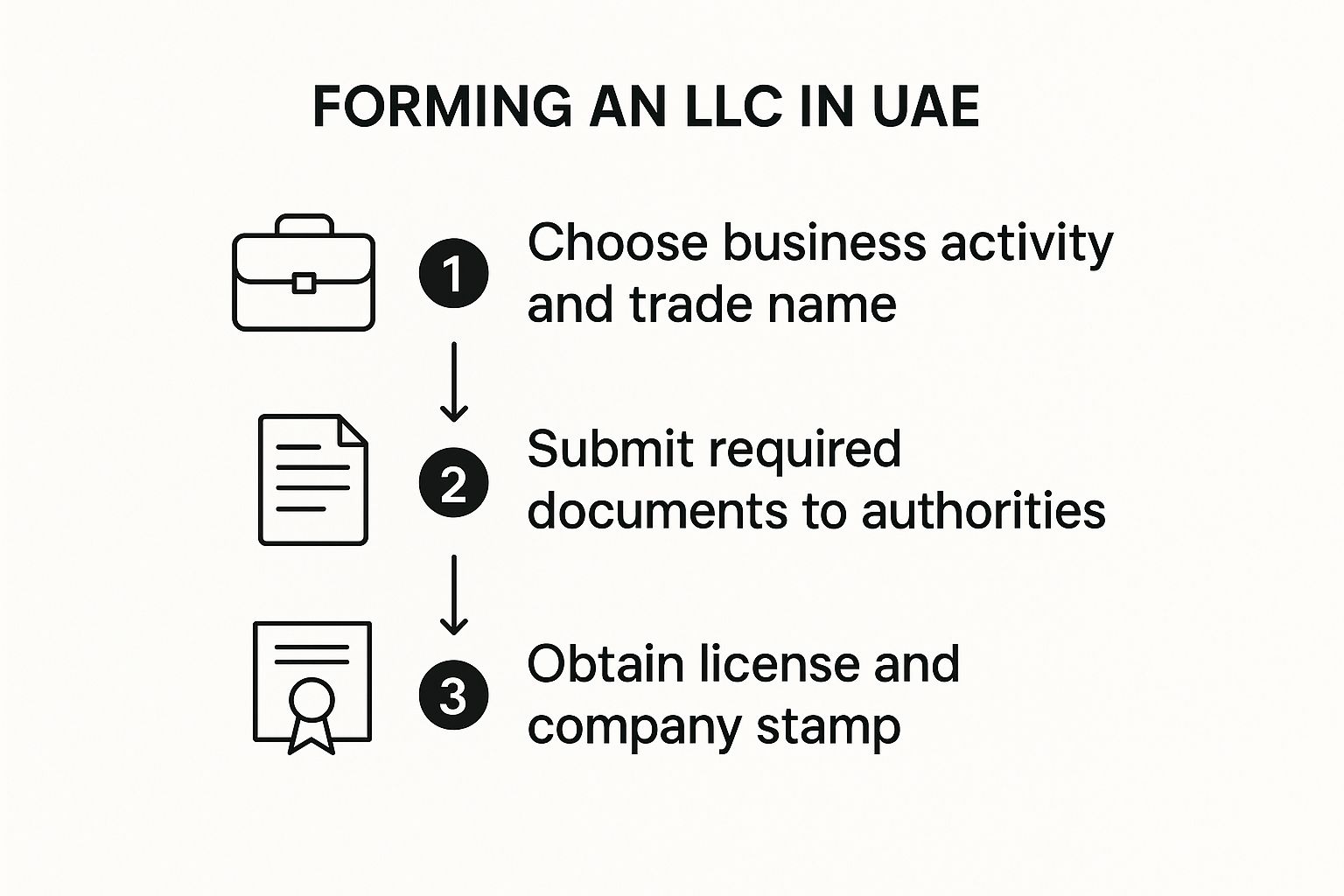
As you can see, each piece of the puzzle—from naming and documentation to licensing—is a necessary step that builds on the last.
Finding a Physical Office Space
One of the hard-and-fast rules for a mainland LLC in the UAE is having a physical office address. You can't use a virtual office for a mainland registration. You'll need to provide a valid tenancy contract, known as an Ejari in Dubai, which must be registered with the authorities.
This isn't just a formality; it proves your company has a real, physical footprint in the emirate. Keep in mind that the size of your office space can directly affect how many employee visas you're eligible for, making it a strategic decision that impacts your future growth.
The entrepreneurial scene in the UAE is buzzing. According to World Bank data, approximately 19,050 new businesses were registered back in 2020. That number has jumped significantly since the 2021 legal reforms allowed for 100% foreign ownership, making the LLC structure more popular than ever. You can dig deeper into these trends by exploring the official business registration data for the UAE.
Final Submission and Licence Issuance
With your notarised MoA and registered tenancy contract in hand, you're on the home stretch. The final step is to bundle all your documents and submit them to the DED. This is also when you'll pay the final fees for your trade licence.
After one last review, the DED will issue your official trade licence. This is the document that legally permits you to start operating. Along with it, you'll receive your Commercial Registration certificate and your Chamber of Commerce membership certificate.
Once you have these, your LLC is officially born and legally recognised. From here, the next steps usually involve applying for the company's establishment card and then starting the visa process for yourself, your partners, and any employees you plan to hire.
Gathering Your Documents and Budgeting for Costs
Alright, you’ve mapped out your business structure. Now it’s time to get practical and shift from strategy to organisation. This part is all about getting your paperwork and finances locked down, and honestly, doing this meticulously now is the best way to avoid painful delays later.
Think of it like preparing your toolkit before starting a big project. When you have every document ready and a realistic budget in place, the registration process stops feeling like a bureaucratic maze and becomes a simple checklist. This preparation is what separates a smooth, quick launch from weeks of frustrating back-and-forth with government departments.
Your Essential Document Checklist
Before you can even think about submitting an application, you'll need to gather a specific set of documents for every partner in the business. If you miss just one small thing, the whole process can grind to a halt. My advice? Get everything together in one folder before you start.
The core requirements don't change much between the emirates; they're the foundation of your company's official file.
-
Passport Copies for All Partners: A clear, colour copy is a must. Double-check that every passport has at least six months of validity left on it.
-
Visa and Entry Stamp Details: If any partners are already in the UAE, you’ll need copies of their current residence visa and the page in their passport with their entry stamp.
-
Emirates ID Copy: For any partner who is a UAE resident, provide a clear copy of the front and back of their Emirates ID card.
-
No Objection Certificate (NOC): This is for anyone on an existing employment visa in the UAE. You may need an NOC from their current sponsor that gives them permission to start a new business.
"Many entrepreneurs focus so much on the business plan that they overlook the simple administrative tasks. Having your documents perfectly organised and attested where necessary isn't just a formality—it shows the authorities you're serious and prepared, which can genuinely speed up approvals."
Crafting a Realistic Financial Plan
One of the first questions everyone asks is, "So, how much does it really cost?" There isn't a single magic number, but you can build a very accurate budget by breaking down the main expenses. Generally, you should plan for total setup costs to fall somewhere between AED 20,000 and AED 30,000 (about $5,450–$8,200), but this can shift depending on your specific business activities and needs.
Let's unpack what makes up that total so you can avoid any financial surprises.
One-Time Setup Costs
These are the initial fees you’ll pay to get your company legally registered and ready to operate. They’re non-recurring, so you just need to budget for them once.
-
Trade Licence Fee: This is the main government fee, and its cost is tied directly to your chosen business activities.
-
Initial Approval & Name Reservation: These are smaller fees for reserving your trade name and getting the initial go-ahead from the Department of Economy and Tourism (DET).
-
MoA Notarisation: Your Memorandum of Association needs to be legally notarised, which involves a fee paid to a public notary.
-
Office Registration (Ejari): There’s a fee to register your tenancy contract with the authorities, which is mandatory for mainland setups.
Once these are paid, your LLC company in UAE is officially on the books. Next, you need to think about the costs that will come up year after year.
Estimated Cost Breakdown for a Mainland LLC in Dubai
To give you a clearer picture, here’s a sample breakdown of the expenses you can expect. Keep in mind that these are estimates and can vary based on your business specifics.
| Cost Component | Estimated Cost Range (AED) | Frequency |
|---|---|---|
| Trade Licence Fee | 12,000 – 15,000 | Annual |
| Initial Approval & Name Fees | 1,000 – 2,000 | One-Time |
| MoA Notarisation | 1,500 – 2,500 | One-Time |
| Office Rent (Ejari) | 5,000+ | Annual |
| Establishment Card | 2,000 | One-Time |
| PRO Services (Optional) | 3,000 – 8,000 | One-Time/Annual |
As you can see, some costs are one-off hits, but others like your licence and office rent are annual commitments. Factoring both into your financial projections from day one is absolutely essential for long-term stability. Planning for the initial outlay and the recurring expenses will put your new venture on solid financial ground right from the start.
Life After Incorporation: Your Ongoing Responsibilities

Holding your brand-new trade licence feels like a huge win, and it is. But it’s really the starting pistol, not the finish line. Launching your LLC company in UAE successfully means you're moving into a new phase—one that’s all about maintaining good legal and financial standing. Dropping the ball on these ongoing duties can quickly lead to fines, operational headaches, or even having your licence frozen.
With the paperwork done, your focus immediately pivots to a few critical administrative steps. These are the things that get your business truly operational and ready to bring on staff. You'll need to apply for your company’s Establishment Card and then kick off the visa process for yourself, your partners, and any employees you’re hiring.
Navigating the New UAE Corporate Tax Landscape
One of your most significant new responsibilities is getting to grips with the UAE's Corporate Tax law. This framework is still relatively new, so understanding what’s required of you from day one is absolutely vital to avoid problems down the road. It has fundamentally changed how every mainland business needs to handle its finances.
The corporate landscape here has shifted dramatically, with the biggest change being the federal corporate tax introduced in mid-2023. This now impacts all mainland companies, including every new LLC. It sets a standard 9% tax rate on any profits that go above AED 375,000 per year; anything below that threshold is still tax-free. As part of this new reality, LLCs must prepare annual financial statements according to International Financial Reporting Standards (IFRS) and appoint independent external auditors. These changes are a clear signal of a maturing corporate sector where knowing your way around tax and reporting is non-negotiable. You can find more insights on these evolving UAE corporate law trends.
Your duties under this law boil down to a few key actions:
-
Tax Registration: First things first, you have to register your company with the Federal Tax Authority (FTA) to get your Tax Registration Number (TRN).
-
Accurate Record-Keeping: Meticulous financial records aren't just good business practice anymore—they’re a legal must. Every invoice, receipt, and transaction has to be properly documented.
-
Annual Tax Filing: Your company has to file a corporate tax return with the FTA every year. This applies even if your profits are below the taxable threshold.
Annual Renewals and Audits
Think of your trade licence not as a one-off purchase, but as an annual subscription that must be renewed with the Department of Economy and Tourism (DET). The process itself is fairly straightforward but absolutely cannot be skipped. It usually involves submitting an updated tenancy contract (Ejari) for your office and paying the renewal fees.
Letting your licence expire can trigger immediate penalties and block all government services tied to your company, including visa renewals. My advice? Set a calendar reminder at least two months before your licence expiry date. It gives you plenty of breathing room to get your documents together and complete the renewal without any last-minute panic.
Depending on what your business does and where it’s registered, you might also need to submit an audited financial report each year. Even if it isn't mandatory for your specific licence, having your accounts audited by a certified firm adds a ton of credibility and is crucial for staying compliant with corporate tax rules.
Staying Compliant with ESR and UBO
Beyond tax and renewals, there are a couple of other key regulations you need to have on your radar: the Economic Substance Regulations (ESR) and the Ultimate Beneficial Ownership (UBO) requirements.
Economic Substance Regulations (ESR)
ESR is for companies involved in specific "Relevant Activities," like banking, insurance, or holding company functions. If your LLC fits into one of these buckets, you’ll need to:
-
File an ESR notification every year.
-
Prove your company has genuine economic "substance" in the UAE.
-
Submit a full ESR report to the right regulatory authority.
Ultimate Beneficial Ownership (UBO)
This regulation is all about transparency. It requires every company to keep a register of its "ultimate beneficial owners"—the actual people who own or control the business. You must submit this information to the authorities to help combat financial crime. Keeping this register accurate and up-to-date is an ongoing legal duty.
Juggling these responsibilities ensures your LLC company in UAE runs smoothly and stays in excellent standing with every government body. It's the bedrock for building sustainable, long-term growth in the Emirates.
Common Questions on UAE LLC Formation
Even with a step-by-step guide in front of you, specific questions always pop up when you're in the thick of setting up an LLC company in UAE. We get it. This section tackles the most common queries we hear from entrepreneurs, aiming to clear up those final bits of uncertainty.
Getting these details right can be the difference between a smooth launch and a frustrating delay.
Can a Foreigner Really Own 100% of a Mainland LLC?
Yes, for most business activities, they absolutely can. The game changed completely in 2021 when landmark legal amendments got rid of the old rule requiring a UAE national to hold 51% of a mainland company's shares.
Today, a foreign investor can have full 100% ownership across more than 1,000 commercial and industrial activities. Just keep in mind that a few strategic sectors, like oil and gas or certain public services, are still off-limits for full foreign ownership.
How Many Shareholders Can an LLC Have?
The LLC structure is built for flexibility, accommodating all sorts of partnership setups. The law is quite clear: you need a minimum of two partners to get started, and you can go all the way up to a maximum of 50 shareholders.
This wide range makes it a perfect fit for a small two-person venture or a much larger business with multiple investors chipping in. Shareholders can be individuals or even other companies.
Is a Physical Office Mandatory for a Mainland LLC?
This is a big one: yes, it’s a non-negotiable legal requirement. Every mainland LLC in the UAE must have a registered physical office address. You simply can't use a virtual office or a P.O. box for your official registration.
You’ll need to provide a valid tenancy contract registered with the proper authority—like the Ejari system in Dubai—to prove you have a legitimate space. The size of your office also has a direct impact on how many employee visas your company can apply for.
One of the most common pitfalls we see is entrepreneurs underestimating the importance of the tenancy contract. The authorities need to see a real, registered physical presence. Trying to get around this with a virtual address for a mainland LLC is a guaranteed way to get your application rejected.
Do I Need to Live in the UAE to Own an LLC?
No, you don't need to be a UAE resident to be a shareholder in an LLC company in UAE. The updated laws make it easy for shareholders to live anywhere in the world and still own a local company.
However, there's a catch. You will almost certainly need to appoint a General Manager for the company who does hold a UAE residency visa. This person will be responsible for the day-to-day operations on the ground.
What Is the Minimum Share Capital for an LLC?
Officially, the UAE's Commercial Companies Law has done away with a specific minimum share capital figure. In the real world, though, the Department of Economic Development (DET) in each emirate will expect the capital stated in your company documents to be "sufficient" for your chosen business activity.
For most standard businesses, a figure somewhere between AED 100,000 and AED 300,000 is typically written into the Memorandum of Association (MoA). The best part? You usually aren't required to actually deposit this money into a bank account during the setup phase.
How Many Visas Can My LLC Get?
The number of employment visas your company is allocated isn't just a random number. It’s calculated based on two main things:
-
Office Size: The bigger your physical office space, the more visas you'll be eligible for. There's a general quota tied to square footage.
-
Business Activity: Some professional activities might qualify for a higher visa quota than, say, a standard trading business.
If you find you need more visas than your initial allowance, don't panic. You can often apply for an exception by providing a solid business case for why you need more staff.
Ready to launch your business without getting tangled in red tape? Al Ain Business Center offers complete solutions to get your LLC company in UAE up and running fast. Our experienced team handles it all—from trade licensing and visa processing to ongoing PRO services—ensuring your journey is smooth from day one. Start your UAE company setup with experts today.
Article created using Outrank