
Renewing your visa in the UAE might seem like a maze of paperwork and appointments, but it’s actually a straightforward path once you know the steps. The whole point of the UAE visa renewal process is to get your documents in order, pass a quick medical check, and secure that all-important residency stamp in your passport. This guide will walk you through everything you need to know about the renewal process for different visa types, making sure you stay on the right side of the law without any stress.
Understanding the Different Visa Renewal Processes in the UAE
Staying in the Emirates means keeping your residency visa valid, and navigating the renewal process is a key part of that. The specific steps and requirements can vary significantly depending on the type of visa you hold, such as an employment visa, a family visa, or a long-term residency like the Golden Visa. Knowing what's coming removes the guesswork and helps you avoid the common slip-ups that can cause delays or, worse, fines.
At its core, the renewal process is just the government's way of confirming you still meet the criteria for living here. They check that your sponsor—whether it's your company, a family member, or even yourself—is still eligible and that you're in good health. Thankfully, a lot of these steps have moved online, making things much more efficient than they used to be.
The Key Milestones in Your Renewal Journey
While the specifics differ, the renewal process for most visa types follows a pretty standard blueprint. Getting ahead of these stages is the secret to a hassle-free experience.
Here’s a quick look at what you’ll be doing:
- Getting Your Documents Together: This is where it all starts. You'll need to round up essential paperwork like your passport, fresh photos, and your sponsor’s documents. The exact documents will change based on your visa type.
- The Mandatory Medical Fitness Test: Anyone over 18 needs to go for a medical screening. It’s a standard procedure at an approved health centre to check for certain communicable diseases.
- Submitting the Application: Your sponsor (or you, if self-sponsored) takes the lead here, submitting the renewal application through official government portals like the ICP or GDRFA, or sometimes with help from a local typing centre.
- Renewing Your Emirates ID: Your visa and Emirates ID are linked. As you renew your visa, you'll also be applying for your new ID card.
- The Final Residency Stamp: Once everything is approved, you'll get a new residency sticker in your passport. That’s it—you’re officially renewed!
A word of advice from experience: don't leave it to the last minute. The government allows you to kick off the renewal process up to 60 days before your current visa expires. Starting early gives you a comfortable cushion to sort out any unexpected issues without the pressure of a looming deadline.
Visa Types and Their Unique Renewal Paths
When it comes to renewing your UAE residency, there’s no single, universal script. The path you'll take depends almost entirely on the type of visa you hold. Each category—from employment to family to long-term residency—comes with its own set of rules, responsibilities, and paperwork. Getting this right from the start is the first step in a smooth UAE visa renewal process.
For most people, the journey begins with an employment visa, where your employer is firmly in the driver's seat. They are legally on the hook for handling the renewal. But that doesn't mean you can just sit back and relax. You've still got a part to play, like providing your original passport and getting your medical fitness test done, so being responsive to your company's PRO is key.
Renewing an Employment Visa
With an employment visa, the cornerstone of your renewal is the updated labour contract or work permit from the Ministry of Human Resources and Emiratisation (MOHRE). While your employer manages this, it's always a smart move to check in with them to make sure it's being processed on time. Any hold-ups here can cause a frustrating domino effect, delaying everything else.
Your responsibilities are straightforward but absolutely critical:
- Get your medical fitness test done as soon as your employer gives you the go-ahead.
- Hand over your passport and any required photos promptly.
- Make sure you're available for your Emirates ID biometrics appointment if one is needed.
Sponsoring and Renewing Family Visas
If you're the one sponsoring your family's visas, the tables turn—the responsibility is all yours. This covers your spouse, children, and any dependent parents living with you. For a spouse's renewal, you'll need your attested marriage certificate (if it's not already on file with the authorities) along with your own valid residency and labour contract to show you still meet the minimum salary requirement.
The process for children is pretty similar, but the rules change as they get older. Sons can generally be sponsored up until they turn 25. Daughters, on the other hand, can remain under your sponsorship as long as they are unmarried. Renewing for dependent parents often has stricter requirements, like proving you're their sole provider, meeting a higher salary threshold, and having a specific type of health insurance for them.
The infographic below highlights the fundamental requirements that are common across most visa renewal applications.
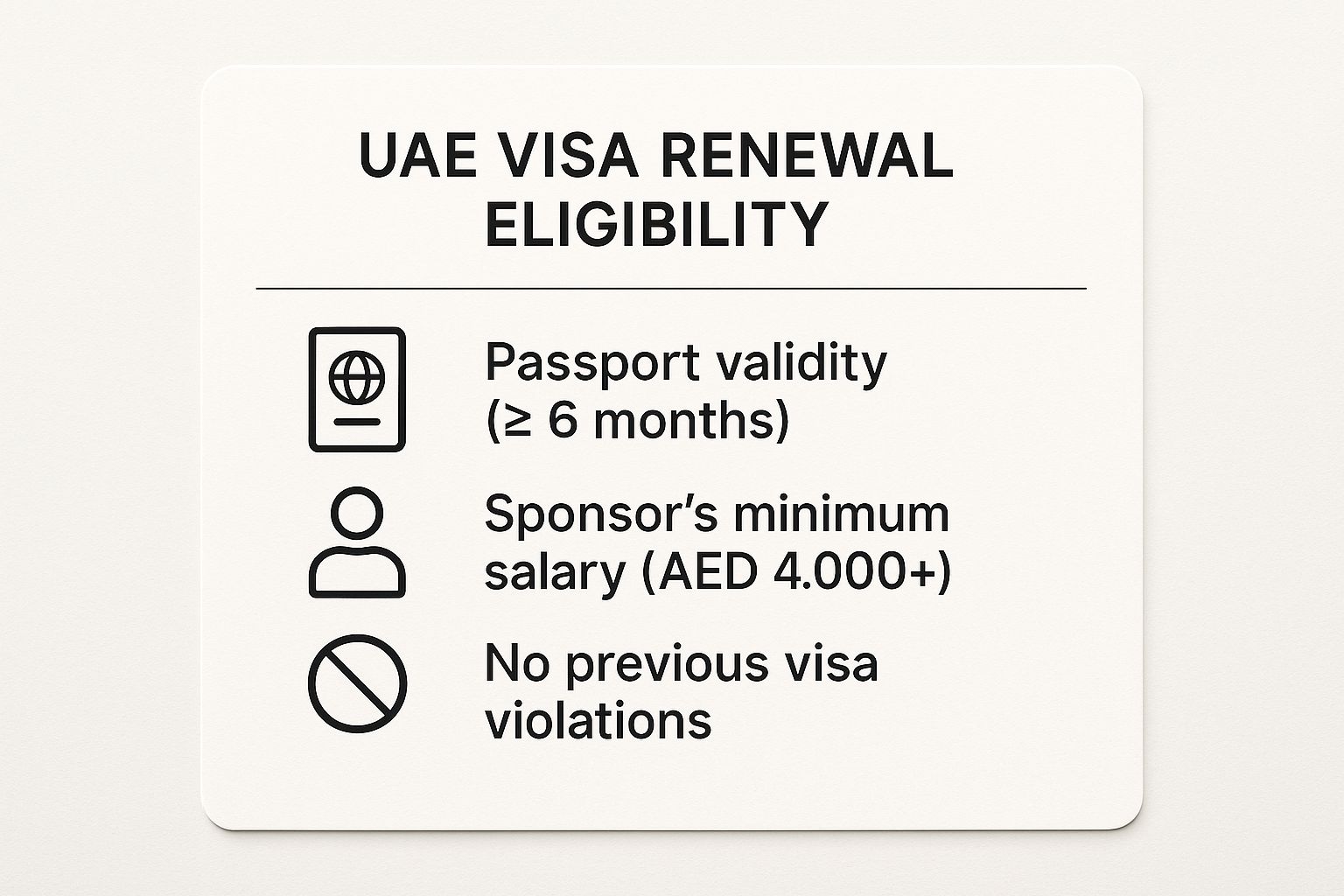
Think of these three pillars—a valid passport, proof of sufficient income, and a clean legal and medical record—as the foundation for almost every successful visa renewal here in the UAE.
To give you a clearer picture of how these requirements shift from one visa to another, here's a quick comparison.
UAE Visa Renewal at a Glance Key Differences
This table breaks down the main distinctions across common visa types, helping you quickly see what applies to your situation.
| Visa Type | Typical Validity | Primary Sponsor/Applicant | Key Renewal Document | Renewal Frequency |
|---|---|---|---|---|
| Employment Visa | 1-2 Years | The Employer | Renewed MOHRE Labour Contract | Every 1-2 years |
| Family Visa (Spouse/Child) | 1-2 Years | The Employed Resident (Sponsor) | Sponsor's Valid Residency & Salary Certificate | Matches sponsor's validity |
| Golden Visa | 5 or 10 Years | The Applicant (Self-Sponsored) | Proof of Meeting Original Criteria | Every 5 or 10 years |
| Green Visa | 5 Years | The Applicant (Self-Sponsored) | Proof of Continued Self-Employment/Income | Every 5 years |
| Freelance Visa | 1-2 Years | The Applicant (Self-Sponsored) | Renewed Freelance Permit & Proof of Work | Every 1-2 years |
As you can see, who takes the lead and what's needed can change quite a bit, so it's vital to know where you stand.
Long-Term Residency The Golden and Green Visas
The UAE has also opened up exciting long-term residency pathways, each with its own renewal rhythm. The popular Golden Visa, for instance, grants a 10-year renewable permit. Launched back in 2019, this programme was a game-changer, offering stability to investors and exceptional talents. The numbers speak for themselves: from 2019 to 2022, Dubai issued 151,666 Golden Visas. By 2023, that figure jumped to around 158,000, almost doubling the issuances from the year before. You can find more data on these trends over at JSB.ae.
The beauty of the Golden Visa is its refreshingly simple renewal. As long as you still meet the original criteria that got you the visa—whether as an investor, an entrepreneur, or a specialised professional—the renewal process is typically very straightforward and doesn't involve a traditional sponsor.
The Green Visa works in a similar way. It allows holders to sponsor themselves for five years, and renewal is much more direct. You just need to show that you still meet the criteria, like maintaining the required income level from your skilled work or self-employment.
Then there are newer categories, like the Freelance Visa. Although a temporary pause on new applications was announced in mid-2025, those who already hold one can still renew it. For these renewals, you'll need to show an active freelance permit from the relevant authority and provide evidence that you're still actively working as a freelancer. Knowing these little details is what makes all the difference for a stress-free renewal.
Your Essential Document Checklist for Renewal
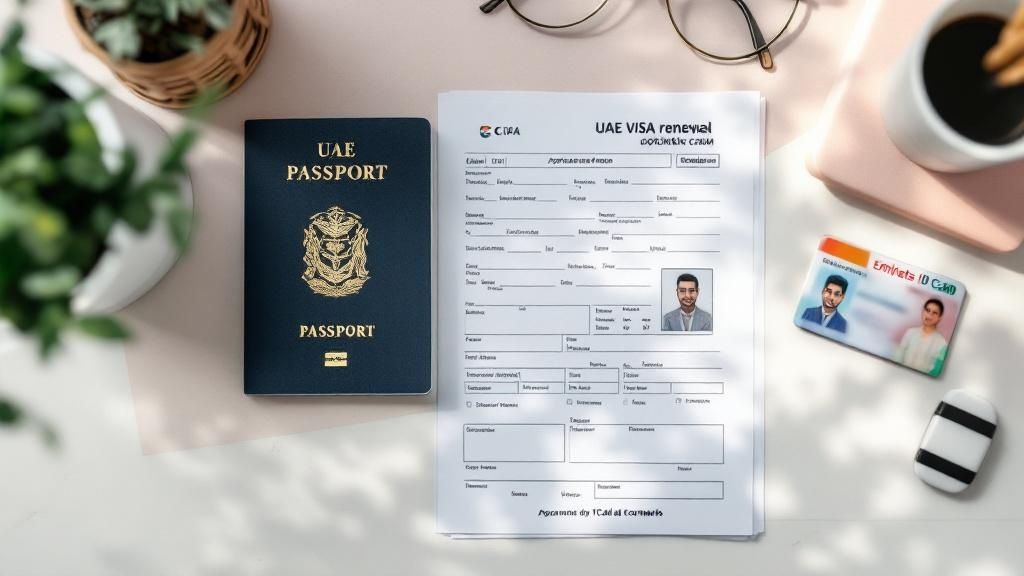
More often than not, a delayed or rejected visa renewal comes down to something simple: missing paperwork. The secret to a smooth UAE visa renewal process isn't some complex trick; it's just about having every single document perfectly in order before you even think about starting the application. Being organised is your best defence against last-minute stress.
No matter your visa type, there's a core set of documents that every single applicant needs. Think of these as the absolute non-negotiables. Getting these right from the start prevents the most common headaches.
Universal Documents for Every Renewal
Before you get into the specifics of your visa category, make sure you have this foundational paperwork sorted. These are required across the board, whether you're renewing an employment visa or a family sponsorship.
- Your Original Passport: This is a big one. It must be valid for at least six months beyond your intended renewal period.
- Recent Passport-Sized Photographs: They must have a crisp white background and meet the very specific guidelines set by the UAE authorities.
- A Copy of Your Current Visa Page: This is your proof of existing legal residency.
- The Emirates ID Application Form: You'll typically get this done at a typing centre or online, and it's processed right alongside your visa renewal.
- Your Original Emirates ID Card: You'll need the physical card, so keep it safe.
From experience, passport photos are a surprisingly common reason for initial rejections. Avoid smiling, make sure your ears are visible, and don't wear glasses or head coverings (unless for religious reasons). Your best bet is to get them done at a professional studio that knows the exact UAE requirements.
Specific Documents for Your Visa Type
Once the basics are covered, the next layer of documents depends entirely on your specific situation. This is where you need to pay close attention. Each document helps tell the story of why you're here, whether you're an employee, a family sponsor, or an investor.
For those on an employment visa, the renewal is tied directly to your job. Your employer will handle a lot of the heavy lifting, but they’ll need some key things from you.
- A valid labour contract or card issued by the Ministry of Human Resources and Emiratisation (MOHRE).
- The company's valid trade licence and establishment card.
- Your academic qualifications, especially if they were required for your initial visa.
If you're the one sponsoring your family, the responsibility falls on your shoulders. You need to prove you can still financially support your dependents and that your relationships are legally recognised.
- Your renewed labour contract and a salary certificate showing you still meet the minimum income threshold.
- An attested marriage certificate for sponsoring your spouse.
- Attested birth certificates for sponsoring your children.
- A valid tenancy contract (Ejari) to prove you have suitable housing.
Preparing for a Golden Visa Renewal
Renewing a Golden Visa is usually a more straightforward affair since it's self-sponsored. The main goal here is simply to show that you still meet the original criteria that qualified you for this long-term residency in the first place.
For an investor, this could mean providing an updated letter from a UAE-licensed investment fund confirming your AED 2 million investment is still active. If you're a specialist or scientist, you might need a current letter of recommendation from a recognised body here in the UAE.
It all boils down to providing fresh proof of your continued eligibility. Getting these documents ready well ahead of time is what makes your renewal as seamless as the residency itself.
Getting to Grips with Visa Renewal Costs

Let's talk numbers. Budgeting for your UAE visa renewal process is one of the most important steps to get right, mainly because it helps you avoid any last-minute financial headaches. The costs can seem a bit complicated at first glance, but they really just break down into a few main categories.
Once you understand these different parts, you can plan properly and make sure everything goes smoothly. The total amount isn't just one flat government fee; it’s a mix of fixed charges and other service expenses that change based on what you need and how quickly you need it done.
Core Government Fees
Think of these as the non-negotiable costs. They're set by the UAE authorities and form the baseline for your renewal budget. Every single applicant has to cover these, no matter their visa type or who their sponsor is.
Here's what you're looking at:
- Application Fee: This is the basic charge for processing the visa renewal itself. The exact amount will depend on how long your new visa will be valid for.
- Emirates ID Fee: Your visa and Emirates ID are linked, so they get renewed together. This means you'll also pay a fee for your new ID card, which will be valid for the same duration as your visa.
To give you a real-world example, the renewal fees in Dubai for a 1-year residence visa typically fall between AED 300 to AED 400. If you're going for a 2-year renewal, that figure is closer to AED 600 and AED 700. You'll find similar costs in Abu Dhabi, though there might be small differences due to local admin charges. Keep in mind, these prices cover the basic renewal and don't include things like the medical test. For a deeper dive into the latest fee structures, you can learn more about the complete cost breakdown for UAE residency renewals on Al Fazone UAE.
Medical Fitness Test Costs
The mandatory medical fitness test is an essential hurdle, and what you pay for it really depends on your timeline. Most health centres offer a few different service levels to match how urgently you need the results back.
You’ll usually have a choice between:
- Standard Service: This is the most budget-friendly option. You can expect your results back in a few business days.
- Express Service: A solid middle-ground choice that gets you the results within 24-48 hours, but for a slightly higher fee.
- VIP Service: The premium track for when you're really pressed for time, delivering results in just a few hours.
Budgeting properly for the medical test is key. While the standard option saves money, an unexpected delay in your renewal could force you to pay for a pricier express service to avoid overstay fines. It's always good to have a little buffer.
Other Variable Expenses
Beyond the fixed government and medical fees, a few other costs can pop up and affect your final budget. These are usually service-related and depend entirely on how you decide to handle your application.
It's wise to be prepared for potential expenses like:
- Typing Centre Charges: If you get help from a typing centre to fill out and submit your application, they'll add their own service fee.
- PRO Service Fees: Many companies use a Public Relations Officer (PRO) to manage renewals for their staff. The cost for their professional expertise will be part of the overall expense.
- Document Attestation/Translation: If any of your key documents, like a marriage or birth certificate, aren't in Arabic, you’ll need to pay for official translation and attestation services.
By adding up these core fees and thinking about which variable costs might apply to you, you can build a realistic budget. It’s the best way to tackle the financial side of your visa renewal with total confidence.
Avoiding Overstay Fines and Grace Period Rules
Letting your UAE visa expire without a plan is one of the most stressful and costly mistakes you can make here. It’s not just a small administrative hiccup; we're talking about daily financial penalties and potential legal headaches that can seriously complicate your future in the country. Getting a handle on the rules for grace periods and overstay fines is absolutely crucial for a smooth UAE visa renewal process.
The second your visa officially expires, a clock starts ticking. The UAE government provides a grace period, which is your window to either finalise your visa renewal or leave the country without facing any penalties. Think of it as a buffer designed to accommodate the renewal process, but it's definitely not an extension you want to rely on.
Navigating the Grace Period
For most standard residence visas, this grace period is 30 days. This is your final opportunity to get everything sorted and your new visa stamped. The UAE has standardised this for most residence categories, but you can’t just assume it applies to you. Fines kick in immediately after this period, typically set at AED 50 per day.
It's so important to confirm the exact grace period for your specific visa type. Some categories like the Golden and Green Visas have historically offered longer periods, but regulations are always being updated. It’s always best to be sure. For a deeper dive, check out this great resource on how to manage the visa renewal grace period on Amer Quick Plus.
Once that grace period is over, the fines begin without delay. There’s often a one-off fee of AED 125 on the very first day of overstay, with an additional AED 50 tacked on for every day that follows. You'd be surprised how quickly these penalties can stack up, turning a simple oversight into a major financial headache.
What to Do About Unexpected Delays
Life happens, and even the most organised person can face unexpected delays. What if your medical fitness test results are taking longer than expected? Or perhaps your sponsor is dragging their feet with the paperwork? These are real, common scenarios that can push you dangerously close to the end of your grace period.
Here’s what you can do:
- Keep the Conversation Going: If your employer is your sponsor, maintain an open line of communication with your company’s PRO. A polite follow-up on the status can go a long way. Make it clear you're ready to provide any needed information instantly.
- Plan for Medical Delays: Medical fitness centres can get incredibly busy, leading to longer turnaround times. If your expiry date is looming, paying extra for an express service could be a very smart investment.
- Have an Exit Plan: If it becomes painfully obvious that the renewal won’t be completed in time, your only surefire way to avoid fines is to exit the UAE before your grace period ends.
It’s a common myth that fines can be easily waived if you have a "good reason" for the delay. This is very rarely the case. The system places the responsibility squarely on the resident and their sponsor to manage the timeline effectively. The best advice is always to start the renewal process well in advance to absorb any unforeseen hold-ups.
Common Questions About Renewing Your UAE Visa
Even when you have all the steps laid out, a few specific questions always seem to come up during the UAE visa renewal process. I've heard them all over the years. This section is all about tackling those common queries we get, giving you direct, no-nonsense answers to help you handle those final details with total confidence.
Let's clear up some of the usual concerns, from the best time for your medical test to what to do if you hit an unexpected snag.
When Is the Best Time to Do My Medical Test?
Timing your medical fitness test is one of those things you have to get just right. Go too early, and you'll find the certificate expires before you can use it—it's typically only valid for 90 days. Wait too long, and you risk a delay that could push you past your grace period.
So, what's the sweet spot? The ideal time to get your medical test done is immediately after your sponsor has officially submitted the renewal application and you've got the forms in hand. As soon as your renewal is in the system, book that appointment.
What Happens if My Renewal Application Is Rejected?
Seeing a rejection notice can definitely be stressful, but it's rarely the final word. The authorities will always give a reason for the rejection, and that reason is your roadmap to fixing the problem.
Most rejections boil down to a few common issues:
- Document Problems: This could be as simple as a blurry passport copy, a missing signature, or a document that hasn't been properly attested.
- Failed Medical Test: If the medical results don't meet the requirements, you'll be notified about the next steps. This could mean more tests are needed or, in some cases, you may have to leave the country.
- Security Holds: Occasionally, an application is flagged for additional security clearance, which just means a bit more waiting.
Once you know the why, you or your sponsor can correct the mistake and resubmit the application. The key is to act quickly and accurately.
A rejection isn't a final "no." It’s an instruction. Address the specific issue raised by the authorities promptly. For instance, if a passport photo was rejected for not having a white background, simply get new photos taken and resubmit.
Can I Renew My Visa if I Am Outside the UAE?
This is a big one we get asked a lot. In almost all cases, you absolutely must be physically inside the UAE to complete the visa renewal. The main reasons are the mandatory in-country medical fitness test and the biometrics appointment for your Emirates ID.
While there are some very rare exceptions, usually for high-net-worth investors or certain Golden Visa holders, the vast majority of residents cannot renew their visa from abroad. If you realise your visa is expiring while you're away, the only real solution is to fly back to the UAE and start the process before your grace period runs out. It saves a world of headaches with overstay fines or potential issues getting back into the country.
Navigating the finer points of visa renewals takes experience and a keen eye for detail. Al Ain Business Center provides end-to-end PRO services to manage your entire renewal, making sure every document is spot-on and every deadline is hit. Let our team handle the complexities so you can focus on what you do best. Visit us at https://alainbcenter.com to lock in a smooth, seamless renewal.
Article created using Outrank